 Drape Haus
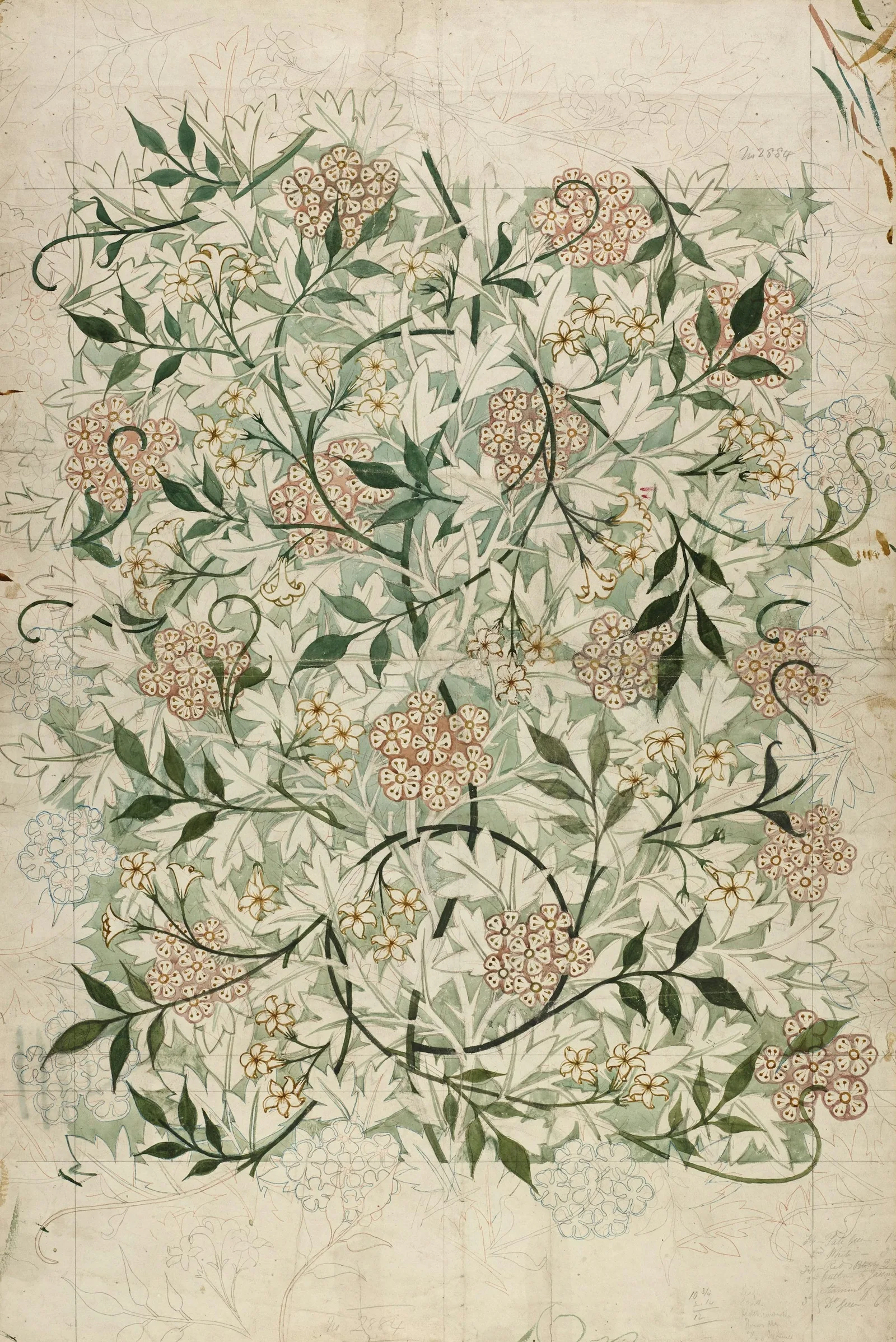
A wallpaper pattern repeat is the distance down the roll before the design starts again. The Wallcovering Installers Association, the American trade body for paperhangers, defines it as the distance from the centre of one motif to the centre of the next. Alongside it, every patterned paper has a match: random (no matching needed), straight (the same motif at the same height on every drop) or drop, also called offset or half-drop (the design shifts by half a repeat on every other drop).
Together, the repeat and the match decide three things you care about. They decide how the pattern lines up across the wall. They decide how much paper is cut off and thrown away between drops, which changes how many rolls you need. And they decide where the first drop has to go, because once it is on the wall, every other drop follows it.
This guide reads the label symbols, explains each match with simple examples, runs real rooms through our wallpaper calculator to show where the repeat costs you a roll and where it costs nothing, and covers how installers plan a feature wall and carry the pattern round corners, windows and doors.
Straight, drop and random match, with simple examples
Random match papers have no pattern to align: plains, textures, many grasscloths and most stripes. The Installers Association's own example of a random match is a stripe, because it matches however the next strip is placed. The German wallpaper industry's institute notes that these papers can be cut one drop after another straight off the roll, which makes them the most economical to hang.
Straight match papers carry the same motif at the same height on every drop. Imagine a wallpaper of single palm leaves, each leaf sitting level with the leaves on the drops either side, all of them the same distance below the ceiling. University of Kentucky extension guidance describes it as the point of match going directly across the strips, so that every strip is the same at the ceiling line. Checks, plaids and orderly grids are usually straight matches.
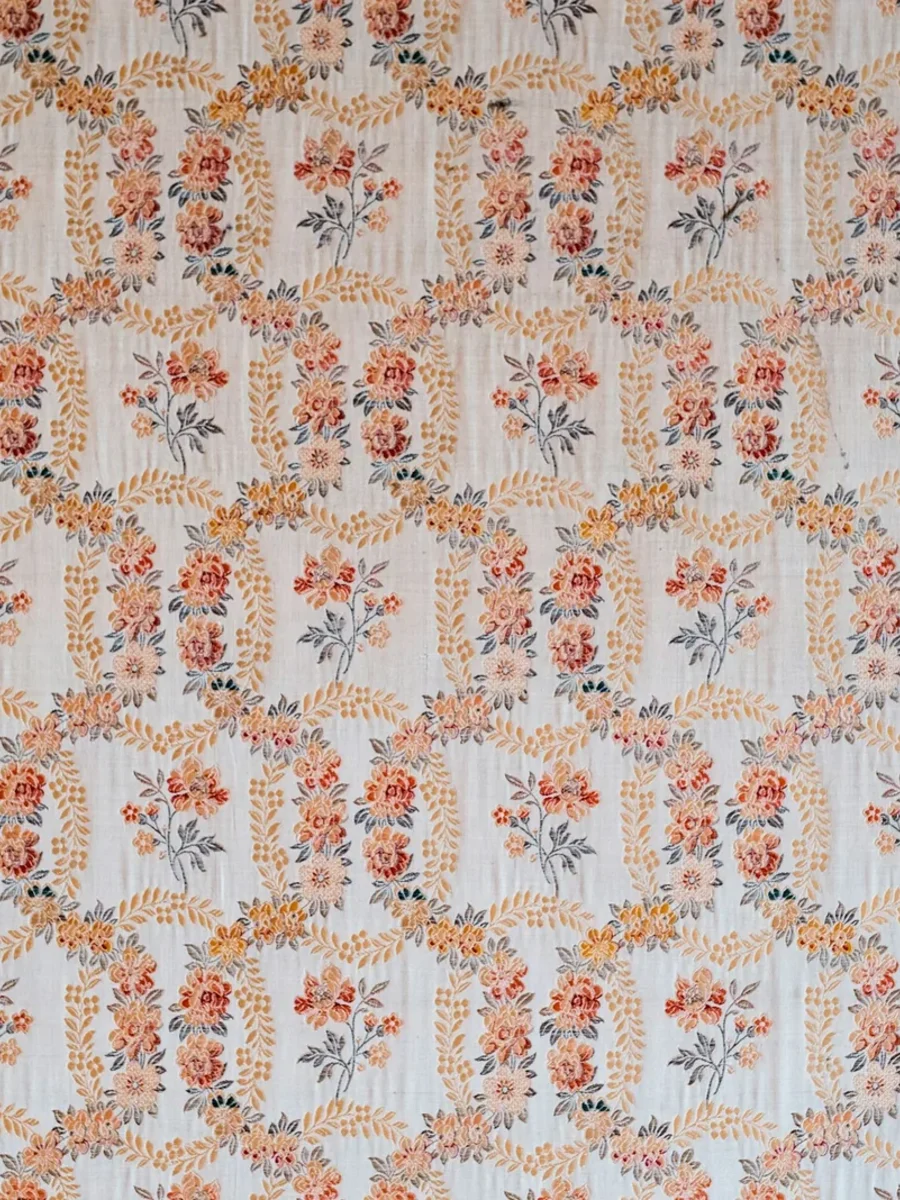
Drop match, which European labels call an offset match, staggers the design. The motif on drop two sits half a repeat lower than on drop one; drop three is identical to drop one again. Picture a trellis or a scatter of birds that runs diagonally across the wall rather than in level rows. The Kentucky guidance puts it simply: the design runs diagonally across the wall, and only every other strip is identical at the ceiling line. Large florals, damasks and many botanical designs are drop matches, because the stagger hides the grid and makes the pattern look continuous.
A fourth symbol, reverse hang, appears on some plain and textured papers. Every second drop is hung upside down. It is not a pattern match at all: as the Installers Association explains, it is used to even out shading, where printing has left one edge of the roll slightly darker than the other. Turning alternate drops puts dark edge against dark edge and light against light.
| Match | What the label shows | How the drops are cut | Waste |
|---|---|---|---|
| Random (free match) | Symbol only, no repeat figure | Continuously off the roll | Least: only the trim |
| Straight match | Symbol plus repeat, e.g. 50 cm | Every drop identical, aligned to the same motif | Up to one repeat per drop |
| Drop or offset match | Symbol plus two figures, e.g. 50/25 | Alternate drops identical; every other drop shifted half a repeat | Up to one repeat per drop; can be reduced by cutting from two rolls |
| Reverse hang | Reverse-hang symbol, no repeat figure | Every second drop turned upside down | As for random |
How to read the repeat on a wallpaper label
Quality papers are marked with symbols set out in the European standard EN 235, and the German wallpaper institute publishes the key. Under the heading for pattern match there are four: free match, straight match with the repeat written in centimetres (for example 50), offset match with the repeat and the offset written together (for example 50/25), and reverse hanging. In 50/25, the first figure is the repeat and the second is how far each alternate drop drops. On a half-drop paper the second figure is always half the first.
The same label carries other information you will need. The batch or production number, which the German institute calls the Anfertigungsnummer, is printed on the insert slip of every roll. There are symbols for washability, light-fastness and how the paper is pasted and removed. Some papers also print match marks on the back, which the institute describes as marks that let the hanger cut and paste quickly and safely even when the pattern on the face is hard to read.
Two points catch people out. First, the repeat on the label is the vertical repeat. A design also has a horizontal repeat across the roll, which is why a large motif may be cut in half at the edge of a drop and completed by its neighbour. Second, offset papers come with an instruction that is easy to miss: the German institute stresses that they should be unrolled in only one direction when cutting. Turn a roll round and the stagger reverses, and the drops will not match.
Planning something like this?
We visit homes across North and South Goa, measure on site, and bring samples to see in your own light.
How the repeat affects the number of rolls you need
Every drop has to start at the same point in the pattern as the drop it matches. So a drop cannot simply be the height of the wall; it has to be long enough to begin at the right motif. Our calculator handles this the cautious way: it rounds the wall height up to a whole number of repeats, then adds 10 cm for trimming at the ceiling and skirting. The German institute's own advice is room height plus 5 to 10 cm, so we take the upper figure. A standard Euro roll is 10.05 m long and 0.53 m wide, and the calculator counts how many whole drops each roll gives, how many drops each wall needs, and adds one spare roll.
The result surprises people: the repeat often changes nothing, and sometimes changes a great deal. A 10.05 m roll gives four drops only if each is 2.51 m or less, three drops up to 3.35 m, and two drops up to 5.02 m. A repeat only costs you rolls when it pushes the drop length over one of those thresholds. On a 2.4 m wall, a plain paper's drops are 2.50 m, so a roll gives four. Each of the repeats the calculator offers, 27, 53 and 64 cm, pushes the drop past 2.51 m, and the roll gives three. Only a repeat that divides exactly into 2.4 m would avoid it.
On a 3.2 m wall, common in older Goan houses and many villas, the effect depends on how the repeat divides into the height, not just its size. A 64 cm repeat fits exactly five times into 3.20 m, so each drop is 3.30 m and a roll still gives three. A 53 cm repeat needs seven repeats, 3.71 m, so each drop is 3.81 m and a roll gives only two. For the same two walls, the smaller repeat needs two more rolls than the larger one. This is why it is worth running the actual paper through the calculator rather than assuming a big pattern is always the expensive one.
These figures are a planning count. On site, a paperhanger may save paper on a drop match by cutting alternate drops from two rolls, a technique both the Installers Association and the Kentucky guidance describe, so the offcut from one roll lines up with the next match on the other. They may also need a little more for the first drop, depending on where the pattern is set at the ceiling. That is why we confirm every count on site before ordering.
| Wall height and repeat | Drop length cut | Drops per roll | Drops needed | Rolls, plus one spare |
|---|---|---|---|---|
| 2.4 m, no repeat | 2.50 m | 4 | 12 | 3 + 1 = 4 |
| 2.4 m, 27 cm repeat | 2.53 m | 3 | 12 | 4 + 1 = 5 |
| 2.4 m, 53 cm repeat | 2.75 m | 3 | 12 | 4 + 1 = 5 |
| 2.4 m, 64 cm repeat | 2.66 m | 3 | 12 | 4 + 1 = 5 |
| 3.2 m, no repeat | 3.30 m | 3 | 12 | 4 + 1 = 5 |
| 3.2 m, 53 cm repeat | 3.81 m | 2 | 12 | 6 + 1 = 7 |
| 3.2 m, 64 cm repeat | 3.30 m | 3 | 12 | 4 + 1 = 5 |
A repeat costs rolls only when it pushes each drop past a threshold: about 2.51 m for four drops per roll, 3.35 m for three, 5.02 m for two.
Planning the first drop on a feature wall
On a single feature wall, the first drop decides everything that follows, so it is planned before any paper is pasted. The Installers Association describes the centre of interest as the dominant motif in a design, usually hung at eye level in the central area of the wall to set the starting point. In practice that means deciding where the strongest motif will sit, both across the wall and up it, and working outwards from there.
Across the wall, the installer chooses between centring a drop on the wall's centre line or centring a seam there, whichever leaves equal, reasonably wide part-drops at both ends. A thin sliver of paper in one corner and a nearly full drop in the other makes a wall look off-centre even when every seam matches. Behind a bed or a sofa, the centre line is usually the furniture's, not the wall's, because that is what the eye reads.
Up the wall, the Kentucky guidance advises starting the first strip so the pattern is pleasing at the ceiling line and not splitting an object there. A row of half-flowers along the cornice looks like a mistake. In older Goan houses, where ceilings and beams are rarely level, the installer also decides where to hold the pattern true: at the ceiling, at eye level, or along a dado, letting any discrepancy fall where it shows least. Every drop is then hung to a plumb line, not to the corner of the room, which is seldom vertical.
Why every roll must come from the same batch
Wallpaper is printed in runs, and each run can differ very slightly in shade. The German institute's advice is that one continuous wall should only ever be papered with rolls bearing the same production number, because small differences in colour cannot be ruled out between runs. The Installers Association calls a run printed at one time a colour run or dye lot, and notes that later runs of the same design and colourway may be slightly different.
Batch matters more with a patterned paper than a plain one. On a plain wall a slight shift in shade may pass unnoticed; on a repeating design it shows as a band where one drop's background is a touch warmer than the next, exactly at the joint where the eye is checking the match. That is the case for ordering the full count at once, checking the numbers on every roll before the first is cut, and keeping a spare from the same batch for repairs. The Kentucky guidance recommends an extra roll or two for precisely this reason, and our calculator always adds one.
A large repeat also makes a short order more painful. If a 3.2 m wall with a 53 cm repeat runs one drop short, there is no offcut long enough to fill it, and a roll from a different batch will not match. Our guide to wallpaper roll sizes covers ordering and storing the spare.
Matching the pattern across corners, windows and doors
Corners are where a pattern most often goes wrong. The German institute's hanging notes say a wide piece of paper should never be carried round or through a corner. The drop is cut so it turns only 1 to 2 cm onto the next wall, nicked so it lies flat, and the remainder is hung on the new wall against a fresh plumb line. Because the new wall starts from a new vertical, a small mismatch inside the corner is normal and accepted; it is the price of drops that hang straight on both walls.
Around a window, a plumbed drop is placed so that its overhang reaches round into the reveal, cut at the level of the sill and the top of the opening so the flap folds into the recess. Short drops are then hung above and below the window, still following the pattern, and the other side is handled the same way. Every one of those short pieces has to start at the right point in the repeat, which is why doors and windows rarely save a whole roll. For doors, the institute's advice is to work towards the opening from one side only, never from both, so the pattern above the frame meets itself correctly.
Every room also has one joint where the last drop meets the first and the pattern cannot match. The Installers Association calls it the kill point, and installers place it somewhere inconspicuous: behind a door, in a corner hidden by a wardrobe, or above a doorway. On a single feature wall there is no kill point, which is one reason a feature wall is the easiest place to start with a bold repeat. Socket and switch plates are papered over and cut out after the paste dries, with the power switched off at the board first.
Choosing a repeat for a Goan room
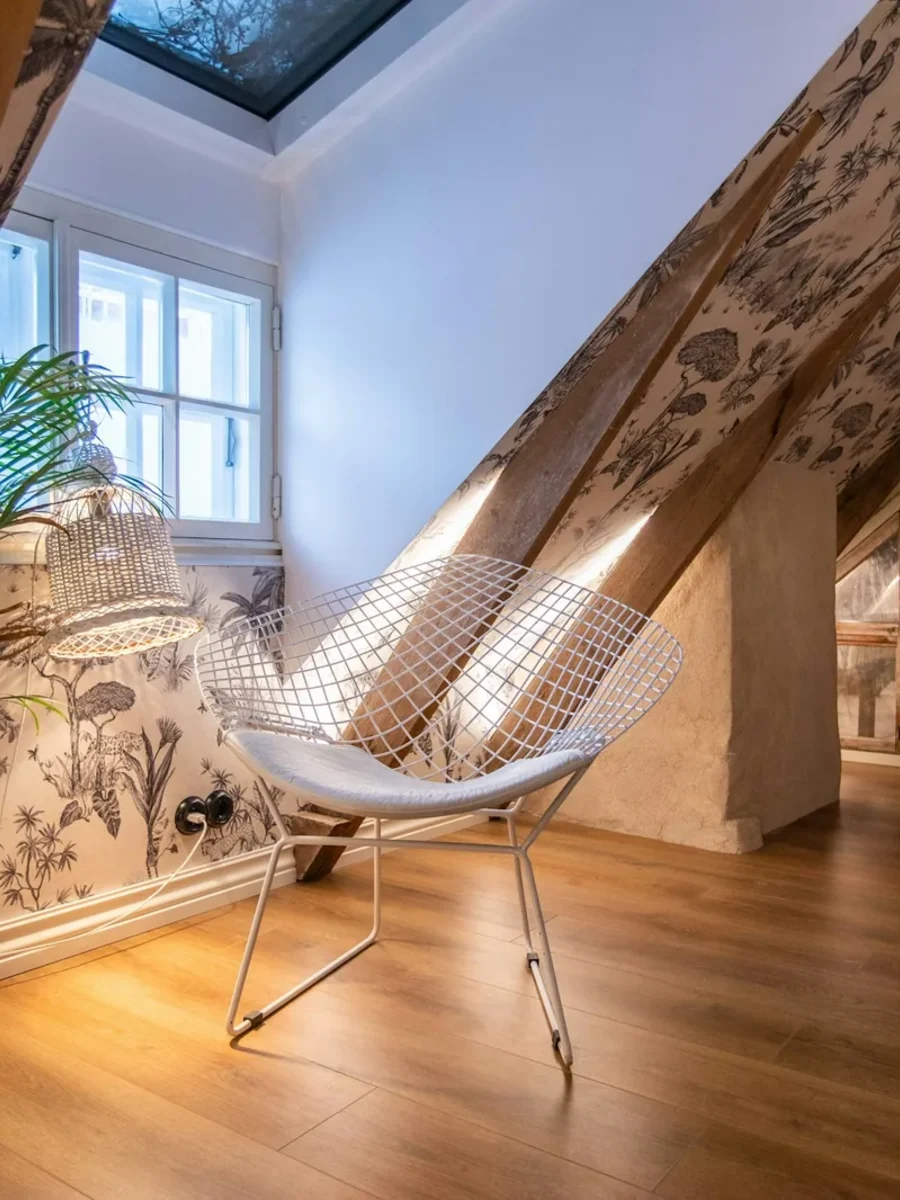
Scale matters as much as maths. The Kentucky guidance notes that large designs usually make a room look smaller and small designs make it seem larger, and that a large pattern is hard to match in a room broken up by doorways, windows and alcoves. A big tropical leaf with a 64 cm repeat is glorious on the single wall behind a bed in a high-ceilinged villa bedroom and fussy in a small flat bedroom with three doors.
Height changes the answer too. The tall walls of an old Portuguese-style house can carry a large drop match beautifully, and the calculator shows the repeat may cost little; in a modern flat with a 2.7 m ceiling, a small straight-match print often sits better. Whatever you choose, the wall comes first: wallpaper only stays up on a dry, sound surface, and our guide to the best wallpaper for humid walls explains how to check it. When you have a shortlist, our home wallpaper service will measure the walls, count the drops and plan the first one with you.