 Drapehaus
Luxury wallpaper is defined less by price than by what it is made of. Hand-printed papers, natural grasscloths, silks and hand-painted panels are built from fibres and pigments that are alive to their surroundings. That is what gives them depth, and it is also why they behave differently in a Goan house than in a showroom. Paper and natural fibre take up moisture from the air, expand, and give it back when the air dries.
Goa's climate puts that to a hard test. The India Meteorological Department's normals show morning relative humidity of 87 to 91 per cent across Goa from June to September, and even the driest months rarely fall much below the high 50s in the afternoon. A designer wallpaper hung on a wall that is carrying moisture, with a paste that feeds mould, will fail however fine the paper.
This article sets out how each kind of fine wallpaper behaves in that humidity, how the wall should be prepared and tested, which adhesives to use, and where not to hang wallpaper at all. The practical side of supply and hanging is on our home wallpaper page.
What distinguishes luxury wallpaper
The substrate, the material the design sits on, decides most of how a wallpaper behaves. Non-woven papers are made from a blend of cellulose and synthetic fibres; they are dimensionally stable, hang by pasting the wall rather than the paper, and usually strip off dry in one piece. Traditional paper-backed wallpapers are pure or mostly cellulose, often printed by hand with screens or blocks, and expand when pasted and again in humid air.
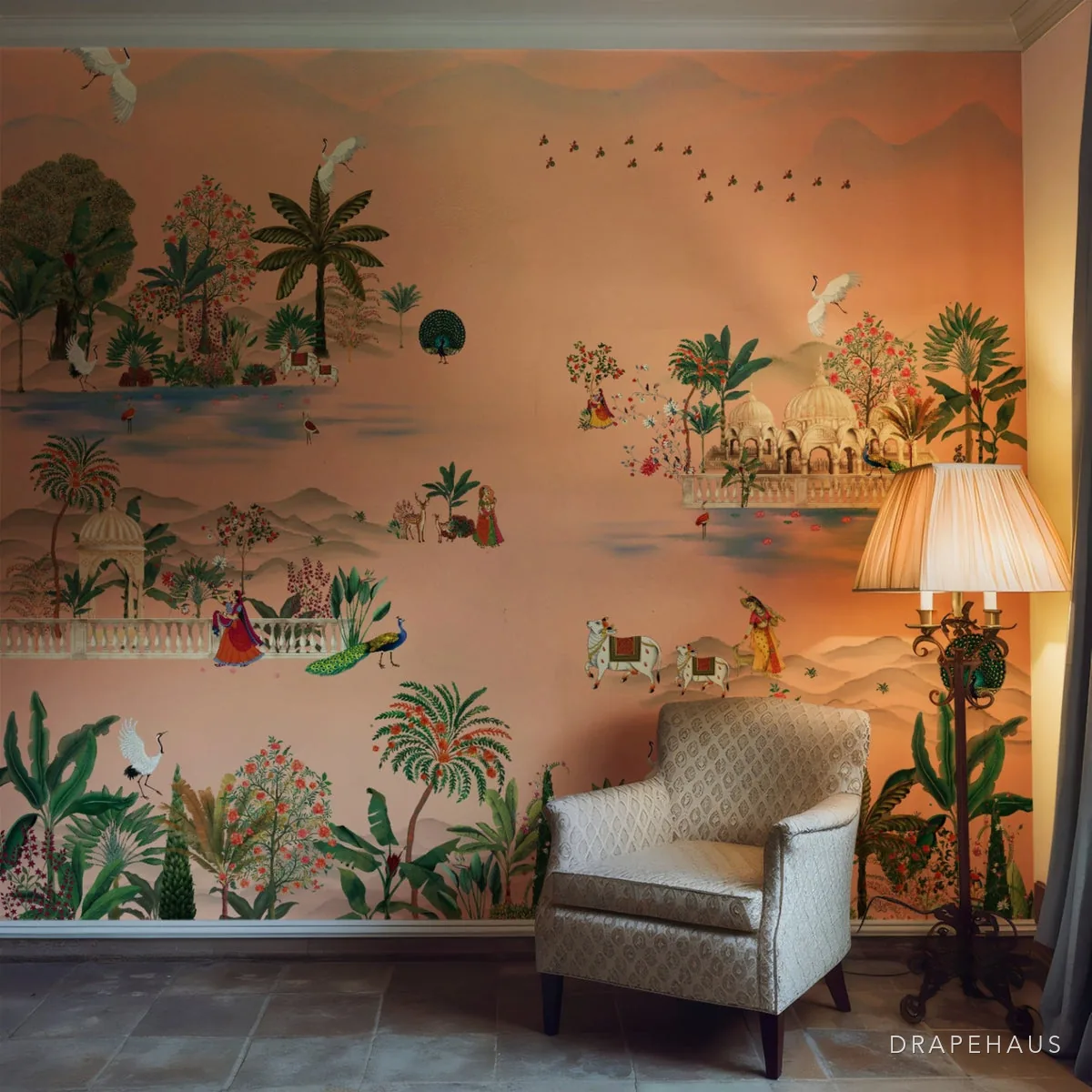
Natural wallcoverings are a separate family. Grasscloth is woven from natural plant fibres and backed with paper; each roll is unique, and the seams show by nature. Silk wallcoverings are woven or laminated silk on paper. Hand-painted panels, often on silk or paper, are commissioned to the room's dimensions and hung as a continuous scene rather than as repeating drops.
Beyond the substrate, the marks of fine work are the printing method, the depth and number of colours, a design scaled to the room, and the care taken over the match between drops. None of these makes a paper less vulnerable to humidity. Several of them make it more so, because they rely on natural materials and water-based pigments.
How each wallpaper behaves in a humid climate
Non-woven is the most forgiving choice for a humid house. It moves less with moisture, the paste goes on the wall so the paper does not need soaking, and many designer collections are now printed on it. Where a room is naturally ventilated and the humidity swings between seasons, non-woven is the substrate we reach for first.
Paper-backed and hand-printed papers are beautiful but more sensitive. They expand when wet with paste, contract as they dry and keep moving with the seasons, which can open seams or cause edges to lift in a room without air conditioning. Hung on a sound, dry wall with the right paste, in a room whose humidity is controlled, they last well.
Grasscloth and silk are the most demanding. One adhesive manufacturer's guidance is that grasscloth and other natural fibre coverings are porous, will absorb moisture and should not be used in areas of high humidity such as bathrooms. Paste or water on the face can stain permanently. Silk marks with water and fades in strong light. Both belong in sealed, air-conditioned rooms away from windows that take direct sun, and hand-painted panels deserve the same protection.
- Non-woven: most stable; first choice for ventilated rooms
- Paper-backed and hand-printed: good in controlled humidity; seams can open where humidity swings
- Grasscloth: porous and visibly seamed; air-conditioned rooms only, never bathrooms
- Silk and hand-painted panels: water-marks and light-sensitive; sealed, shaded rooms only
Planning something like this?
We visit homes across North and South Goa, measure on site, and bring samples to see in your own light.
Wall preparation and moisture readings before hanging
Almost every wallpaper failure we are called to is a wall failure. Peeling edges, bubbles and black spotting at the seams usually mean moisture in the wall, not a fault in the paper. New plaster needs time to dry out, an old wall may be drawing damp up from the ground or in from a leaking window, and an external wall can take in rain through the whole monsoon.
So the wall is tested before any paper is ordered. That means moisture readings taken with a meter at several heights, including low down and near windows and corners, and compared with the limit the paper's maker sets. It also means looking for salt deposits, hollow or loose plaster, and old mould staining. The US federal guide specification for wallcoverings is plain that the source of moisture has to be found and fixed before new wallcovering is installed.
Heritage walls need extra thought. Lime plaster on laterite is designed to take up moisture and release it again, and a vinyl or heavily coated paper seals that surface and traps the water behind it. Our guide to laterite and old walls covers why; on these walls a breathable paper, or a limewash rather than wallpaper, is often the honest answer.
If the wall is not dry, the paper is not the problem, and no paper will be the solution.
Adhesives, primers and fungicide
Wallpaper paste is food for mould. Traditional starch and cellulose pastes are organic, and a film of paste held behind a paper in 90 per cent humidity is an ideal place for mould to grow. The US federal wallcovering specification calls for primers and adhesives recommended by the wallcovering's maker and containing a non-mercury mildewcide, and for wallcoverings protected with mildew inhibitors. That is sound practice for any humid climate.
The primer matters as much as the paste. A wallcovering primer seals the plaster so it does not draw paste out of the paper, evens the surface colour behind thin or pale papers, and makes future removal possible without taking the plaster with it. On natural coverings, some makers recommend a primer tinted close to the colour of the paper so any hairline gap at a seam does not show white.
Follow the paper's maker on paste type and method, not habit. Grasscloth and silk are generally hung with a paste made for delicate coverings, applied carefully so none reaches the face. Non-woven is hung by pasting the wall. A mismatch between paper and paste, particularly a heavy vinyl adhesive on a delicate paper, is a common cause of staining and failure.
Where not to hang it
The inside face of an external wall is the first place to be cautious. The US federal wallcovering specification advises against wallcovering on the interior face of exterior walls because moisture can accumulate behind it and lead to mould and material failure. In Goa, where external walls take driving rain from June to September, a wall that faces the monsoon is a poor candidate for fine paper, and a vinyl that seals it is worse.
The second is any wall with a history of damp or fungus. If a wall has grown mould before, find out why before covering it; our article on fungus on walls explains the usual causes. Behind wardrobes, beds pushed tight to a wall and heavy furniture are also risky, because the paper behind them never gets air.
The third is the obvious one: bathrooms and kitchens for anything natural. Grasscloth and silk should never go in a wet room. Steam, splashes and daily wiping are exactly what natural fibres cannot take. Where a bathroom does need pattern, a washable vinyl on a well-ventilated internal wall is the right tool, and the fine paper belongs in the room next door.
Living with fine wallpaper through the seasons
Humidity inside the room is the variable owners control. The US EPA advises keeping indoor relative humidity below 60 per cent, ideally between 30 and 50, to limit mould. That is out of reach in a naturally ventilated Goan room in July, which is why the most delicate papers belong in rooms with air conditioning or a dehumidifier running through the monsoon.
A house closed for the season is the hardest test of all. Humidity climbs, nothing moves the air, and a paper that was fine while the house was lived in can spot with mould in a few weeks. Our guide to the closed-house season covers ventilation and dehumidification; wallpapered rooms are among the first to protect.
Clean gently and by the maker's instructions: a soft brush for grasscloth, a barely damp cloth for washable papers, and nothing wet on silk. Keep sun off light-sensitive papers with sheers or blinds. Keep a spare roll from the same batch, stored flat in a dry room, so a damaged drop can be replaced with a matching one.