 Drape Haus
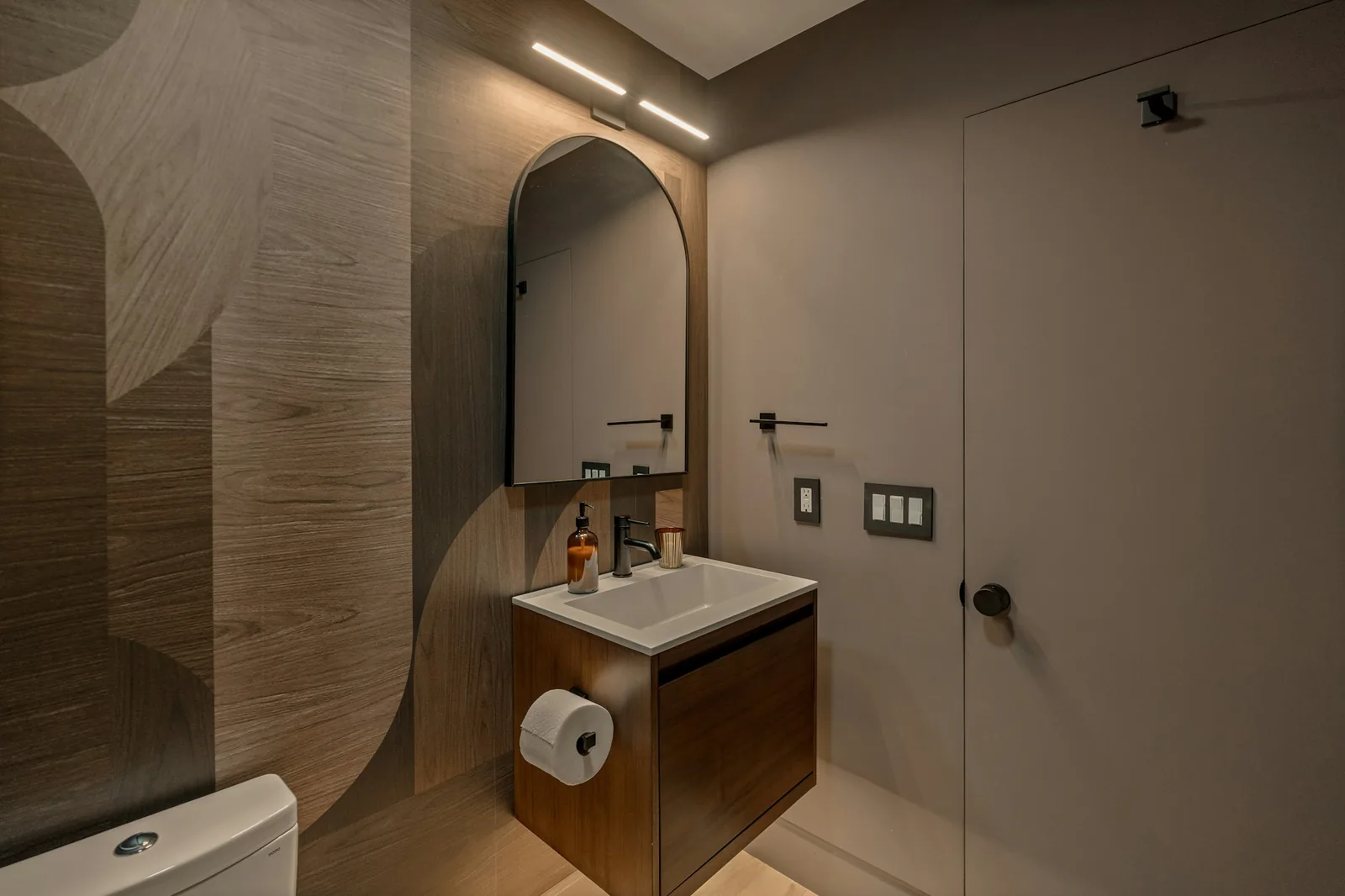
Bathroom wallpaper works well in a powder room or guest toilet and badly in a shower room. A powder room has a basin and a WC, short visits and little steam, so a washable vinyl on its walls behaves much as it would in a hallway. A bathroom with a shower fills with steam every day, and in Goa that steam meets air that is already at 87 to 91% humidity on monsoon mornings, according to the India Meteorological Department. Paper on those walls has to dry out after every shower, and for four months of the year it rarely gets the chance.
So the real question is not whether a wallpaper is waterproof. It is whether the room clears its steam quickly, and whether the paper is kept out of reach of splashes. Get those two right and a bathroom can carry a bold pattern for years. Get them wrong and the seams lift, the edges darken and mould grows behind the paper where you cannot see it.
This guide separates the rooms, sets ventilation as the first requirement, explains which papers tolerate occasional moisture, and covers sealing, alternatives for the wet zones and the checks that catch mould early.
Powder rooms and shower rooms are different problems
A powder room or guest toilet is the easiest place in a house to wallpaper, and often the most rewarding. It is small, so a striking pattern costs little paper, and guests see it more than any other room. The moisture is limited to hand-washing at the basin, which is easy to keep off the walls with a tiled or panelled splashback.
A full bathroom is harder in stages. A bathroom with a bath or shower but a good window and a strong extract fan can take paper on the walls furthest from the water. A small shower room with a high window onto a duct, the common arrangement in flats, is the worst case: steam hangs for an hour after every shower and nothing dries. In that room, wallpaper inside the shower is out of the question and even the far walls are a gamble.
Treat the rest of the bathroom in zones. The wet zone is anything the shower can reach and needs tile or stone over waterproofing. The splash zone is around the basin and bath, wet often but briefly. The dry zone is everything else: above a tiled dado, the wall behind the WC, the far side of a larger bathroom. Wallpaper belongs only in the dry zone.
| Room or zone | Wallpaper? | Conditions |
|---|---|---|
| Powder room or guest toilet | Yes | Washable vinyl; splashback behind the basin |
| Bathroom dry zone, good fan and window | Usually | Scrubbable vinyl; above a tiled dado; seal the edges |
| Small shower room with weak ventilation | Rarely | Only after ventilation is fixed, and far from the shower |
| Splash zone round basin and bath | No | Tile, glass or PVC marble sheet instead |
| Inside the shower | Never | Tile or stone over waterproofing |
Ventilation comes first
Before choosing any paper, fix the air. The US Environmental Protection Agency advises running the bathroom fan or opening the window when showering. US Department of Energy guidance, produced by the Pacific Northwest National Laboratory, is more specific: bathroom fans should vent directly outdoors, not into a roof space or the void between floors, should move at least 50 cubic feet per minute when used intermittently or 20 when run continuously, and ideally keep running for an hour after a shower. A timer switch or a humidity sensor makes that happen without anyone remembering.
Many Goan bathrooms fall short. Older houses often have a small high window and no fan; many flats vent into a shared duct that also carries other flats' steam. A fan that recirculates air into a false ceiling, or one so weak that the mirror stays fogged for half an hour, is not ventilation. Fixing it is a job for an electrician and sometimes a builder, not for us, but it is the single change that decides whether bathroom wallpaper lasts.
The amount of water is not small. A US Department of Agriculture bulletin reprinted by Oregon State University Extension puts the moisture that cooking, laundering and bathing add to a house at 7.6 litres or more a day where air circulation is inadequate. In a closed bathroom much of a shower's share lands on the walls and ceiling.
If the mirror is still fogged twenty minutes after a shower, the room is not ready for wallpaper.
Planning something like this?
We visit homes across North and South Goa, measure on site, and bring samples to see in your own light.
Which wallpaper copes with occasional moisture
There is no such thing as a truly waterproof wallpaper, because every paper has seams and edges, and the paste behind it is water-based. What there is, is paper whose surface does not take up water and can be cleaned. The University of Kentucky's extension guide describes vinyl wallcoverings as mildew and moisture proof on the surface, washable with warm soapy water and often scrubbable with a soft brush, and recommends them for bathrooms. Its comparison table rates fabric-backed vinyl as the most durable, scrubbable grade for heavy-use rooms including bathrooms. The same guide notes that even well-hung wallcoverings can come loose in a bathroom where steam is a factor.
Check the washability symbols on the roll, graded under test methods such as the European standard EN 12956. For a bathroom, choose scrubbable, or at least extra-washable, rather than spongeable. Uncoated papers, which the Kentucky guide says stain easily from moisture, grasscloth, silk and flock do not belong in a bathroom at all.
One caution cuts the other way. Vinyl's resistance to water also makes it close to vapour-proof, and US Department of Energy guidance warns against such layers on the inside of walls in warm, humid climates, where moisture from outside condenses behind them. In a bathroom, that matters most on an external wall of an air-conditioned en-suite. A non-woven paper breathes better, but many are less washable, so it suits a powder room better than a shower room. Our article on luxury wallpaper in humid homes explains how different papers react to moisture.
Sealing edges and seams near basins and the mirror
Water gets behind bathroom wallpaper at its edges, so the edges are where the work goes. Start with a wall that is dry: the US federal guide specification for wallcoverings sets a maximum moisture meter reading of five per cent for plaster and masonry before hanging, and calls for primers and adhesives containing a mildewcide. Hang in the dry season, and butt the seams tightly.
Stop the paper short of anything wet. Above a tiled dado or splashback, finish it a few millimetres above the tile and run a bead of clear, mould-resistant sealant along the junction. Around the basin, keep a splashback of tile, glass or a PVC marble sheet wide and tall enough that a hand-wash never reaches the paper. At the skirting, where floors are mopped daily, the same sealed gap applies.
Mirrors and cabinets need thought. A mirror glued directly onto wallpaper traps moisture behind it and pulls on the paper; fix it on clips or spacers so air can move behind, or set it on a panel or tile and paper around it. Plan the positions of the mirror light, the shaver socket and any towel rail before papering, and fix the rail into the wall through small, sealed cuts rather than through a loose sheet of paper.
PVC panels and tiles for the wet zones
Inside the shower, tile or stone over a proper waterproofing layer is still the only right answer. Everything else is a finish that sooner or later lets water behind it. Around the basin and bath, tile and glass remain excellent, and PVC marble sheets make a quick, nearly joint-free splashback that can often go over sound existing tiles.
PVC wall panels are also the honest alternative for a bathroom that cannot be made dry enough for wallpaper. They do not take up water, they wipe clean, and they will not blister in steam the way paint and paper do. They are a finish rather than waterproofing, so the joints and edges still need sealing in the splash zone, and they should never go over a wall that is already damp. A PVC ceiling over the shower ends the yearly peeling that steam causes. Our bathroom wall panels guide covers where they belong and how they are fitted.
A combination often gives the best result: tiles to dado height or full height in the shower, PVC marble sheet behind the basin, and wallpaper on the dry walls above and beyond. The pattern then carries the room without being asked to survive the water.
Cleaning bathroom wallpaper and inspecting it for early mould
Clean little and often. The University of Kentucky guide recommends lukewarm water and mild soap on washable coverings, working from the bottom up and wiping dry, and says abrasives should not be used on any wallcovering. In a bathroom that means a soft sponge, not the scouring pad kept for the tiles, and no bleach-based cleaners on the paper.
Inspect once a month in the monsoon, with a torch held low against the wall. Look at the seams nearest the shower and basin, the bottom edge at the skirting, the corners behind the WC and the area around the mirror. The early signs are a seam that has started to lift, a faint shadow or darkening along an edge, a bubble that was not there before, or a musty smell close to the wall. The US Environmental Protection Agency notes that mould can grow hidden on the back of wallpaper, so a darkening edge often means more behind it.
Deal with a lifting edge at once. The Kentucky guide's remedy is to ease the paper back, apply a thin coat of white household glue, press it down and wipe off the excess. If a seam keeps lifting, or a dark shadow spreads under the paper, the wall behind is wet: take the drop off, find the cause, let the wall dry and rehang with a spare from the same batch.
Guest bathrooms in homestays and rentals
A bathroom in a homestay or rental villa has a particular problem: the people using it do not know to open the window or leave the fan running. A paper that survives in an owner's en-suite can fail in a guest room within a season. If you want wallpaper in a guest bathroom, keep it to the powder room or to dry walls well away from the shower, and put the extract fan on a timer or humidity sensor so it runs whether or not anyone remembers.
Houses closed through the monsoon add a further risk. Humidity climbs with nothing moving the air, and a papered bathroom can spot with mould in weeks. Leave a vent open or the fan on a timer, and ask whoever checks the house to open the windows on dry days. Our guide to the closed-house season covers the rest of the house.
If you would like to see what suits your bathroom, we can bring washable and scrubbable samples from the home wallpaper collection, check the walls' moisture, and suggest where paper will last and where a panel is the better choice.