 Drape Haus
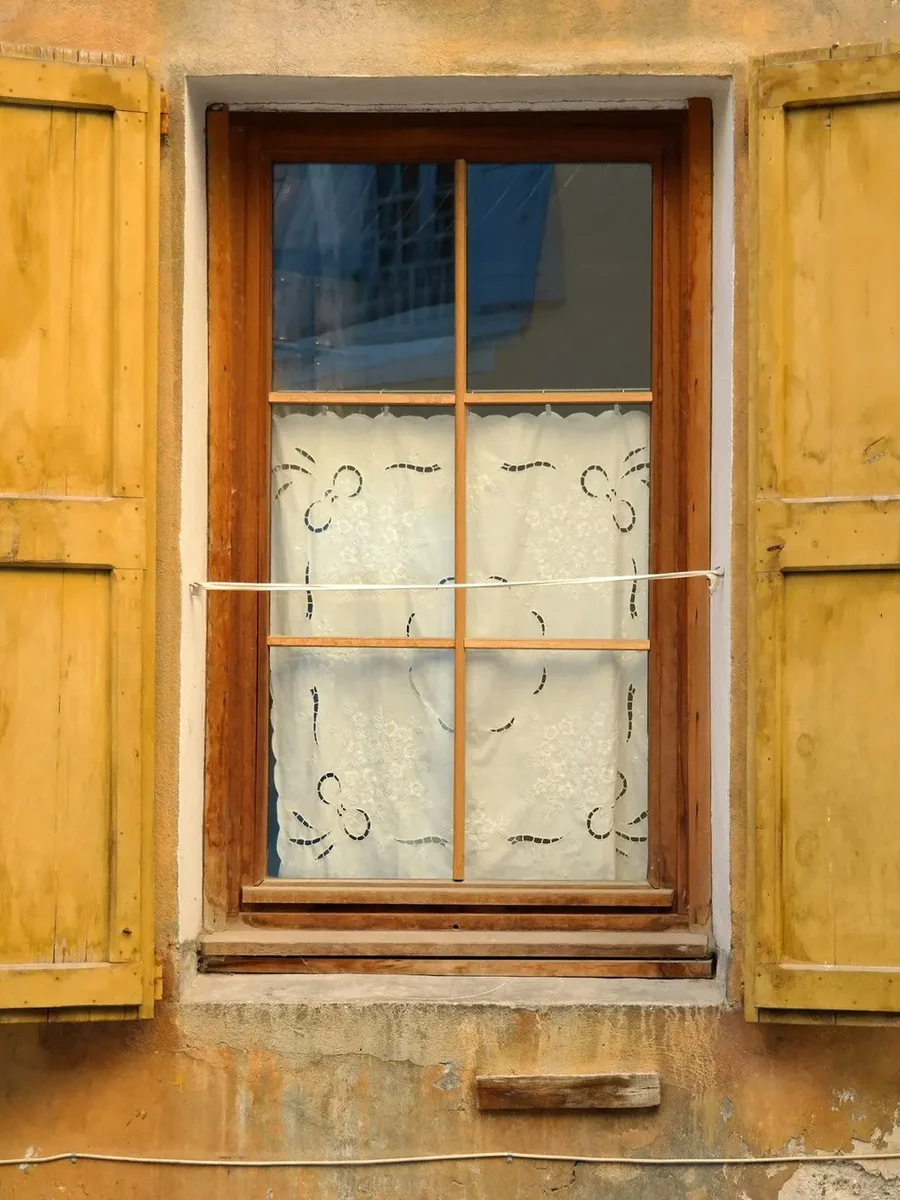
Curtains for old houses have a harder job than curtains for new ones. In a Goan house built a century or more ago, the windows are tall, often taller than the doors, and few are truly square. Many have timber shutters that open into the room, a fanlight or arched head above, and sometimes panes of oyster shell rather than glass. The walls around them are laterite and lime, which crumble under a careless drill.
Good curtains in these rooms start from the window, not the fabric. They are measured at several points because the opening is uneven, they hang from high enough that the fanlight still reads, they stack clear of the shutters so both can be used, and they are fixed into something that will hold for years. Fabric and colour follow.
This guide takes those decisions in order. It complements our broader piece on heritage villa interiors, which covers scale, lighting and furniture, and our guide to curtains for Goan houses, which shows the styles we make most often.
What makes an old window hard to dress
Height is the obvious difference, but it is not the hardest one. Old houses have settled, so a window that looks square may be a centimetre or two out across its width and more over its height. Floors slope, sometimes noticeably, towards the verandah or the street. Reveals are deep because the walls are thick, and the inside face of the wall may lean slightly. A curtain made to a single measurement will hang short at one corner and drag at the other.
Then there is everything already in the opening. Inward-opening shutters or casements need room to swing and somewhere to fold back against. Fanlights and arched heads above the window are part of its design; a pole run straight across the middle of an arch cuts it in half. Oyster-shell panes already soften the light, so the sheer that a glass window needs may be redundant. Insect screens may be fitted in the reveal. Any curtain scheme has to leave all of these working.
Finally, the walls. Laterite blocks bedded in lime, finished with lime plaster, behave very differently from a concrete wall. Plaster can be soft and hollow behind the surface, the laterite is porous and variable, and old timber lintels and frames may be sound or may hide termite damage. Where the curtain is fixed matters as much as what it is made of.
Measuring tall, uneven windows so curtains hang straight
Measure everything at least three times. Take the width at the top, middle and bottom of the opening, and the height on the left, in the centre and on the right. Then measure the drop you actually want, from the planned fixing line to the floor, at both ends of the track and in the middle, because the floor is rarely level. Our general guide on how to measure for curtains explains the basic method; in an old house the repetition is the point.
Record what surrounds the opening as well. Note the width of each shutter leaf and how far it swings into the room, the height and shape of any fanlight or arch, the distance from the top of the architrave to the ceiling, and anything on the wall either side, such as a switch, a niche or a door, that limits how far the curtain can stack back. Photograph each window square-on and from the side.
Made-to-measure curtains are cut to the shortest drop where the floor slopes, so that the hem clears the floor everywhere, or made with a slightly graded hem where the difference is large. In a humid house a hem that just clears the floor, rather than puddling on it, stays drier and cleaner through the monsoon. We measure on site for exactly these reasons; the fabric calculator gives a first idea of quantities, but it assumes a square window.
| Measurement | Where | Why it matters |
|---|---|---|
| Width | Top, middle and bottom of the opening | Shows how far out of square it is and sets the track length |
| Height | Left, centre and right | Reveals lean and settlement |
| Finished drop | Fixing line to floor at both ends and centre | Floors slope; the shortest drop sets the hem |
| Shutter leaves | Width of each leaf and its swing | Curtains must stack clear of open shutters |
| Fanlight or arch | Height above the window and shape | Decides whether the rod goes above it |
| Wall either side | Clear wall to the nearest obstruction | Limits the stack-back space |
| Head to ceiling | Top of architrave to ceiling | Decides between a wall rod and a ceiling track |
Planning something like this?
We visit homes across North and South Goa, measure on site, and bring samples to see in your own light.
Rod above the fanlight, or a ceiling track
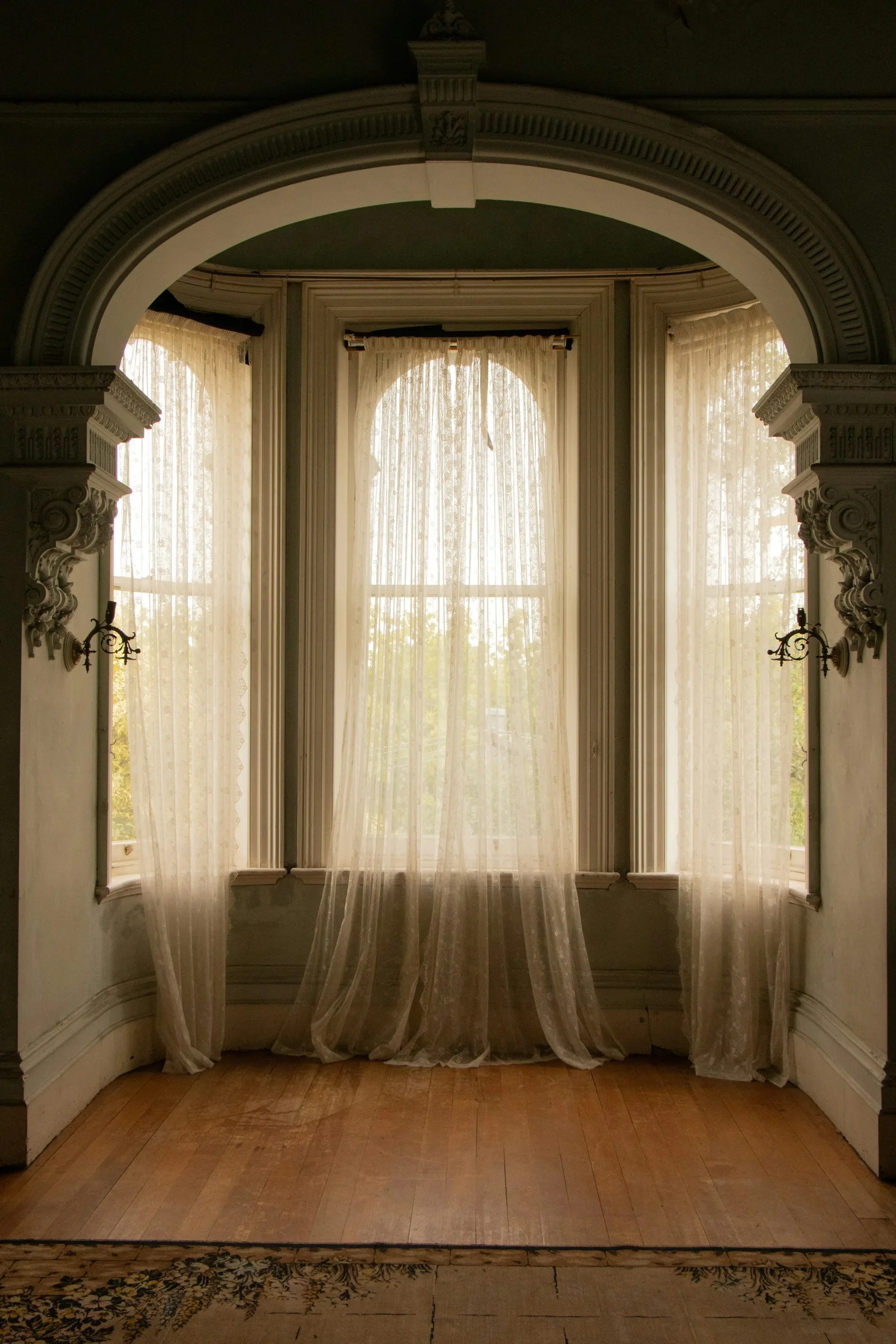
On a tall window with a fanlight, the usual answer is to fix the curtain above the fanlight, not across it. Hung that way, the curtain frames the whole opening, the arch or transom remains visible when the curtains are open, and the room reads as tall as it is. Taking the curtain right up also helps it perform: the US Department of Energy advises hanging draperies as close to the window as possible and, for best effect, against the ceiling or with a cornice at the top, so that less air circulates behind them.
When there is little wall between the fanlight and the ceiling, or that wall is too soft to take fixings, a ceiling-fixed track is often the neatest solution. It fixes into the timber ceiling or a batten above it, avoids drilling the wall at all, and lets the curtain fall from the full height of the room. Ceiling tracks also suit long runs across several windows and bays, and they make motorisation easier later. Our ceiling curtain tracks are used in old houses for exactly these reasons.
A pole on brackets suits shorter or lighter curtains, rooms where the hardware is meant to be seen, and windows with solid masonry or a sound timber frame above them. On a long, heavy drop, a pole needs intermediate brackets, and on a wide window the curtain cannot pass them without a passing-ring system. The comparison below sets out the trade-offs; our guide to types of curtain rods covers the hardware in more detail.
| Rod on wall brackets | Ceiling-fixed track | |
|---|---|---|
| Fixes into | Masonry or timber above the window | Ceiling timbers or a batten |
| Best for | Moderate drops, visible decorative hardware | Very tall drops, little wall above the fanlight, long runs |
| Heavy linen or lined curtains | Needs closely spaced, well-fixed brackets | Carries weight evenly along its length |
| Arched or fanlight heads | Fix above the arch so it stays visible | Hangs from the ceiling, clearing the arch completely |
| Motorisation later | Limited | Straightforward, if power is planned |
Fixing into lime plaster, laterite and old timber
The commonest failure in an old house is a curtain that pulls out of the wall a few months after it goes up. Lime plaster is soft and sometimes hollow behind the face, and a standard plastic plug in crumbly laterite has little to grip. Every time the curtain is drawn, the fixing is levered slightly, and in time it works loose, taking a lump of plaster with it.
The answer is to fix into something sound. That may be the timber window frame or lintel where it is solid and free of termite damage, the laterite itself behind the plaster using fixings designed for soft or hollow masonry, or the ceiling structure. We drill old walls without hammer action where possible, find out what is behind the plaster before committing, and keep fixings away from carved architraves and painted decoration. Our guide to laterite and old walls goes further into the options.
Two habits make later life easier. Record where every fixing went, with a photograph and a note, so that holes are not multiplied when curtains are replaced. And if the ceiling or plaster is being repaired anyway, tell the carpenter or plasterer where tracks will go, so that a batten or a sound fixing zone can be built in before the surface is closed.
Fix to what is sound, not to what is convenient. A good curtain on a failing fixing becomes a repair job on the wall.
Shutters, shell panes and mosquito nets: keep all three working
Internal shutters are the best storm protection and the best blackout an old house has, and a curtain must never stop them closing. The US National Park Service's guidance on cooling historic buildings lists shutters, operable windows and curtains among the features to use to reduce heating and cooling loads. In practice that means fixing the curtain far enough forward that it hangs clear of the shutter leaves when they are folded back, and making the track long enough that the curtains stack beyond the shutters rather than over them. Projecting brackets or a ceiling track set a little into the room solve most cases. Where shutters are folded into the reveal, the curtain can stack against the wall beside them.
Oyster-shell panes change what the curtain needs to do. The shell already diffuses light and gives privacy by day, so a sheer behind it adds little. Many owners choose a single layer of unlined or lightly lined linen that can be drawn at night or against the hottest sun, leaving the shell panes visible for most of the day. Our article on oyster-shell windows explains how they are made and cared for.
Insect screens add one more layer to plan. A sliding or removable frame fitted inside the reveal keeps the original window and shutters untouched and leaves room for curtains on the room side. Think through the order from the outside in: window, screen, shutters, curtain, and check that each can be opened without fighting the next. Sliding window nets are made for exactly this kind of opening.
Fabrics that suit old houses and the monsoon
The fabrics that look right in old Goan rooms are mostly the ones that cope with them: linen, cotton, linen blends and lined sheers. They breathe, they soften strong west light rather than blocking it entirely, and they can be taken down, washed and dried. The India Meteorological Department records mean morning humidity in Goa of 87–91% from June to September, and a curtain hung in a house that breathes has to live with that.
Heavy velvet and densely interlined curtains are designed for cold, sealed rooms. In a Goan house they hold moisture and dust, they are heavy on old fixings, and they are hard to keep fresh in the rains. If you want the depth of a heavier curtain, a good linen with a cotton lining usually gives it without the weight. Coated blackout linings belong in bedrooms that need them, hung clear of the wall.
Linings also protect. The Canadian Conservation Institute is plain that light damage to colours is irreversible, and a curtain facing a west window for years will fade on its exposed folds. A lining takes much of that exposure and can be replaced more easily than the face fabric. Our linen curtains and cotton curtains are the usual starting points in these houses.
| Fabric | Suits | Watch for |
|---|---|---|
| Linen and linen blends | Salas, bedrooms, tall drops; relaxed, natural look | Creases; choose a weight that hangs well at full height |
| Cotton | Bedrooms, everyday rooms, painted woodwork | Fades in direct sun unless lined |
| Lined sheers or voiles | Glass windows that need daytime privacy | Often unnecessary behind shell panes |
| Lined linen with blackout | Bedrooms, guest rooms for letting | Hang clear of the wall so air can move behind |
| Velvet and heavy interlined drapes | Rarely the right choice here | Holds moisture and dust; heavy on old fixings |
Colour against limewash and painted woodwork
Lime-washed walls are never one flat colour. They shift through the day as the light moves, and they carry a slight texture that synthetic paint does not. A bright optical white curtain beside an off-white limewash can make the wall look grubby. Natural, unbleached and softly tinted whites, oatmeal, stone and pale ochre usually sit better, because they share the warmth of the lime.
The painted woodwork gives the other cue. Many Goan houses have shutters, frames and doors painted in a strong colour, and the curtain does not need to compete. A plain linen in a tone drawn from the wall, with the woodwork left to provide the colour, is the safe choice. Where you want the curtain to be the colour, choose one that the woodwork can stand next to, and keep it plain rather than patterned, because the windows themselves are already the pattern of the room.
Always look at samples in the room, against the wall, at different times of day, and with the shutters both open and closed. Morning light from the east and late light from the west change a fabric more than any screen shows. Our curtain colour guide has more on testing. When you are ready, book a home visit and we will measure every window, check the walls and bring samples to see in your own light.