 Drape Haus
The main types of curtains, sorted by what they do, are sheer curtains for soft light and daytime privacy, blackout curtains for darkness, lined curtains for drape, privacy and fade protection, thermal or heat-reducing curtains for hot glass, printed curtains for pattern, and layered curtains that combine a sheer and a heavier curtain on one window. Sorted by how they hang, the main types are pinch pleat, pencil pleat, eyelet, wave or ripple fold, rod pocket and tab top.
Most rooms need one type from each list: a job and a heading. A bedroom might take a blackout-lined pinch pleat on a ceiling track; a living room a sheer on a wave heading behind a lined curtain; a guest room a lined eyelet curtain on a pole. The fibre comes after that, chosen for the room's humidity, sun and distance from the sea.
This guide walks through each type, what it is good and bad at in a Goan house, and which rooms it suits. All of them are on our curtains pages, and you can see the main ones on a drawn Goan window, morning to night, in the curtain simulator.
Two ways to sort curtain types: what they do, and how they hang
Shops tend to mix the two lists together, which is why the choice can feel endless. A blackout curtain can have an eyelet heading or a pinch pleat; a sheer can be gathered on a pencil pleat tape or hung on a wave track. The job decides the fabric and lining. The heading decides how the folds fall, how wide the open curtain stacks, and whether it hangs from a pole or a track.
The table sets out the headings. Fullness, the amount of fabric compared with the width of the track, is given as our fabric calculator uses it, because it is the biggest single driver of how much fabric a curtain takes. Tab-top curtains, with loops of fabric over a pole, are usually made flat or at low fullness and suit curtains that are rarely drawn.
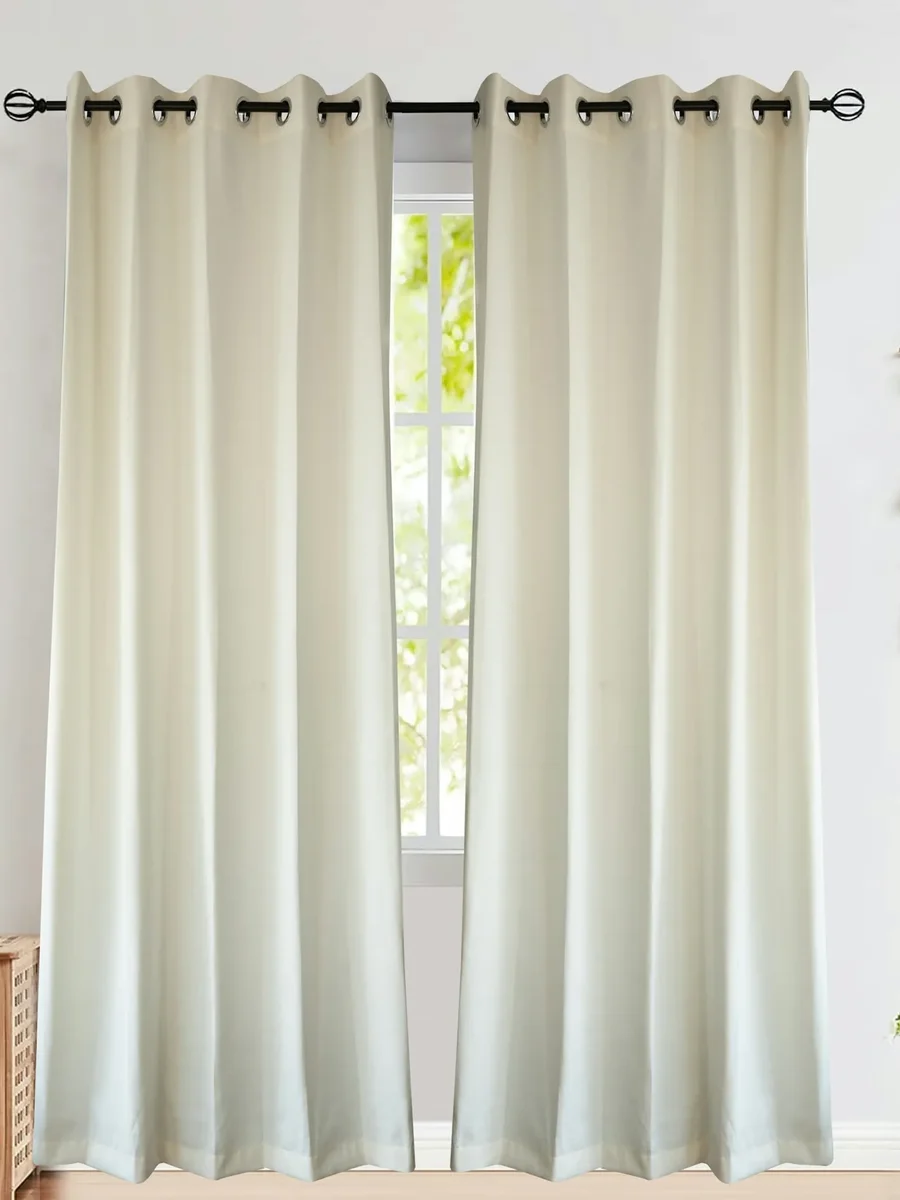
In a Goan house the heading has a practical side too. A wave heading stacks tightly beside a wide sliding door that is used all day. A pinch pleat suits a formal room with tall windows. An eyelet slides easily on a pole and suits a rental, where guests want one obvious movement. Our article on how much fabric you need shows how the heading changes the metres.
| Heading | Look | Hangs from | Fullness in our calculator |
|---|---|---|---|
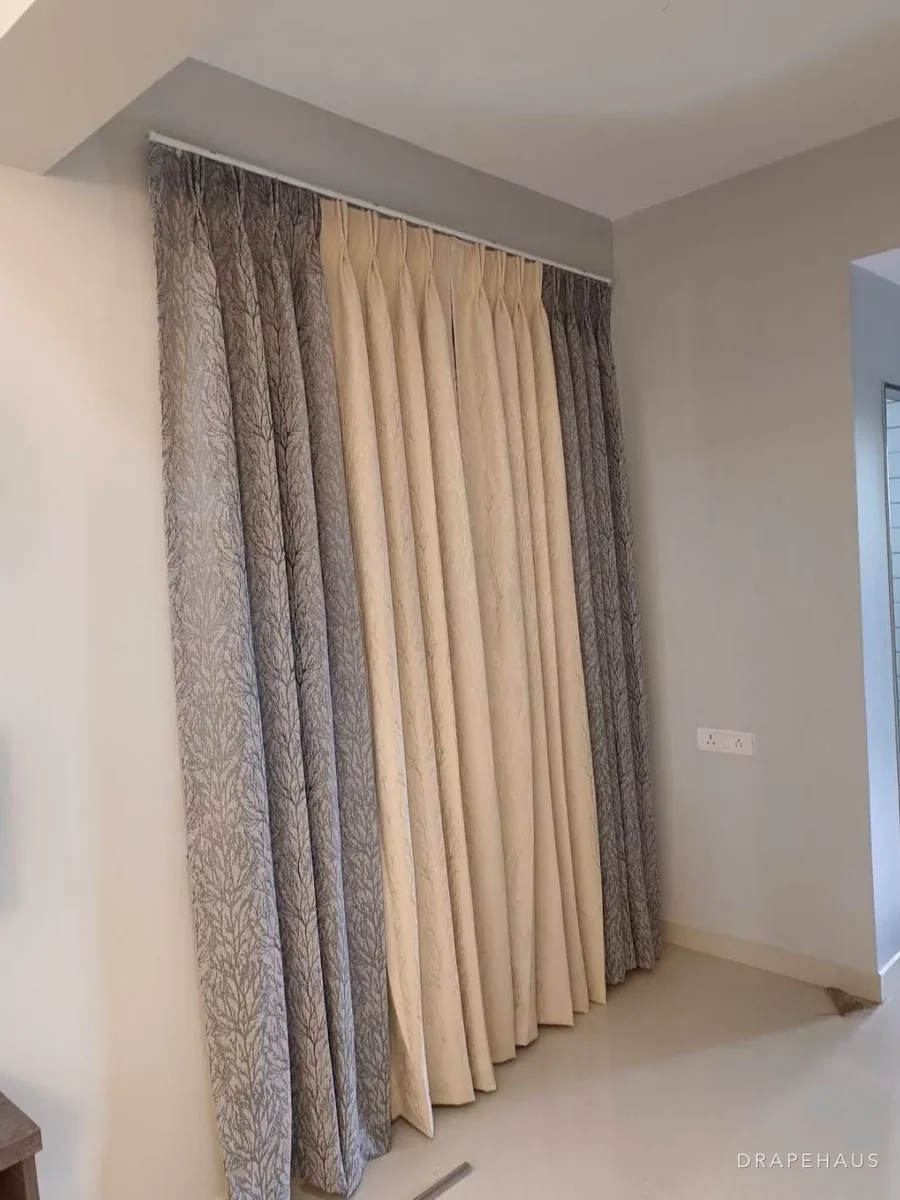
| Pinch pleat | Tailored groups of stitched folds | Track or pole | 2.25× |
| Pencil pleat | Close, soft gathers on a tape | Track or pole | 2.5× |
| Eyelet | Deep, even folds through rings in the fabric | Pole only | 2.2× |
| Wave / ripple fold | Continuous S-shaped curve | Compatible track | 2.2× |
| Rod pocket | Gathered directly onto the pole | Pole only | 1.75× |
| Tab top | Fabric loops over the pole | Pole only | Not in the calculator |
Sheer curtains: soft light, daytime privacy and breeze
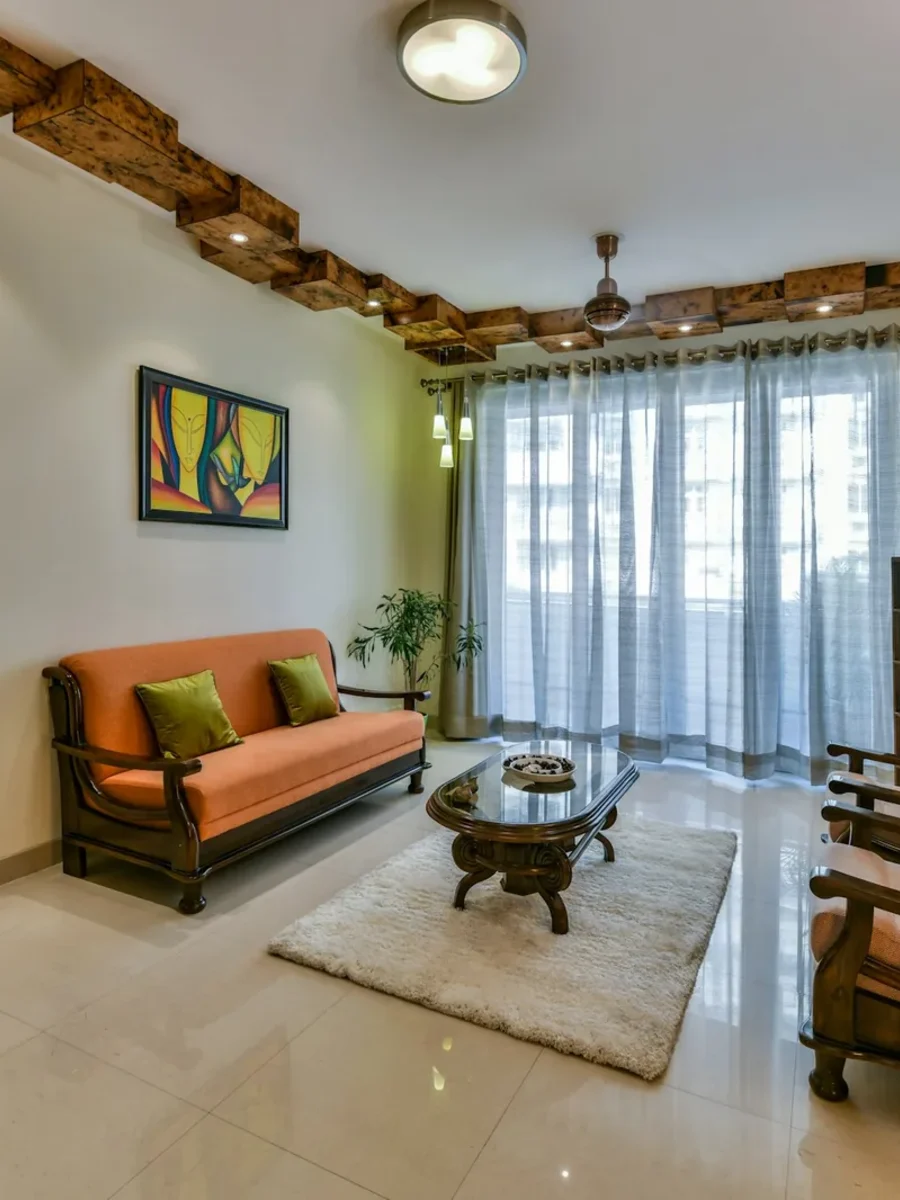
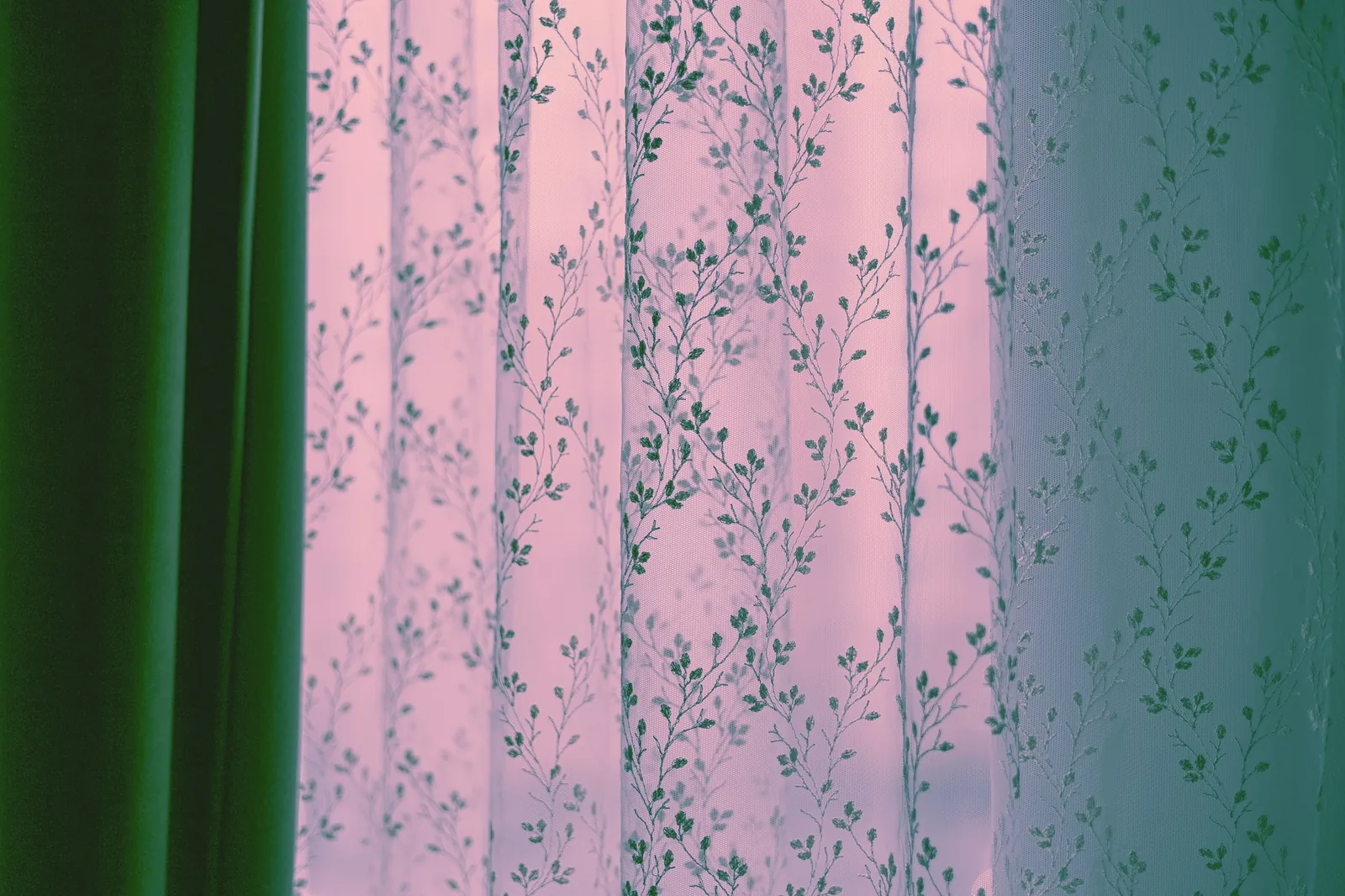
A sheer is a translucent fabric, most often a polyester voile, sometimes linen or a linen-look weave. Drawn across a window in daylight it softens glare, blurs the view in from the lane and lets air pass, while the room stays bright. In a Goan living room that is open to the garden or the balcão most of the year, a sheer is often the most useful single curtain in the house. Our sheer curtains page shows the weights we make.
Two limits matter. A sheer does very little against heat, because most of the sunlight still passes through. And its privacy works only while it is brighter outside than in; once the lamps are on, a sheer shows the room to anyone outside. In a street-facing room it needs a second layer for the evening.
Choose the weight for the breeze. A very fine voile at an open sea-facing window will billow and tangle, and near a ceiling fan it can lift towards the blades. A slightly heavier weave or a weighted hem hangs straighter. Polyester sheers shrug off humidity far better than pure linen ones, which matters if the house is closed for the monsoon.
Planning something like this?
We visit homes across North and South Goa, measure on site, and bring samples to see in your own light.
Blackout and lined curtains: darkness, drape and fade protection
A blackout curtain is a face fabric of your choice with an opaque lining behind it. It is the type for bedrooms where people sleep past sunrise, media rooms and guest rooms in a homestay. The lining stops light passing through the cloth; the fitting decides whether the room is truly dark. Light leaks round the sides, over the top and where a pair meets, so a blackout curtain wants a track that runs wide of the window, a ceiling fix or pelmet, and an overlap at the centre. Our blackout curtains page explains the fitting.
A lined curtain uses an ordinary lining rather than a blackout one. The lining gives the curtain body, so it falls in fuller, more even folds; it stops a printed pattern reading backwards from the street; and it protects the face fabric from sun. Fading cannot be undone, and ultraviolet weakens natural fibres as well as bleaching them, so on a sunny window the lining is a working layer, not a luxury. It takes the sun, and it can be replaced without remaking the curtain.
In Goa, both need a lining that breathes. A sealed or foam-backed layer against cold glass in a closed house through the rains is where mildew starts, which is also why we line but do not interline curtains here. Our guide to blackout linings compares the constructions.
Thermal and heat-reducing curtains for west-facing rooms
A west-facing room in Goa takes the afternoon sun low and straight in, at the hottest time of day. Thermal curtains, which in practice means a lined curtain with a reflective or coated backing, or a dense lined fabric, help when they are drawn across that glass. The figure most often quoted comes from the US Energy Saver programme: in the studies it cites, a medium-coloured drape with a white plastic backing reduced heat gain by 33%. Its advice is to keep such curtains closed on any window the summer sun strikes directly.
Two cautions keep expectations honest. Anything inside the window lets the heat through the glass first and then tries to hold it back; an awning or outdoor blind on a hot west wall intercepts it outside, which is why US building guidance describes exterior attachments as typically more effective than interior ones. And a heat-reducing curtain only works when it is closed, so it suits rooms where you are happy to draw it through the worst hours.
A practical pattern for a west living room is a sheer on the window side of a double track for glare, and a lined or thermal-backed curtain on the room side, drawn on the hottest afternoons and in the evening. Our guides to west-facing glare and heat gain cover the outside options too.
A curtain inside the glass helps with heat; shade outside the glass helps more.
Printed and patterned curtains in strong sun
A printed curtain gives a room its character in one decision: a botanical in a bedroom, a stripe in a study, an ikat in a dining room. Scale matters first. A large print needs a tall window and a calm room to read well; a small, busy print can look restless at three metres high. Pattern also costs fabric, since each drop must be cut so the motif lines up with its neighbour.
Sun matters second. The Canadian Conservation Institute notes that direct noon sunlight approaches 100,000 lux, and that for colours sensitive to light, ultraviolet usually accounts for less than half of the fading. Strong colour on a west- or south-facing window will fade on the folds that catch the light, and a UV film on the glass will not prevent it. Line printed curtains, keep the most saturated prints for windows that do not take direct sun, and ask about lightfastness before choosing.
On a sunny window, prints with a pale ground and mid-toned motifs age more gracefully than dark grounds, where fading shows as a streak along each fold. Our printed curtains page covers scale and placement.
Layered curtains, matched to Goan rooms
Layered curtains put a sheer and a heavier curtain on one window, usually on a double track. The sheer sits nearest the glass and stays drawn through the day; the lined or blackout curtain in front closes at dusk. It is the arrangement that solves most problems in a single opening, because the light and privacy needed at noon are not the ones needed at night.
It does need planning. Both layers must stack beside the glass, so the track runs wider than for a single curtain, and the brackets or ceiling track must sit far enough forward to clear handles, shutters and insect nets. The table matches curtain types to the rooms of a typical Goan home. Our layered curtains page shows the combinations, and the simulator lets you open and close each layer.
| Room | Usual choice | Why |
|---|---|---|
| Living room | Sheer behind a lined curtain, wave or pinch pleat | Breeze and glare control by day, privacy after dark |
| Master bedroom | Blackout-lined, ceiling track, with a sheer behind | Darkness at dawn, softness by day |
| Children's room | Lined or blackout cotton blend, no loose cords | Naps, easy washing, safety |
| Guest room or homestay | Blackout-lined polyester or blend, eyelet or wave | Guests value darkness; durable and easy to use |
| Home office | Sheer or light-filtering lined curtain | Glare off screens without darkening the room |
| Dining room | Lined curtain, often printed | Evening privacy and character |
| Kitchen and bathroom | Usually a blind instead | Steam, splashes and grease are hard on fabric |
Fabric families for each type
Any of these types can be made in several fibres, and in Goa the fibre is chosen by exposure. Monsoon mornings here run at close to 90% humidity on the IMD record, and cotton and linen soak that up and give it back slowly, while polyester barely takes any in. So near the sea or in a closed house, polyester and blends are the safe base for every type; in a lived-in, ventilated room inland, linen and cotton come into their own.
Velvet and heavy drapes are a type of their own. They give deep colour, weight and quiet, and they belong in sealed, air-conditioned rooms; in a breezy coastal room their pile holds damp. Our linen and velvet pages cover each in detail, and the coastal fabric advisor suggests fibres for your house.