 Drape Haus
How much fabric you need for curtains comes from five numbers: the track width, the fullness of the heading, the width of the fabric, the finished drop, and the pattern repeat if there is one. Multiply the track by the fullness to get the gathered width. Divide that by the usable fabric width and round up to whole widths. Work out each cut length from the drop plus hem and heading allowances, rounded up to the repeat. Multiply widths by cut length, and that is the metreage.
For a typical pair of lined pinch-pleat curtains on a 275 cm track, with a 250 cm drop in a plain 137 cm fabric, that comes to 17.4 metres of face fabric. Add a large pattern and the same pair needs 19.2 metres. The rest of this article shows where every one of those centimetres comes from, so you can check a quote or plan your own windows.
The figures here are exactly the ones our curtain fabric calculator uses, so you can follow each example on screen. Measure first, using our guide on how to measure for curtains: every calculation below starts from the track, not the window.
The calculation in five steps
Gathered width. Multiply the track or pole width by the fullness for your heading. Fullness is how much more fabric goes into the curtain than the width it covers. At 2.25 times, a 275 cm track needs about 619 cm of fabric across the pair. University of Kentucky Extension guidance puts the floor at twice the window width, and warns that scanty curtains do not drape, hang or move well.
Number of widths. Fabric comes off the roll in a fixed width, so the gathered width is made up of whole widths joined side by side. Deduct 10 cm from each width for side turnings, divide the gathered width by what is left, and round up. You cannot buy two-thirds of a width. For a pair, the calculator then rounds to an even number so both curtains are identical.
Cut length. Each width is cut to the finished drop, plus 20 cm for a weighted double hem, plus a heading allowance that depends on the style, from 12 cm for a pencil pleat or wave heading to 20 cm for a pinch pleat. Pattern. If the fabric has a repeat, each cut length rounds up to a whole number of repeats so the design lines up across every join. Total. Multiply the number of widths by the cut length, and convert to metres; the calculator rounds the result up to the next 10 cm.
Fullness is the first thing people cut to save fabric, and the first thing they regret.
Fullness by heading: eyelet, pinch pleat, wave and the rest
Different headings need different amounts of fabric to look right. A pencil pleat gathers the most and is the most forgiving, so our calculator uses 2.5 times. A pinch pleat folds fabric into stitched groups and uses 2.25 times. Eyelet and wave headings fall in deep, regular curves and use 2.2 times. A rod-pocket curtain, gathered directly onto a pole and usually left closed, uses 1.75 times. These sit inside the range of roughly 2 to 2.5 times that our curtain guides work to for most headings.
Our curtain rod length planner uses the same fullness figures as the calculator: it turns them into the size of the open stack, which sets the track length, while the calculator turns them into metres of cloth. On a wave track the final fullness is fixed by the spacing of the carriers, so the workroom will confirm it against the track itself.
More fullness gives deeper folds and a richer drape, and also a wider stack when the curtain is open. Less fullness shows more of a pattern and saves fabric, but below about twice the track width even a good cloth looks thin. If the quote is too high, a plainer fabric at proper fullness almost always looks better than a fine fabric skimped.
| Heading | Fullness | Heading allowance | Hangs from |
|---|---|---|---|
| Pencil pleat | 2.5× | 12 cm | Track or pole |
| Pinch pleat (French) | 2.25× | 20 cm | Track or pole |
| Eyelet | 2.2× | 15 cm | Pole only |
| Wave / ripple fold | 2.2× | 12 cm | Compatible track |
| Rod pocket | 1.75× | 18 cm | Pole only |
Planning something like this?
We visit homes across North and South Goa, measure on site, and bring samples to see in your own light.
Fabric widths, and where the joins fall
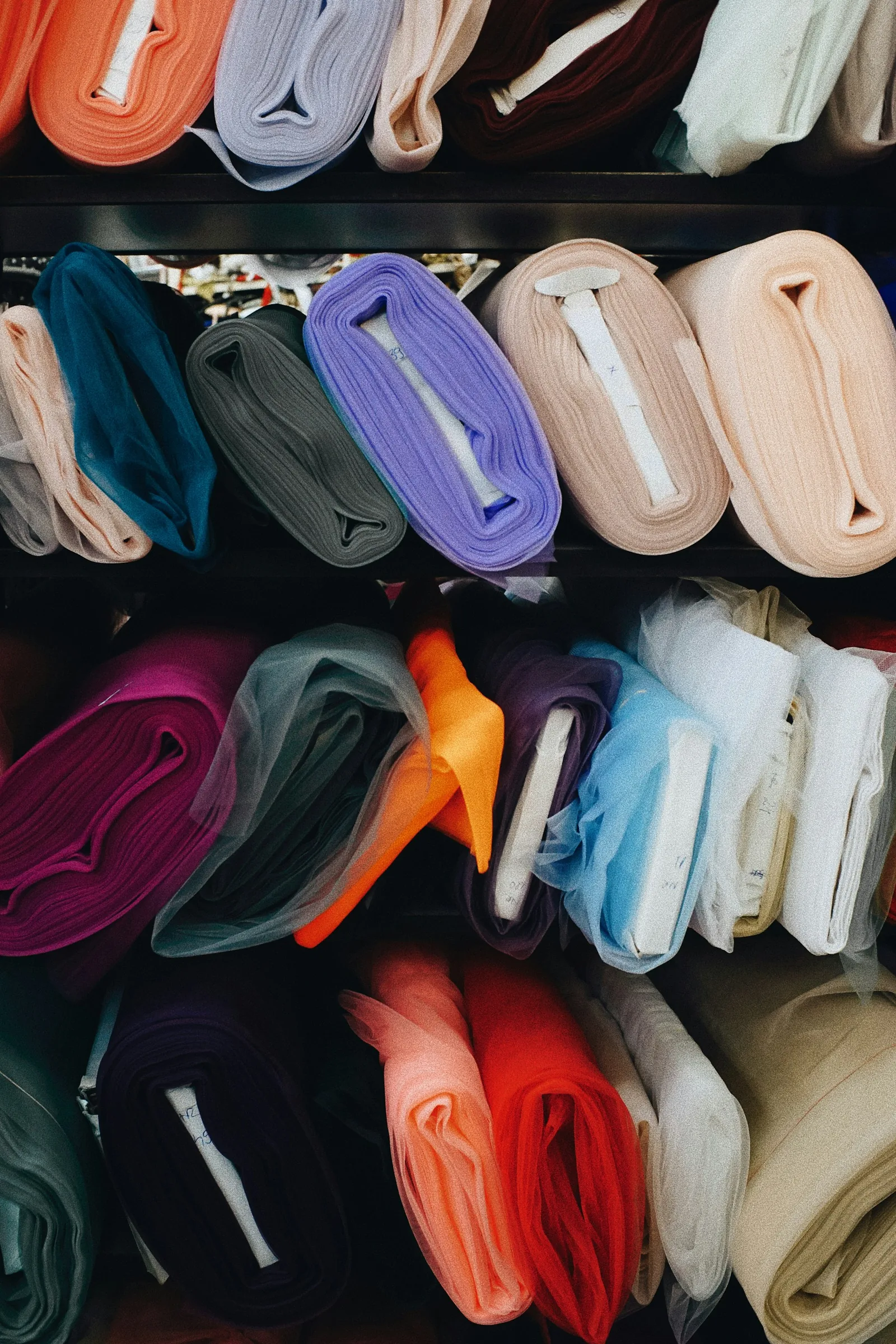
Most curtain fabric comes in a standard width of about 137 or 140 cm. Sheers and some plains also come extra wide, at 280 or 300 cm. Those are the four widths offered in our calculator; always check the label on the actual bolt, because a few centimetres either way can change the count.
Rounding is where fabric quietly disappears. Take a 350 cm track with a wave heading. The gathered width is 770 cm. On a 137 cm fabric, each width gives 127 cm after side turnings; 770 divided by 127 is 6.06, which rounds up to 7, and then to 8 for a matched pair. On a 140 cm fabric, each width gives 130 cm; 770 divided by 130 is 5.92, which rounds to 6. With a 250 cm drop the cut length is 282 cm, so that is 8 × 282 cm = 22.56 metres, shown as 22.6, against 6 × 282 cm = 16.92 metres, shown as 17.0. Three centimetres of fabric width saves two whole drops.
Joins are placed so the eye does not find them. In a pair, each curtain gets the same number of widths, and any part width is normally set towards the outer edge, where the folds and the stack hide it, rather than at the leading edge where the curtains meet. With extra-wide fabric turned on its side, called railroading, the roll width becomes the drop, so a wide sheer can run the full length of a window with no vertical joins at all. That only works when the drop plus hem and heading fits inside the roll width, and our calculator flags the cases worth asking about.
Pattern repeat: why patterned curtains need more fabric
A printed or woven pattern repeats at a fixed interval down the roll. For the design to line up across every join, and to sit at the same height on every curtain in the room, each cut has to start at the same point in the repeat. The 1950 curtain-making manual cited below says the repeats must be counted and arranged to come exactly opposite one another on every piece of drapery in the room.
In practice that means each cut length rounds up to a whole number of repeats. A cut length of 290 cm in a plain fabric becomes 297 cm with a 27 cm repeat, because 11 repeats are 297 cm. With a 64 cm repeat it becomes 320 cm, five repeats, because four repeats would only be 256 cm. Thirty centimetres of waste per width is not much on one cut; across six widths it is 1.8 metres.
Large repeats suit tall windows and large rooms, where the motif has space to read. On a short drop, a big repeat can waste nearly a whole repeat on every width. If two fabrics appeal equally, look at the repeat on the label before deciding: it can be the difference of a few metres across a room of windows.
Worked example: a Goan French window
Picture a pair of timber French doors, 150 cm across the frame, opening onto a balcão. The owner wants lined pinch-pleat curtains in a plain fabric, drawn back in the day and closed at night, with the hem just clear of a tiled floor. The curtain rod length planner gives a 275 cm track for a lined pinch-pleat pair on a 150 cm opening, running about 61 cm past the frame on each side. The measured drop from the track to just above the floor is 250 cm.
Now the arithmetic. Gathered width: 275 × 2.25 = 618.75 cm, call it 619. Usable width per drop of 137 cm fabric: 137 − 10 = 127 cm. Widths: 619 ÷ 127 = 4.87, which rounds up to 5, then to 6 so the pair matches, three widths per curtain. Cut length: 250 + 20 hem + 20 pinch-pleat heading = 290 cm. Total: 6 × 290 = 1,740 cm, so 17.4 metres of face fabric.
Change one thing at a time and watch the total. In a fabric with a 27 cm repeat, the cut length becomes 297 cm and the total 17.9 metres. With a 64 cm repeat it becomes 320 cm and 19.2 metres. Switch the same window to a pencil pleat and the gathered width rises to 688 cm, still six widths, but the shorter heading allowance gives a 282 cm cut and 17 metres. The lining is calculated separately, and a workroom will quote it alongside.
| Version | Gathered width | Widths | Cut length | Fabric |
|---|---|---|---|---|
| Pinch pleat, plain | 619 cm | 6 | 290 cm | 17.4 m |
| Pinch pleat, 27 cm repeat | 619 cm | 6 | 297 cm | 17.9 m |
| Pinch pleat, 64 cm repeat | 619 cm | 6 | 320 cm | 19.2 m |
| Pencil pleat, plain | 688 cm | 6 | 282 cm | 17.0 m |
Worked example: a balcony sliding door
A sliding door onto the balcony of a coastal flat is 240 cm wide, and the owner wants lined wave curtains on a ceiling track, because a wave heading stacks tightly and runs smoothly every day. The planner gives a 405 cm track for a lined wave pair on a 240 cm opening, about 82 cm past the glass each side. The drop from the ceiling track to just clear of the floor is 240 cm.
Gathered width: 405 × 2.2 = 891 cm. Widths of 137 cm fabric: 891 ÷ 127 = 7.02, which rounds up to 8, four per curtain. That 0.02 of a width costs a full drop, which is why it is worth checking whether a slightly wider fabric or a slightly shorter track would bring the count down. Here a 140 cm fabric does not help: 891 ÷ 130 = 6.85, which still rounds to 7 and then 8. Cut length: 240 + 20 + 12 wave heading = 272 cm. Total: 8 × 272 = 2,176 cm, which the calculator rounds up to 21.8 metres.
If the owner adds a sheer behind it on a double track, the sheer usually runs the same length of track so both layers stack beside the glass. In a 137 cm voile that is another eight widths. In an extra-wide voile used railroaded, the roll width becomes the drop and the sheer has no joins at all, which is how we usually make long sheers. The calculator shows the standard-width count; ask us to price the railroaded version alongside. The layered curtains page shows how the two layers work together.
Hems, headings, side turns and the things a calculator cannot see
The allowances in our calculator are working figures: 20 cm at the hem for a weighted double hem, 10 cm across each width for side turnings, and a heading allowance by style. A deeper hem, a contrast border, a lining sewn in a different way or a heading tape with different requirements all change them a little, which is why a workroom's figure can differ from yours by a few tens of centimetres.
Some things no calculator can see. Real windows are not square, floors are not level, and a fabric may need to be cut so that a motif sits in a particular place on the hem or at eye level. Natural fibres can also move with humidity, which matters for an exact floor-length hem in a Goan monsoon; our curtain length guide covers how to allow for it. None of this makes the calculation unreliable for planning. It is accurate enough to compare fabrics, headings and quotes on the same terms. Cutting comes after a site measure.
When the numbers are in hand, the next step is choosing the cloth itself. Our curtains collection sets out the fabrics, linings and headings we make, and we bring full-length samples to the house so you can see them against your own light before anything is ordered.