 Drapehaus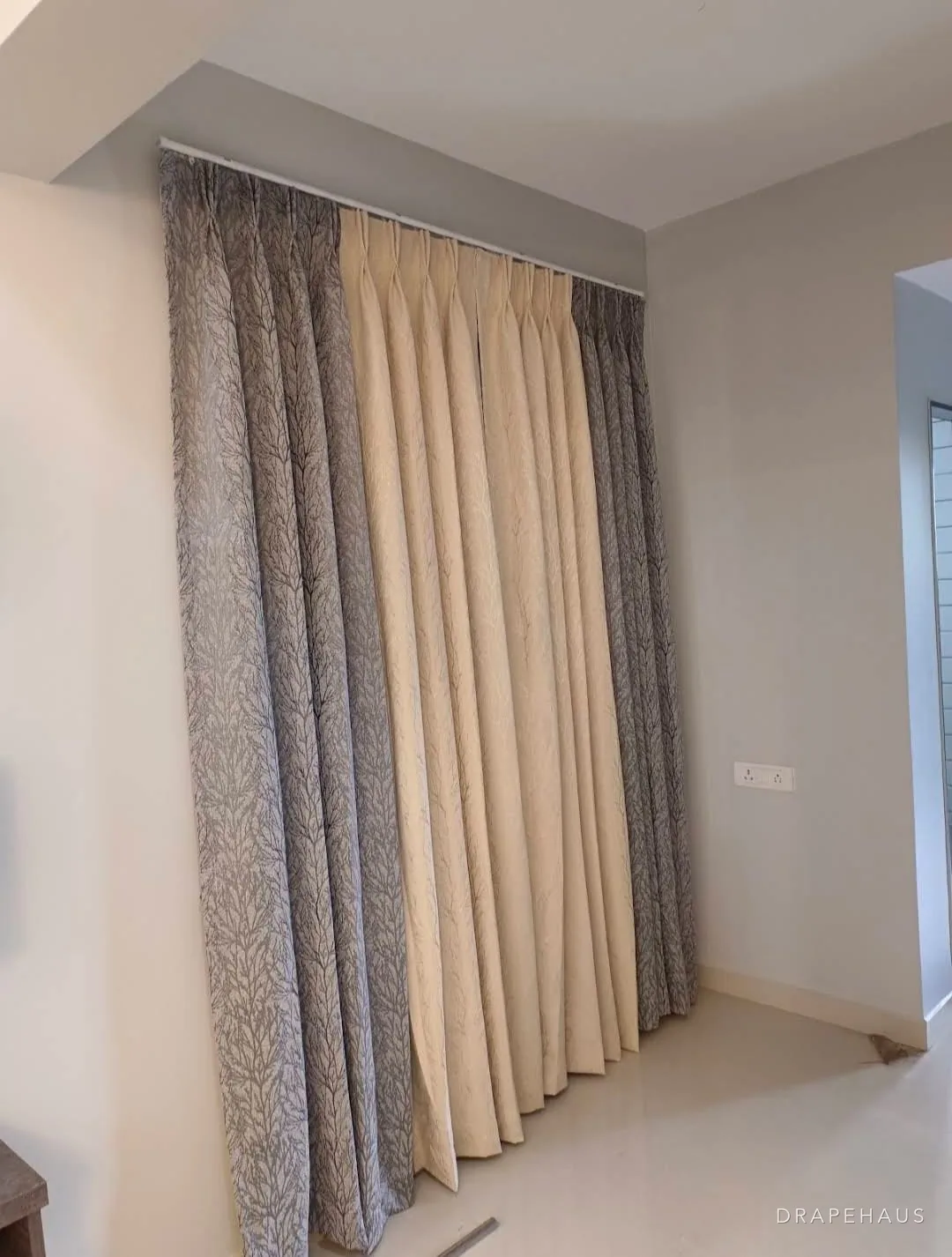
Designer curtains are usually described by their fabric, and the fabric does matter. But two curtains made from the same bolt can look entirely different on the window: one hangs in deep, even folds, stacks neatly clear of the glass and breaks gently at the floor; the other looks thin, pulls at the heading and never quite closes. The difference is in the making, and almost none of it shows on a sample.
Properly made curtains start with a survey and a set of decisions: how full, which heading, what lining, how the hem is finished, where the curtain goes when it is open and what it hangs from. In a humid coastal climate some of the conventions of European drapery, interlining above all, need rethinking rather than copying.
This article explains each of those decisions, what to ask for, and where the trade-offs lie. It is written for owners and designers specifying made-to-measure curtains, and it ends with the flame-retardant standards that apply when the curtains are going into a hotel or a let villa.
Fullness: the first mark of luxury curtains
Fullness is the ratio of the flat fabric width to the width the curtain covers when closed. A curtain made at double fullness uses two metres of fabric for every metre of track. Too little fullness and the curtain looks flat and mean when drawn; too much and it becomes bulky, stacks wide and hides the window when open. It is the single decision that most affects how a curtain looks, and the first place cost is quietly saved.
The right ratio depends on the heading and the fabric. Pleated headings generally need more fullness than wave or ripplefold headings to look generous, fine and sheer fabrics need more than heavy ones, and a patterned fabric may be made a little less full so the design still reads. Ripplefold systems are unusually precise: fullness is set by the spacing of the carriers on the track, and one widely used system's fabrication guide offers 60, 80, 100 and 120 per cent options, with its standard 100 per cent carriers producing two times fullness.
Ask what fullness a quote assumes, and whether it is the same for every window. Our fabric calculator shows how fullness, drop and pattern repeat change the metres needed, which is the easiest way to compare two quotes on the same terms. A quote that looks lower because it assumes less fullness is not describing the same curtain.
| Fullness option | Fabric-to-track ratio | Carrier spacing |
|---|---|---|
| 60% | 1.6x | 2 5/8 in |
| 80% | 1.8x | 2 3/8 in |
| 100% | 2x | 2 1/8 in |
Heading styles for custom curtains
The heading is the top of the curtain, where the fullness is gathered and attached to the track or pole. A pinch pleat gathers the fabric into groups of two or three folds stitched together at the base, spaced evenly across the width; a French pleat is the same idea with the folds fanned out at the top. Both are formal, tailored and hand-finished at their best, with buckram stiffening inside the heading so the pleats stand upright for years.
An inverted or box pleat folds the fabric behind the heading so the front reads as flat panels with a crisp line at the top. It suits modern rooms and fabrics with a strong pattern that a pinch pleat would break up. A goblet pleat, stuffed to hold a rounded cup shape, belongs in formal, high-ceilinged rooms.
Wave and ripplefold headings clip the curtain to evenly spaced carriers on the track so it falls in a continuous, even S-curve. They stack tightly, suit long runs and motorised tracks, and look the same from inside and out. Their drawback is that they need a compatible track, so the heading and the curtain hardware have to be chosen together.
Planning something like this?
We visit homes across North and South Goa, measure on site, and bring samples to see in your own light.
Linings and interlinings, and the humidity problem
A lining protects the face fabric from sun, gives it body and improves the way it falls. Standard cotton or polyester linings suit most rooms; blackout linings darken bedrooms; thermal linings add insulation in air-conditioned rooms. In a sunny climate the lining is also a sacrificial layer: it takes the ultraviolet and fades so the face fabric does not, and it can be replaced without remaking the curtain.
Interlining is a soft, blanket-like layer sewn between face and lining. In European drapery it is the mark of a properly made curtain, giving a padded, luxurious fall and real insulation. In Goa it is questionable. Panjim's morning relative humidity is 91 per cent from July to September, and an interlining is an absorbent layer sealed inside two others, with no way for moisture to escape. Against a cool external wall through a long monsoon, that is a recipe for mildew.
For most rooms here we prefer a well-chosen lining alone, with enough fabric weight and fullness to give the fall people want from interlining. Where a heavy, insulated curtain is right, usually in a sealed, air-conditioned bedroom or media room, synthetic fabrics and linings are safer than natural ones. Our velvet curtains page covers where heavy drapery genuinely works.
In a humid house, lining protects a curtain. Interlining, more often than not, is where the mildew starts.
Hand finishing in designer curtains: hems, weights, pattern
Properly made curtains are finished by hand where it shows. Side hems and bottom hems are blind-stitched so no line of machine stitching crosses the face, corners are mitred so the hem folds lie flat, and the lining is left loose at the hem or secured with lock stitches so face and lining can move independently as the fabric responds to humidity. A deep, double-turned bottom hem gives the curtain weight and a clean line.
Weights keep the curtain hanging straight. Small weights sewn into the corners hold the leading edges plumb; a chain weight run along the hem gives an even drop on sheers and lightweight fabrics. On a window by the sea, ask what the weights are made of and how they are covered, since salt air is hard on exposed metal.
Pattern matching is where care shows most. Every width must be joined so the pattern runs continuously across the seam, every curtain in the room must start the pattern at the same height, and a pair must mirror each other. That requires buying enough fabric for the pattern repeat, which is why a patterned curtain can use noticeably more fabric than a plain one of the same size.
- Blind-stitched side and bottom hems, no visible machine stitching
- Mitred corners with weights sewn in
- Lining locked in so face and lining hang as one
- Pattern matched across widths and aligned across the room
- Heading stiffened with buckram for pleated styles
Stack-back, drapery hardware and the track
Stack-back is the space a curtain occupies when it is fully open. A generously made curtain stacks wide, and if the track stops at the edge of the window the open curtain will cover part of the glass. The track should extend beyond the opening on each side far enough to take the stack, so the window is fully clear by day. Where there is no wall to spare, a heading that stacks tightly, or a one-way draw to the side with more room, is the answer.
Height matters too. Mounting the track or pole well above the opening, close to the ceiling or cornice, makes the window read taller and hides the head of the frame. In a room with more than one curtain layer, a double track lets a sheer and a lined curtain work independently; our layered curtains page describes the arrangement.
The hardware has to carry the weight. Lined, full curtains are heavier than they look, particularly at long drops, and brackets need to be sized and spaced for the load and fixed into solid material. A curtain that drags on an undersized track, or a pole that bows in the middle, spoils the best-made fabric work.
Flame-retardant drapery for hotels and let villas
Curtains in hotels, restaurants and many let properties are usually required to meet flame-retardancy standards, set by the operator, the insurer or the brand's own specification. The Indian standard is IS 15741:2007, which covers resistance to ignition of curtains and drapes. International hotel groups commonly ask for BS 5867-2, usually Type B, with Type C for higher-risk settings, and many also reference NFPA 701, the American test method for flame propagation of textiles and films.
Flame retardancy is either inherent, built into the fibre, or applied as a finish. Inherently flame-retardant fabrics keep their performance for their life; treated fabrics depend on the finish surviving cleaning. Ask for the test certificate for the specific fabric and the cleaning instructions that go with it, and check that the lining is certified too.
The making follows the same principles as residential curtains, with extra attention to durability, consistency and documentation, so a curtain in one room can be matched years later in another. These requirements change and differ between operators, so confirm the current standard with the operator, brand or insurer before the fabric is ordered, and keep the certificates with the property's records.