 Drape Haus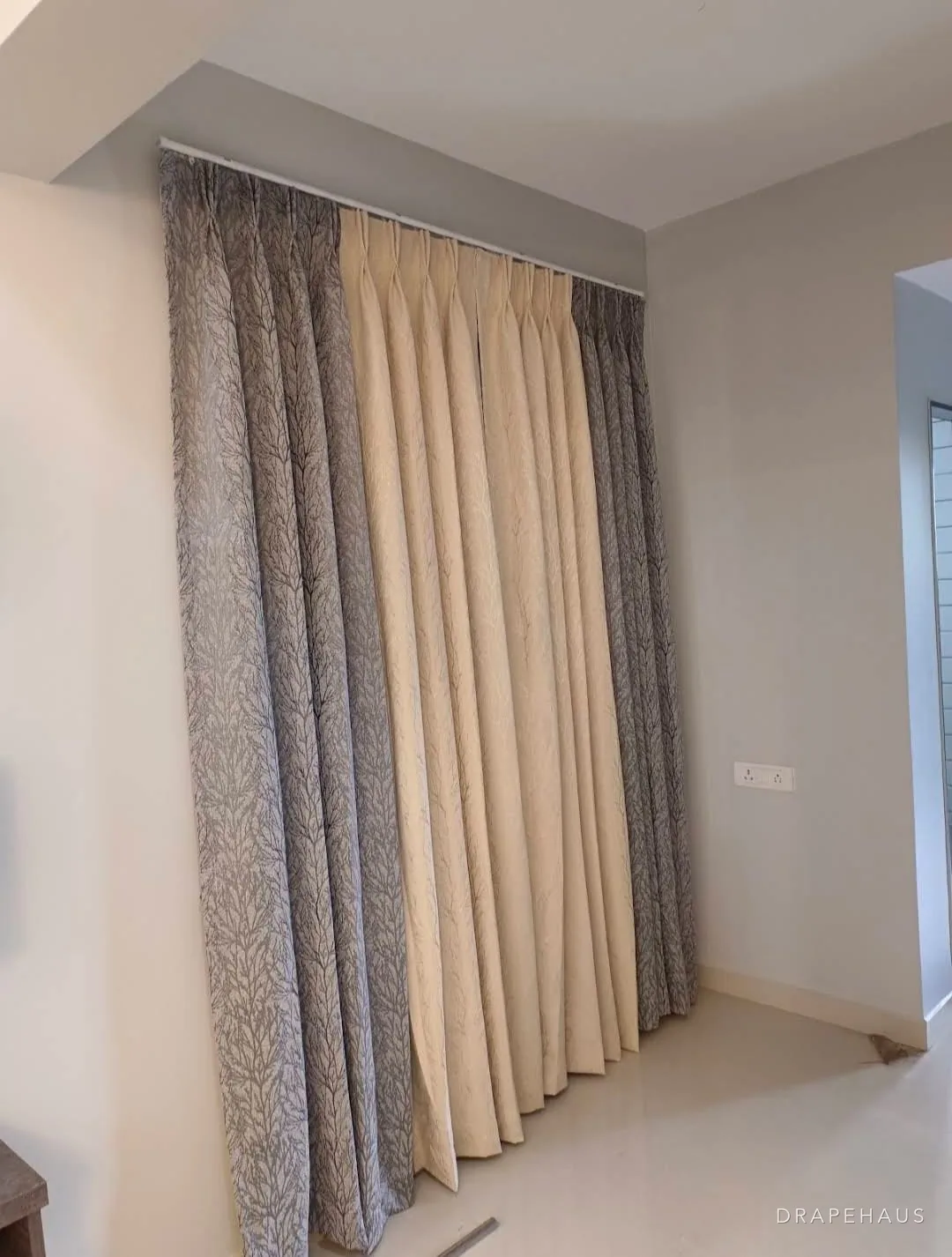

There are five standard curtain lengths. Sill length stops just above the window sill. Below-sill runs past the sill and covers the trim beneath it. Floor length finishes just clear of the floor. A break is a little longer, so the hem rests on the floor and the fabric bends slightly. A puddle is longer again, with fabric pooled on the floor. Each has a place, and the right one depends on the window, the room and who uses it.
In a Goan house, the practical default is floor length, finished just clear of the floor. Tiled, oxide and terracotta floors are mopped daily, the air through the monsoon sits close to saturation, and a hem that touches the floor picks up water, grit and, eventually, mould. Sill and below-sill lengths suit windows with something underneath them. Break and puddle lengths belong in formal, air-conditioned rooms, if anywhere.
Below, each length is compared, with what it costs in fabric, what it means for children and pets, how humidity affects natural fibres, and how to measure for the length you choose. You can try lengths on a drawn Goan window in our curtain simulator, and see the metres each one takes in the fabric calculator.
The five curtain lengths compared
Length is usually the last thing people decide and the first thing they notice. A curtain that stops a few centimetres short of the floor looks like a mistake; one that stops at the sill on a tall window makes the window look squat. The table sets out each length, where the hem sits and where it works best.
Most rooms are better served by choosing one length for the whole room, or the whole floor of a house, rather than mixing. Hems that line up across a wall read as one deliberate line. The exception is a window with furniture, a counter or a built-in seat beneath it, which takes a shorter curtain while the rest of the room stays floor length.
| Length | Where the hem sits | Works best | Watch for |
|---|---|---|---|
| Sill | Just above the sill | Recessed windows, windows over a seat, desk or bed | Looks short on a tall window |
| Below-sill | Past the sill, covering the trim beneath | Windows with a ledge, low cabinet or AC unit below | Can catch on furniture pushed close |
| Floor, just clear | Just above the floor | Most rooms in a Goan house | Uneven floors; natural fibres moving with humidity |
| Break | Resting on the floor, with a slight bend | Formal rooms with a hard-wearing, regularly cleaned floor | Gets wet when floors are mopped |
| Puddle | Pooled on the floor | Formal, air-conditioned rooms rarely walked past | Dust, damp, trips, crawling children |
Sill and below-sill curtains: when shorter is right
Short curtains are not a lesser option; they are the right one wherever something sits beneath the window. A bed pushed under a window, a desk in a home office, a built-in seat in a bay, a kitchen counter, a cot in a nursery: in each case a floor-length curtain would have to drape over the furniture or be pushed aside every time it moves. The 1950 manual cited below makes exactly this point about window seats and shelves, and notes that draperies may be sill length particularly in recessed windows.
A sill-length curtain inside a recess also suits older Goan houses with deep reveals and timber shutters, where the frame and the wall around it are worth keeping clear. Hang it on a recess track or a pole between the side walls, and keep the hem a little above the sill so it does not drag on the timber or sit in condensation running off the glass in the monsoon.
Below-sill curtains, which run past the sill and cover the trim underneath, work where a curtain at the sill would look too short but floor length is impractical, for instance above a low cabinet or an air-conditioning unit fixed under the window. Do not split the difference by accident. A hem that stops 20 cm off the floor, with nothing below it, looks like a curtain bought for another window.
Planning something like this?
We visit homes across North and South Goa, measure on site, and bring samples to see in your own light.
Floor-length curtains, just clear: the Goan default
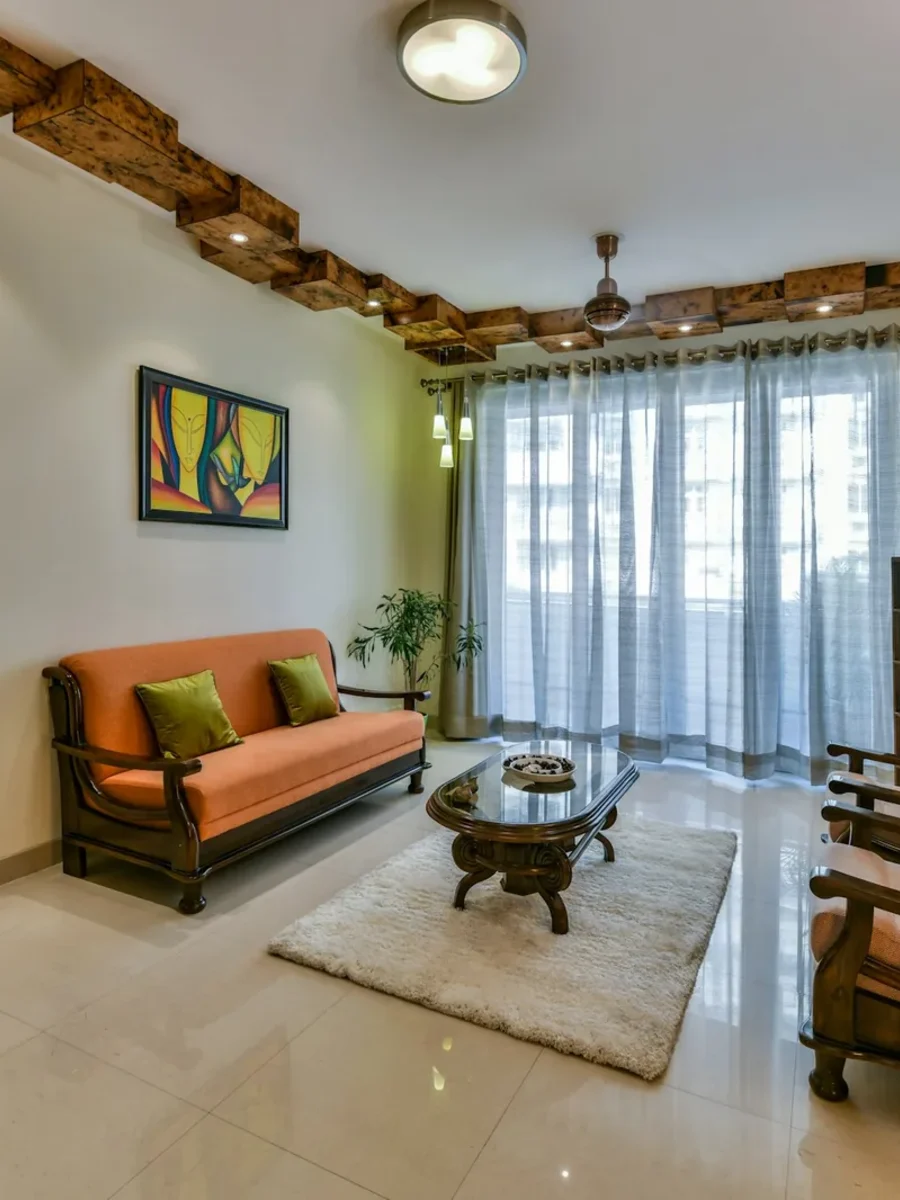
Floor-length curtains make a window look taller and a room look finished, especially when the track is fixed high, near the ceiling. Finishing them just clear of the floor keeps all of that and avoids the problems of fabric on a wet floor. The hem hangs straight, a mop passes underneath, and in the monsoon the bottom of the curtain dries with the rest of it instead of wicking water up from the tiles.
Floor length also costs more fabric than sill length, and it is worth seeing how much. Take a 120 cm bedroom window with unlined eyelet curtains. Our curtain rod length planner gives a 170 cm pole for a pair. With a 135 cm sill-length drop, the cut length is 135 + 20 hem + 15 heading = 170 cm; 170 × 2.2 = 374 cm gathered, which needs four widths of 137 cm fabric; four cuts of 170 cm come to 6.8 metres. At floor length, with a 240 cm drop, each cut is 275 cm and the total is 11 metres. Same window, same pole, about 60% more fabric.
That extra fabric is usually money well spent on a living-room or bedroom window, and less so on a small window in a corridor or bathroom. Run your own windows through the fabric calculator with both drops before deciding.
In most Goan rooms, finish curtains just clear of the floor: long enough to look floor length, short enough for the mop.
Break and puddle lengths, and why they struggle here
A break, where the hem just rests on the floor and the fabric bends slightly, and a puddle, where extra fabric pools on the floor, are formal looks. The 1950 manual quoted here describes very formal draperies with 6 to 12 inches, about 15 to 30 cm, lying along the floor, and less formal ones that should just escape it. It also warns that formal floor-trailing draperies act as dirt catchers, and that there is nothing elegant about a dirty drapery dragging along the floor.
In a Goan house the problem is moisture as much as dirt. Cotton and linen are hygroscopic: the Smithsonian's Museum Conservation Institute notes that natural-fibre textiles absorb moisture very quickly and dry out very slowly, and that stagnant air above 80% relative humidity will support mould on them. India Meteorological Department figures put Goa's mean morning humidity at 87 to 91% from June to September. Fabric lying on a floor that is mopped every day, in a room that may be closed for weeks, is the first part of a curtain to spot.
If you love the look, keep it to a sealed, air-conditioned room with a dry floor, use a synthetic fabric that absorbs little moisture, and keep the puddle modest. A break is a gentler compromise. Neither suits a house that is closed through the monsoon; our guide to the closed-house season explains what happens to fabric left in still, damp rooms.
Natural fibres, humidity and an exact hem line
Linen and cotton respond to the air around them. Because they take up moisture, a curtain in a natural fibre can change length a little between the dry months and the monsoon, and pure linen moves more than most. The 1950 manual allowed an inch for every yard of curtain length for shrinkage in fabrics that were not pre-shrunk, which is a reminder that natural cloth has always moved. Modern finishes have reduced the problem; they have not removed it.
That matters most for a hem cut to sit exactly at the floor. A floor-length linen curtain can sit slightly differently in August from how it sits in January. There are three sensible responses. Choose the just-clear length rather than a hem that kisses the floor, so a small change does not reach the tiles. Choose a linen blend or a linen-look polyester where an exact line matters, because synthetics take up very little moisture. Or let a pure linen curtain hang and settle before the hem is finally set, which a workroom can plan for.
Sheers move too, and in a breezy room they also lift. A full-length voile near a ceiling fan or an open sea-facing window may need a weighted hem to hang straight. Our linen curtains page explains how we allow for movement when we cut, and the linen fabric guide covers blends.
Safer lengths for toddlers and pets
Curtains that pool on the floor are tempting to a crawling child and a cat alike. A child can grab and pull a pooled hem, trip on it, or bring down a curtain and its pole; the 1950 manual already warned that floor-trailing draperies could prove a menace with very young children. Just-clear floor length or sill length removes most of that. For a nursery or a small child's room, sill length over a cot-free window, or floor length just clear, are both sound.
Cords are the more serious hazard. The US Consumer Product Safety Commission states that children have strangled on the cords of window blinds, shades, draperies and other window coverings, and that cordless window coverings are the only option that eliminates the strangulation hazard. RoSPA adds that corded curtain tracks can pose the same risks as blinds, and advises fixing any cord cleats at least 1.5 metres from the floor and keeping cots and beds away from windows. In a child's room, choose a track drawn by hand, a wand or a motor.
Pets are mostly a matter of fabric and length together. Claws catch in open weaves and loose hems, and a dog lying against a puddled curtain leaves it damp and hairy. A tight weave finished just clear of the floor is the easiest to live with. Our kids' room curtains page sets out the fabrics and fittings we suggest there.
How to measure for the length you chose
Measure from the fixing point, not the window. Decide where the track or pole will be, mark it if it is not yet fitted, and measure down to the hem position you chose: just above the sill, past the sill trim, or just above the floor. Take the reading at the left, the centre and the right, and write down all three; floors and sills are rarely level. Where the three disagree, a floor-length hem is set from the smallest figure, which keeps every part of it off the tiles.
Wait for the finished floor. If tiles, stone or a new oxide finish are still to be laid, any drop taken now will come out too long once they are down. If you plan a rug under the window, decide whether the curtain should clear the rug or the floor beside it.
Our full guide on how to measure for curtains covers widths, recesses and old openings step by step. When you have chosen the length, we can confirm it on a measuring visit and make the curtains to it.