 Drapehaus
Drapehaus
Preparing the room
Drapehaus
Preparing the room
Carpets
Flat-woven cotton and jute dhurries are the most practical rugs for a Goan house: light to lift, quick to dry and easy to wash or shake out after the rains.
8 × 10 ft · advised
Room
Rug style
Standard sizes (ft)
Rug
8 × 10 ft
2.4 × 3.0 m
Floor border
3.0 ft
each long side
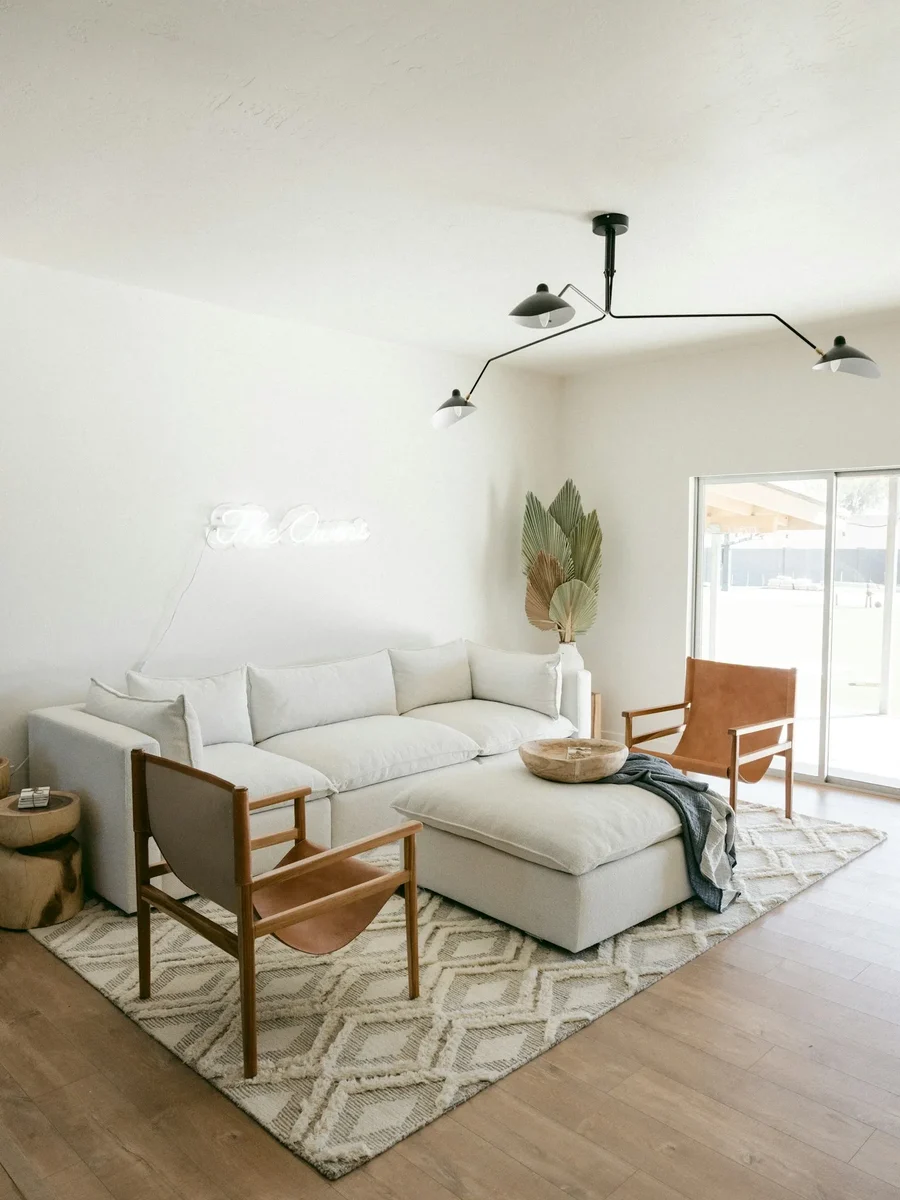
In a sitting area, the front legs of every sofa and chair should rest on the rug, with a margin of bare floor around it. We confirm the size on site, against the real furniture.
In short
By the Drapehaus studio · How we write
Is it right for you?
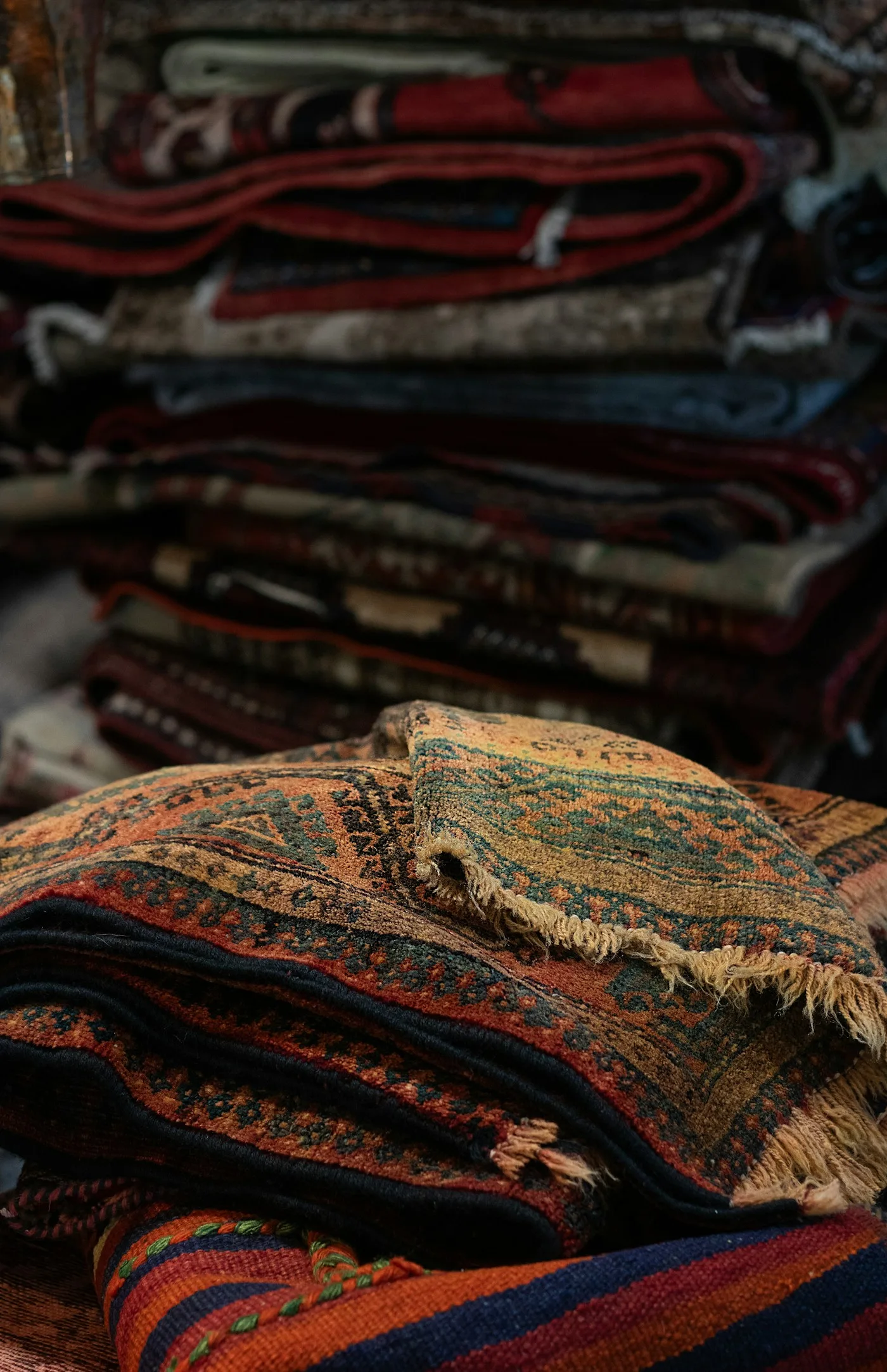
A dhurrie is woven rather than knotted or tufted: the coloured weft threads pass over and under the warps and are beaten down tight, so the pattern is the structure and there is no pile standing up from it. That one fact explains nearly everything good about it near the sea. There is nowhere for sand to hide, nothing to crush, and very little bulk to hold water, so it dries in hours where a pile rug can take days.
It suits houses where doors stand open to the garden, where people walk in barefoot from the beach, and where the floor is cool stone or oxide that you want to soften without covering. It is also the natural companion to a pile rug: a large flatweave sets the size of a room, and a smaller, softer piece sits on top where people gather.
A dhurrie is not soft in the way a wool pile rug is, and it does little for the acoustics of a large, echoing room on its own. If comfort underfoot and quiet are the priority, use it as the base layer rather than the only one.
The details
With no pile to hold sand or damp, a dhurrie is ideal for verandas, beach homes, homestays and children's rooms. They come in bold stripes and geometrics as well as quiet naturals.
Because they are light, dhurries can be rolled away in minutes when the house closes for the monsoon and brought back out for the season.
Your options
Flatweaves share a construction but behave very differently depending on the fibre. The choice is about where the rug will lie and how it will be cleaned.
Swipe for all 5 →
The honest view
Sand has nowhere to hide
Grit sits on the surface or falls through to the floor, so a shake or a quick vacuum clears it. Pile rugs pull sand down into the base where it wears the fibres.
Dries in hours
Thin and flat, a dhurrie dries quickly after a spill or a humid spell, which is exactly what matters in a climate where drying is the challenge.
Light enough to move
One person can lift, carry and roll most dhurries. That makes monsoon storage, cleaning and rearranging a small job rather than a two-person project.
Reversible and even-wearing
Many dhurries are identical on both sides, so they can be turned over to double their life and even out fading from the sun.
Not soft underfoot
A flatweave is thin and firm. It softens a stone floor visually but not physically, so layer it or choose a thicker weave where comfort matters.
Can slip and ruck
Being light, a dhurrie moves on polished floors and forms ridges. A thin underlay that grips is essential indoors.
Colours can run
Some cotton dhurries use dyes that bleed when washed. Test a small corner first, and wash cold, fast and separately.
Side by side
Where a flatweave earns its place, compared with the rugs you might otherwise choose.
| Cotton dhurrie | Jute flatweave | Wool pile rug | Outdoor flatweave | |
|---|---|---|---|---|
| Sand and grit | Shakes out | Shakes out, sheds fibre | Holds it deep | Hoses off |
| Drying time | Fast | Slow if soaked | Slow | Fastest |
| Softness | Low | Low, textured | High | Low |
| Washable | Often | No, dry-clean only | Specialist only | Yes, hose |
| Rolls for storage | Small and light | Bulky | Heavy | Light |
| Covered verandah | Yes | Dry season only | No | Yes |
Swipe to compare →
Rather see it in your own room?
We bring samples to the house, measure every window, and specify for the light and exposure you actually have.
Room by room
Under a deep roof, a cotton or outdoor flatweave defines the seating and survives sandy feet. Take cotton in when the rains start.
Washable, reversible and easy to replace, with bright stripes and geometrics that suit children's rooms well.
As a large base layer under a smaller pile rug, or on its own in a relaxed room where coolness matters more than softness.
A cotton dhurrie by the bed can go in a wash between guests and dries quickly. Keep a spare so the room is never bare.
A cotton runner in front of the counter is practical and washable. Avoid jute, which marks with water.
Only if it is hung to dry each day. A flatweave left on a wet floor will mildew like any textile.
In depth — tap a heading to read
Layering solves a common problem in coastal rooms: the rug that is soft enough is too small, and the rug that is large enough is too hard. A flatweave on the floor sets out the whole seating area and takes the grit, and a smaller wool or hand-knotted rug on top gives softness and colour exactly where feet rest. It also protects the top rug, which no longer sits directly on cold, damp stone.
For the layers to look intended rather than accidental, the base should be clearly larger, with a generous and even border showing all round, and the two should differ in texture. A flat jute or natural cotton base with a pile rug on top is the classic pairing; two busy patterns rarely work. Set the top rug slightly off-centre or at an angle only if the furniture arrangement supports it.
Flat under soft, large under small, plain under patterned.
In a house near the beach, the floor near every outside door is a buffer zone. Sand arrives on feet, salt arrives on the air, and both end up in whatever textile is nearest. A dhurrie at the door catches most of it, and because it has no pile, a shake over the verandah rail or a quick vacuum returns the floor to clean. It is simply easier to keep a flatweave fresh than to rescue a pile rug.
Salt is hygroscopic, which means it draws moisture from the air. A textile carrying salt stays faintly damp, even in the dry months. Regular shaking and, for cotton, an occasional rinse in fresh water removes the salt before it can hold damp against the fibres. Outdoor flatweaves on open decks can simply be hosed with fresh water and left to dry in the sun.
Because the pattern is woven in rather than carved into pile, flatweaves excel at crisp geometry: stripes, checks, diamonds and bold borders, alongside plain woven naturals. In a coastal house, simple stripes in indigo, rust, ochre or faded green sit naturally with lime-washed walls and timber, and read as relaxed rather than formal.
Scale the pattern to the room. Broad stripes laid across a narrow room make it feel wider; lengthways, they lead the eye to a view. A strongly patterned dhurrie wants plain upholstery and curtains, while a quiet natural flatweave lets a patterned sofa or a hand-knotted top layer lead. In rooms that get strong sun, remember that saturated colours will soften over seasons; many people like the look.
Flatweaves are the easiest rugs to see through the rains. Before the house closes, wash or clean them, let them dry right through on a sunny day, then roll them loosely and store them off the floor in a ventilated room. Being thin, a whole house of dhurries takes up little space, and they come out again ready for the season.
If the house stays open, keep cotton dhurries in use indoors but bring them in from verandahs, where driven rain from the west can reach further under the roof than you expect in July. Jute is best rolled and stored for the wettest months, as it browns and weakens when it stays damp.
Living with it
Shake smaller pieces outdoors weekly; vacuum larger ones on both sides without a beater bar. Turn reversible pieces over each time you clean.
Test a corner for colour bleed first. Wash cold, quickly and on its own, in a machine for small pieces or by hand in a large tub, then rinse well.
Dry in the sun and moving air, flat or over a rail, turning it once. Wash only on dry days so it is fully dry before nightfall.
Blot spills on jute immediately and avoid water. Vacuum wool flatweaves and send them to a specialist for washing.
Turn rugs end to end and flip reversible ones every few months, so sun and traffic wear both sides evenly.
Avoid these
A light rug will slide and ruck on stone and tile. Use a thin, breathable gripping underlay cut slightly smaller than the rug.
Soaking jute can shrink, brown and weaken it. Spot-clean with little water and dry immediately.
Even a cotton dhurrie will mildew if it stays wet on a verandah for days. Bring it in, or use an outdoor flatweave there.
If the flatweave underneath is only slightly larger than the rug on top, the layering looks accidental. Make the base clearly bigger.
Checklist
More in carpets
Rugs, runners and fitted carpet chosen for a humid climate.
From the Journal
All articlesOur process
One team from the first visit to the last bracket, so nothing is lost between the person who specified it and the person who fits it.
FAQ
They are one of the best choices — flat-woven, so sand shakes out, and quick to dry after a wet season.
Many cotton dhurries can be gently washed; jute ones are better spot-cleaned and aired. We advise on each piece.
Both are flat-woven with no pile. Dhurrie is the name used in India, traditionally for cotton flatweaves; kilim is the name used across Turkey, Iran and Central Asia, usually for wool flatweaves, often with slits where colours meet. In practice the terms overlap, and both work in similar ways in a room.
Use a thin rug underlay cut slightly smaller than the rug, so it grips both floor and rug without showing. Choose a breathable, open-mesh or felt-backed type, not solid rubber. For layered rugs, a light gripper between the two layers stops the top rug creeping.
Small cotton dhurries often can, on a cold, gentle cycle, washed on their own after a colour test. Larger pieces are better washed by hand or professionally. Always dry them flat or over a rail in sun and moving air, and never leave them folded while damp.
Jute brings a natural texture that suits coastal rooms and is an excellent base layer. But it absorbs water, weakens when wet and can brown if soaked, so keep it indoors, away from pool doors and bathrooms, and roll it away in a closed house during the rains.
A cotton dhurrie works under a deep verandah roof in the dry season but should come in when the rains start. For open decks and poolsides, choose an outdoor flatweave in polypropylene or polyester, which can be hosed with fresh water and dried in the sun.
Next step
We start with a visit to see how the house is lived in: which doors stay open, where sand comes in, which verandahs are sheltered and where rugs might be layered. We measure, then bring flatweaves in different fibres and colours to lay on your own floor in the room's own light. We supply the right underlays, make runners and dhurries to size where needed, and advise on washing and monsoon storage. Book a home visit and we will plan it with you.