 Drape Haus
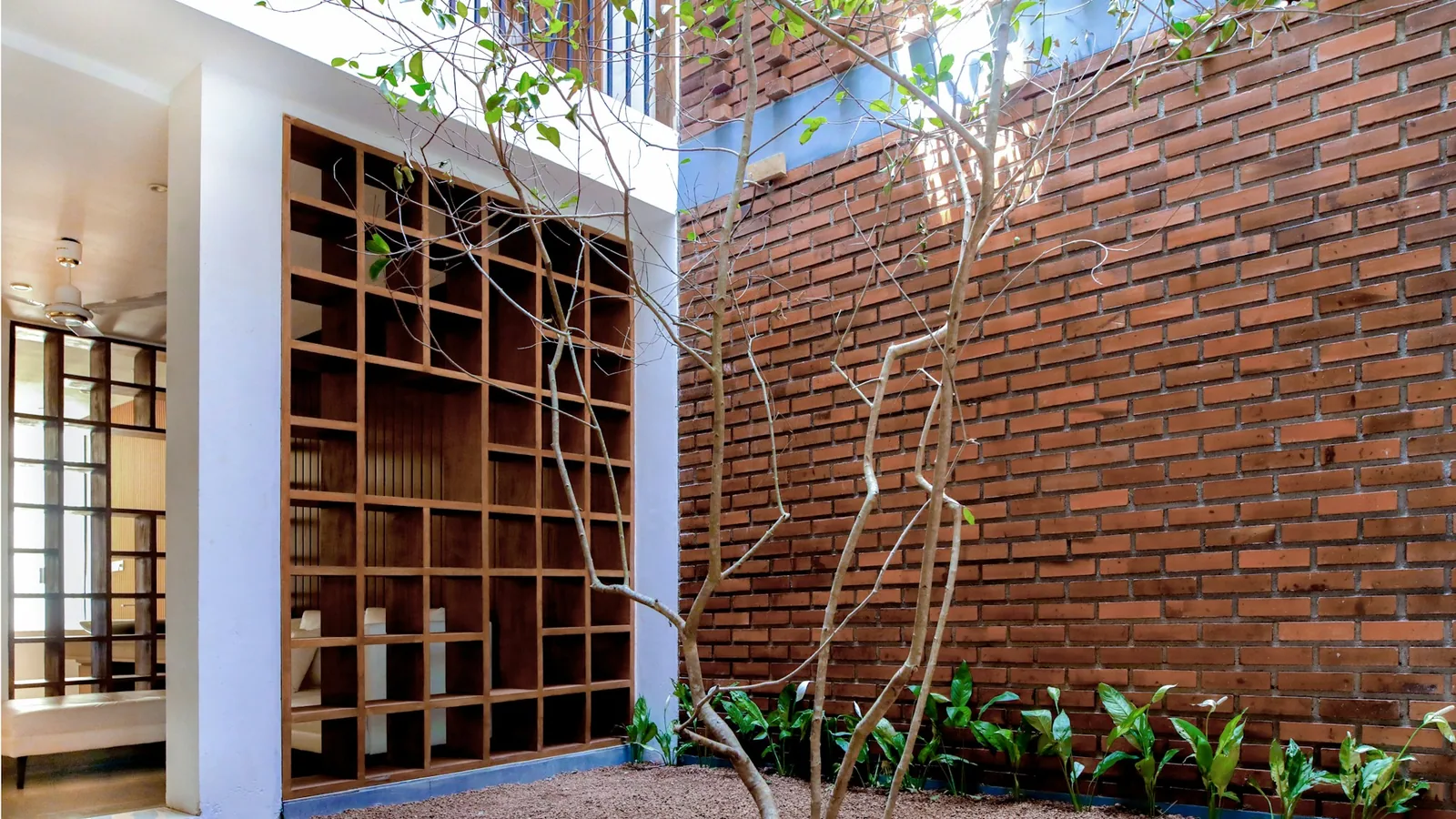
A courtyard villa wraps its rooms around an open-to-sky centre. Daylight reaches deep into the plan, air moves through rooms on every side, and the family has a private outdoor room that no neighbour can see into from the street. The idea is old in Goa: traditional Hindu houses were built around an open courtyard, and many Catholic houses kept inner courts. Contemporary villas have taken it up again, often with a plunge pool or a frangipani at the centre.
What the new versions sometimes forget is the monsoon. The India Meteorological Department records about 91% of Goa's annual rain falling between June and September, carried on winds that blow mostly from the west and south-west. An open courtyard collects that rain, and the doors and windows around it meet the weather from every angle. In the dry months the same courtyard can throw harsh light into the rooms and store heat in its paving.
This guide covers how to shade, screen and furnish the edges of a courtyard so the rooms around it stay comfortable in every season: glare, rain, mosquitoes, furniture for covered edges, privacy from above, and the planting and drainage that keep humidity down indoors.
Why the courtyard works, and where modern versions go wrong
The courtyard answers problems that a deep villa plan creates. Rooms in the middle of a large house would otherwise be dark and airless. A courtyard gives each of them a window onto daylight and a path for air, and it lets the house be open while staying private. Our article on Goan architecture describes the local tradition, including the open rajangan of Hindu houses with its tulsi vrindavan at the centre.
Older courtyards were usually ringed by covered verandahs, deep eaves and thick walls. Rain fell into the open centre, but the edges stayed dry and shaded, and rooms opened onto a sheltered walkway rather than straight onto the weather. Many modern courtyard villas drop that buffer. Full-height glass doors open directly onto the courtyard, the roof edge is a thin slab with little overhang, and the paving runs level from the living-room floor to the pool.
That makes for striking photographs and harder living. Glass doors facing the courtyard take reflected glare from pale paving and water. Rain blown by a squall reaches doors with no overhang. When the doors are opened for the evening breeze, mosquitoes from the planting come in with it. Each of these has a shading or soft-furnishing answer, and most are easiest to plan before the villa is finished.
Shading the courtyard edges against glare
Glare in a courtyard comes from above and below. Direct sun reaches the rooms on whichever side faces it, while pale stone paving and a pool reflect light into rooms on the shaded side too. IMD notes that Goa's skies are generally clear or lightly clouded from November to April, so through the dry season the courtyard can become the brightest, hottest surface in the house.
The most effective shade sits outside the glass. The US Department of Energy's Building America guidance notes that exterior attachments block sunlight before it passes through the window, so they are typically more effective at reducing heat gain than interior ones. Around a courtyard that means a fixed or retractable awning over the most exposed doors, a sail shade across part of the open space, or a retractable canopy over a sitting area that folds back when the sky is grey. Our awnings and outdoor shade service covers each.
Each has its place. Fixed awnings are simple and strong but stay up all year, so they must be designed to shed heavy rain and wind. Retractable awnings and canopies give shade in the dry season and fold away for the monsoon, when fabric left out can be damaged. Sail shades are light and sculptural, but they come down before the rains and need strong fixing points designed in from the start.
Inside the glass, sheer curtains or translucent blinds soften whatever reflected light still gets through. A sheer in a warm off-white takes the edge off the glare from pale stone without cutting the room off from the courtyard.
| Option | Best for | In the monsoon |
|---|---|---|
| Fixed awning or canopy | Doors facing the sun all year | Stays up; must shed heavy rain and resist wind |
| Retractable awning | Seating used in the dry season | Retract, or remove the cover, before the rains |
| Sail shade | Part-shading an open centre | Take down before June |
| Outdoor roller blind on a verandah edge | Low sun and side glare | Lowered against driven rain where rated for it |
| Sheer curtain inside the glass | Softening reflected glare | Unaffected; keep doors shut in storms |
Planning something like this?
We visit homes across North and South Goa, measure on site, and bring samples to see in your own light.
Keeping driving monsoon rain out of the rooms
Monsoon rain in Goa rarely falls straight down. IMD notes that winds from June to August are mostly westerly to south-westerly, and that monsoon thunderstorms are sometimes accompanied by squalls. In a courtyard the walls break some of the wind, but gusts swirl and rain lands on doors from every direction. July alone brings about a third of the year's rain.
The first defence is architectural: a roof overhang or covered walkway along the courtyard edge, a step or upstand at each threshold, and paving that falls away from the house to a drain. If the villa is still being built, these matter more than any fabric. If it is finished without them, the remaining answers are about managing the edge.
Outdoor blinds on a covered verandah or walkway, running in side channels or held taut on cables so they do not flap, can be lowered when rain arrives and raised when it passes. They will not make a verandah watertight, but they keep most of the spray off the doors and the furniture behind. The fabric must be made for exterior use and the fixings stainless or coated, because a courtyard edge is wet for four months.
Inside, curtains on courtyard doors should stop just clear of the floor rather than pooling, so a wet threshold does not wick water into the hem. A lined curtain drawn across a door that leaks will hold damp against the glass; deal with the seal instead. Rugs near courtyard doors should be washable flatweaves that can be lifted and dried.
If the villa is still on paper, ask for the overhang. No blind does the job of a deep eave.
Nets for the evening breeze
The best hour in a courtyard is the evening, when heat leaves the paving and a breeze moves through the open doors. It is also when mosquitoes are most noticeable, and a courtyard with planting, a pool, water bowls and drains offers them plenty of places to breed.
The World Health Organization notes that the mosquitoes that spread dengue are active during the day and breed in water-holding containers around homes, and it lists window screens among household protective measures. Around a courtyard, that means attention to anything that holds still water, from saucers under pots and blocked drain gratings to an ornamental urn, and screens on the doors you want to leave open.
Wide courtyard openings suit sliding door nets running on their own track beside the glass, or pleated nets that fold away to the side. Both let the doors stand fully open for air while keeping insects out, and neither needs taking down for the season. For a bedroom opening onto the courtyard, a net on the window lets the room be aired at night without a fan fighting the mosquitoes.
Choose frames in powder-coated aluminium and a mesh that tolerates the courtyard's moisture. Plan nets for every courtyard door at the start, rather than adding them after the first evening outdoors.
Furnishing the covered edge
The covered walkway or verandah around a courtyard is often the most used part of the house: a sofa looking at the pool, a dining table under the eaves, a daybed in the shade. It is also splashed, sun-struck and humid, so furniture made for indoors fails there quickly.
Outdoor upholstery starts with the filling. Quick-dry foam, which lets water drain through instead of holding it like a sponge, is the usual choice for seat cushions that will meet spray, and covers should zip off for washing. The fabric matters most. Solution-dyed acrylic, with the colour in the fibre itself, resists fading in strong sun and dries quickly; our outdoor and marine upholstery uses fabrics of this kind.
Frames should be teak, powder-coated aluminium or synthetic weave over aluminium; plain steel rusts at the joints and stains the cushions. Rugs on a covered edge should be synthetic flatweaves that can be hosed down and dried in sun. Natural-fibre rugs such as jute and sisal absorb water and grow mould in that position.
In the monsoon, bring cushions in when the house is closed or a storm is forecast, and stand frames on small feet so water runs underneath. A covered edge planned with a ventilated store cupboard close by is far easier to keep than one where everything has to be carried across the house.
Privacy from upper floors and neighbours
A courtyard is private from the street but often visible from above: from the villa's own upper bedrooms, from a neighbour's terrace, or from a taller building next door. In paired villas sharing a courtyard wall, a guest on one upper floor may look straight into the other's pool.
Shading can double as screening. A sail or a pergola with a slatted roof cuts the view from directly above while letting light through. On the upper floor, a slatted screen across a balcony that overlooks the courtyard blocks the sightline while keeping air moving; our piece on louvers design ideas covers spacing and materials. A tree at the edge of the courtyard gives a canopy that hides the space from above as it grows.
For rooms around the courtyard, layered window treatments let you choose privacy by the hour. A sheer gives daytime privacy from across the courtyard, and a lined curtain or blackout blind behind it gives full privacy at night, when lit rooms are visible from every side. The courtyard is one space: four walls of glass with every curtain open after dark means everyone in the house can see into every room.
Planting, drainage and humidity in the surrounding rooms
A courtyard in a monsoon climate has to get rid of water fast. Paving should fall to generous drains that are cleared before June, gutters and downpipes should discharge away from walls, and planters against the house should drain somewhere other than the foot of a wall. Water standing at the base of a laterite wall soaks upward, and it shows inside as tide marks, flaking paint and a musty smell.
Planting needs similar care. Dense beds against the house keep walls shaded and wet; leave a gap so walls can dry and air can circulate. Plants release moisture, so a courtyard packed with foliage will feel more humid than one with a few trees and open paving. Choose planting that shades without enclosing.
The rooms around the courtyard should then be run like any room in a Goan monsoon. The US EPA recommends keeping indoor relative humidity below 60%, ideally 30–50%. In practice that means closing courtyard doors during heavy rain, running air-conditioning or a dehumidifier in rooms with good furniture and fabrics, and opening up again when the weather clears. Our guide to monsoon damp and mildew covers it in more depth.