 Drape Haus
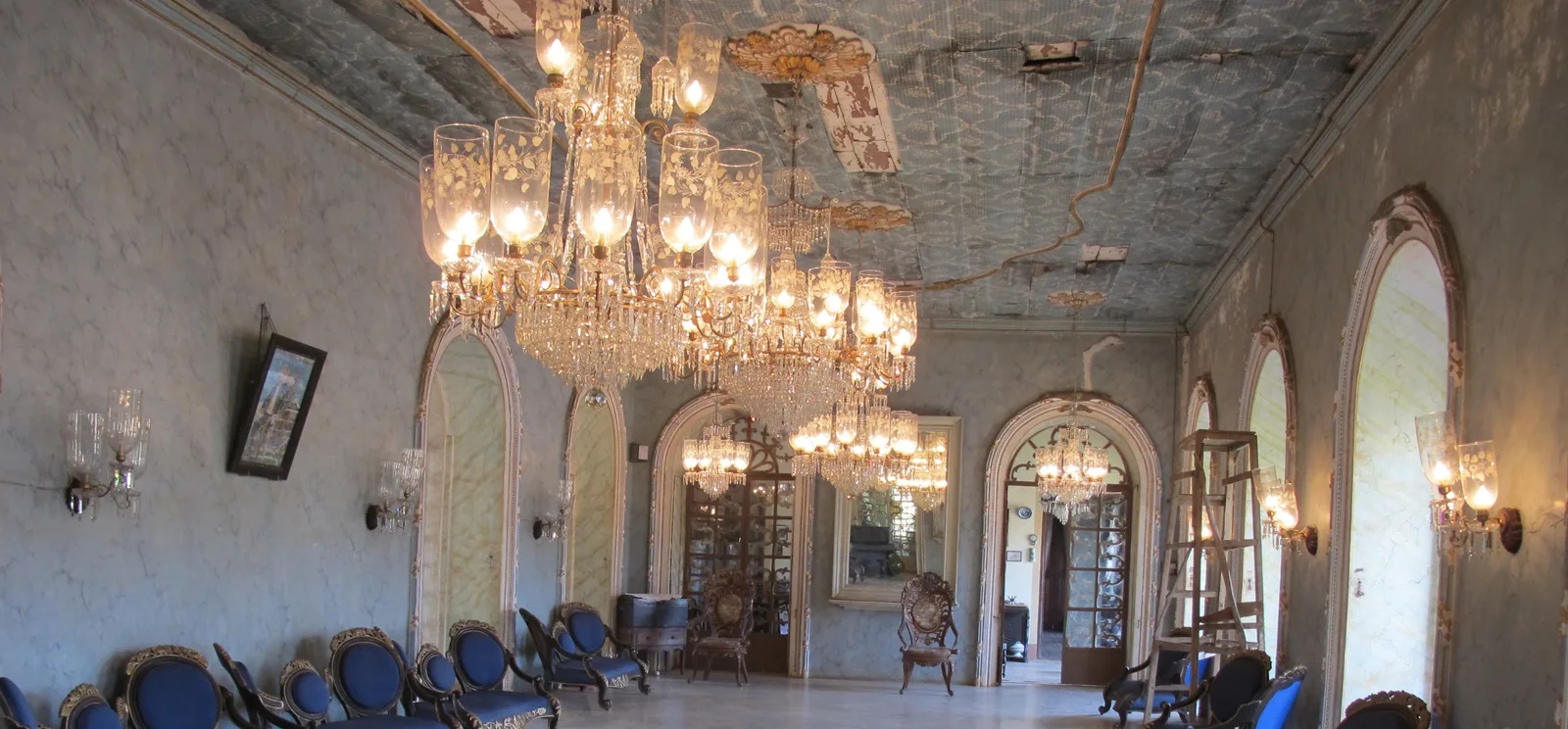
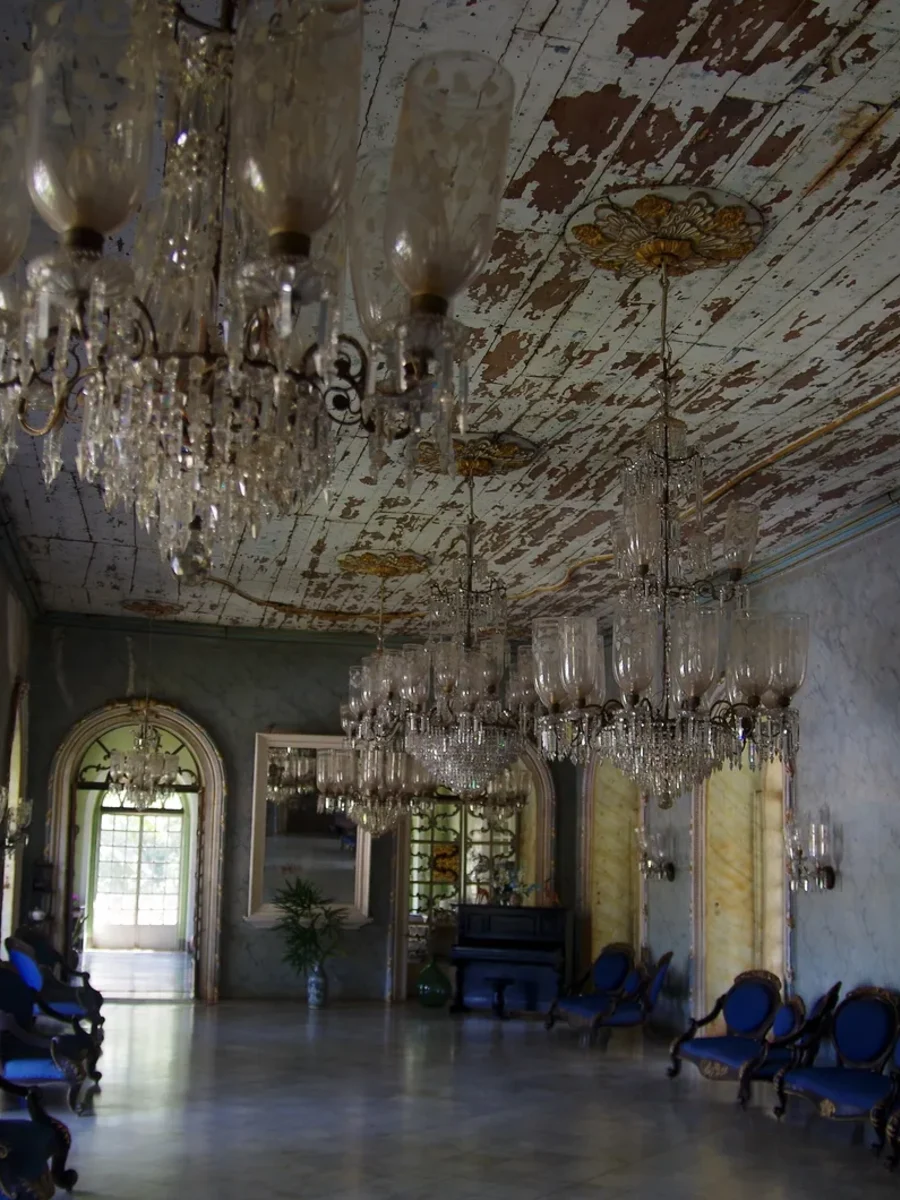
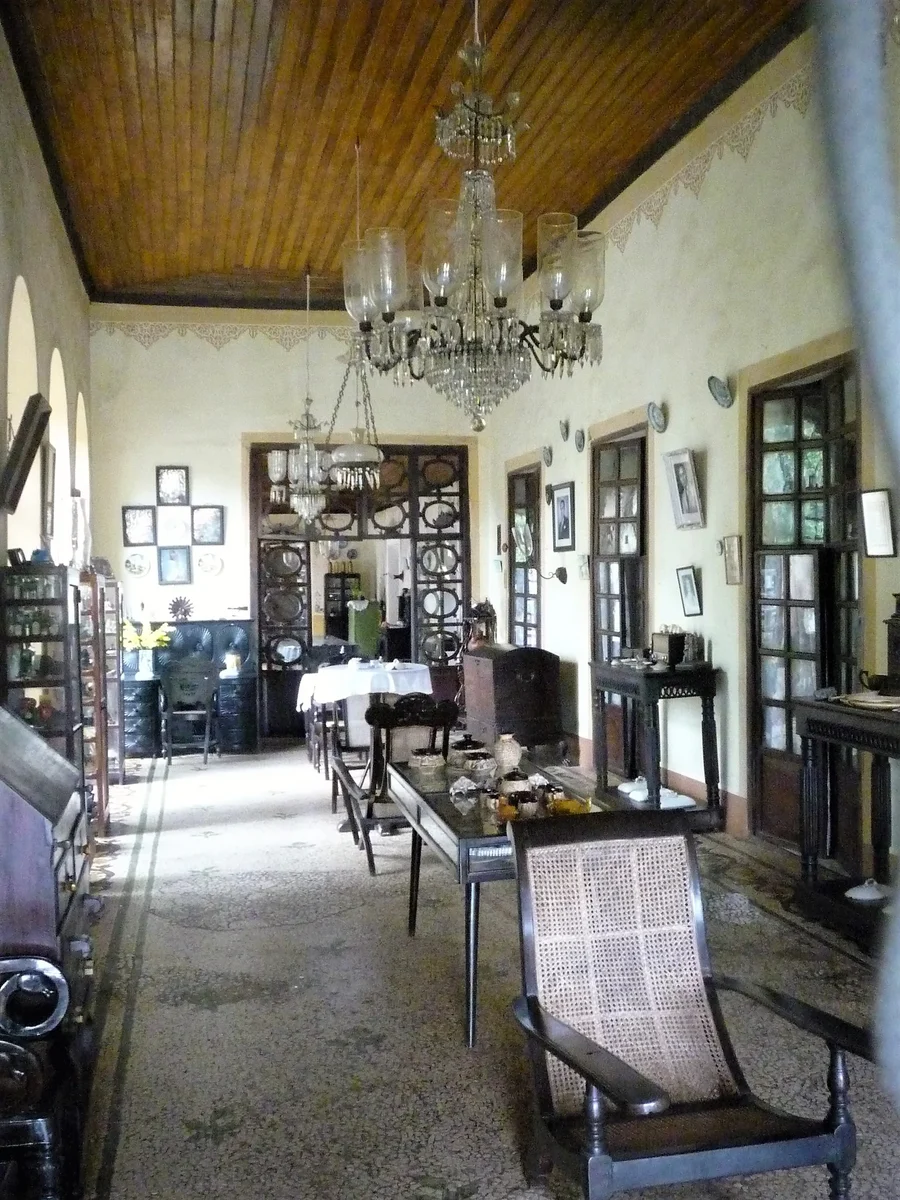
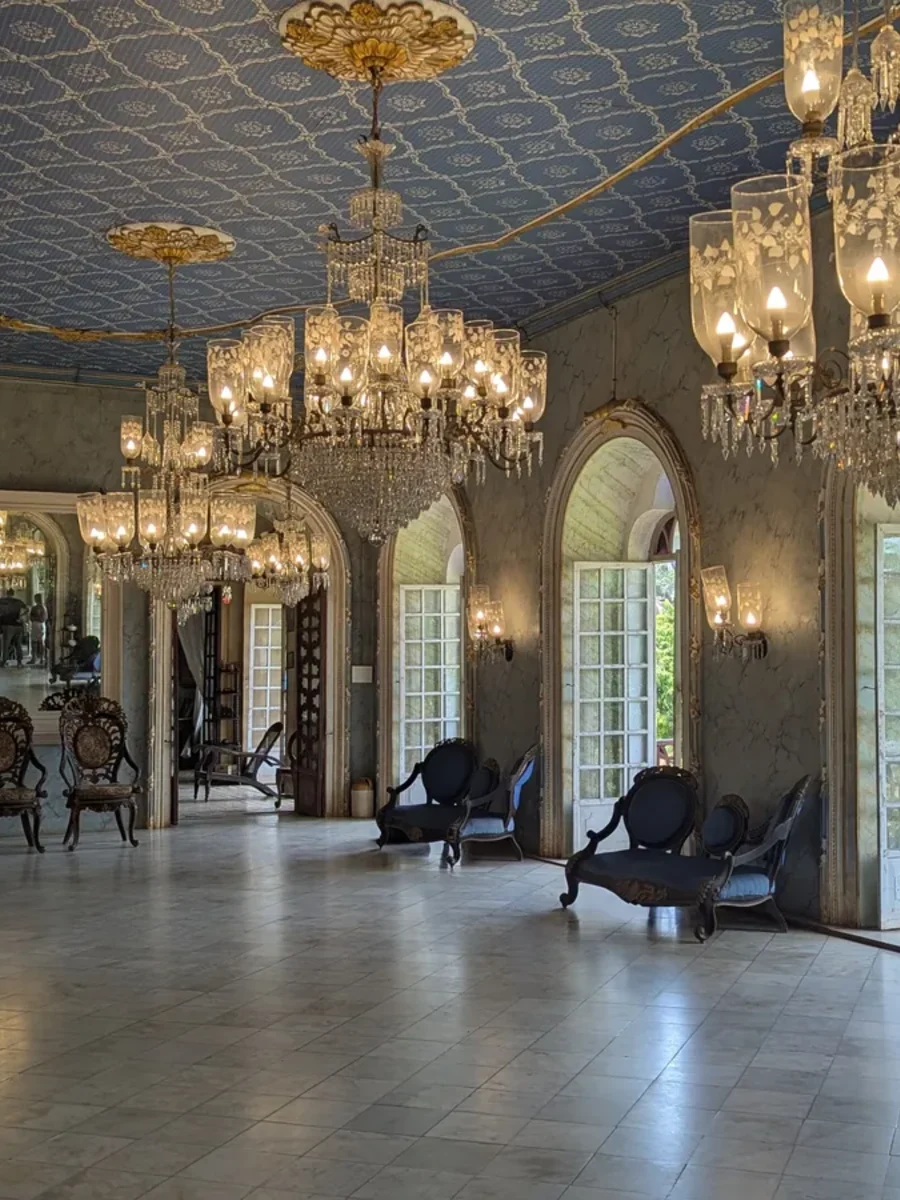
Goan chandeliers are the glass and crystal light fittings that hang in the reception rooms of the old Portuguese-era mansions, and in many Goan temples and churches too. The Government of Goa's overview of the heritage mansions lists chandeliers from Belgium among their imported furnishings, beside mirrors and cut glass from Venice. Family accounts repeat the story house by house: Belgian chandeliers at the Figueiredo house in Loutolim, chandeliers from Venice and Belgium at Braganza House in Chandor.
Those claims are part of how Goa tells its history, and many of them may be right. But very few are backed by an invoice, a maker's mark or a museum study, and chandeliers are objects that were often repaired, rearranged and added to over two centuries. This guide sets out what the sources say and what kind of evidence would settle the question.
The second half is practical. An old chandelier in a Goan house lives through salt air, monsoon damp, ceiling fans, termites in the roof timbers and decades of improvised wiring. We explain how to clean the glass and metal without damage, why rewiring and the move to LED should be done by a qualified electrician, and how a heavy fitting should be hung from an old timber ceiling.
Belgian, Venetian or European: what the sources claim
Read side by side, the published descriptions are less specific than they first seem. The official account of the mansions says chandeliers came from Belgium as a general statement about the houses. The official page on Braganza House describes the chandelier in the Great Salon only as antique and from Europe. The more precise attributions come from families speaking to writers, and they are honest family history rather than documented fact.
None of this means the claims are wrong. Goan families of the 18th and 19th centuries bought widely from Europe, and the same official account lists Chinese porcelain, Venetian mirrors and Portuguese tapestries in the same houses. It does mean that if you own a chandelier said to be Belgian, the attribution is a tradition to treasure rather than a fact to rely on when insuring, selling or restoring it.
| Source | What it says | What the claim rests on |
|---|---|---|
| Government of Goa, overview of heritage mansions | Chandeliers from Belgium, mirrors and cut glass from Venice | A general description of the houses, with no individual pieces named |
| Government of Goa, Braganza House | An antique chandelier from Europe in the Great Salon | The official page; no maker or date given |
| Frontline (2007), Braganza House west wing | Crystal chandeliers from Venice and Belgium | The family's account to the writer |
| The National (2019), Figueiredo house | Belgian chandeliers in the family museum | The family's account to the writer |
| Casa Araujo Alvares (family website) | Antique chandeliers imported from various parts of the world | The family's own description |
Why the origin of a chandelier is hard to prove
Chandeliers are assemblies, not single objects. A conservation study of glass chandeliers published in the Journal of the American Institute for Conservation in 1998 explains that they were often assembled from parts made by different suppliers, refitted and modernised as fashions changed, and repaired with whatever drops were available. It concludes that it is often impossible to know what a chandelier looked like at any particular moment in its history.
Makers' marks are rare. When the collections team at Harewood House in England cleaned a late-18th-century chandelier, they found no maker's mark and dated it instead from construction details: the type of finial fixing, the candle nozzles and the six-sided, un-notched arms. Even then, the house's own records did not explain how or when the chandelier had arrived.
Science can help with one question. The same 1998 study notes that virtually all 18th-century English chandeliers were made of lead glass and continental ones of soda-lime glass, and that the two fluoresce differently under ultraviolet light. A conservator with a UV lamp can therefore tell the glass types apart and spot later replacement drops. That will not prove a chandelier is Belgian, but it can show whether it is consistent with a continental origin and how much of it is original.
Treat a family attribution as a story worth recording, and ask a conservator before you treat it as provenance.
Planning something like this?
We visit homes across North and South Goa, measure on site, and bring samples to see in your own light.
Glass, crystal and brass: telling what you have
Most old chandeliers in Goan houses fall into a few types. The earliest true glass chandeliers, which the 1998 study dates to around 1720, have a glass stem and glass arms that carry the candle nozzles, all threaded on a central iron rod. From the end of the 18th century, frame chandeliers became popular: a metal frame dressed with cascading chains of graduated glass drops, which give the fitting its shape. Others are essentially metal fittings, in brass or gilt, dressed with glass beads, drops and prisms, a fashion the study traces back to the mid-17th century, before glass arms existed.
In everyday use, crystal usually means glass containing lead, which is heavier and throws brighter colours when cut. Ordinary soda-lime glass is lighter and slightly less brilliant, and both can look very similar once dusty. Early fittings sometimes used rock crystal, a natural quartz, for some ornaments. You cannot reliably tell them apart by tapping or by eye; a conservator's UV lamp and a look at the cutting are better guides.
The metal matters as much as the glass. The study notes that brass mounts were tin-plated, gilded, silver-plated or coated with a tinted shellac lacquer that imitates gilding. That last finish is easily destroyed: even a mild ammonia rinse or very hot water can strip it and blacken the brass beneath. Before you clean any metal on an old chandelier, find out what the finish is. Many Goan temples are also lit by crystal chandeliers, as Sahapedia's study of Goan temple architecture notes; those belong to the temple and are cared for by its custodians, so admire them and leave them alone.
Cleaning glass drops and brass arms in salt air
In Goa a chandelier gets dirty in a particular way. Salt carried on the sea breeze settles with the dust and attracts moisture, so in the monsoon a film forms on the glass that dulls it and can begin to corrode the pins and hooks that link the drops. Ceiling fans speed the process by driving air and dust past the fitting. Near the coast, a light dusting every few months and a fuller clean once a year in the dry season keep the problem under control.
Museum practice is cautious. At Harewood, a chandelier that is fully cleaned roughly once every ten years was dismantled from scaffolding, every part placed in a labelled bag, and each drop cleaned with cotton swabs dipped in deionised water and dried with paper towels before it was rehung. The 1998 study warns that the greatest threat to a hanging chandelier is the ladder, that the fitting should not be spun round to reach the far side, and that gloves can catch on protruding pins and do more harm than bare, clean hands.
At home, keep it simple. Switch off at the mains, not just the wall switch. Work with a second person and a stable platform, spread a padded cloth below, and photograph every side before you touch anything. Clean the drops with distilled or deionised water and a soft cloth, adding at most a drop of mild, pH-neutral washing-up liquid for greasy films, and dry them fully before rehanging. Never spray cleaner onto a fitting with live sockets or old wiring in it. If pins snap as you work, the study's advice is to replace brittle old copper pins with new brass chandelier pins rather than trying to straighten them.
Rewiring and moving to LED
Most old chandeliers in Goa were made for candles and were electrified later, often more than once. The 1998 study is blunt about the result: wiring was forced through spaces too small for it, holes were drilled through glass and metal, and wire below current standards was used to keep it hidden. It reports that shorts and fires from worn wiring are common in electrified period fittings, and recommends that any rewiring be done by a qualified electrician working with a conservator.
We make and fit soft furnishings; we are not electricians, and rewiring a chandelier is not a job for a curtain fitter or a handyman. What we can say is what to ask for. Ask for the old wiring to be replaced throughout rather than patched, for the chandelier to be earthed where it has metal parts, for cables to follow the existing routes without new holes in the glass, and for the work to be checked again after the first monsoon, when damp finds any weak connection.
LED lamps make that work safer and the fitting easier to live with. Building guidance from Pacific Northwest National Laboratory for the US Department of Energy notes that a standard incandescent bulb gives off 90% of its energy as heat, while LEDs use about 75% less energy and emit very little radiated heat. Less heat means less stress on old glass and less risk to nearby fabric. Choose warm white lamps, below 3,000 K, so the glass sparkles rather than looking clinical, and if you add a dimmer, make sure it is one designed for LEDs.
Hanging a heavy chandelier from an old timber ceiling
Old Goan houses have timber ceilings: boards fixed beneath joists, under a roof that moves with the seasons. A chandelier must never hang from the boards. It needs a hook fixed into a joist or into a purpose-fitted timber bearer spanning two joists, and that timber must be sound. Termites and long-term damp both work in roof spaces where nobody looks, and a joist that looks fine from below can be hollow inside.
The 1998 study sets the standard for the hardware. The chain should be closed-link steel or brass, strong enough to hold more than the full weight of the chandelier, and the ceiling hook should be fixed so that turning the chandelier cannot unscrew it or loosen its fixing. It recommends that a structural engineer decide how the hook is fixed to the building. For a large fitting in a high hall, that advice is worth following, and it costs far less than the damage a falling chandelier does.
Check the fixing whenever the roof is repaired, and look into the roof space above the hook after each monsoon for damp staining or termite tracks. Keep ceiling fans well clear of a chandelier's drops. Our article on wooden ceilings in old houses explains how these ceilings are built and what goes wrong with them, and the guide to termites and timber covers what to look for.
Lighting and dressing the room around the chandelier
A chandelier was never meant to light a room on its own. In the old mansions it was the centrepiece of the formal rooms, and the rest of the light came from windows by day and from lamps and candles by night. The same approach works now: let the chandelier hang as the focal point, often dimmed, and put table and floor lamps at the seating groups so the room has warm pools of light at eye level. Our article on the Goan ballroom describes how those great rooms were laid out.
Fabrics change how a chandelier reads. Light sheers at the windows catch and soften its reflection at night, while heavy, dark curtains absorb it and make the room feel smaller. In a room with a chandelier, sheer curtains behind lined main curtains in a warm, mid-toned linen or velvet usually look right. Keep all fabric, including curtain heads, pelmets and festive drapes, well away from any lamps that still run hot.
Salt air affects the curtain hardware as well as the chandelier. Near the coast, choose aluminium or coated tracks and rust-resistant fittings, as our guide to salt-air damage explains. If you are restoring a formal room around an old chandelier, book a home visit and we will measure the windows and bring fabrics to see under the room's own light.
How to clean a glass chandelier at home
For a sound, modern or modestly old fitting. For a rare or fragile chandelier, ask a conservator first.
Switch off and isolate
Turn off the circuit at the mains and leave the fitting to cool. Do not rely on the wall switch alone.
Prepare the space
Move furniture away, lay a padded cloth or blanket beneath, and set up a stable platform. Work with a second person who stays at floor level.
Record before you touch
Photograph every side and sketch where each chain of drops hangs, so it can be rehung exactly as it was.
Take down the drops in order
Remove chains and drops in a planned order, keeping each set in its own labelled bag or tray. Do not spin the chandelier to reach the far side.
Wash the glass gently
Clean each piece with distilled or deionised water and a soft cloth or cotton swab, adding at most a drop of mild, pH-neutral detergent for grease. Avoid ammonia-based glass sprays near metal finishes.
Dry fully
Dry every piece with a lint-free cloth and let it air-dry before rehanging. In the monsoon, work on a dry day so no moisture is trapped at the pins.
Check pins and hooks
Replace any brittle, bent or corroded pins with new brass chandelier pins rather than straightening old ones.
Rehang and test
Rehang the drops using your photographs, with cut faces outward, then restore power and check every lamp.