 Drapehaus

The monsoon in Goa is not a season of occasional heavy showers. It is four months in which rain falls on most days, the sky stays overcast, the wind comes steadily off the sea and the air sits close to saturation. By the India Meteorological Department's figures, roughly 91% of the state's annual rain, which averages 3,370.7 mm, arrives between June and September.
For anyone who owns a house here, and especially one that is closed or lightly used through those months, it is worth knowing exactly when the rain comes, how much falls, and from which direction. Each of those decides where the water ends up.
This piece sets out the dates and numbers from IMD, then looks at the mechanisms: driven rain on west and south-west walls, the long saturation of masonry, and the humidity that does more damage indoors than any single leak.
When does the monsoon start in Goa?
IMD's normal date for the onset of the south-west monsoon over Panjim is 5 June, and its normal withdrawal date is 14 October. Both come from the revised normals IMD published in May 2020, based on 1971–2019 data. The older normal for withdrawal was 30 September, so on paper the wet season is now about two weeks longer than many people remember.
These are averages, not forecasts. Onset in a given year can come noticeably earlier or later, and IMD declares it each year against rainfall, wind and cloud criteria. Pre-monsoon thundershowers usually arrive first: May averages 81.3 mm of rain over about three rainy days, and a wet spell in late May should be planned for rather than hoped against. Withdrawal is gradual too. October still averages 165.8 mm across 7.5 rainy days, and humidity stays high through the month. In practice a house is not properly dry again until well into November.
| Month | Normal rainfall (mm) | Rainy days | Share of annual rain |
|---|---|---|---|
| May | 81.3 | 3.1 | 2.4% |
| June | 908.5 | 21.9 | 27.0% |
| July | 1,118.5 | 27.3 | 33.2% |
| August | 707.7 | 24.9 | 21.0% |
| September | 327.5 | 14.5 | 9.7% |
| October | 165.8 | 7.5 | 4.9% |
Goa rainfall: how much, and how hard
Goa rainfall averages 3,370.7 mm a year across the state: 3,347.1 mm in North Goa and 3,394.2 mm in South Goa. There are on average 102.5 rainy days a year, and 86% of them fall between June and September. July is the wettest month, with 1,118.5 mm, and rain on 27.3 of its 31 days in an average year.
Averages hide intensity. The heaviest 24-hour rainfall recorded at a Goa station is 461.8 mm, at Mapusa on 15 June 1996: more than half of a normal June's rain in a single day. Gutters, downpipes, terrace outlets and site drainage have to cope with days like that, not with the monthly average spread evenly.
Whole years swing too. South Goa's wettest year in IMD's record is 1961, with 468.4 cm, 138% of normal; North Goa's is 2010, with 421.7 cm, 126% of normal. A house has to survive the wet years, and the details that fail first are the ones that were only just adequate in an ordinary one.
Planning something like this?
We visit homes across North and South Goa, measure on site, and bring samples to see in your own light.
Wind, driven rain and the west-facing wall
Through the monsoon the wind at Panjim blows predominantly from the west and south-west, off the sea, and peaks in July at a mean speed of 12.8 km/h. At Mormugao the July mean is 14.9 km/h. Those are averages across the whole day; squalls are much stronger.
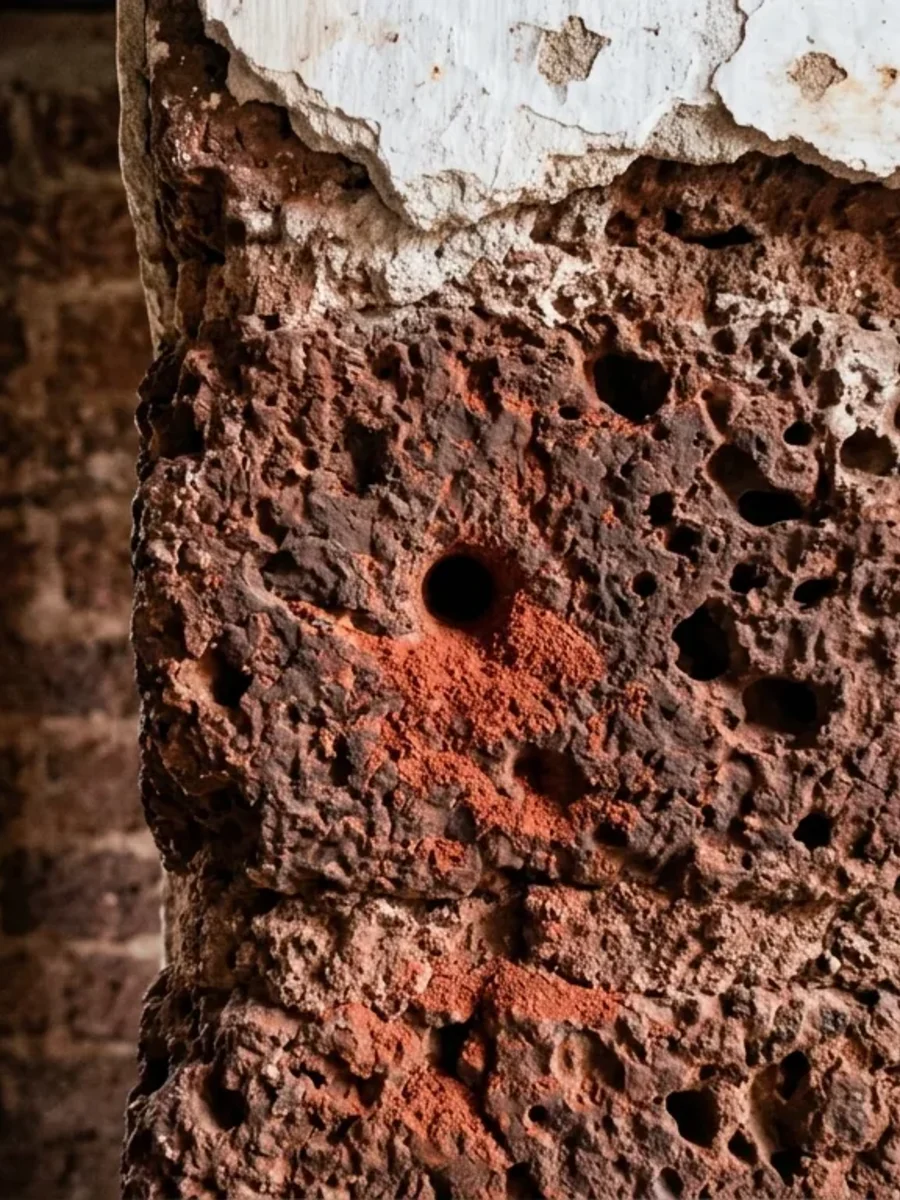
Direction matters more than speed. Rain carried on a steady onshore wind is pushed against the west and south-west faces of a building for weeks at a time. It finds hairline cracks in plaster, open joints around window frames, gaps under sills and poorly lapped roof tiles, and it soaks porous masonry such as laterite far more deeply than rain falling straight down. The inside face of a west or south-west wall is where monsoon damp most often appears first.
It also explains why a window that seems perfectly sound in February leaks in July: many seals only fail under sustained wind pressure. If you are surveying a house, or buying one, the monsoon is the time to look, ideally during or just after a spell of heavy westerly rain. Older laterite and lime walls behave differently from modern block walls here, which our guide to laterite and old walls explains.
What the monsoon in Goa does inside a house
Water coming through walls and roofs is the visible problem, but humidity is the larger one. At Panjim, relative humidity averages 88–91% at 08:30 from June to September and 82–87% at 17:30. The sky is heavily clouded, 6 to 7 oktas, for most of the season, with an average of 19 overcast mornings in July. There is no sun to dry things and no dry air to dry them into.
Everything absorbent moves towards that humidity: plaster, timber, upholstery, leather, clothes, books and mattresses. Timber swells, so doors and drawers stick. Masonry that has taken on driven rain stays damp for weeks. And at those levels, mould will colonise almost any organic surface that stays still and undisturbed. We deal with each case separately: fungus on walls, fungus on wooden furniture and fungus on clothes and in wardrobes.
Near the coast there is a further complication. The same onshore wind that drives the rain also carries salt, which settles on fabric, metal and glass and draws in moisture of its own, so coastal houses see corrosion and spotting that inland houses do not.
Preparing a house for the rains
Preparation happens in April and May and divides into the envelope and the contents. The envelope, meaning roof, gutters, downpipes, external plaster, window seals and drainage around the plinth, is work for a builder or waterproofing contractor and has to be finished before the pre-monsoon storms. The contents are about airflow and storage.
For soft furnishings the rules are simple: nothing absorbent pressed against a cool external wall, nothing sealed in plastic, nothing stored damp, and air moving over everything as often as possible. In a house that will be closed, curtains are usually better taken down, cleaned and stored properly, which is what our monsoon take-down and storage service is for.
During the rains, the most useful thing anyone can do in a closed house is open it on dry days and run the fans, and in the rooms that matter, run dehumidifiers with doors and windows shut. A house visited every week or two comes through in a very different state from one left shut for four months.
The monsoon's direction matters as much as its volume: check the inside face of west and south-west walls first.