 Drape Haus
There are six main types of mosquito nets for windows: fixed frames, sliding nets, pleated nets, roller (retractable) screens, magnetic nets and velcro, or hook-and-loop, nets. They all use similar mesh. What separates them is how they open, how they are held in the window, and how well they survive being used every evening for years.
For most Goan homes the short answer is this. Sliding nets suit sliding windows. Pleated or roller screens suit windows where you want the view clear by day. Fixed frames suit ventilators and windows you never reach. Magnetic and velcro nets are stopgaps for rentals and odd windows. The longer answer depends on how your windows open, which way they face, and who lives in the room.
This guide takes each type in turn, then matches them to the windows Goan houses actually have, from aluminium sliders in a new flat to the tall timber casements of an old house, and finishes with a room-by-room guide.
The six types of mosquito nets for windows, and how each opens
A fixed frame is a rigid aluminium frame with mesh stretched across it, screwed or clipped into the window opening. It does not open. You take it out with a tool or by releasing clips. That makes it the simplest and toughest screen there is, with nothing to wear out, and the least convenient if you ever need to reach the glass or the handle.
A sliding net is a framed mesh panel that runs on rollers in its own track, parallel to the glass. You slide the window open, then slide the net across. Because each has its own track, you can have the glass open and the net closed, both closed, or both open. Our sliding window nets are made this way, with the frame and track sized to the opening.
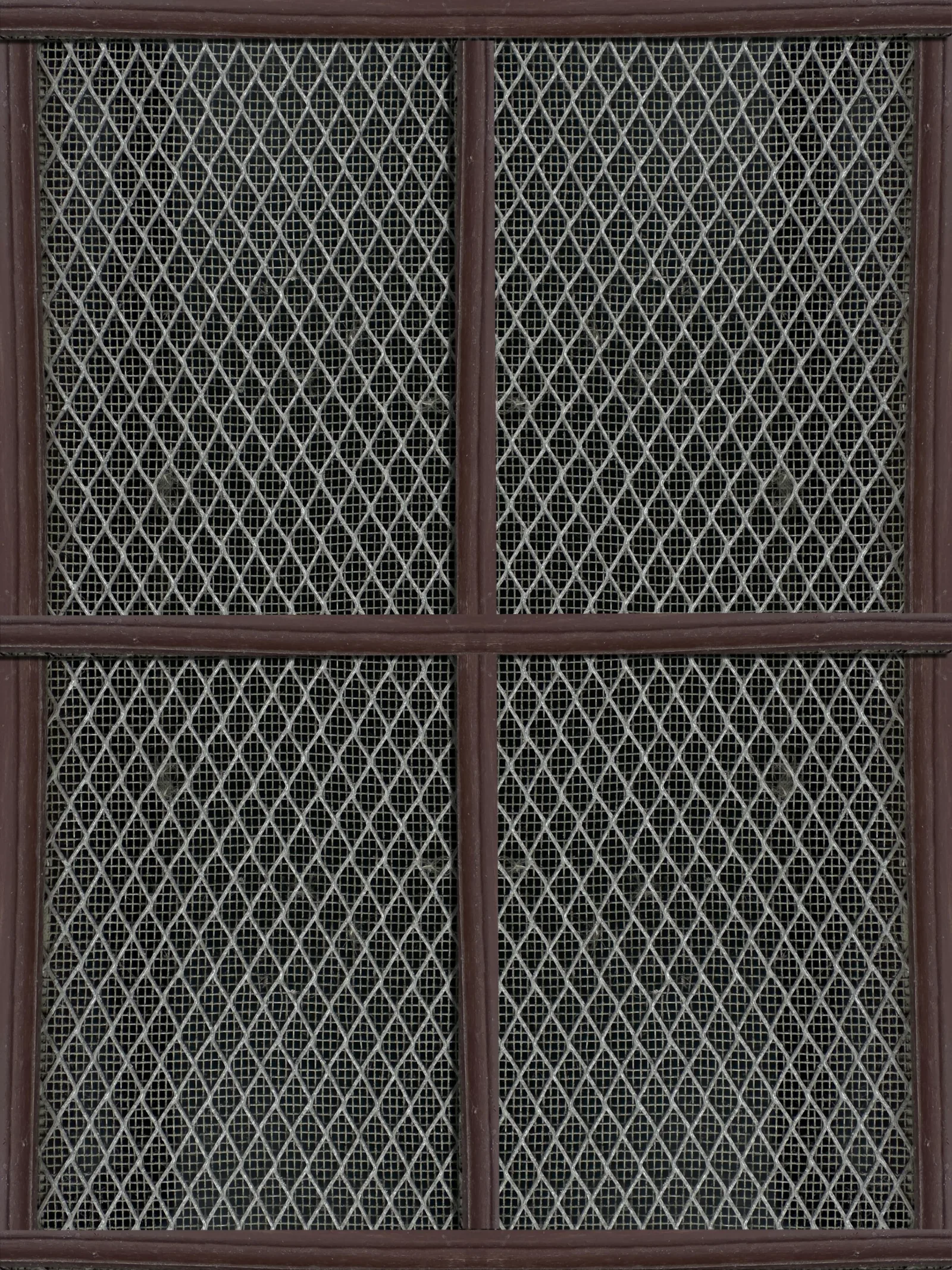
A pleated net is mesh folded like a paper fan, held between a top and bottom guide, with fine cords through the pleats to keep them evenly spaced. Pushed aside, it packs into a slim post a few centimetres wide. Drawn across, it covers the window. A roller screen stores its mesh on a sprung roller inside a cassette, and you pull it down or sideways by a bar that latches at the far side; release the latch and the spring winds the mesh back in. Both are often sold as retractable nets, and both disappear almost completely when open.
A magnetic net is soft mesh with magnetic strips sewn or glued along its edges, which stick to a matching strip fixed round the window frame with adhesive. A velcro net works the same way with hook-and-loop tape. Both are put up by the owner, peeled off for cleaning and pressed back. Neither has a frame, so neither keeps its shape on its own.
- Fixed frame: rigid, permanent, removed only with a tool or clips
- Sliding net: framed panel on rollers, slides beside the glass
- Pleated net: folds into a slim side post, draws across on cords
- Roller screen: winds into a sprung cassette, pulls out to a latch
- Magnetic net: soft mesh held by magnetic strips round the frame
- Velcro net: soft mesh held by hook-and-loop tape round the frame
Matching the screen to the window: sliding, casement and tall French windows
Sliding windows in aluminium or uPVC are the easy case. Most have the depth for an extra track, and many aluminium sections include a spare channel for exactly this. A sliding net then looks as if it came with the window. The one decision that matters is which side the net parks on, so it does not sit in front of the opening pane when you want air.
Casement windows are hinged, and the screen must go on the side the sash does not swing into. Where casements open outwards, the net goes inside the frame, and you open and close the window by reaching past it. That favours a pleated or roller screen, which you can draw back to reach the handle, or a small hinged screen frame. Where casements open inwards, the screen goes on the outside face, which usually means a fixed frame fitted from outside, and that is harder on upper floors.
The tall French windows of older Goan houses are the hardest. They are often two leaves opening inwards, well over head height, with a fanlight above, set in a deep laterite reveal and rarely square after decades of monsoons. Many also have external shutters or an iron grille. Here a pair of pleated nets meeting in the middle, or a single roller screen on a narrower window, keeps the proportions of the opening and lets the leaves still swing. A sliding net on its own sub-frame across the face works where there is wall beside the window to park it. On heritage windows such as the oyster-shell windows of old Goan houses, we plan the screen so it can come out again without marking the original timber.
Grilles are the other thing to look at before choosing. A screen can sit between the glass and the grille, or on the room side of both, depending on the depth available. The mosquito net chooser lets you pick an opening and slide each type open and shut to see how it would look.
Measure the depth of the frame or reveal before choosing a type: it decides where a screen can go far more often than taste does.
Planning something like this?
We visit homes across North and South Goa, measure on site, and bring samples to see in your own light.
Mesh at a glance, and how salt air and monsoon damp treat it
Whichever type you choose, the mesh inside it will be one of a few materials. The most common is fibreglass: glass-fibre yarn coated in PVC, woven and fused into a fabric. A US federal guide specification for aluminium windows, for example, calls for an 18 × 16 mesh of PVC-coated glass-fibre threads, or an 18 × 16 mesh of coated aluminium wire, which gives a sense of what a standard window screen is. Heavier polyester meshes are sold as pet-resistant. Stainless steel is the strongest.
By the sea, the difference between them shows within a few seasons. Fibreglass and polyester do not rust. Aluminium mesh corrodes in salt air and turns chalky and brittle. Stainless steel depends on its grade: the Australian Stainless Steel Development Association advises grade 316, or one with equivalent corrosion resistance, as a minimum within five kilometres of the surf, which takes in most of Goa's coastal belt. Our guide to mosquito mesh for windows compares the materials, mesh counts and colours in detail.
Monsoon damp affects all of them more quietly. Through the south-west monsoon, the India Meteorological Department records morning humidity of 87–91% across Goa. Dust, salt and insect remains on a mesh hold that moisture and can grow mould, and the frames and tracks around the mesh suffer more than the mesh itself.
| Mesh | Salt air | Strength | Typical use |
|---|---|---|---|
| Fibreglass (PVC-coated) | Does not rust | Tears under claws or a push | Most windows |
| Polyester (pet-resistant) | Does not rust | Much tougher, slightly coarser | Pets, children, busy openings |
| Aluminium wire | Corrodes and turns brittle | Dents and creases | Avoid on the coast |
| Stainless steel | Depends on grade; 316 near the sea | Strongest | Exposed or high-wear positions |
Monsoon wind: pop-outs, sagging and sand in the tracks
The IMD's climate summary for Goa describes winds strengthening from the west and south-west between June and August, and notes that monsoon thunderstorms are sometimes accompanied by squalls. A window facing the sea or an open hillside takes that wind on the face of its screen, and each type reacts differently.
Fixed frames cope best, provided the clips or screws are sound. Sliding nets cope well if the frame is stiff enough for its size and the top track has anti-lift blocks, small stops that prevent a gust from lifting the panel out of the bottom track. A sliding net without them can pop out in a squall and fall outside. Pleated nets rely on their cords and guides, and in a hard gust the mesh can billow and pull the pleats out of line. Roller screens depend on how firmly the edges of the mesh are held in their side channels; a lightly built screen lets the mesh blow out of them. Magnetic and velcro nets fare worst: wind gets behind the soft mesh, peels the edge away and leaves it sagging.
The sensible habit is the same for every type: in a storm, close the glass and leave the net parked or retracted behind it. A screen is there to keep insects out of an open window, not to hold back weather.
Sand is the other monsoon and beach-belt problem. Fine sand and grit collect in bottom tracks and guides, grind against rollers and make a sliding net drag or jump its track. Tracks with drainage slots, brush seals at the foot of the panel and a quick vacuum through the season prevent most of the trouble.
Cleaning, repair and re-meshing for each type
Every type needs the same basic care, a soft brush, mild soap and fresh water, but the effort and the repair options differ a great deal. A sliding net lifts out of its track and can be washed flat. A fixed frame usually comes out with its clips. Pleated and roller screens are cleaned in place, gently, because the folds, cords and spring do not like being handled. Our step-by-step guide to cleaning mosquito nets covers each.
Repair is where framed systems earn their keep. A sliding or fixed frame can be re-meshed when the mesh tears or ages, and rollers and brush seals can be replaced, so a sound frame stays in service for many years. A pleated net can usually have its cords re-tensioned, and its mesh replaced as a pleated pack. A roller screen whose spring has weakened can sometimes have the spring or the roller replaced, but on many designs the cassette is sealed and the screen is replaced as a unit. Magnetic and velcro nets are simply replaced when the mesh or the adhesive gives up.
| Type | Cleaning | Typical repair |
|---|---|---|
| Fixed frame | Remove and wash flat | Re-mesh the frame |
| Sliding net | Lift out and wash flat; vacuum the track | Re-mesh, new rollers and brush seals |
| Pleated net | In place, along each pleat | Re-tension cords; replace the pleated mesh |
| Roller screen | In place; clear the side channels | Spring or roller replacement, or a new unit |
| Magnetic or velcro | Peel off and hand-wash | Replace mesh or tape |
If a sound frame has torn or tired mesh, re-meshing is almost always a better use of money than a new net.
Room by room: which type goes where
Bedrooms are where open windows matter most, because the night breeze is often more comfortable than a sealed, air-conditioned room. Sliding nets on sliding windows, or pleated nets on casements, let the glass stay open all night. Living rooms usually have the widest glass and the best view; where the view is the point, pleated or roller screens that vanish by day are worth the extra care they need.
Kitchens need a screen that comes out for washing, because cooking grease settles on mesh and holds dust. A sliding net that lifts out, or a fixed frame on clips, is the practical choice; keep pleated screens away from the hob. Bathrooms usually have a small high window or ventilator that is rarely reached, which suits a fixed frame with stainless fixings, since steam and salt together are hard on mild-steel screws.
Children's rooms need tougher mesh and a frame that cannot be lifted out of its track by a curious push. One point needs saying plainly: no mosquito net is a safety barrier. Safe Kids Worldwide's advice is that screens are meant to keep bugs out, not children in. Windows above the ground floor still need grilles or restrictors, whatever screen you choose.
Homestay and rental rooms need screens guests understand without instruction and cannot easily damage. A framed sliding net with a clear handle generally outlasts anything softer. For balcony doors and French doors, our guide to the mosquito net for a sliding door covers thresholds, pets and sea wind, and for kitchens specifically, see mosquito nets for kitchens.
- Bedroom sliding windows: sliding net
- Bedroom or living-room casements: pleated net or roller screen
- View windows: pleated or roller, retracted by day
- Kitchen: lift-out sliding net or clip-in fixed frame
- Bathroom and ventilators: fixed frame, stainless fixings
- Rentals and one-off windows: magnetic or velcro as a stopgap
Why every opening counts
A screen only works if the mosquitoes have no other way in. The NCVBDC's vector control compendium describes house screening as a physical barrier against Anopheles and Aedes mosquitoes that should be placed on all openings, including windows, doors and eaves, and encourages householders to close holes and fill crevices in walls. The World Health Organization's guidance on housing and vector control lists screening of windows, doors and eaves against Aedes, Anopheles and Culex mosquitoes, and notes that Aedes, the mosquitoes that spread dengue, bite during the day. Screens matter in daylight hours, not only at night.
In practice that means looking beyond the windows you notice. The ventilator above the bathroom door, the gap where an air-conditioner pipe passes through the wall, the space under an old door and the open eaves of a tiled roof all matter. One unscreened opening in a bedroom undoes a perfectly screened window. Our guide to insects and screens goes through the usual weak points in Goan houses.
WHO also notes a trade-off worth respecting: screening can reduce indoor ventilation, which affects comfort. That is a reason to choose a screen people will actually open and close, and to keep it clean so it passes as much air as it can, not a reason to go without. When you are ready, our mosquito nets are measured and fitted to each opening in the house.