 Drape Haus
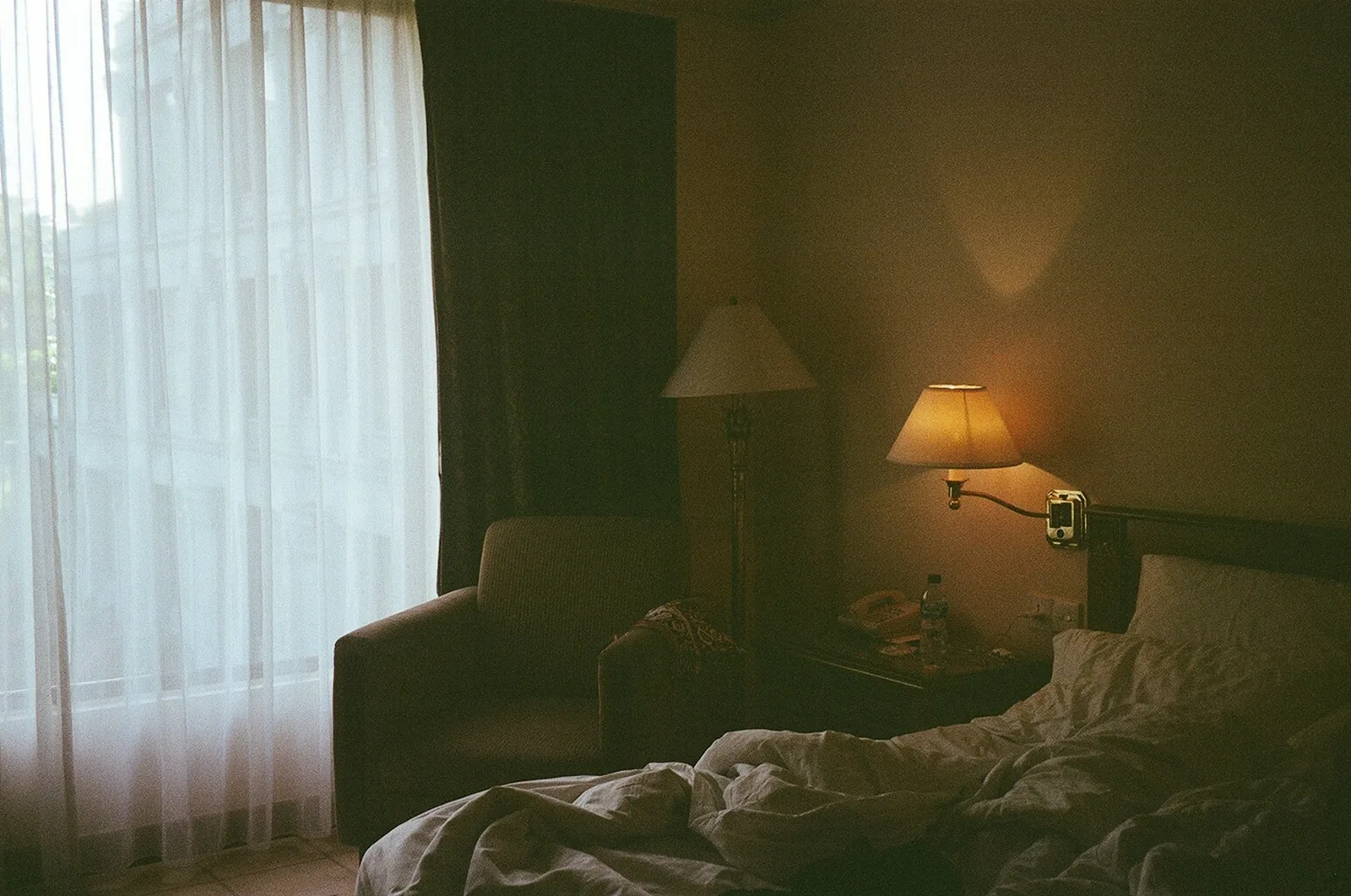
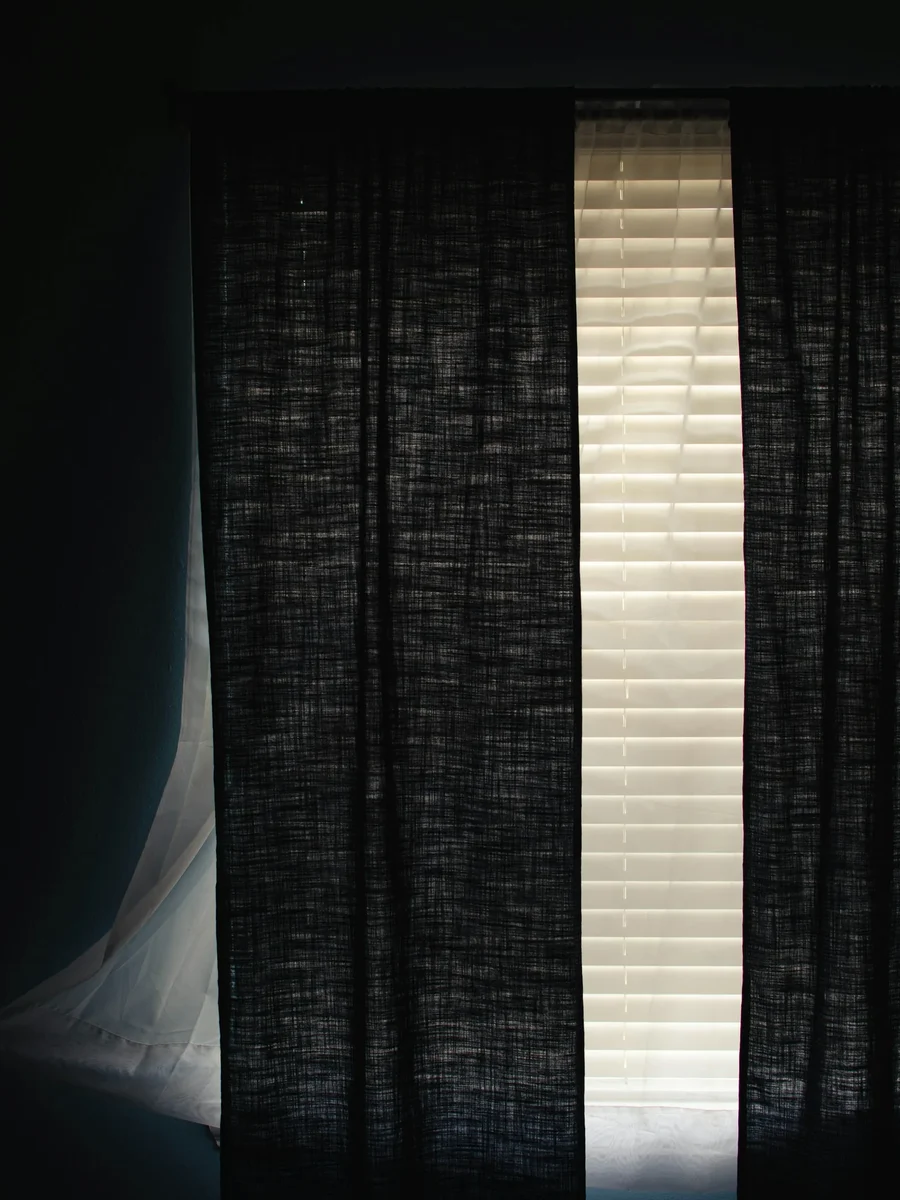
The difference between blackout and room-darkening curtains is how much light the fabric itself lets through. A blackout fabric or lining is opaque: hold it against the midday sun and no light passes through the cloth. A room-darkening fabric, often called dim-out, cuts the light heavily but not completely, so a faint glow still comes through in bright sun. Either one can leave a bedroom grey at dawn, because most of the light in a curtained room arrives round the edges, not through the fabric.
So the honest choice has two parts. First, how much light may pass through the cloth: none, for a shift worker or a home cinema; a little, for a living room where you want to see the television in the afternoon without living in a cave. Second, how much effort goes into the edges: the track, the overlap, the returns and the hem. A blackout lining on a badly fitted pole will lose to a dim-out curtain hung well.
Below we set out what the two terms mean, how the industry actually tests darkness, the main lining constructions and how each behaves in a humid house, which rooms need which, and a simple test you can do with a sample before ordering. Our blackout curtains page shows what we make, and the blackout curtain simulator lets you compare the options on a drawn window.
Two labels, two different promises
In curtain shops the words are used loosely. Blackout, room darkening, dim-out, light blocking and 99% blackout all appear on packets, often without any test behind them. There is no single agreed definition in retail, so the useful thing is to know what each word is trying to describe and then check it with your own eyes.
Blackout should describe a material that lets no light through: a coated lining, a coated fabric, or a densely woven cloth with an opaque core. Room darkening or dim-out describes a material that reduces light a great deal but lets a small amount through when the sun is on it. A plain lined curtain, with an ordinary cotton or polycotton lining, is a step below that again. It makes a room dim and private, not dark.
The trade body for blinds and shutters in the UK goes further than most retailers. Its guidance note on room darkening says it knows of no shading product that gives 100% light exclusion, and that the term black out should therefore not be used to describe a whole product's performance. A fabric may be 100% opaque; the product as hung at a window is not. That one distinction explains most of the disappointment people feel with blackout curtains.
| Label | Light through the fabric | Typical result in a sunny room | Usual use |
|---|---|---|---|
| Unlined curtain | A lot, tinted by the fabric | Bright, coloured glow | Living rooms, verandah doors |
| Lined curtain (standard lining) | Little | Dim, private, edges bright | Living rooms, dining rooms, many bedrooms |
| Room darkening or dim-out | Very little; a faint glow in bright sun | Dusky; you can still read a clock | Living rooms with a TV, children's rooms, guest rooms |
| Blackout fabric or lining | None through the cloth | Dark, apart from the edges | Bedrooms, shift workers, media rooms |
| Blackout curtain plus channelled blind | None through the cloth, little at the edges | As dark as a domestic room gets | Day sleepers, home cinemas |
How darkness is actually tested
There is a proper way to measure this, and it is worth knowing because it shows why the edges matter. The British Blind and Shutter Association's guidance describes the method set out in the European standards for blinds and shutters, BS EN 14500 and BS EN 14501. No electronic sensor is sensitive enough to stand in for the human eye, so a person sits in a light-tight room facing the product while the outer side is lit. The observer waits 15 minutes for their eyes to adjust, because, as the note puts it, the smallest pinprick of light begins to appear as a bright beam over time.
The standard then gives two grades. A number from 0 to 4 rates the material alone, its opacity. A letter from A to E rates the whole system, meaning the material together with any frame or channels that stop light at the edges. For the top class, A, no light may be perceived with 75,000 lux on the outside; at class C the test light is only 1,000 lux. A product hung without any light-exclusion frame, as a curtain or a free-hanging blind is, can reach E.4 at best: a very good material with nothing holding its edges.
Those test levels make sense once you compare them with real sun. The Canadian Conservation Institute gives almost 100,000 lux for direct noon sunlight. A dim-out fabric that looks perfectly dark when you test it against a lamp in the evening may show a glow at noon, and a gap of a few millimetres at the side of a blackout curtain lets through enough of that light to brighten the ceiling. Curtains are not usually sold with these classes in India, but the logic is the right way to think about any curtain you buy.
Opacity is a property of the fabric. Darkness is a property of the whole window.
Planning something like this?
We visit homes across North and South Goa, measure on site, and bring samples to see in your own light.
Why light still gets round a true blackout curtain
A closed curtain hangs a little in front of the wall. Light that reaches the gap behind it escapes at the top, down both sides, where a pair meets in the middle and under the hem, and then bounces off the ceiling and walls into the room. The BBSA note makes the same point for blinds: fitting a product outside the window reveal reduces the light filtering round its edges but will not stop it completely. A curtain is a free-hanging product by definition, so some edge light is always part of the deal.
How much reaches you depends on fitting more than fabric. A track fixed to the ceiling leaves no gap above. A track that runs well past the frame lets the closed curtain overlap the wall. Returns, where the end of the curtain turns back to meet the wall, close the side gap; overlap arms close the centre; a hem finished just clear of the floor closes the bottom. Our article on blackout curtains for the bedroom walks through each of those fixes in turn.
There is one more route that people forget: the fabric itself, at the stitching. Every needle hole through a coated lining is a pinhole, and rows of them show as tiny dots of light once your eyes adjust. Well-made blackout curtains keep stitching through the coated layer to the sides and heading, and a separate lining joined only at the edges avoids most of it. Eyelet headings punch holes straight through every layer, which is why an eyelet blackout curtain is rarely the darkest option.
Coated, woven and separate linings compared
Coated blackout is a base cloth with layers of opaque coating on the back. The construction we specify is a three-pass acrylic coating, which gives full opacity and stays supple in heat. Its weakness is that a coating does not breathe like cloth, so the curtain needs an air gap behind it and should be opened on dry days. Foam-backed blackout is lighter and costs less to buy, but in our experience the foam stiffens, cracks and sheds under sustained heat and humidity, so we do not use it here.
Triple-weave fabrics carry a layer of dark yarn woven into the middle of the cloth between two decorative faces. There is no coating to crack, the fabric drapes like an ordinary curtain and most versions wash well, which is a real advantage in a humid climate. Most woven constructions are dim-out rather than full blackout, though: they cut light heavily, and a little passes in bright sun. They are the natural choice for a room-darkening curtain.
A separate blackout lining is sewn or hooked behind a face fabric of your choice. It lets a linen, a print or a velvet become a blackout curtain, it takes the sun so the face fabric fades far less, and it can be replaced when its coating ages without remaking the curtain. A detachable lining, hooked onto the same track as the curtain, can also come off for washing or for the monsoon. Our guide to blackout linings goes deeper into each construction.
Whichever you choose, look at the side that faces the glass. US Department of Energy guidance reports studies in which medium-coloured draperies with white plastic backings cut heat gain by 33%. A white or pale back reflects sun; a dark back absorbs it and warms the room. Most good blackout linings are white or ivory on the window side for this reason.
| Construction | Light | Feel and drape | In a humid house |
|---|---|---|---|
| Three-pass acrylic-coated lining | Blackout | Supple, slightly firm | Needs an air gap; open on dry days |
| Foam-backed coated fabric | Blackout when new | Stiff, light | Degrades in heat and damp; we avoid it |
| Triple-weave fabric | Usually dim-out | Soft, drapes like cloth | Breathes better; most wash well |
| Standard cotton or polycotton lining | Dim, not dark | Soft, adds body | Breathes; dries reasonably |
| Detachable blackout lining | Blackout | Two independent layers | Can be removed for washing or the monsoon |
Choosing by room: bedrooms, media rooms, children and living rooms
Bedrooms are where blackout earns its place, and the case is about sleep. NHS advice suggests people may find it easier to sleep in a room that is quiet, dark and cool, and lists fully closing curtains to keep the room dark among the things to try, with an eye mask if light is still a problem. Its page on insomnia says the same: make sure the bedroom is dark and quiet, using curtains, blinds, an eye mask or ear plugs if needed. An east-facing bedroom in Goa from November to April, when the IMD describes skies as generally clear or lightly clouded, gets bright early light, and a blackout lining fitted wide and high is the comfortable answer.
Shift workers and day sleepers need more than a curtain alone. A blackout roller blind inside the reveal, ideally with side channels, behind a blackout curtain on a ceiling track is the nearest a home gets to the standard's better classes, because the channels act as the light-exclusion frame the test rewards. Our blackout blinds page covers channelled rollers.
Media rooms are a judgement call. The BBSA note observes that limiting light in a room with screens improves viewing and cuts glare, and also warns that an opaque material can create the need for artificial lighting. A family room used mainly in the evening may need nothing more than a dim-out curtain; a dedicated cinema room used at midday wants blackout and careful edges.
Children's rooms usually need darkness for an early bedtime in bright evenings and for afternoon naps, but not a room that stays dark all day. A blackout or dim-out lining on a curtain that opens fully and easily suits them, with no loose cords. Living rooms rarely need blackout at all: a standard or dim-out lining gives evening privacy and takes the edge off the afternoon sun while leaving the room usable.
| Room | Our usual choice | Why |
|---|---|---|
| Main bedroom, east-facing | Blackout lining, ceiling track, returns | Dawn light is the problem |
| Bedroom for a shift worker | Blackout curtain plus channelled blackout roller | Daytime sleep needs the edges closed too |
| Children's room | Blackout or dim-out, cordless, easy to open | Early bedtimes and naps, bright days |
| Home cinema or media room | Blackout if used by day; dim-out if mainly evenings | Screens need less light, not always none |
| Living room | Standard or dim-out lining | Evening privacy, softer afternoons |
| Guest room or homestay | Blackout lining, robust track, detachable if washed often | Guests notice early light more than fabric |
Rentals, homestays and guest rooms in Goa
In a let villa or a homestay, a dark bedroom is one of the few furnishing details guests notice and mention. People on holiday sleep later than they do at home, and an east-facing room with a glowing curtain edge is the commonest complaint. For these rooms we favour a blackout lining over a dim-out one, a ceiling or wall track that runs well past the frame, and overlap arms, because guests close curtains in a hurry and never adjust them.
Durability matters as much as darkness. Guest curtains are drawn roughly, washed more often and handled by housekeeping, so a coated lining sewn permanently to the face fabric can crack where it is folded and washed. Detachable linings let the face fabric go to the laundry while the lining is wiped and rehung, and they let you keep a spare set. Our guide for beach homestays covers the rest of a rental bedroom.
The monsoon brings the other risk. IMD's climate summary for Goa puts morning humidity between 87 and 91% from June to September, and the US Environmental Protection Agency advises keeping indoor humidity below 60% and drying damp materials within 24 to 48 hours to prevent mould. A blackout curtain left closed across a shut window in an empty house is a still, damp pocket of air against wet glass. If the house closes for the season, draw blackouts fully open before you leave, or have them taken down; our monsoon take-down and storage service does this for owners who are away.
Test a fabric for light blocking before you buy
You cannot judge light blocking from a swatch on a counter. Borrow the logic of the standard test instead: put the sample between your eye and a strong light, in a dark room, and give your eyes time. The list below is a simple home version. It will not give you a class, but it will tell you quickly whether a fabric is genuine blackout, dim-out or just a heavy lining.
Test with the strongest light you can. A phone torch in a dark room at night is a far weaker source than sun on a window at noon, so a fabric that hides a torch completely may still glow in direct sun; the standard's own dim-out test uses only 1,000 lux for the same reason. If a fabric passes against the midday sun with your eyes adjusted, it is blackout in practice. Then ask for the lining to be made up the way it will be stitched, because the stitch lines are where pinholes appear.
- Choose a sunny window at midday and darken the rest of the room as much as you can
- Hold the sample flat against the glass, covering the light completely with your hands round the edges
- Wait several minutes for your eyes to adjust before deciding; the formal test allows 15
- Look for an overall glow (dim-out), pinpricks along seams (stitching), or nothing at all (blackout)
- Check the side that faces the glass is white or pale, for heat as well as looks
- Fold the sample and press the fold; a coating that crazes when creased will not last in washing
- Ask whether the lining will be sewn in or detachable, and how it should be cleaned