 Drape Haus
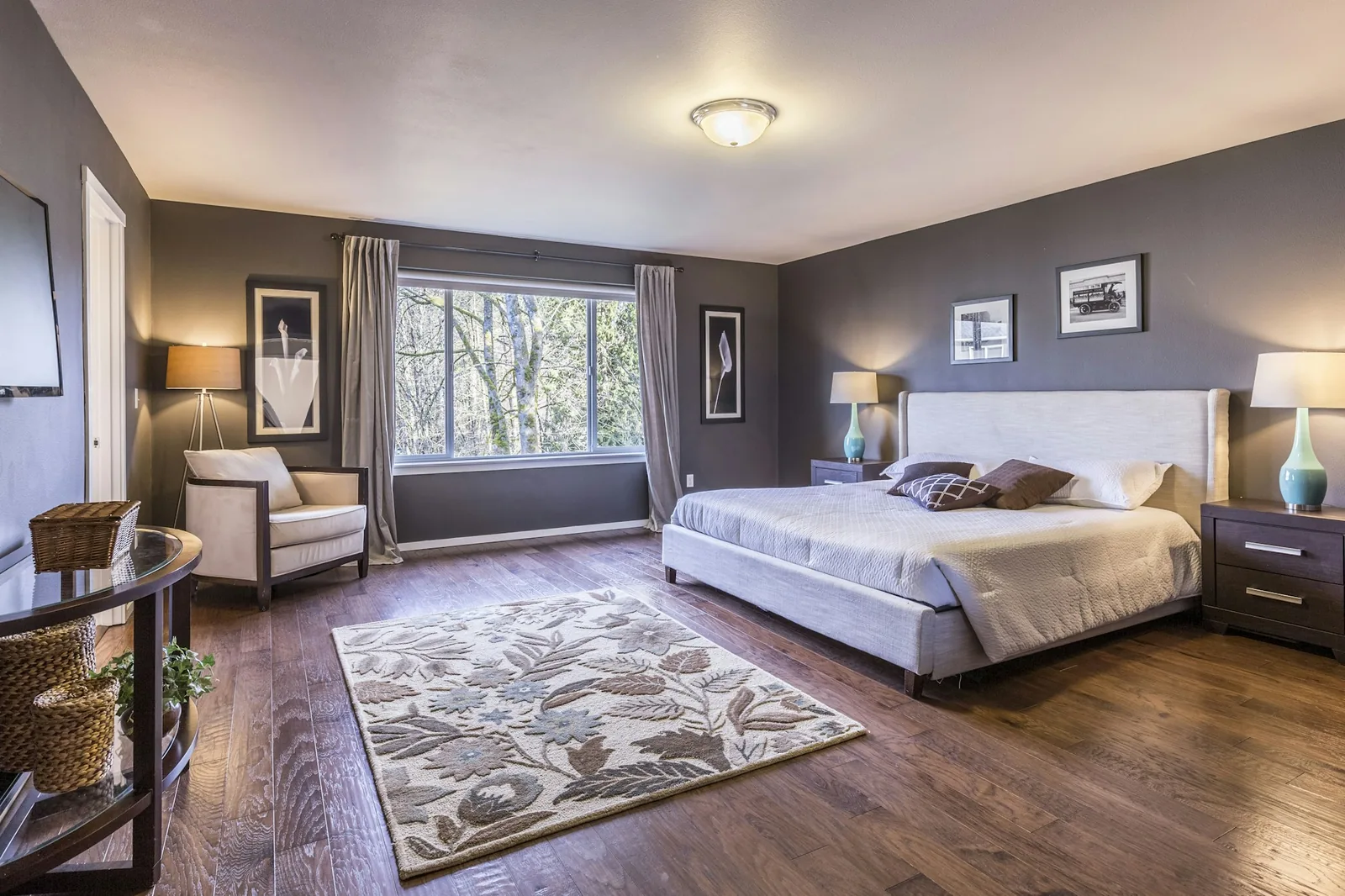
For a king bed, a 9 × 12 ft rug (about 2.7 × 3.7 m) is the size to plan on if the room allows, laid across the bed so it runs well past both sides and the foot; in a tighter room, 8 × 10 ft (about 2.4 × 3.0 m) works with narrower margins. For a queen, 8 × 10 ft is the usual answer. For a single, a 5 × 8 ft rug across the foot or beside the bed, or a runner, is enough. Those are the same conventions our rug size planner uses.
The aim under a bed is different from a living room. Nobody needs the pillows on a rug. What matters is that your feet land on something soft when you get up, that the rug frames the bed rather than hiding under it, and that there is still a clear band of floor round the edge. In a Goan bedroom, with a wardrobe along one wall, a door to the bathroom and a cool tiled floor, the clearances often decide the size before the bed does.
Below are the placements, the sizes in feet and metres for each bed, how to work round wardrobes and doors, and how to keep a rug from slipping on tile and stone.
Measure the bed you actually have
Bed names are a poor guide in India, so start with a tape measure. Indian Standards do not fix what a queen or king mattress measures. IS 7933, the 2022 standard for polyurethane foam mattresses, leaves length and width to be agreed between supplier and purchaser, and IS 13489, the standard for bed mattresses, says domestic mattress dimensions are as specified in the order. The original 1975 edition of IS 7933 set only minimums: 1,800 mm long and 750 mm wide. Makers therefore sell slightly different sizes under the same name.
Measure the bed frame, not just the mattress, because a deep wooden frame or an upholstered headboard can add several centimetres all round. Measure the bedside tables too, and their distance from the bed. Then measure the room, the wardrobe and its doors, and the path to the bathroom. Those numbers, rather than a size label, are what the rug has to fit.
For planning, our rug size planner draws a queen of around 5 ft across, with its frame, and treats a king as roughly a foot wider. If your bed is wider or longer than that, move one size up in the tables below; if the room is narrow, look at the runner option.
Three placements under and around a bed
Under the lower two-thirds is the most common and usually the best. The rug starts a little below the bedside tables, so the tables stand on bare floor, and runs under the bed and out past the foot. You see a generous border of rug on both sides and at the end, which is exactly where feet land. It needs a smaller rug than a full-under placement and it keeps the bedside tables steady, since they are not perched half on and half off a pile edge.
Fully under the bed and the bedside tables is the most generous look and suits a large room. The rug runs from behind the tables to well past the foot, and everything stands on it. It needs a big rug, often the largest standard size the room can take, and it is the hardest to lift and air in the monsoon.
Runners either side, or a single rug across the foot, suit narrow rooms, single beds and beds pushed against a wall. Two runners give a soft landing on both sides without a large rug colliding with a wardrobe, and each one is light enough to shake out, wash or roll away for the rains.
Keep bedside tables either fully on the rug or fully off it. Half on, they rock.
Planning something like this?
We visit homes across North and South Goa, measure on site, and bring samples to see in your own light.
Rug sizes for king, queen and single beds
The table follows the conventions in our rug size planner: six standard sizes, a bedroom rug that frames a queen-width bed on three sides with at least about 8 × 9.5 ft of coverage, and a band of bare floor of at least 1.5 ft between rug and walls. The metric figures are conversions of the standard imperial sizes, which is how most rugs are still sold. A made-to-measure rug can sit between them.
Use the table as a starting point, then check it against your own measurements. If the margin of rug beside a king bed comes out narrower than a stride, either go up a size or switch to runners. If the floor border to the walls falls below about 45 cm, go down a size.
| Bed | Placement | Rug size | In metres (approx.) |
|---|---|---|---|
| King | Lower two-thirds, generous room | 9 × 12 ft | 2.7 × 3.7 m |
| King | Lower two-thirds, tighter room | 8 × 10 ft | 2.4 × 3.0 m |
| King | Fully under bed and tables, large room | 10 × 14 ft | 3.0 × 4.3 m |
| Queen | Lower two-thirds | 8 × 10 ft | 2.4 × 3.0 m |
| Queen | Fully under bed and tables | 9 × 12 ft | 2.7 × 3.7 m |
| Queen or king | Small room, across the foot | 6 × 9 ft | 1.8 × 2.7 m |
| Single | Across the foot or beside the bed | 5 × 8 ft | 1.5 × 2.4 m |
| Any bed | Runners either side | Roughly the bed's length | Measured to the bed |
Clearance for wardrobes, doors and side tables
A rug has to share the floor with things that move. A furniture-arrangement guide from the University of Arkansas extension service asks for at least 30 inches, about 76 cm, for walkways, 36 inches, about 91 cm, at doorways, and 36 inches or more in front of drawer units. Those are planning figures from a US guide rather than rules, but they are a sensible check in a bedroom where a wardrobe stands a short distance from the foot of the bed.
Open the wardrobe doors and drawers fully and see where they reach. A hinged door that sweeps over a thick rug catches on it; a sliding wardrobe does not, but its runner at floor level should stay clear of the rug edge so dust and fluff do not collect in it. Check the bedroom and bathroom doors the same way, and keep the rug edge out of their swing. A low-pile or flatweave rug causes fewer problems near doors than a deep pile.
Then check the walkway round the bed. If the rug's edge falls in the middle of the path between bed and wardrobe, people step on and off it many times a day, which is where edges curl and trip. Either bring the rug fully under that path or stop it short of it. In many Goan bedrooms, where the wardrobe runs along one long wall, the answer is a rug that is generous on the window side and stops cleanly before the wardrobe side, or a pair of runners.
Runners on either side, or one large rug
One large rug looks calmer and more luxurious; two runners are more practical. The choice usually follows the room. In a large master bedroom with space all round, a single rug under the lower two-thirds of the bed ties the room together. In a narrow room, a guest room or a rental, runners do the job with less disruption and are much easier to look after.
Runners need to be long enough to make sense of the bed, so start from roughly the bed's length and adjust so they finish neatly level with or just past the foot. Leave a strip of floor visible at both ends and along the outer side. Use the same rug for both runners, or two that are clearly a pair, so the bed still looks symmetrical.
Runners also suit the monsoon. A pair of flat cotton runners can be lifted, washed and dried in a day; a large pile rug under a heavy bed is a two-person job to roll and store. If the house closes for the rains, that difference matters. Our guide to the best rugs for humid homes covers fibres, and dhurries and flatweaves are the easiest to live with.
Rug pads on tiled, marble and oxide floors
A rug on a smooth floor needs something to stop it sliding, especially in a bedroom where people get up in the dark. The NHS lists rugs among the things you could trip on at home, and the risk rises for older family members and small children. A good underlay grips the floor and the rug together so the edge stays flat and the rug does not creep when you step onto it.
Choose the pad for the climate as well as the grip. An open-mesh or felt-and-rubber pad lets air pass under the rug, so the floor and the back of the rug can dry. A solid rubber sheet traps moisture against a cool tiled floor in the monsoon, which is how rugs come to smell. On red, black or coloured oxide floors, try the pad on a hidden corner first, since some rubbers can mark a polished surface over time.
Cut the pad a few centimetres smaller than the rug on every side so it does not show. In an air-conditioned bedroom, where the floor stays cool and dry, a slightly thicker pad adds warmth underfoot; in a naturally ventilated room, keep it thin and breathable and lift the rug every couple of weeks in the rains.
Check your layout before you buy
The quickest check costs nothing. Mark the rug's outline on the floor with masking tape or sheets of newspaper, then live with it for a day: open the wardrobe, walk to the bathroom at night, sit on the edge of the bed. Too small usually feels obvious within minutes, and too big shows up as a rug edge under a door.
For a scaled view, the rug size planner lets you set the room's dimensions in feet, switch to the bedroom layout and compare the six standard sizes drawn over the floor, with the border of bare floor worked out for you. Our page on bedroom rugs covers materials for Goan bedrooms, and our carpets and rugs collection is where to start once the size is settled; we can supply rugs and runners made to the size your room needs.