 Drape Haus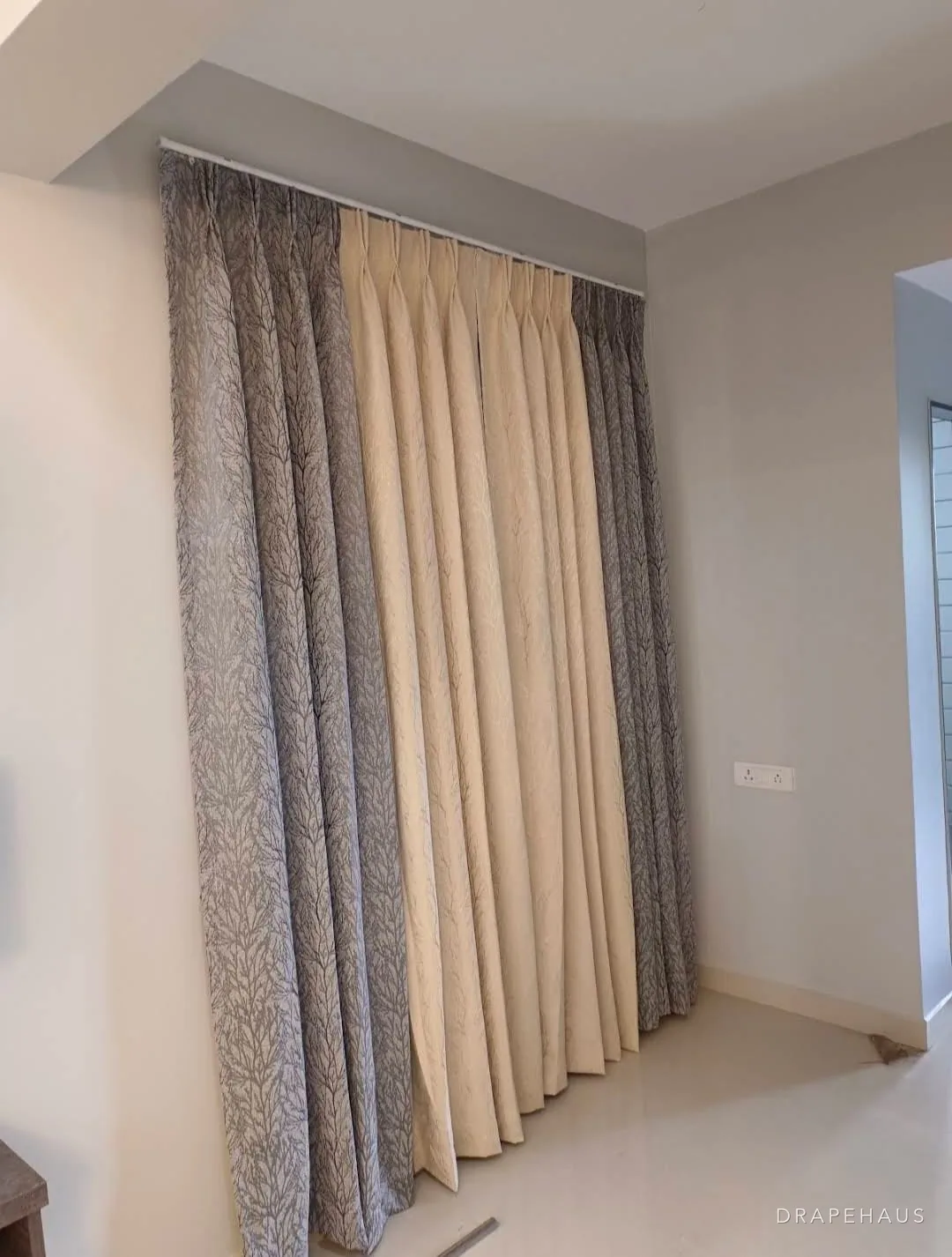
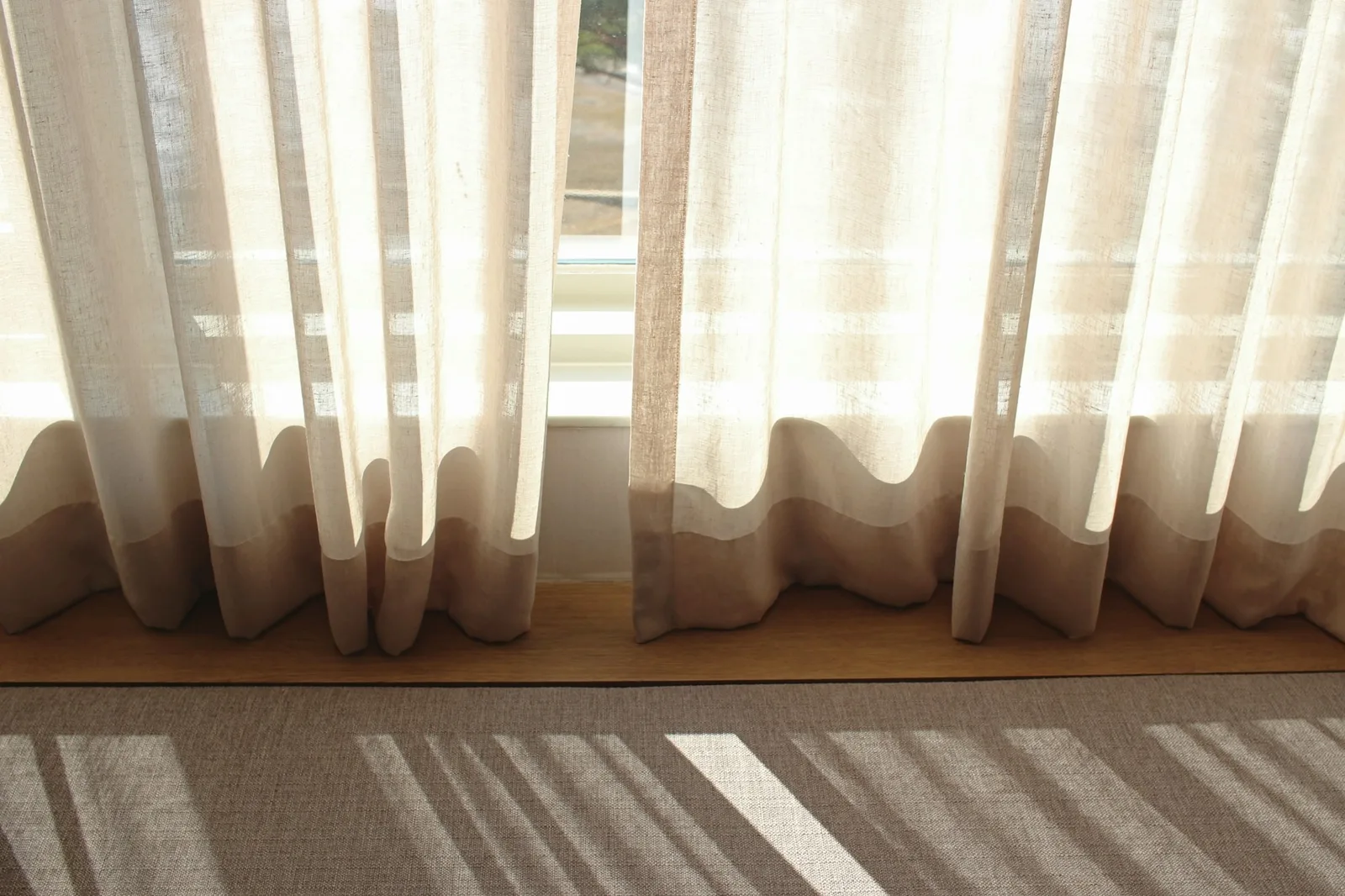
Wave curtains, also called ripple fold or S-fold curtains, hang in one continuous, even S-shaped curve from end to end. The curtain itself is made flat. A tape with press studs or hooks at fixed intervals is sewn along the top, and it clips onto carriers that run inside a dedicated track. The carriers are linked at a set spacing, so when the curtain closes the fabric swings alternately in front of and behind the track, making the same wave every time.
That precision is the point. A wave curtain looks equally orderly drawn and open, looks the same from inside and from the street, stacks into a narrow bundle at the side, and runs more evenly on a motor than any other heading, because every carrier moves in step. It is the heading we fit most often across the wide sliding doors and tall glazing of newer Goan villas.
Below is how the wave is formed, what the track and carriers do, how much fabric it takes against a pinch pleat, why it suits motorised tracks, which fabrics hang well in it, the clearance it needs, and what drives the cost. Our ripple fold curtains page shows the finished look, and the curtain rod length planner shows how much wall a wave curtain needs beside the glass.
How a wave curtain forms its S-shaped folds
Start with a flat, hemmed panel of fabric. Along the top, the workroom stitches a stiffened tape carrying press studs at a fixed pitch. In one manufacturer's ripple-fold fabrication guide, the studs on the tape sit 4¼ inches apart, about 10.8 cm, whatever fullness is chosen. Each stud snaps onto a carrier in the track. Between two carriers, the fabric that hangs from one stud to the next has nowhere to go but forward or back, and it alternates: one fold towards the room, the next towards the glass.
The same guide points out a practical consequence. Because the heading is a straight tape rather than a set of sewn pleats, the panel needs only straight hemming, with no stiffening crinoline in the heading, and off the track it lies perfectly flat. That makes a wave curtain easier to launder and press than a pleated one, and easier to take down before the monsoon.
Wave, ripple fold and S-fold are names for the same idea. Different systems attach the fabric in different ways, by snap tape, hooks or a tape that clips over gliders, but the look is the same: a regular, sculpted ripple rather than the clustered folds of a pleat or the loose gathers of a pencil heading.
The track and carriers set the fold
On an ordinary track the curtain decides its own folds, and they wander as it is drawn. On a wave track the carriers are joined by a cord or chain at a fixed spacing, so the folds stay the same size whether the curtain is half open or fully closed. The spacing is chosen before the track is made up, and it sets how deep the wave is.
The arithmetic is simple once you see it. If the fabric between studs is fixed at about 10.8 cm, moving the carriers closer together makes each loop of fabric stand out further, and puts more fabric on every metre of track. The manufacturer's table gives the result: carriers about 6.7 cm apart give 1.6 times fullness, about 6.0 cm give 1.8 times, and about 5.4 cm give two times. The table below converts its figures to metric.
This is also why a wave curtain cannot hang from a pole. Rings on a pole slide freely and bunch together, and the even spacing is lost. The heading needs a compatible track, which can be fixed to the wall, to the ceiling or inside a recess. The track ends also matter: the guide shows the curtain finished with a return, a short length of tape hooked back to the track end, which turns the outer edge of the curtain towards the wall and closes the side gap.
| Fullness option | Fabric-to-track ratio | Carrier spacing | Look |
|---|---|---|---|
| 60% | 1.6× | about 6.7 cm | Shallow, open wave |
| 80% | 1.8× | about 6.0 cm | Medium wave |
| 100% | 2× | about 5.4 cm | Full, deep wave |
Planning something like this?
We visit homes across North and South Goa, measure on site, and bring samples to see in your own light.
Fullness and fabric: wave against pinch pleat
Our fabric calculator uses 2.2 times fullness and a 12 cm heading allowance for a wave heading, against 2.25 times and 20 cm for a pinch pleat. On a wave track the final fullness is fixed by the carriers, so the workroom confirms the figure against the track being fitted; the calculator's figure is the working number for planning and comparing quotes.
Take a 300 cm opening, such as a pair of sliding doors onto a verandah, with lined curtains in a pair. Our planner gives a 480 cm track for a wave heading, about 89 cm past the opening on each side, against 545 cm for a pinch pleat, about 122 cm each side. The wave version needs 65 cm less wall, because the planner stacks wave curtains about 15% tighter than other headings: the folds nest into each other when the curtain is drawn back.
The fabric comes out close. With a 250 cm drop in a 137 cm plain fabric, the wave pair needs 480 × 2.2 = 1,056 cm of gathered width, ten widths, each cut 282 cm: 28.2 metres. The pinch-pleat pair on its longer track needs 1,226 cm, still ten widths after rounding, each cut 290 cm: 29.0 metres. So the honest summary is that a wave heading saves a little fabric and a good deal of wall, not the other way round. Our guide to how much fabric you need explains the rounding.
| Heading | Track | Past the opening, each side | Widths | Cut length | Fabric |
|---|---|---|---|---|---|
| Wave | 480 cm | about 89 cm | 10 | 282 cm | 28.2 m |
| Pinch pleat | 545 cm | about 122 cm | 10 | 290 cm | 29.0 m |
Why wave curtains suit motorised tracks in villas
A motorised curtain is pulled from one point, the master carrier at the leading edge. With a pleated or gathered heading, the fabric behind it is pushed along loosely and can bunch or lag. With a wave heading, every carrier is linked to the next, so the whole curtain moves as one piece and arrives at the same, even stack each time. That is why most motorised curtain tracks are specified with a wave or ripple-fold heading.
Villas in Goa often have exactly the openings where motors help: a wall of sliding glass onto a pool deck, a double-height living room, a bedroom with windows above head height. US Department of Energy guidance notes that automated coverings are easier to operate, especially in hard-to-reach places, and observes that 75% of residential window coverings stay in the same position every day. A curtain that is drawn by a schedule or a wall switch is one that actually gets closed against the afternoon sun.
Two cautions. A motor needs power at one end of the track, which is easiest before plastering, and it stops in a power cut, so a manual override matters. Our article on motorised curtains for villas covers wiring, motor sizing and outages, and the motorised curtains page shows what we fit.
Fabrics that hang well in a wave heading
Not every cloth suits the shape. The ripple-fold guide says as much: since not every fabric looks flattering in the heading, the fabric should be checked for compatibility, and if in doubt a sample should be made up and hung. That is good advice, and in practice a short trial drop on a length of track tells you more than any swatch.
Mid-weight plains, linen-look weaves and soft textures form the most even wave. Voiles and sheers suit it especially well; made in an extra-wide fabric, a sheer can run a long window with no vertical joins, and the regular spacing lets air move between the folds in the humid months. A blackout or standard lining sewn to the face fabric follows the same curve, so wave curtains can be as dark as any other heading on a well-placed track.
Very stiff or heavily coated fabrics tend to form angular folds rather than soft curves, and very heavy cloth can drag on the carriers over a long run. Strong horizontal patterns read differently too, because every other fold faces away from you. A large motif can be broken up by the ripple; a small, all-over pattern or a texture survives it well. Near the sea, pair the heading with an aluminium track and stainless or plastic fittings; plated steel parts rust and mark pale fabric.
Clearance: the wave needs depth in front of the glass
Because the fabric swings both in front of and behind the line of the track, a wave curtain needs more depth than a flat panel suggests. The folds facing the glass have to clear window handles, the frame of a sliding insect net, a sill, or timber shutters folded back into the reveal of an older house. A ceiling track set too close to the window will press the back of every fold against them.
Double tracks need more again. A sheer on a wave track behind a lined wave curtain needs two clear lines, each with room for its own ripple, and the front layer must not catch the back one. In a flat with a split air-conditioner above the window, or a bedroom with a wardrobe beside it, those few centimetres can decide where the track goes.
So the track position is measured from the obstacles, not from the window. When we survey a wave curtain we note every projection on the window wall, the depth of any ceiling pocket and the width of wall each side for the stack, and set the track line from those.
Measure the deepest projection on the window wall first. The wave starts from there.
What drives the cost compared with standard headings
We do not publish prices, because every window differs, but the drivers are easy to list. The largest is the hardware: a wave curtain needs a dedicated track with linked carriers and master carriers, where a pleated curtain can hang from a simpler track or a pole. A motor, if you want one, adds the motor, its control and power at the window.
Fabric is usually similar to or a little less than a pinch pleat on the same opening, as the worked example shows. The making is different rather than more: the panel is flat and hemmed with a tape, which avoids hand-formed pleats and stiffening, but the tape must be placed accurately so the studs line up with the carriers and the leading edges meet. Ceiling pockets, recessed channels and double tracks add their own work, and they are simplest to build while the ceiling is still open.
Over its life a wave curtain tends to be economical to keep. Off the track it is a flat panel that launders and presses easily, carriers and tape are replaceable, and the heading does not droop the way a softened pleat can after years of humid weather. If you are weighing it against other headings, our guide to curtain heading types compares them side by side, and our curtain tracks page explains the hardware.