 Drape Haus
Sofa reupholstery is worth it when the frame is sound and you like the sofa's shape and size; a new sofa makes more sense when the frame is weak, damaged or simply the wrong shape for the room. That is the whole decision in one sentence. The rest of this guide is about how to tell which situation you are in, before anyone quotes for fabric.
The question comes up constantly in Goa because so many households own seating that outlasts its cover. Teak and rosewood settees inherited with a house, a pair of armchairs bought when the flat was new, a family sofa with the right depth that no shop seems to make any more. In a humid climate the soft parts give up first: webbing stretches, foam crumbles, fabric fades on the side nearest the window. The timber underneath is often fine.
We rebuild sofas and chairs for a living, so we have an interest. That is exactly why we start every reupholstery enquiry with the frame, and say so when a piece is not worth the work.
Check the frame yourself in five minutes
You can learn most of what matters before calling anyone. Take the seat cushions off and lift one end of the sofa a few centimetres. A solid hardwood frame is heavy; a frame of board and battens is surprisingly light. As you lift, watch the far corner: a sound frame rises as one piece, while a weak one twists or the joint at the corner opens visibly.
Next, rock it. Stand at one arm and push it gently forwards and back, then do the same with the back rail. A little movement at a glued joint is common and usually repairable, because glue gives up long before good timber does. Creaking that follows the movement tells you which joint has gone. What you do not want to see is a rail that bends, or a leg that moves independently of the frame.
Then look underneath. Many sofas have a thin dust cloth stapled across the bottom; with a torch you can often see through the edges or a small tear. You are looking for the joints, the condition of the webbing or springs, and any sign of insects or damp. The Indian Standard code for furniture joints, IS 3845, calls for joints to be glued and describes rail-to-leg joints built as mortise and tenon with a corner block to strengthen them. That is the construction you hope to find. Staples driven through thin board, with no blocks at the corners, is the construction that rarely justifies a rebuild.
- Heavy frame that lifts as one piece: a strong candidate for reupholstery
- Loose joints that creak but timber that is hard and clean: usually repairable
- Small round holes or fine powder on the floor beneath: insects, which must be dealt with first
- Soft, dark or crumbling timber near the feet: damp or decay, often the end of that frame
- Light board frame held mainly by staples: rarely worth the labour
A loose frame is fine. A rotten or flimsy one is not. That difference settles most decisions.
Reupholster, repair, cover or replace: a decision table
There are really four routes, not two. A sofa repair fixes a failed part, such as a broken spring, a loose arm or a cracked leg, and keeps the fabric you have. A fitted sofa cover changes the surface when the sofa underneath is still comfortable. Full reupholstery strips the piece to its frame and rebuilds every layer. Buying new starts again.
The table sets out which symptoms point to which route. Most sofas sit clearly in one row once you have done the frame check above.
| What you find | Best route | Why |
|---|---|---|
| Sound frame, comfortable seat, tired or stained fabric | Fitted cover, or reupholstery for a tailored look | Nothing structural needs work; only the surface |
| Sound frame, fabric fine, one sagging seat or a broken spring | Repair | Open only what has failed and close it again |
| Sound frame, sagging seat and worn fabric together | Full reupholstery | Doing the repair and the recover separately wastes work |
| Heirloom or heritage piece, any condition short of decay | Reupholstery, or conservation for rare pieces | The frame and carving are the value |
| Frame twists, board and staples, or extensive insect or damp damage | Buy or commission new | New fabric would outlast the structure under it |
| Frame sound but the shape is wrong for you | Buy or commission new | A rebuild cannot make a shallow seat deep |
Planning something like this?
We visit homes across North and South Goa, measure on site, and bring samples to see in your own light.
Heirlooms and heritage pieces worth saving
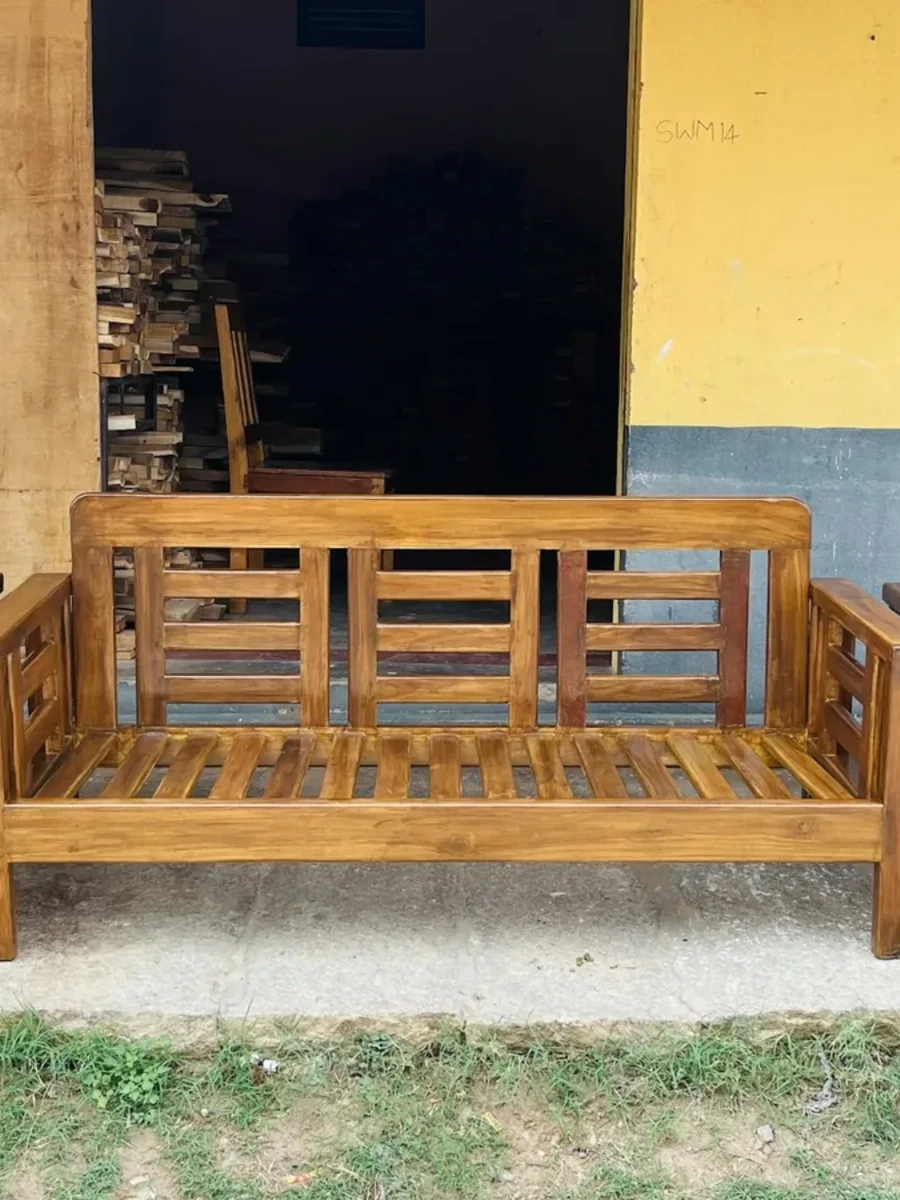
Some pieces are worth rebuilding whatever the arithmetic says. Older Goan houses often hold seating made in dense hardwoods by craftsmen who expected it to be re-covered many times: carved settees, caned planters' chairs, upholstered dining chairs that match a table nobody would separate them from. Their frames are usually overbuilt by modern standards, and the upholstery was always the part meant to be renewed.
With these, the aim shifts from comfort alone to keeping what is original. Polished show-wood should be protected while the old covering comes off, existing tack lines reused where possible so the rails are not riddled with new holes, and carving left alone. Traditional pieces were stuffed with coir or hair over hessian rather than foam blocks; on an important piece the upholstery can be rebuilt the old way, while on a piece that is simply loved, a hybrid with modern foam often makes more sense. Very rare or fragile pieces may need a conservator rather than an upholsterer.
If the furniture came with an old house you are restoring, plan it alongside the rooms. Our guides to restoring an old Portuguese house and heritage villa interiors look at the wider picture, and the wooden sofa buying guide explains how to judge the timber in a show-wood frame.
Comfort upgrades only a rebuild allows
Reupholstery is the one moment you can change how a sofa feels without replacing it. With the frame bare, the suspension can be renewed entirely: worn jute webbing replaced with modern elastic webbing, slack springs re-tied, or sinuous springs fitted where the frame was built to take them. A seat that used to bottom out can be made firm again from the deck up.
The cushions can be specified afresh. Seat foam can be a denser grade, a firmer one for an older parent who finds rising difficult, or a softer one wrapped in fibre for a television room. Back cushions can be filled more or less generously, which changes the effective seat depth by a few centimetres. Feather can be swapped for fibre if the house is closed through the monsoon. Within limits, seat height can be raised with a thicker cushion.
Details can change too. A skirted sofa can be finished on show-wood legs that lift it clear of the mop; a fixed cover can become removable; piping, buttoning or a tight back can be added or taken away. What a rebuild cannot do is change the geometry of the frame. A shallow sofa stays shallow and an upright back keeps its angle, so if the shape itself has never suited you, that is a reason to buy new.
What drives the cost of each route
We do not publish prices, because they depend on the piece, but the factors are predictable. For reupholstery, the biggest is labour: how much frame repair the stripping reveals, how many cushions there are, and how complex the shape is. Deep buttoning, channelled backs, curved arms and pleated skirts all take hours. The second is fabric: the number of metres, which rises sharply with large pattern repeats and stripes that must be matched, and the grade of cloth. Collection and return add a little, more if the sofa has to come down a narrow stair.
For a new sofa, the cost follows the hidden layers: frame timber and joinery, the suspension system, the density and thickness of the foam, the fabric, and whether it is made to measure or taken from stock. Two sofas that look alike in a photograph can differ widely in all of these, which is why price alone is a poor guide.
The fair comparison is over time, not at the till. A rebuilt hardwood frame can be re-covered again in another decade or two. A low-grade sofa that sags within a few years has to be replaced in full, and the next one carries the same risk. Our guide to reupholstery fabric explains how to work out the metres so you can compare quotes properly.
The waste argument for keeping a sound frame
Sofas are bulky, mixed-material objects that are hard to recycle. We could not find a national figure for discarded furniture in India, but the United States Environmental Protection Agency publishes one, and it is a useful reference point. In 2018, the year of the EPA's latest product data, 12.1 million US tons of furniture and furnishings were discarded in the United States, 4.1% of all municipal solid waste. Wood was the largest material in that furniture; 19.5% of it was burned for energy recovery and 80.1% went to landfill.
Keeping a sound frame in use avoids adding one more sofa to a figure like that. The parts that wear out, the foam, webbing and fabric, are replaced; the timber, usually the most valuable material in the piece, carries on. It is not a reason to rebuild a poor frame, but it is a good reason not to throw out a good one.
When damp or mould has reached the inside
A sofa that has been soaked by a leak or flood, or has grown mould inside the cushions during a closed monsoon, is a harder case. NC State Extension describes upholstered furniture damaged by water and mould as seldom salvageable, and says mouldy padding should always be discarded. It adds that a piece with sentimental value can be stripped to the frame, the frame cleaned, and then reupholstered once the frame is completely dry.
That matches what reupholstery involves anyway. If the frame is solid timber and dries out without softening, a full rebuild with all-new filling is a reasonable route for a piece you care about. If it was board, or the timber has gone soft, replacing the sofa is usually the honest answer.
What happens during reupholstery
Knowing the stages helps you judge a quotation, because a job that skips one will look fine on delivery and fail within a year or two. Expect the piece to be away for some weeks; longer if the frame needs significant work or the fabric has to be ordered in.
- Assessment at home: frame check, discussion of comfort and any restyling, fabric samples seen in the room's light
- Collection and stripping: old fabric, filling and suspension removed down to bare timber
- Frame repair: loose joints opened, cleaned and reglued, cracked rails spliced or replaced, any insect damage cut back to sound wood
- New suspension: webbing or springs renewed and tensioned
- New filling: foam cut to the frame and wrapped, back cushions refilled
- Covering: fabric cut with patterns centred and matched, piping and finishes added, dust cover fitted underneath
- Return and placing: the piece checked with you in the room, with labelled offcuts kept for future repairs