 Drapehaus
Drapehaus
Preparing the room
Drapehaus
Preparing the room
Season
Chovoth is the festival Goan households prepare hardest for, and it arrives at the most difficult possible moment. Falling in late August or early September, it lands squarely inside the monsoon, which means the traditional deep clean and refresh of the house has to happen in the wettest weeks of the year.
By the Drapehaus studio · 19 September 2026 · How we write
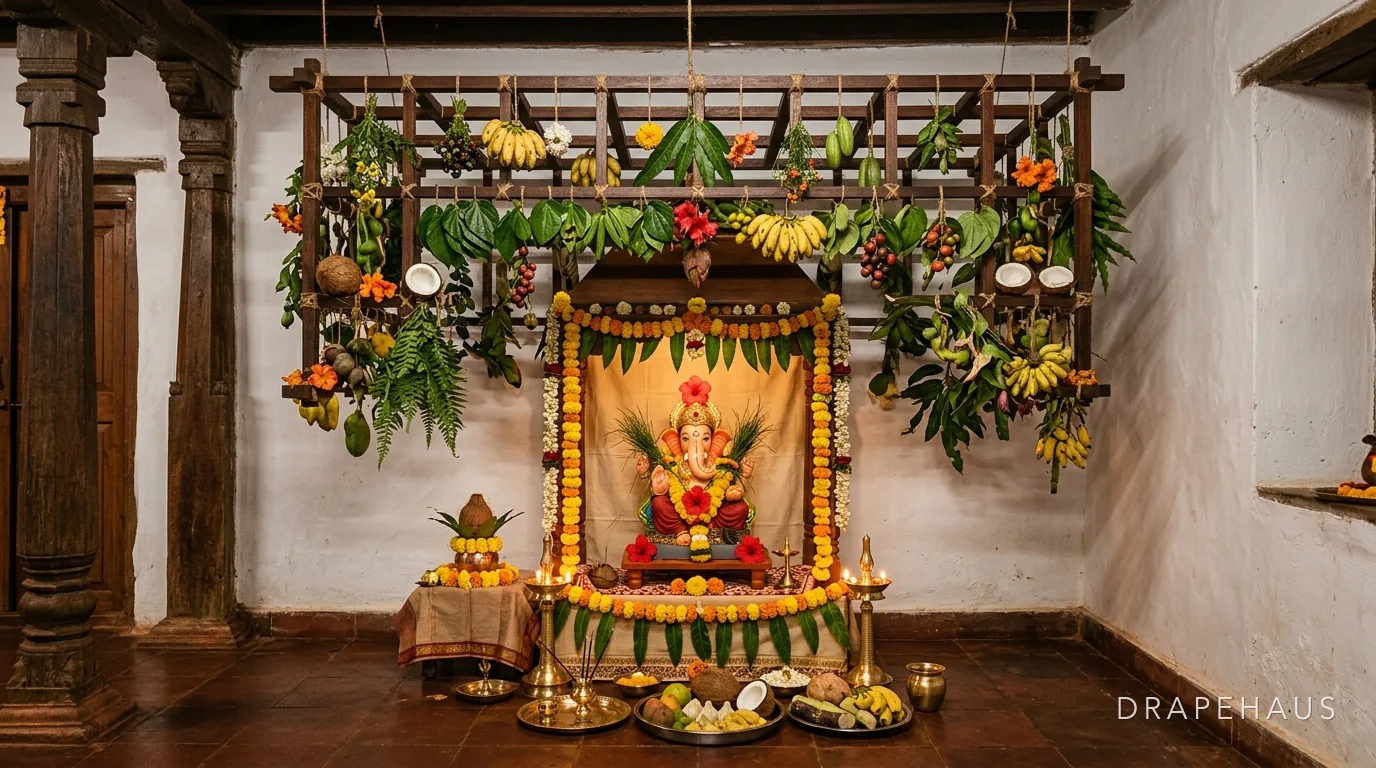
Families return from across India and abroad, the house fills, and the room where the idol is installed becomes the centre of the home for the duration. That room in particular gets attention that it may not receive at any other point in the year.
The practical consequence for anything involving fabric is that timing is everything. Work that would be simple in November is genuinely difficult in August, and the households that manage it comfortably are the ones that started in June or July.
This room carries the weight of the festival, and in most Goan homes it is a space that is also used normally for the rest of the year. Preparing it usually means clearing, cleaning and refreshing rather than redecorating.
Above the idol hangs the matoli, the canopy of local fruits, vegetables and forest produce that is particular to Goan celebration of the festival. It is suspended from the ceiling, which matters practically — anything fixed at ceiling level near that spot needs to accommodate it, and a recessed curtain track or a ceiling-mounted fitting should be considered in that light.
Fabric choices in this room tend towards the clean and uncomplicated. Light colours, simple weaves, nothing that competes visually. Many households prefer to remove heavier curtains for the festival entirely and let the room feel open, which is a reasonable instinct and costs nothing.
The traditional deep clean before Chovoth runs directly into the problem that nothing dries in late August. Washing curtains in the week before the festival is optimistic; they will not be dry, and hanging them damp starts the mildew process described elsewhere on this site.
The workable approach is to do fabric work several weeks ahead, in late July or the first half of August, and accept a couple of dry days as the window. Failing that, dry indoors with fans rather than hoping for sun.
Where something genuinely cannot be cleaned in time, taking it down for the festival is better than putting up something damp. An uncovered window for a week is not a problem; a mildewed curtain for the next decade is.
Rather see it in your own room?
We bring samples to the house, measure every window, and specify for the light and exposure you actually have.
More on this — tap a heading to read
If new curtains or soft furnishings are wanted for Chovoth, the order needs to be placed in June at the latest. Made-to-measure work takes weeks, monsoon logistics slow everything down, and the fortnight before the festival is when every workshop in Goa is fully committed.
Installation in the days immediately before is best avoided entirely. Houses are full, the room is being prepared, and a fitter working around that is an imposition on a household that has enough to do.
For families who come back specifically for the festival, it is often better to plan the fabric work for their next visit in a drier month, and treat Chovoth preparation as cleaning rather than renewal.
In Goa, Chovoth is centred on the family home rather than on large public installations, and many families return to an ancestral house in the village for it. Some of those houses are lived in year-round. Others are kept closed for much of the year and opened mainly for the festival.
A house that has been shut since the start of the monsoon will have spent two or three months in saturated air by the time the family arrives. Curtains that stayed up, mattresses on beds and cushions on chairs may all have taken on damp, even if nothing is visibly marked yet.
If you can, ask whoever looks after the house to open it and run fans a week or two before the family arrives. That alone takes the edge off the musty smell and gives a chance to spot any fabric that has mildewed, while there is still time to take it down rather than discovering it with the house full.
Oil lamps and incense are part of worship in many homes, and during the festival they may be lit more often and for longer than at any other time of year. Wherever there is an open flame, fabric within reach of it deserves a moment's thought, particularly light sheers that move in a draught from a fan or an open door.
The simplest precaution is placement. Tie back or hook clear any curtain that could swing towards the shrine area, and make sure no fabric hangs directly above a lamp. A ceiling fan running at speed can move a voile a surprising distance, so check with the fans on as well as off.
For a room that hosts flame regularly, it is worth asking about fabrics tested for resistance to ignition. In India the relevant standard for curtains and drapes is IS 15741, and many hospitality fabrics are also tested to BS 5867-2 or NFPA 701. These reduce the risk rather than remove it, so placement still matters.
Because Chovoth falls in the rains, fabric chosen for the festival room has to survive the same conditions as everything else in the house. Good polyester and polyester-blend fabrics now look and hang much more like natural fibres than they once did, and they dry quickly, resist mildew and wash easily after the festival.
Cotton and linen suit the clean, simple look many households want, and there is no reason not to use them. The trade-off is that they need airing and drying with care, and a white cotton curtain that picks up a mark during the festival may be difficult to wash and dry properly until the rains ease.
Removable, washable covers are worth considering for cushions and seating in the main room. With a full house, food and a great deal of coming and going, being able to take a cover off, wash it and have it dry on a fan within a day or two is more useful than any particular fabric.
Households keep the idol for different lengths of time. A day and a half is common in Goa, and other families observe five, seven, nine or eleven days before the immersion. Whatever the length, the house tends to empty quickly afterwards as family members return to where they live. Knowing the family's own custom helps plan when the house will be full and when it will be quiet again.
Those days just after the festival are a good moment for a quiet assessment. Mats, cushions, bedding and curtains that were used heavily can be washed and dried properly, and any damage from the preparations or from guests can be noted while it is fresh in everyone's mind. A short written list is enough, and it is far more reliable than memory by October.
It is also a natural point to decide on anything for the coming months. Diwali and Christmas both follow within a few months, and a decision made in September, while the rains are still falling and workshops are quieter, lands comfortably before either rather than in the middle of the October rush.
Diagnosis
WhyLate August is the wettest part of the year, and ambient humidity means nothing air-dries properly.
FixWash several weeks ahead in a dry break, or dry indoors with fans. Never hang anything damp.
WhyMade-to-measure lead times plus monsoon logistics, ordered in the fortnight when every workshop is busiest.
FixOrder by early June for a festival installation. Anything later is realistically for afterwards.
WhyTrack or a ceiling-mounted fitting was positioned without accounting for the canopy suspended above the idol.
FixRaise this at the survey. It is easily accommodated when known in advance and awkward to change afterwards.
WhyInstallation scheduled into the days when the household is at its busiest.
FixSchedule well before or well after. A week of bare windows is far less disruptive than a fitting team mid-preparation.
WhyShut since the start of the rains, with fabric and bedding sitting in saturated air for months.
FixHave the house opened and fans run a week or two before arrival, and take down anything that has marked.
WhyLight fabric moved by a ceiling fan or a draught from an open door during the festival.
FixTie back or hook clear any curtain near the shrine area, and check the placement with fans running.
WhyFixed covers on heavily used seating, in weather where nothing dries quickly.
FixUse removable, washable covers in the main room so any mark can be dealt with on a fan within a day or two.
Checklist
Order any new work by early June
Wash fabric several weeks ahead, not in the final week
Dry indoors with fans rather than waiting for sun
Flag the matoli position before any ceiling fitting
Consider removing heavy curtains for the festival rather than replacing them
Avoid scheduling installation in the days immediately before
Have a closed family house opened and aired a week or two ahead
Keep curtains clear of lamps and incense, checking with fans running
Use removable, washable cushion covers in the main room
Use the days after the immersion to wash, dry and assess
From the Journal
All articlesFAQ
By early June. Chovoth falls in late August or early September, made-to-measure work takes weeks, and monsoon logistics slow every stage. Ordering in August means the curtains arrive after the festival, not before it.
Do it several weeks ahead and use a dry break, or dry indoors with fans running. What you must not do is hang anything damp — in late August it will not dry afterwards, and that is how curtains mildew for good.
Light colours and simple weaves that do not compete visually. Many households prefer to take heavier curtains down for the festival and leave the room open, which costs nothing and often looks better. Flag the matoli position before any ceiling-level fitting.
Better not to. The household is at its busiest, the house is full of returning family, and the room is being prepared. Schedule well before or well after — a week of bare windows is far less disruptive than fitters working around the preparations.
Ask whoever looks after it to open the house and run fans a week or two before the family arrives. That clears much of the musty smell and shows up any curtains, bedding or cushions that have taken on damp during the rains, while there is still time to take them down and deal with them.
They can be, particularly light sheers that move in a fan's draught. Tie back or hook clear anything that could swing towards a lamp, and make sure nothing hangs directly above one. For rooms that regularly have open flame, ask about fabric tested to IS 15741 for resistance to ignition.
Good polyester and polyester blends dry quickly, resist mildew and now hang much like natural fibres, so they cope well with a festival in the rains. Cotton and linen suit the simple look many households want but need more careful airing. Removable, washable cushion covers help whatever the curtains are.
In the days after the immersion, once the house has emptied. Workshops are still relatively quiet in September, and a decision made then lands comfortably before Diwali and Christmas rather than in the October rush, when every household in Goa is trying to do the same thing.
Keep reading
