 Drape Haus
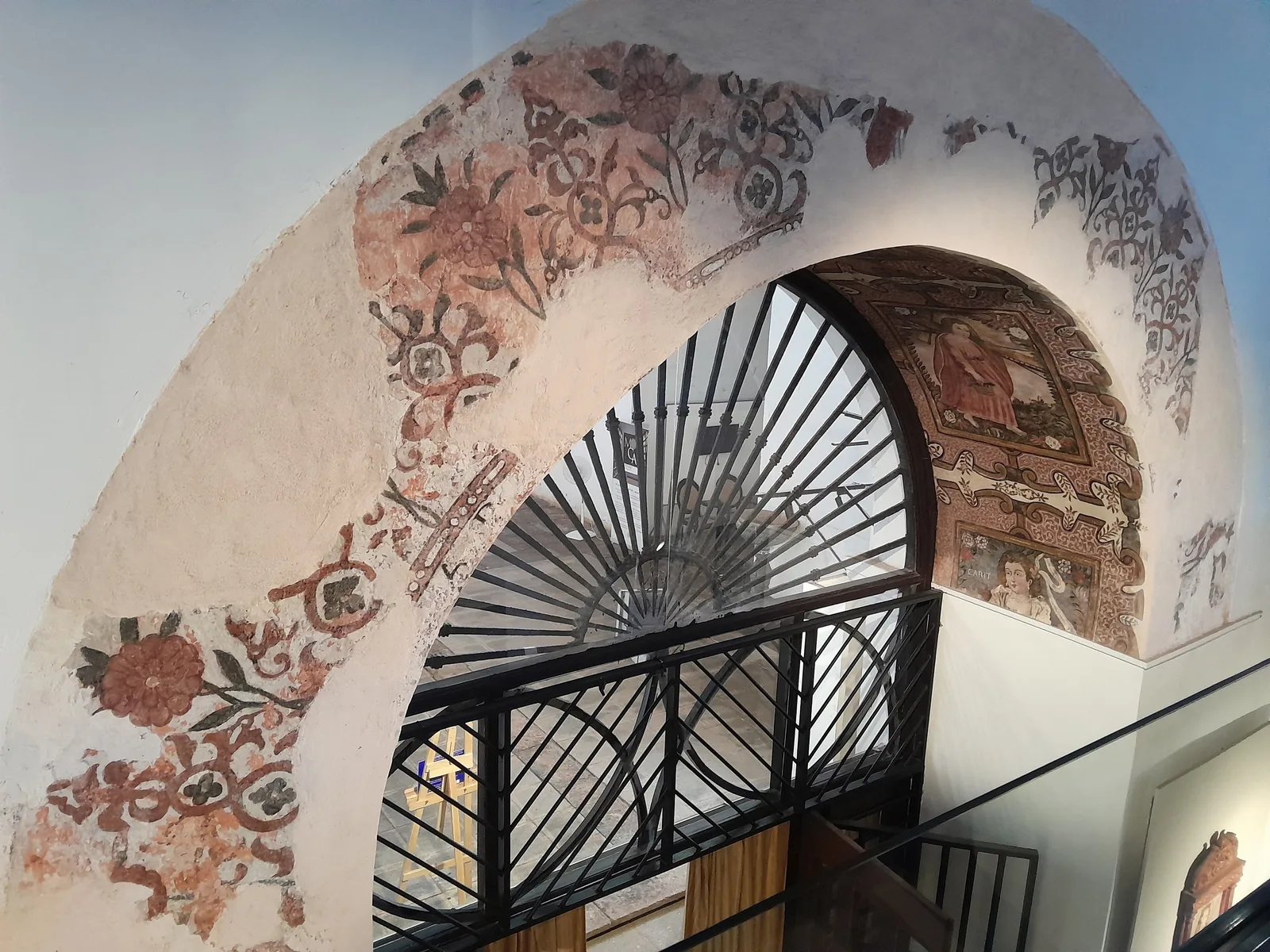
Kaavi art is the mural tradition of the Konkan coast in which designs in a single laterite red are worked into white lime plaster on the walls of temples and some old houses. The name comes from kaav, the red oxide pigment, and the full term kaavi kalé means, roughly, red-oxide art. A 2020 study in the Journal of Traditional Building, Architecture and Urbanism describes it as an incised plasterwork found along the coasts of Goa, Maharashtra and Karnataka, mostly in Hindu temples but also in churches, a mosque, Jain temples and houses.
In Goa it is also something more than decoration. Heritage writer Heta Pandit, who has documented kaavi in Goa for years, describes it as a sacred art that defines sacred space, rendered on the walls of temples and in the sacred spaces of Hindu homes. That matters for anyone who wants to bring its look indoors, and it shapes the advice at the end of this guide.
Below we explain how kaavi was made, as the two most detailed published accounts describe it, where examples survive, what its motifs are, and how to use them in wallpaper, fabric and panels with care. For the place of kaavi among the other elements of the Goan house, start with our field guide to Goan architecture.
What kaavi is, and why one colour
Kaavi uses two materials that the Konkan has in abundance: lime, burnt from seashells, and red earth from laterite, which the 2020 study notes is called thambdi mathi in Konkani and huramunji in Kannada. The red comes from the iron oxides in the laterite. The result is a wall finish of only two tones, a deep maroon red and the white of lime, in patterns ranging from simple borders to full figurative murals.
The same study gives a practical reason for the single colour. Citing earlier research on the coastal art of Karnataka, it explains that multicoloured painted murals could not survive the heavy rain and humidity of the monsoon, because their surfaces would keep peeling, whereas a shell-lime and laterite finish made part of the plaster itself was far more resistant. Kaavi is, in that sense, a climate-proof mural.
Its origins are uncertain. Researchers have argued that it began in Goa, on the evidence of scripts, dress and ornaments in the oldest murals, while others have suggested the incised technique arrived with the Portuguese. The 2020 study notes motifs shared between Goan temples and some of the earliest Portuguese-era buildings in Old Goa, and admits that the dating of temple murals is difficult because renovations were frequent and records few. Both Pandit and the 2020 authors record a link between Goa and the kaavi temples of coastal Karnataka, which temple priests there explain through families who left Goa in the 16th century and took their deities and temple art with them.
How kaavi was made: two published accounts
The 2020 study, based on site surveys and experiments, describes a sequence of layers. A rough lime plaster 20 to 40 mm thick goes onto a wall of laterite stone or compressed laterite blocks. A smooth lime plaster follows. Then comes the kaavi layer, made from sieved laterite soil and lime putty in a ratio of 4 to 0.5, ground to a butter-like paste and left to ferment for two days. It is applied over the smooth plaster as thin as an eggshell, and the etching starts at once, while it is wet, so that scratching through the red reveals the white beneath. Plant and other organic additives, including jaggery, appear in the lime mixes, and the study found that every artisan had his own recipe.
Tools were simple: steel bodkins called kanta, a timber compass, and wooden stencils for repeating geometric designs. Large murals were drawn on paper, the lines pricked with pins, and the design transferred by dusting dry lime through the holes. Because the red layer must be worked wet, the artisan could only lay as much as he could finish. Curing began about twelve hours after the etching and continued for four days at six-hour intervals, and the surface was polished with smooth river stones or with coconut husk and coconut oil.
Pandit's account, from her fieldwork in Goa, describes the process the other way round: the wall is plastered and cured, the design is etched out of the white, and the cavities are filled with kaav, a paste of fine red soil, charcoal and the sap of a liana creeper as binder, then rubbed flush. The 2020 study also found that in some Goan buildings the etched areas were refilled with lime so the finished mural lay flush with the wall. The two accounts may describe different workshops, periods or surviving practice, and we have kept both rather than choose between them. What they agree on is that kaavi is part of the plaster, not paint on top of it.
| Kaavi (2020 study) | Sgraffito in Goa's churches (Pandit, 2017) | |
|---|---|---|
| Base layer | White lime plaster first | Red or black earth applied to the wall first |
| Top layer | Thin red kaavi layer over the white | Design scratched out and filled with white lime |
| Where found | Temples, some houses, also churches and other buildings | Old Goa's churches, the Archbishop's Palace, the Chapel of Our Lady of the Mount |
| Motifs | Borders, medallions, geometric patterns, deities and epic scenes | Christian motifs, different in execution and taste |
| Surface | Cured and polished, often flush with the wall | Flush where the design is filled |
Planning something like this?
We visit homes across North and South Goa, measure on site, and bring samples to see in your own light.
Where kaavi survives in Goa
Most surviving kaavi in Goa is on temples in the northern and eastern talukas and on a small number of old houses. The 2020 study illustrates the Maruti temple at Advalpal, kaavi medallions on the soffit of the Maruti temple at Pernem, and the Morjai temple at Morjim, where kaavi runs along the cornices, pilasters, openings and plinth. Pandit's writing adds the Shri Saptakoteshwar temple at Narve, a state-protected monument where she records that later interventions have left the original kaavi barely visible, and restored examples at the Vijaydurga temple at Keri, the Kshetrapal temple near the Siolim bridge and the Maruti temple at Advalpale. At Morjim, she records, the temple's trustees chose to remove a later pink colour wash to bring the kaavi back. A 2026 piece in The Goan, on the traditional skills behind Goa's buildings, likewise places kaavi in hinterland temples and older chapels.
Houses are rarer and almost all private. Pandit describes ocean-wave borders running along the middle of the walls of the Deshprabhu house in Pernem, a Ganesha with a cobra around his waist at the Desai house in Lamgaon, Bicholim, and Vishnu reclining on the serpent at the Rane house in Sankhelim. She also describes separate business or guest houses, set apart from the main house, where buyers of farm produce were received, richly decorated to impress. The 2020 study notes that kaavi in houses was often the first to be lost when owners rebuilt with modern materials.
Visit with respect. These are living temples and family homes, not galleries. Dress modestly, follow the custom at the entrance, ask the priest or custodian before taking photographs, and never touch the walls. Do not lean against a decorated wall, chalk over a motif or rub it to bring up the colour. Private houses are private: look from the road unless the family has invited you in.
Kaavi is part of a sacred space. Ask before photographing it, and never touch it.
The motifs: borders, medallions and figures
Pandit groups kaavi designs into three families. First, running borders: waves, dots and lines of half-open or upturned lotus buds, which often divide a wall into lower and upper halves and give the building its proportions. Second, floral designs, either as circular medallions or as running lengths. Third, figures: heavy, full-bodied male figures and animals with divine attributes, including door guardians whose dress and headgear she traces to Yakshagana theatre.
The 2020 study adds the architectural logic. Openings were edged with kaavi borders. Cornices and plinths carry rows of inverted leaves and spirals. Pilasters have V-shaped or inverted-V bands. Geometric fields are built from triangles, squares, hexagons and octagons. Flowers are drawn as groups of oval petals, and adding a trunk turns a flower into a tree. The large murals sit in niches or on platforms, from about half a square metre to more than three, framed by an arched ring of flames.
Two motifs show how much meaning sits in the patterns. Pandit describes medallions of interlaced cobras radiating from a centre, drawn with two bodkins and a string as a compass, and links them to the cobra in Goan domestic worship. The lotus, she notes, stands for purity and transcendence. A pattern that looks like a pleasant border to a visitor may carry a meaning to the family or the temple that made it.
Using kaavi motifs indoors, respectfully
Because kaavi defines sacred space, the respectful line is fairly clear. The deities, door guardians and narrative murals belong where they were made: in temples and in the shrines of homes. Printing them on cushions, bedroom wallpaper, rugs or bath tiles turns devotional images into pattern, and putting a deity on something that is sat or walked on will offend many people. Leave the figures alone unless you are commissioning a genuine work for a family shrine.
The borders and geometric work are a different matter. Wave and lotus-bud borders, interlocking hexagons, and floral medallions are architectural ornament as much as symbol, and they translate well into a modern room when treated with restraint. A single border at dado or frieze height, a pair of medallions above a doorway, or a cushion with a running wave pattern acknowledges the tradition without imitating a temple wall. In a home prayer room, a kaavi-style border around the shrine is fitting; our article on pooja room curtains covers the fabric side of that room.
Do not copy a specific temple's design onto a product without asking. A medallion photographed at a named temple is that temple's heritage, and its custodians may not want it reproduced. Take inspiration from the families of motifs, as documented by researchers, and have an artist draw your own version.
- Suitable for home use: wave and lotus-bud borders, geometric fields, floral medallions, the laterite-red and lime-white palette.
- Best kept for shrines and commissioned work: deities, door guardians, epic scenes and cobra medallions.
- Avoid anywhere: sacred figures on floors, rugs, doormats, bath tiles or anything that is sat on.
Wallpaper, fabric and panels that interpret kaavi
The simplest way to bring the kaavi palette into a room is colour alone: a lime-white wall, a laterite-red border or a red-earth cushion against natural linen. Pattern can follow. A custom mural wallpaper with a single kaavi-inspired border, printed in two tones on a textured, matt ground, reads far closer to the real thing than a busy repeat. Our home wallpaper range includes made-to-measure murals printed from an artist's drawing.
Choose the wallpaper for the wall. On an old lime-plastered laterite wall, a vinyl paper traps moisture and causes damp and mould; a breathable, non-vinyl paper or a framed panel hung clear of the wall is safer, as our guide to the best wallpaper for humid walls explains. Never paper over an original kaavi wall, even to protect it; that is a job for a conservator.
On fabric, kaavi motifs work best printed in one colour on cotton or linen: cushion covers with a medallion, a table runner with a wave border, or curtains with a narrow printed band near the hem. Keep the rest of the room quiet, with plain linen sofas and natural timber, so the red-and-white pattern reads as the one decorative note. Our cushions and soft furnishings can be made up in a fabric printed to your design.
| Approach | Works best for | Watch out for |
|---|---|---|
| Colour only: lime white and laterite red | Any room, large or small | Reds fade in strong west light; line curtains |
| Single printed border on wallpaper | Living rooms, halls, a prayer corner | Use breathable paper on old lime walls |
| Printed cushions and runners | Sofas, dining tables, window seats | Keep sacred figures off anything sat on |
| Framed panel by a living artist | A focal wall, above a console | Agree credit and reproduction rights in writing |
| Real kaavi on new lime plaster | A shrine, entrance or new heritage-style house | Needs a skilled practitioner and a lime-plastered wall |
Commissioning an artist, and crediting the work
Pandit wrote in 2017 that there seemed to be no traditional practitioners of kaavi left in Goa, and that much of the knowledge of materials and tools had been lost. The same paper notes Goa-based architects who had taken up the practice to keep it alive, and her later writing mentions a kaavi artist from Karnataka working with researchers. Practitioners are few, so ask the heritage groups that have documented kaavi for names of people working today.
Treat a commission as you would any original artwork. Agree in writing what you are buying: a mural on your wall, a drawing, or the right to print the design on wallpaper or fabric, and for which uses. Credit the artist on anything you show publicly, and do not hand their drawing to a printer for a second product without permission. If you want a design printed on wallpaper and cushions, tell the artist at the start so the drawing can be made at the right scale and the fee can reflect it.
A real kaavi mural also needs the right wall. It is a lime technique and will not bond to cement plaster or modern paint, so it suits a new lime-plastered wall or a carefully prepared old one, and it should be cured as the artist directs. When the design is ready to print, send it to us with the room's measurements and we will advise on the wallpaper, fabric and scale.