 Drape Haus
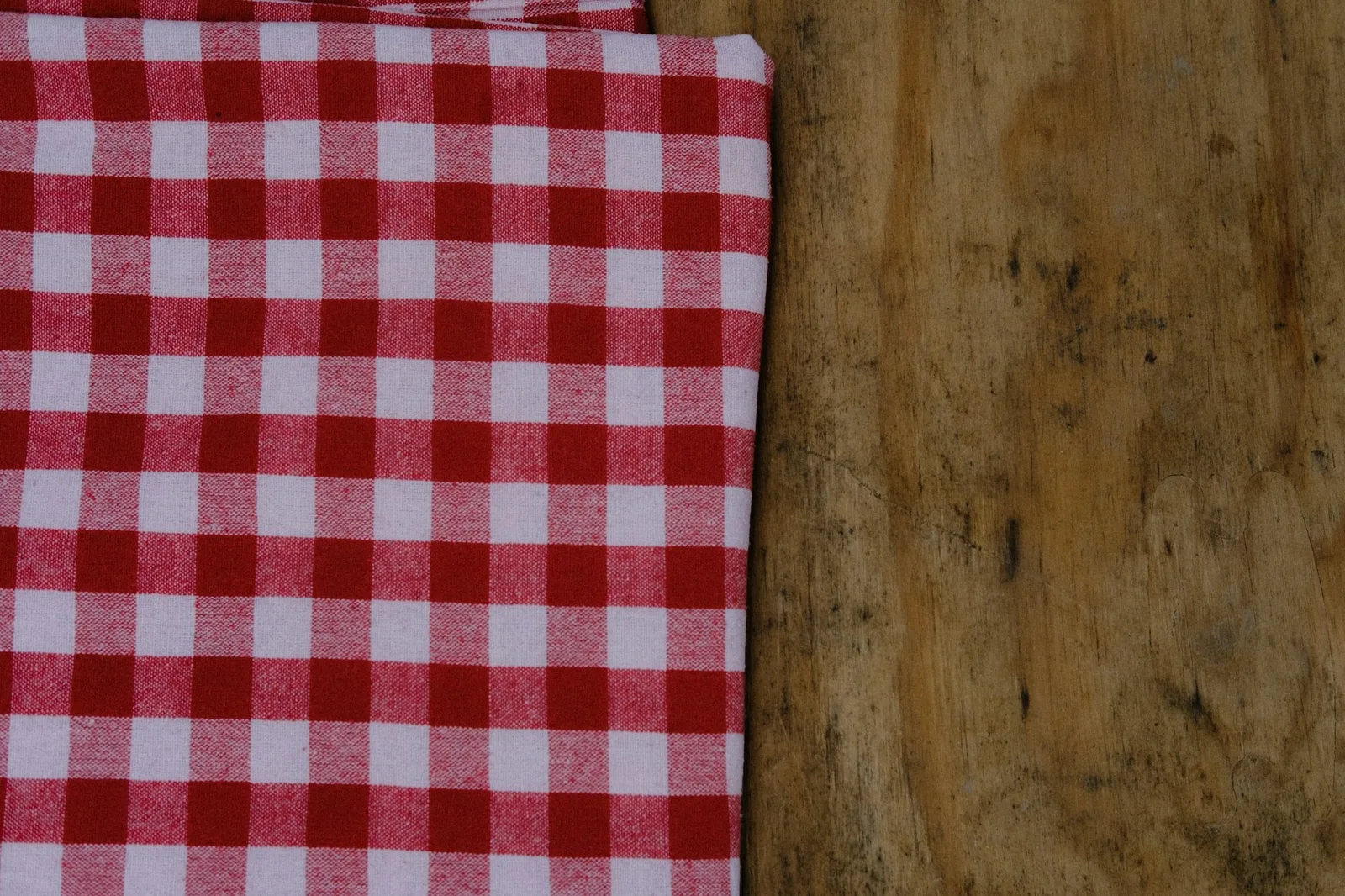
The kunbi saree is the checked cotton saree of Goa's oldest farming communities, the Kunbi and Gawda, woven traditionally in red and white with a sturdy body that stood up to work in the paddy fields. It is the one saree Goa can call its own, and after more than a century in which it was barely woven in the state, it is back on Goan looms through a government training programme and a handful of independent weavers. Its bold checks also happen to make some of the best cushion covers, runners and kitchen curtains a Goan home can have.
Using it well means three things. Know what you are buying, because powerloom and printed checks are sold alongside handwoven cloth. Respect what it is, because this is a community's dress, not a generic gingham. And treat the dyes with caution, because strong reds on handloom cotton can bleed in the first wash and spoil a white sofa or a set of white piping.
This guide covers the weave's history and its pending geographical indication, how to tell genuine handloom from lookalikes, the pieces it suits indoors, a simple colourfastness test borrowed from textile conservators, and a washing and drying routine for Goa's wet months. We make cushions, bolsters and curtains from customers' own fabric, so the practical parts come from the workroom.
What the kunbi saree is, and why some prefer the name kapod
The fullest written description of the saree is the statement of case filed with India's Geographical Indications Registry in 2024. It describes a 100 percent cotton cloth, handwoven locally, with a red base and a checked pattern, worn by Kunbi and Gawda women. The traditional length was about four to five yards, shorter than an ordinary saree, because it was worn above the ankle for field work. It was tied with a knot on the right shoulder, a drape the statement calls dethli, and was originally worn without a blouse.
Colour carried meaning. The same document lists a small, fixed palette of red, white, yellow and green with darker maroon, purple and black, and says the colours were associated with stages of life from youth and marriage to old age and death. Accounts differ on the details: a 2026 feature in The Navhind Times quotes a tribal rights advocate who says red was the festive colour while maroon and blue were worn for mourning. What all the sources agree on is that the classic combination is red and white checks, and that the body relied on checks rather than printed or woven motifs.
The Navhind Times feature also records that many in the Gawda community call the garment the kapod, and that the traditional version had a border of two rows of small rudraksha motifs. The GI statement notes that check sizes varied between communities, with Christian Gawda women wearing larger squares. If you are using the cloth in a home, it is worth knowing both names and a little of the story, because the people who wore it have not always been the ones who benefited from its revival.
Kunbi checks are woven, not printed: the colour runs right through the cloth and the pattern looks the same on both faces.
How the weave disappeared and how it came back
The decline came from several directions at once. Writing in Gulf News in 2019, the late Goan designer Wendell Rodricks said the saree had not been woven in the state for over a hundred years, blaming colonial restrictions on Indian dress and the caste prejudice that kept it a tribal garment. The GI statement says that between the 1920s and 1950s production was concentrated in a few weaving families in villages such as Candolim, Bastora and Pernem, and that Goans later bought similar powerloom saris woven around Dharwad and Hubli in Karnataka. The Navhind Times adds stigma, rising cotton prices and a shift to polyester among older wearers.
The revival has two strands. One began in 2009, when a textile researcher approached Rodricks and was led to a family of handloom weavers in Pernem who were still weaving the checked kashti cloth; the collection they developed was shown at India Fashion Week in 2010. Rodricks himself wrote that his version changed the colours, dropped the dobby edge and added ikat, so it was a reinterpretation rather than the traditional saree.
The other strand is public. According to The Navhind Times, the Goa Department of Handicrafts, Textile and Coir began handloom training for women around 2014, and about 20 centres across the state, including Pernem, Bicholim and Shiroda, now teach the kunbi weave: six months of training followed by nine months of support with looms, yarn and a stipend. A 2023 press note from the Government of Goa quotes the department's director saying there was demand for 2,000 kunbi sarees a month that the trained weavers could not yet meet. ThePrint reported in 2024 that 45 first-generation women weavers had formed a cooperative across four centres, some housed in disused school buildings. In 2022 the Union textiles ministry approved a Kunbi Handloom Crafts Village near the Selaulim dam in Sanguem, which the Navhind feature describes as still in the works.
Planning something like this?
We visit homes across North and South Goa, measure on site, and bring samples to see in your own light.
The GI application: what it covers and what it does not yet mean
A geographical indication ties a product's name to the place and methods that give it its character. You will see kunbi cloth described as GI-tagged in markets and online. As of October 2026 that is not correct. The Geographical Indications Registry lists application number 1278, 'Goa Kunbi Saree & Fabrics', filed on 18 June 2024 by a Goan handloom weavers' cooperative in classes 24 (textiles) and 25 (clothing), with its status shown as examination. No registration certificate has been issued, so no seller can yet claim a registered GI for kunbi cloth.
The application is still useful to a buyer because it describes what the applicants consider authentic. Its statement of case gives the revival saree as six metres long and 48 inches wide, woven from fine 2/60s cotton warp and 60s weft supplied through the National Handloom Development Corporation, in red, maroon, yellow, green and bleached white. Crucially for interiors, it also covers kunbi fabrics: cloth woven in the checked pattern without a border, which the applicants mention being made into jackets, along with checked shawls with a narrow plain border.
One honest caution from the people involved. The Navhind Times quotes a designer who has worked with the weave noting that the government-trained weavers are producing the basic checked weave but not yet the traditional borders, which are what set the cloth apart from checks woven elsewhere. For a cushion or a curtain, the plain checked yardage is exactly what you want. If you are buying a saree as a heritage piece, ask about the border.
Telling handwoven kunbi from powerloom and printed checks
Red-and-white checks are woven all over India, and a printed check can be run off any mill. None of that is wrong in itself, but if you want Goan handloom you should be able to tell the difference. The tests below are general textile knowledge rather than anything official, and none of them is proof on its own. Use them together, and ask the seller directly where and how the cloth was made.
The most reliable place to buy is close to the source: the government training-cum-production centres, the department's exhibitions and craft fairs, and the state handicrafts emporia. Weavers' groups also sell at exhibitions around the state. Ask whether the cloth was handwoven in Goa, what the yarn is, and whether the dye is natural or synthetic; a maker will know, and a reseller who cannot answer is telling you something too.
| Check | Handwoven kunbi | Powerloom | Printed lookalike |
|---|---|---|---|
| Back of the cloth | Pattern identical on both faces | Pattern identical on both faces | Pale or blurred on the back |
| Where colours cross | Blended squares where red warp meets white weft | Blended squares, very even | Flat ink, sometimes slightly off-register |
| Regularity | Small variations in beat and check size along the length | Uniform, machine-perfect checks | Uniform, with a crisp printed edge |
| Edges | Firm selvedge, sometimes slightly wavy | Straight, tight selvedge | Often a cut edge or plain white selvedge |
| Handle | Dense, slightly crisp cotton that softens with washing | Smooth and even | Stiff from print paste until washed |
Where kunbi cloth works in a room, and where it does not
The weave was designed to be worn hard and washed often, so it belongs on things that are handled and laundered: cushion covers, bolster covers, table runners, napkins, a throw over the arm of a sofa, a bedspread in a guest room. It is less suited to anything that sits in full sun all day or hangs as a large, unlined curtain, because strong reds on cotton fade on the face that takes the light. The Canadian Conservation Institute notes that ultraviolet light fades many dyes, natural and synthetic alike.
Scale matters more than colour. A large check on a small cushion looks busy, and a small check on a long curtain reads as a flat pink from across the room. Use the boldest checks on big, simple shapes such as a bolster or a bedspread, and a single kunbi cushion among plain ones on a sofa. If the cloth you have is a saree with a border, plan the cutting so the border becomes the edge of a runner or the band of a cushion, rather than being cut off.
Width decides the cutting plan. At about 122 cm wide, a length of kunbi yardage gives two 50 cm cushion fronts side by side with room for seams, or one long bolster cover across the width. For a kitchen café curtain on a short rod, one width usually covers a standard window with a gentle gather. Our fabric calculator helps you work out how much to buy before you order from a weaver, because a second batch may not match the first.
- Cushion and bolster covers on a plain sofa or a cane settee, with zips so they can be washed
- Café curtains on a kitchen or bathroom window, where the light is filtered rather than direct
- Table runners and napkins, which suit the cloth's original purpose of being used and washed
- A bedspread or folded throw in a guest room, away from the afternoon sun
- A fabric-covered headboard panel or pinboard, where the checks can be seen but are not rubbed
Making up: matching checks, linings and the right trims
Checks expose careless cutting. On a cushion, centre a check on the front and match the lines at the zip on the back. On a pair of curtains, cut both from the same point in the repeat so the checks line up across the window when they are closed. Handwoven checks are never perfectly regular, so a maker matches by eye at the most visible line rather than by measurement alone; allow a little extra cloth for this.
Kunbi cotton is fairly light for a curtain. Line it with a plain cotton lining if it will hang at a window that gets any direct sun, which protects the dye and gives the curtain enough body to hang straight. For a kitchen café curtain on a north or east window, unlined is fine and easier to wash. Our cotton curtains page explains the lining choices, and the cotton fabric guide covers how cotton behaves in Goan humidity.
Choose trims after the colourfastness test, not before. White piping on a red check is a classic look and a classic disaster if the red bleeds. Self-piping cut from the same cloth, a plain natural cotton, or no piping at all is safer until you know how the dye behaves. Use zips or envelope backs on every cover so that it comes off for washing; a sewn-shut kunbi cushion cannot be cared for properly. When you have the fabric, our cushions and soft furnishings service makes covers to the exact size of your inserts and seats.
Washing, drying and the monsoon
Goa's climate is hard on cotton for four months of the year. The India Meteorological Department records morning relative humidity between 87% and 91% from June to September, and about 84% in October. The Canadian Conservation Institute explains why that matters for textiles: at 70% relative humidity mould can take three months or more to develop, but at 90% it can develop in a few days. A damp cushion cover left on a sofa in August is exactly the condition it describes.
Pre-wash the cloth before it is cut, so any shrinkage happens before the cover is made rather than after. Wash kunbi covers on their own or with other dark colours in cool water, with a mild detergent and without bleach or optical brighteners. Dry them on a line in shade with good air movement, because full sun fades the reds and a slow, airless dry indoors invites mildew. In the monsoon, a fan and a dehumidified room do more than any detergent.
Store spare covers clean and completely dry, folded in a cotton bag or wrapped in an old cotton sheet inside a cupboard, never in a sealed plastic bag where trapped moisture condenses. In a house that is closed for the rains, take the kunbi covers off and store them rather than leaving them on cushions in a shut room. Our monsoon take-down and storage service does this for curtains and cushions in homes that are left empty.
Pairing kunbi checks with linen, cane and white walls
Kunbi checks are strong enough to carry a room's colour on their own, which is why they need quiet company. They sit best against lime-white walls, unpainted or dark timber, natural linen and cane. Keep the sofa and main curtains plain, in oat, stone or white, and let two or three kunbi pieces supply the red. On a red oxide floor, the checks pick up the floor's colour and the room hangs together without any effort.
Avoid mixing several checked or striped fabrics in one place, and resist adding every other Goan reference at once. A room with kunbi cushions, azulejo tiles, a samai lamp, crochet runners and shell lamps reads as a showroom. Our article on Goan home decor ideas covers the wider palette, and living room decor ideas explains how to build a cushion scheme from one colour already in the room. The kunbi weave works best as that one colour. When you have the cloth, send us your measurements and we will plan the cutting with you.
How to test kunbi cloth for colourfastness before it is made up
This is a simplified home version of the spot test the Canadian Conservation Institute describes for textiles before wet cleaning. Do it on an offcut or a hidden corner, on every colour in the cloth.
Prepare white blotters
Cut a few small squares of white cotton or white kitchen paper. Use plain water at the temperature you plan to wash in, roughly 20–30°C.
Wet one colour at a time
Place a drop or two of water on a red square of the cloth and let it soak in. Repeat separately on the other colours, including any border or dobby yarns.
Blot and wait
Press a white square on the wet spot with a light weight on top. Check it after a few seconds, then at 2, 5, 15 and 30 minutes. Stop as soon as any colour appears on the white.
Repeat with detergent
If plain water shows nothing, repeat on a fresh spot with your detergent mixed at washing strength. Detergent can release dye that water alone does not.
Decide how to wash
No transfer: wash as normal with dark colours, cool. Faint transfer: wash alone, cold, several times before making up, and skip white piping. Strong transfer: use the cloth only for pieces that are rarely washed, or ask a dry cleaner.