 Drape Haus
Goan handicrafts span far more than souvenirs. Goa Tourism lists terracotta and pottery, brass casting and copperware, bamboo and fibre craft, wood turning and lacquerware, crochet and embroidery, coconut-shell carving and shell craft among the state's living crafts, made both by artisans in their villages and at government craft complexes. Many of them were made for use in Goan houses long before anyone sold them to visitors, which is the best reason to bring them home: they were designed for this climate and this way of living.
This guide is practical rather than decorative. For each craft it explains what it is, who makes it and where, which part of a home it suits, and what Goa's humidity, salt air and sun will do to it. It ends with how to buy honestly, because mass-made imports are sold as local craft in every tourist market.
Our separate article on Goan home decor ideas covers the overall look of a Goan interior. This one is about the objects themselves and how to keep them.
What counts as a Goan handicraft
Goa Tourism describes the state's crafts as an aesthetic blend of Portuguese and Indian cultures, made by artisans working in their own rural surroundings and at arts and crafts complexes run by the government, and sold through handicraft emporia and stalls at tourist spots. Its list of major crafts runs from bamboo work, woodcarving and brass to shell craft, papier-mâché and wooden lacquerware, with jute macramé, fibre craft, crochet and embroidery, coconut-shell carving and metal embossing among the rest.
Behind much of this is public training. Goa's Department of Handicrafts, Textile and Coir, set up as a separate department in 2013, runs training-cum-production centres in both districts under its Vishwakarma Kaushal Yojana scheme. Its citizen's charter lists centres for trades including handloom weaving, pottery, wood craft, bamboo and coir. That matters to a buyer: a good share of what is made in Goa today is made by people trained in these centres, and their exhibitions are among the most direct places to buy.
A useful working definition for a home is simple. A Goan handicraft is made by hand in Goa, from a material and in a form that has a history here. A terracotta planter thrown in Bicholim qualifies. A resin Ganesh shipped in from elsewhere and sold on a beach road does not, however well it is painted.
The crafts at a glance: who makes them and where they belong
The table below sets out the crafts most worth living with, where they are made according to the sources named, and the place in a house each one suits best. The last column is the one most guides leave out: the specific way each material suffers in a Goan year.
| Craft | Made by or in | Best place in a home | Watch out for |
|---|---|---|---|
| Terracotta and pottery | Potters around the state; Goa Tourism singles out Bicholim | Verandah, balcony, stair landing, courtyard | White salt bloom; water marks on timber beneath |
| Brass and copperware | The Kansara community in Mapusa, Sanquelim and Bicholim | Sala console, dining sideboard, home shrine | Dark tarnish and green spots in salt air |
| Bamboo baskets and chiks | Bamboo workers, traditionally the Mahar community | Kitchen, verandah, windows | Borer beetles; mould in still, damp corners |
| Cane and rattan seating | Cane furniture makers, documented in Panaji by NID | Verandah, bedroom window, reading corner | Colour change in sun; brittleness if sealed |
| Banana and sisal fibre craft | Goa's main fibre-craft centre at Corlim | Table mats, baskets, wall pieces indoors | Mould on undyed fibre in the monsoon |
| Coconut-shell carving | Carvers across the state | Shelves, small lamps, serving pieces | Mould on unfinished inner surfaces |
| Wood turning and lacquerware | Woodworkers; cradles and toys for festive use | Children's rooms, shrines, display shelves | Lacquer crazing in heat; termites in bare wood |
| Azulejo tiles | Tile painters in Goa | Kitchen splashbacks, entrances, nameplates | Very little; fired glaze is durable |
Planning something like this?
We visit homes across North and South Goa, measure on site, and bring samples to see in your own light.
Earth and metal: terracotta, brass and copper
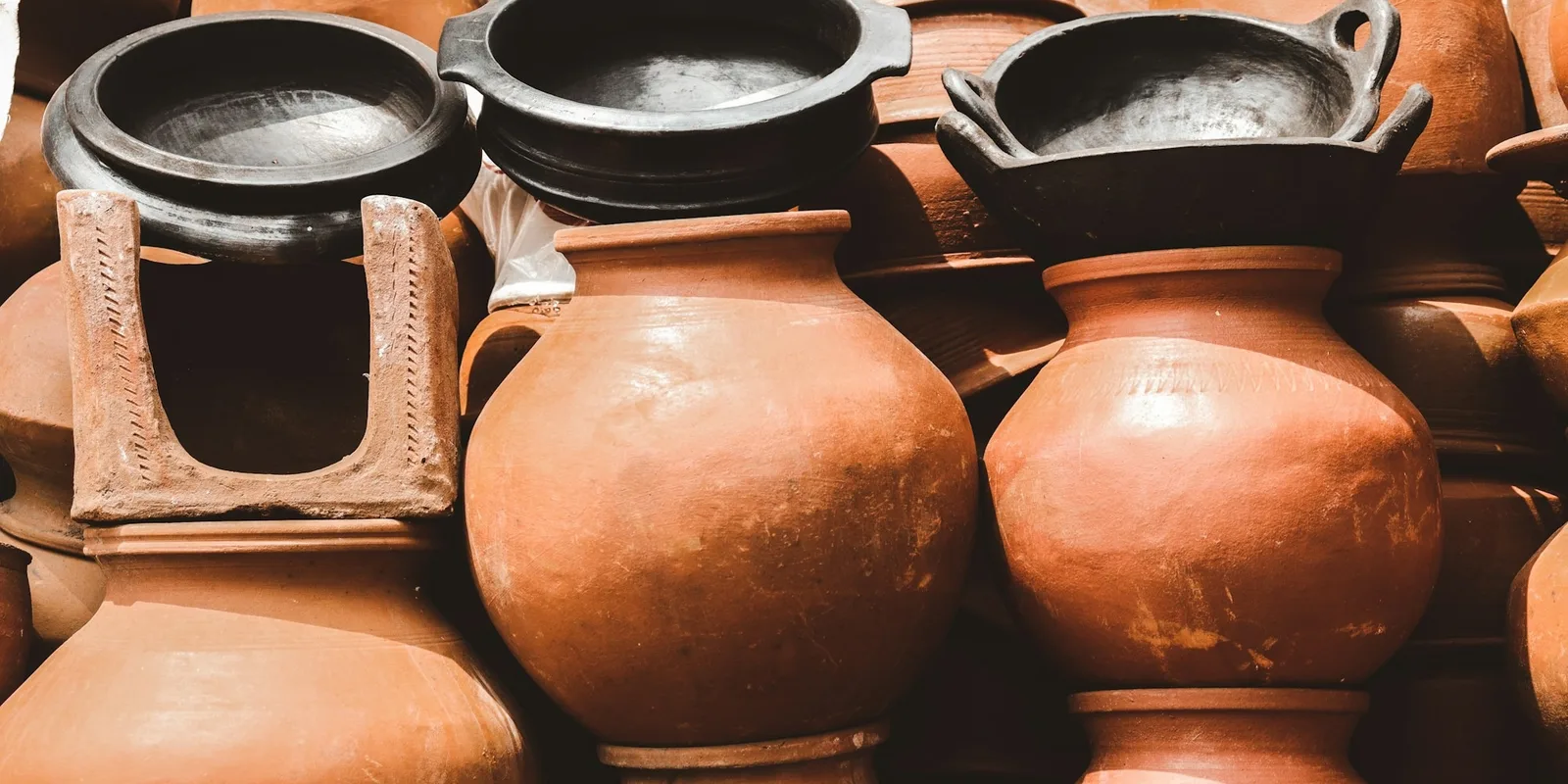
Terracotta is the craft most Goan homes already have without thinking of it as craft. Goa Tourism lists flower pots, bowls with floral designs and figures of saints, gods and animals among the potters' work, and a 2022 survey of Goan handicrafts in the Journal of Asian Arts, Culture and Literature adds hanging pots, planters and bells, and notes that idol makers are using clay, natural fibre and vegetable dyes for Ganesh Chaturthi images in place of plaster of Paris. On a verandah or a laterite ledge, a group of red pots of different heights looks more Goan than any bought ornament.
Unglazed terracotta is porous. It draws water up from a wet saucer and lets it evaporate from the surface, which is why it keeps plants cool and why it grows a white crust of salts after a season or two. That crust is harmless and brushes off when dry; our article on white fungus or efflorescence explains the same process on walls. The real risk is to what sits under the pot: never stand a watered terracotta pot directly on a wooden table, a rug or a tiled sill without a glazed saucer and a gap for air.
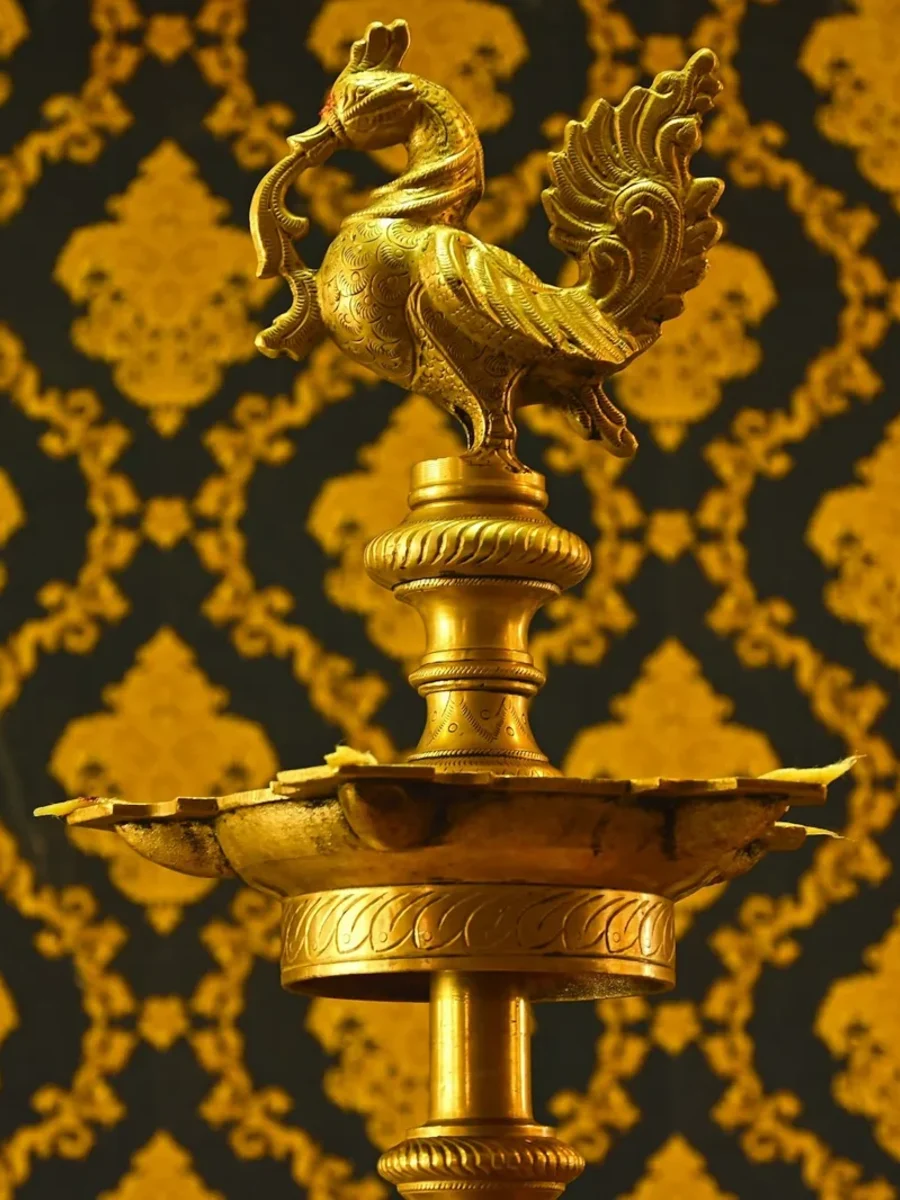
Brass is the other great Goan material. The Asia InCH encyclopedia of crafts records that Goa's brass lamps for temples and festivals are made by the Kansara community, practising in Mapusa, Sanquelim and Bicholim, by casting from wax-and-resin patterns and then turning, hand-engraving and buffing the pieces. Goa Tourism adds that utility vessels were traditionally made from copper sheet. Brass and copper darken quickly in Goa's salt air; the National Park Service's museum handbook names coastal environments among the most severe for metals. Our guide to samai lamps and brass care covers cleaning and storage in detail.
Bamboo, cane and fibre: the crafts that need air
Bamboo is one of Goa's oldest crafts. The 2022 handicrafts survey records that it began as utility work for farmers and fishermen, naming the patio basket for carrying, the supli for cleaning rice, the valli for washing grain and the dali for drying it, and that these are still in common use alongside newer decorative pieces such as lamp shades and chiks. A supli or dali hung on a kitchen wall, or a stack of patio baskets for storing onions and coconuts, is craft that works for its place.
Bamboo has one serious enemy. The University of Maryland Extension notes that bamboo is susceptible to powderpost beetles because of its high starch content, and that the beetles leave round exit holes roughly 0.8 to 3 mm across with fine, flour-like dust below. Check bamboo pieces before you bring them home and again after each monsoon. Cane is a different material: a National Institute of Design study of cane furniture makers in Panaji explains that rattan is a climbing palm whose peeled core is rattan and whose skin is cane, and observes that sunlight can change the natural colour of rattan furniture, which is one reason it is usually kept indoors or under a deep roof.
Fibre crafts made from banana and sisal, centred on Corlim according to Goa Tourism, and jute macramé share the same weakness as any undyed plant fibre: they feed mould when the air is wet and still. Conservators at the Canadian Conservation Institute put numbers on it: mould that needs months to get going at 70% relative humidity can take hold in days once the air reaches 90%, which is roughly where Goa's monsoon mornings sit. Keep fibre pieces away from external walls, give them moving air, and in a closed house take them down and store them dry.
Never varnish bamboo, cane or fibre to protect it from damp. A sealed surface traps moisture behind it and cracks as the material moves.
Wood, coconut shell, shell craft and tiles
Goa Tourism describes wood turning and lacquerware as a craft of cradles, baby carts, toys and corner stands, used mostly by Hindu families on religious occasions. The bright lacquered colours are made to be handled, so a turned toy or a small lacquered stand belongs on a child's shelf or beside a home shrine rather than behind glass. Keep lacquered pieces out of direct afternoon sun, which dulls and crazes the finish, and watch bare wooden bases for the mud tubes that mean termites have found them.
Coconut-shell carving needs a skilled hand, as the 2022 survey points out, and the best pieces are fine: table lamps, candle stands, cups and the coconut masks Goa Tourism mentions. The polished outer shell is hard and durable; the rough inside is where mould starts in the monsoon. Wipe the inside with a dry cloth now and then and do not store shell pieces in closed boxes through the rains. Seashell craft, which the survey traces to the Portuguese period when shells were used to adorn doors and windows, is best used sparingly: one shell-inlaid box or mirror says more than a room of them.
Hand-painted tiles are the most climate-proof Goan craft. The Asia InCH encyclopedia records that Goan azulejos are fired at 1200°C, then glazed, painted and fired again at the same temperature to fuse the colour to the tile, and that blue and yellow with floral patterns and religious scenes were the traditional favourites. That second firing is why a painted tile can sit behind a cooker or beside a front door for decades. A small panel in a kitchen splashback or a single tile as a house name are the classic uses; the tile itself is not where humidity does damage, the grout and the wall behind it are.
Displaying crafts room by room
Crafts look best where they would have been used. A verandah or balcão suits terracotta and bamboo: a row of pots along the parapet, a supli on the wall, a cane chair with a cushion. Keep anything fibre or wooden under the roof and off the floor, because driving monsoon rain reaches further onto an open verandah than most people expect. Our article on the Goan balcão covers how these spaces were used.
In the sala, the main sitting room, brass and wood carry the weight. One good brass lamp or a pair of candle stands on a console, a carved or lacquered box, and a crochet runner under them is enough. The kitchen takes tiles, copper and bamboo: a tiled splashback, copper vessels on an open shelf away from the hob's grease, baskets for produce. Bedrooms want softer crafts, such as a crochet bedspread, a kunbi-check cushion or a cane chair by the window, and nothing that gathers dust above the bed.
Group rather than scatter. Three terracotta pots together, or five brass pieces on one tray, read as a collection; the same objects spread across every surface read as clutter and take far longer to dust and air. Leave plain wall around each group. White lime walls are the best background Goan crafts can have.
Crafts and soft furnishings: making them work together
Handicrafts are small and textured; soft furnishings are large and set the mood of the room. They work together when the big textiles are quiet. Plain linen or cotton curtains, a plain sofa and a flat-woven rug give crafts a calm background. Patterned curtains and a busy rug leave a brass lamp or a group of pots with nothing to stand against.
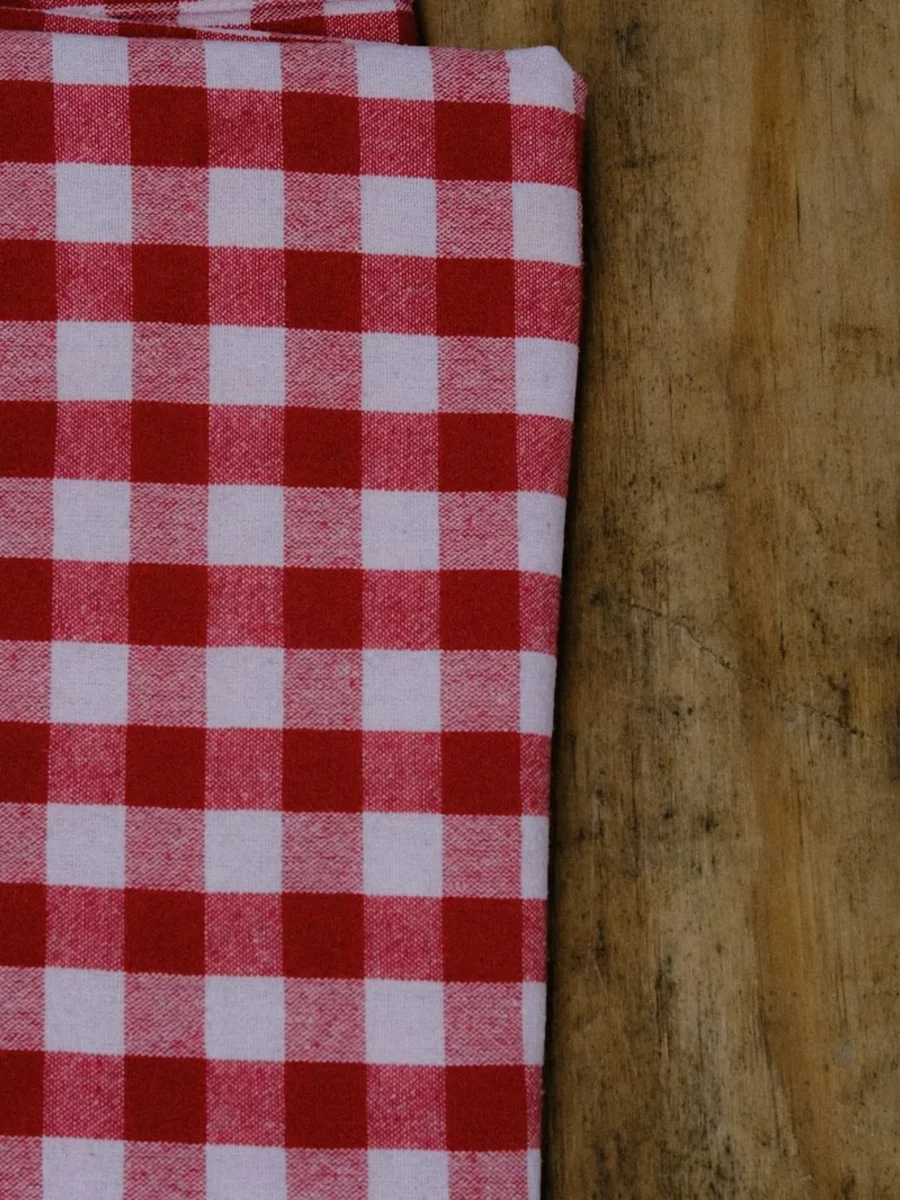
Let one textile tie the crafts to the furniture. A kunbi-check cushion picks up the red of terracotta, an indigo cushion echoes blue tiles, an ochre one sits with brass; our guide to kunbi fabric for interiors covers the checked weave in detail. At the windows, bamboo and chik blinds continue the natural textures of baskets and cane into the room. On the floor, cotton dhurries and flatweaves suit crafts better than plush pile, and they can be rolled and stored dry for the rains.
If the room already has a strong craft piece, such as a carved chest or a long planter's chair, build the textiles around it rather than buying crafts to match new curtains. We make cushion covers in your own handloom cloth as well as in our fabrics.
Buying honestly: spotting imports sold as local craft
Tourist markets in Goa sell a great deal that is not made in Goa. That is not a crime, but it is worth knowing what you are paying for. Hand-thrown pots vary slightly in shape and show throwing rings inside; moulded imports are identical and often have a seam line. Hand-cast brass has some weight, slight irregularities in engraving and a turned finish; thin, light pieces with crisp stamped patterns are usually pressed sheet. Woven bamboo and fibre show joins and small variations; a perfectly regular basket with stapled or glued ends is machine-made.
The surest route is to buy from the maker or close to them. The Department of Handicrafts, Textile and Coir takes its trained weavers' work to exhibitions, and Goa Tourism notes that the state's crafts are sold through handicraft emporia as well as at tourist stalls. Ask who made a piece and where; a seller who knows the village and the maker is usually telling the truth, and one who answers 'Goa' and nothing more may not be. If a product is sold as carrying a geographical indication, you can check the claim yourself on the GI Registry's public search; the kunbi weave, for example, is still only an application. When the crafts are chosen, our cushions and soft furnishings and curtains can be made to sit quietly around them.