 Drapehaus
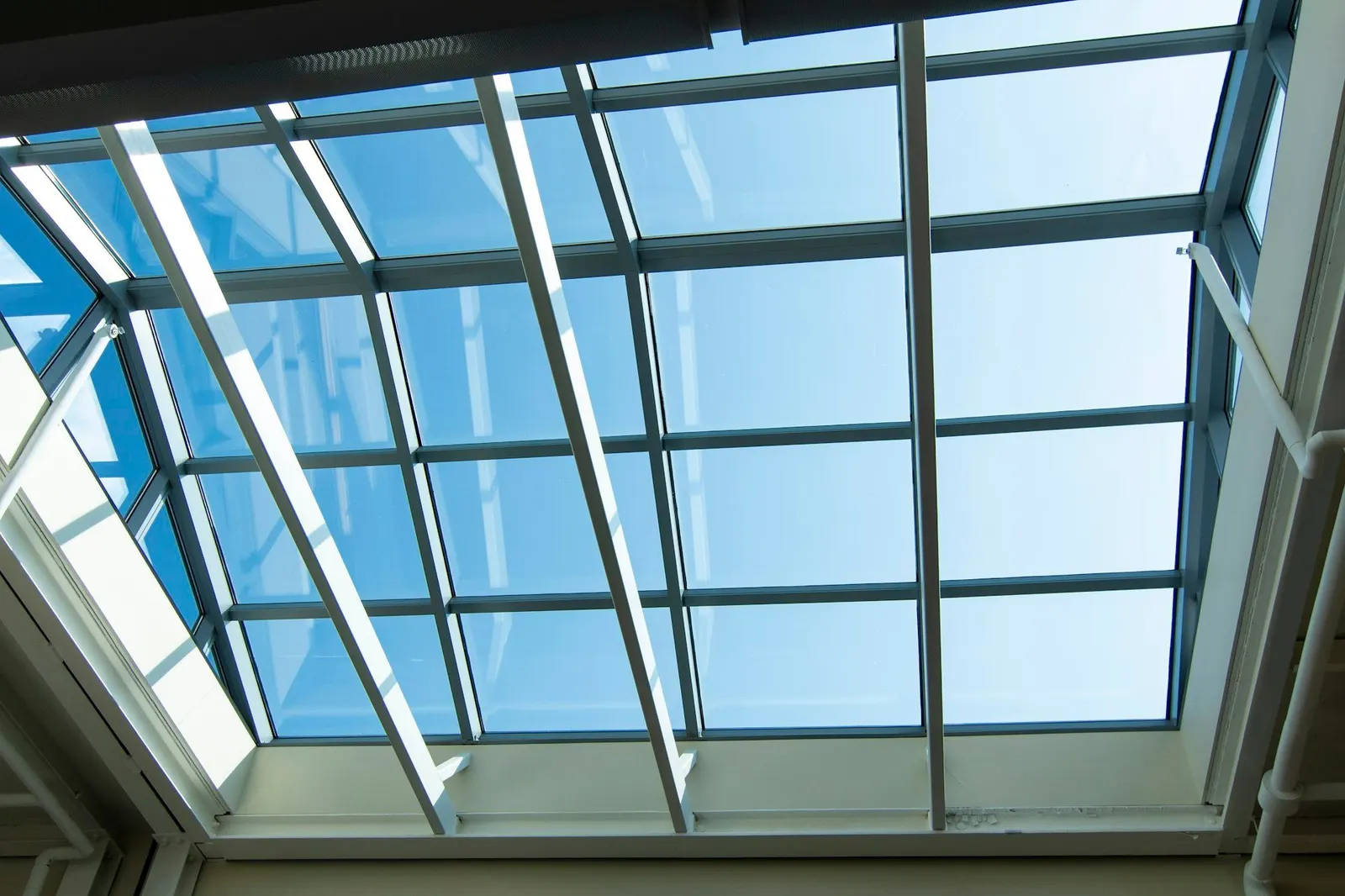
Skylights and roof windows bring a quality of light into a villa that no wall window can, which is why architects love them over stairwells, bathrooms and deep-plan living rooms. They also bring heat. The roof faces the sun for most of the day, and a pane of glass set into it catches radiation at angles that a vertical window is spared. Skylight blinds are usually specified after the owners have spent their first April underneath one.
The problem is harder than it looks. A blind for a skylight hangs horizontally or on a slope, so gravity pulls it into a sag rather than a straight drop. It is out of reach, so anything operated by hand will not be used. And it sits directly under the part of the building most exposed to monsoon rain, where a leak or condensation will find the fabric first.
This article covers how much heat overhead glazing really lets in, whether to shade inside or outside the glass, which fabrics suit which rooms, how tensioned systems keep the blind flat, and what to check before anything is fitted.
Why overhead glass is the hottest glass in the house
Guidance from the US Department of Energy's Building America Solution Center, run by the Pacific Northwest National Laboratory, puts the geometry plainly: one square foot of roof area can receive about three to four times as much solar radiation on a midsummer day as one square foot of north- or south-facing wall. That comparison was made for North American latitudes. At fifteen degrees north, with the sun passing close to overhead for part of the year, a skylight in Goa is if anything more exposed.
Once sunlight reaches the glass, most of its energy gets through. The US Department of Energy's Energy Saver guidance estimates that about 76 per cent of the sunlight falling on standard double-pane windows enters the building as heat. A skylight that looks modest from below can therefore be one of the largest single heat sources in a room, and because the heat arrives high up it pools under the ceiling, where warm air already collects.
The same PNNL guidance is blunt about it: minimise skylight area, and where a building must have skylights, low solar heat gain glazing becomes extremely important. Blinds are the second line of defence, not the first. If the skylight is still at drawing stage, the glazing specification will do more than any fabric, and it is worth asking the architect for the glass's solar heat gain figure before the order is placed.
Skylight shades and heat: inside or outside the glass
Where the shade sits decides how much heat it can stop. An exterior shade intercepts sunlight before it reaches the glass, so the energy is reflected or re-radiated outdoors. An interior blind catches it after it has passed through, warms up, and releases much of that heat into the room. The difference is large, and PNNL's summary of recent research gives it numbers.
In extreme heat, interior roller shades reduced the hours a home spent at dangerous temperatures by about 18 per cent, insulating interior shades by about 23 per cent, and exterior shades by about 55 per cent. DOE field studies have also found whole-home summer cooling savings of 15 to 25 per cent from high-efficiency shades used well. On a skylight, where the heat load per square metre is already higher than on any wall, those differences are magnified.
Exterior skylight shading exists, as external screens, awnings over roof lights and fixed louvres, but it has to be designed with the roof and its drainage, and it must survive the monsoon wind. For most villas the realistic answer is an interior blind chosen and fitted to do as much as an interior blind can: a reflective or light-coloured outer face, fitted close to the glass, with edges sealed so hot air is not simply pumped around it. Our guide to heat gain sets out the same order of priorities for ordinary windows.
| Shade type | Reduction in heat-danger hours |
|---|---|
| Interior roller shade | about 18% |
| Insulating interior shade | about 23% |
| Exterior shade | about 55% |
On a skylight, an interior blind improves comfort. Only the glazing or an exterior shade substantially changes the heat load.
Planning something like this?
We visit homes across North and South Goa, measure on site, and bring samples to see in your own light.
Fabric for skylight blinds: blackout, solar screen or cellular
The room decides the fabric. Over a bedroom or a media room, the blind has to be blackout, and a skylight is unforgiving: any gap at the edges shows as a bright frame on the ceiling. Over a stairwell, a kitchen or a living space, total darkness is rarely wanted and a solar screen fabric does more useful work. Solar screens are woven with a stated openness, the proportion of the fabric that is open weave. Lower openness blocks more sun and glare and shows less sky; higher openness keeps more of the view and the light that the skylight was built for.
Colour matters more overhead than on a wall. A light or metallised outer face reflects part of the incoming energy back through the glass before the rest is absorbed. A dark fabric absorbs most of it and radiates heat down onto the people underneath. Where the room side needs to be dark for appearance, a fabric with a reflective back and a coloured face is the compromise.
Pleated and cellular shades are also made for roof windows. The trapped air in a cellular fabric is what gives the insulating interior shade its edge over a plain roller in the PNNL figures. Whatever the construction, choose synthetic fabrics for skylights. They hold their shape under tension, tolerate the heat that builds up between blind and glass, and resist mildew far better than cotton or linen, which our blackout linings guide explains in more depth.
Tensioned side channels: keeping a roof window blind flat
An ordinary roller blind relies on gravity to hang straight. Tilt it to a slope or lay it flat under a skylight and gravity works against it: the fabric sags in the middle, flaps when air moves and gaps at the sides. Skylight blinds solve this with tension. The fabric runs in side channels, or is held by tensioned cables or a sprung bottom bar, so it stays taut in any position, from a gentle roof pitch to fully horizontal.
Side channels do a second job. They close the gap between the fabric edge and the frame, which is where light leaks round a blackout blind and where warm air circulates behind a solar blind. On a skylight that has to darken a bedroom, channels on all sides are what separate a blind that dims the room from one that genuinely darkens it.
All of this depends on the opening being square and the survey being precise. Skylight shafts are often built with a plaster lining that is slightly out of true, and a tensioned system will show every millimetre of it. The survey should measure the shaft at several points and check the diagonals, not just record a single width and length.
Motorised blinds for skylights
A skylight blind is almost always out of reach, and a blind that needs a pole or a ladder will be set once and left. That makes motorisation the normal specification rather than an upgrade, for the same reasons set out in our guide to double-height windows. A wall switch at the foot of the stairs, or a schedule that closes the blind through the middle of the day, is what makes the blind useful.
Power is the practical question. On a new build, a supply can be taken to the skylight shaft before it is lined, which allows a mains motor and a wall switch. As a retrofit, battery motors avoid chasing finished plaster, and some skylight systems pair them with a small solar panel on the glass. For outages, surges and override arrangements, the same principles apply as on any motorised window, covered in power cuts and motorised blinds.
Scheduling is where a skylight blind repays its cost. Overhead glass takes its heaviest load in the middle of the day, when most people are not standing underneath thinking about it. A blind that closes itself late in the morning and opens again in the late afternoon keeps the heat out without anyone having to remember, and in a house that is empty between visits it protects floors and furniture from fading.
Condensation and monsoon leaks
In a room cooled by air conditioning, the inner surface of a skylight can be cooler than the humid air around it, and the gap between a closed blind and the glass traps that air against the pane. When the glass is cooler than the air's dew point, moisture condenses on it. The blind then sits in a small damp pocket, which is exactly where mildew starts. Leaving a small gap at the top of a blackout skylight blind, or opening it regularly, lets that pocket dry out.
Leaks are the larger risk. Goa's normal July rainfall is 1,118.5 mm, driven by westerly and south-westerly winds that pushes water into any weakness in flashing or sealant. A skylight with a slow leak will soak a blind, stain it and grow mould on it long before the water shows on the ceiling. The US EPA advises that wet materials dried within 24 to 48 hours will in most cases not grow mould; a blind wedged against a leaking frame never dries.
So check the skylight before fitting anything under it: the flashing, the sealant and the drainage, ideally after a heavy shower. A blind is not a fix for a leak and should not be asked to hide one. Before the monsoon, run the blind fully open, check the channels for staining and ask whoever looks after the roof to inspect the skylight when they clear the gutters.