 Drape Haus
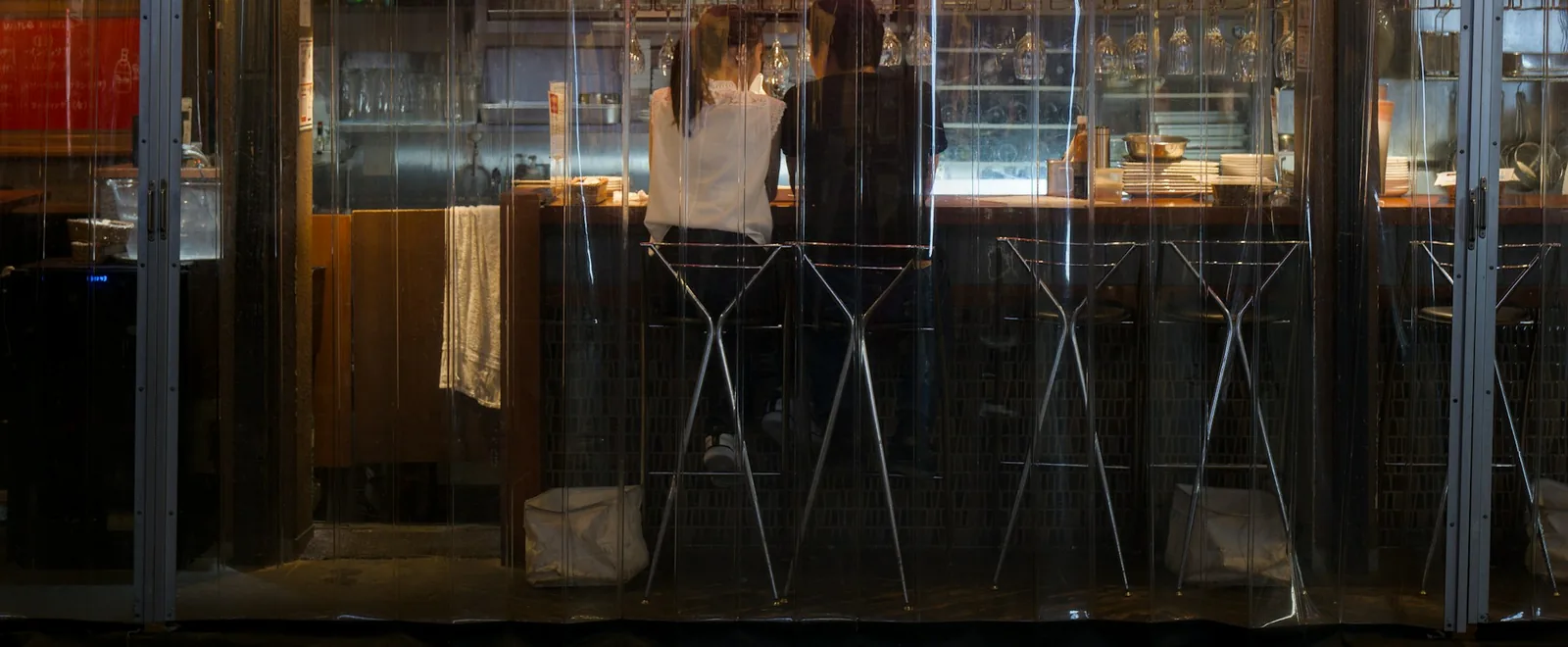
A PVC strip curtain is a row of flexible, overlapping plastic strips hung from a rail across a doorway. People, trolleys and forklifts push through; the strips fall back behind them. Because the doorway is never fully open, less air passes through it, so a cold room stays colder, an air-conditioned shop loses less cool air to the street, and some dust, fumes and flying insects are kept out.
They are a working tool for back-of-house doors: cold rooms and walk-in chillers, kitchen stores, loading doors and the door between a hot kitchen and a cooled service area. They are not the right answer for a home, a restaurant's front entrance or a balcony, and they do not replace proper insect screening on windows.
One thing to say first: Drape Haus does not make or fit industrial PVC strip curtains. They are not in our catalogue, and specialist suppliers do this work. We write about them because Goan restaurant and café owners ask us about doorways, and the honest answer often involves strips at the back and something else at the front. What we do supply for food businesses is covered at the end.
What strip curtains actually do, and what they don't
A strip curtain reduces air exchange through a doorway that has to stay usable. That is its main job, and it does it well. In refrigeration it is so well established that US federal energy rules have required every walk-in cooler and freezer made since 1 January 2009 to have strip doors, spring-hinged doors or another method of minimising infiltration when the doors are open. Infiltration is the warm, humid air that rushes into a cold room through an open door; in Goa's climate it carries moisture that turns to frost and condensation inside.
The same principle helps on other doors. An air-conditioned shop with a door propped open for customers, a bakery with a hot oven room next to a cooled packing area, or a kitchen store next to a loading yard all lose less conditioned air, and admit less dust and fumes, with strips across the opening.
What strips do less well is keep insects out. They reduce how many get through, because the doorway is mostly closed, but every time someone walks through, the strips part, and gaps open at the edges and between strips that have been pushed out of line. A strip curtain is a partial barrier, not a seal. The food-safety rules discussed below ask for screens, self-closing doors and air curtains; strips are not a substitute for screening the windows and keeping doors closed.
- Hold cold in walk-in chillers and cold rooms
- Cut the loss of air-conditioning through busy doors
- Reduce dust, fumes and draughts from yards and loading areas
- Reduce, but do not stop, flying insects
- Keep a doorway passable for trolleys and staff with full hands
Where they belong in a Goan restaurant, bakery or shop, and where they don't
The best places are behind the scenes. The door of a walk-in chiller or cold room is the classic one. The door between the kitchen and a dry store or a back yard, used constantly by staff with crates, is another. In a bakery, the opening between the oven area and a cooler packing room suits them, and in a fish or meat shop, strips across the door to the chiller hold the cold in.
Front-of-house is a different matter. A curtain of plastic strips at the entrance to a restaurant or café tells customers they are walking into a service area. Guests have to push the strips aside with their hands, which is not what they want after washing them, and the strips quickly show greasy fingerprints. For a dining room, a solid self-closing door, a glazed door with a closer, or an air curtain above an open door is usually the better answer.
They do not belong in homes. A kitchen door, a balcony or a bedroom needs a fabric curtain, a fitted mosquito net or a proper door. For a balcony that takes driving monsoon rain, clear PVC sheet rain curtains are a different product altogether, and our guide to PVC rain curtains for balconies covers them. For a doorway inside the house, our guide to door curtains is the place to start.
Strip curtains are for back-of-house doors that must stay passable. At the front door and in the home, choose something else.
Planning something like this?
We visit homes across North and South Goa, measure on site, and bring samples to see in your own light.
Standard, low-temperature and tinted strips
Suppliers sell strips in a few broad kinds. Standard clear strips are for ordinary temperatures: shop doors, kitchen stores and loading doors. Low-temperature formulations, often called polar grade, are made to stay flexible in freezers and cold rooms, where ordinary PVC stiffens. Ribbed strips have raised ridges along their length that take the scuffs from trolleys and pallets, so the flat surface between them stays clearer for longer.
Tinted strips, often yellow or amber, are sold as insect-deterrent, on the idea that the colour makes the doorway less attractive to flying insects. We have not found independent evidence of how well they work in a doorway, so treat the colour as a possible help rather than a solution, and ask the supplier what they base the claim on. Clear strips have a real safety advantage: staff can see someone coming the other way.
PVC also ages. A study of PVC photodegradation published in a peer-reviewed journal explains that light exposure makes PVC lose hydrogen chloride, forming chemical structures that cause discolouration, which is why clear PVC near a sunny door yellows and clouds over time. Strips that have yellowed, hardened or scratched until staff cannot see through them should be replaced; ask the supplier for UV-stabilised strips for any door that gets sun.
- Standard clear: shop doors, stores, loading doors at room temperature
- Low-temperature (polar): cold rooms and freezers
- Ribbed: doors with trolleys and pallets
- Tinted: sold as insect-deterrent; independent evidence is limited
Strip width, overlap and mounting height
Three choices decide how well a strip curtain works: how wide and thick the strips are, how much they overlap, and how they are hung. We have not found an independent standard for these, so here is the principle and the questions to ask, rather than figures.
Wider, thicker strips hang more steadily and resist draughts better, which suits taller doors and cold rooms, but they are heavier to push through. Narrower, thinner strips are lighter for staff on foot. More overlap between neighbouring strips gives a better seal when the curtain is still, but makes it heavier to pass and harder to see through. A pedestrian door to a store needs much less than a loading door with trolleys or a cold room with a large temperature difference across it.
Mount the rail just above the door opening so it covers the full width, with a little overhang at each side, and let the strips hang close to the floor without dragging, so they do not sit in water and grease. Use a rail that lets individual strips be lifted off for cleaning and replacement. Where trolleys or pallets pass, check the strips do not catch on handles, and that staff can see through them. Ask the supplier to size the strips and overlap to your door's height, its traffic and the temperature difference across it, and to put that in the quote.
Hygiene and cleaning in a humid commercial kitchen
In a busy kitchen, strips collect grease, flour, fingerprints and the general film of cooking, and in Goa's humidity they can stay damp enough for mould to take hold along the bottom edges. A dirty strip curtain is worse than none in a food area, because staff and food trolleys brush against it all day.
FSSAI's Schedule 4 asks catering and food service businesses to keep a systematic cleaning schedule that says what is cleaned, how often and how, and its general requirements ask for the mesh or screens on openings to be the kind that can be easily removed for cleaning. The same logic suits strips. Choose a hanging system where strips lift off individually, put the strips on the written cleaning schedule, and wash them in warm water with a food-safe detergent, rinse, and let them dry before rehanging.
How often depends on the door. A strip curtain next to the cooking line may need wiping every day and a full wash every week; a store-room door may need much less. The point is that someone is responsible for it and it is on the list. Replace strips that are cracked, cloudy, permanently stained or hard to see through. The US Environmental Protection Agency's central point about mould, that controlling moisture is the key to controlling mould, applies too: strips that hang into a wet floor will grow it.
What food-safety rules say about doorways
In India, the hygiene requirements for food businesses sit in Schedule 4 of the Food Safety and Standards (Licensing and Registration of Food Businesses) Regulations, 2011. In the version published in FSSAI's compendium, the general requirements for licensed businesses say that windows, doors and all other openings to the outside should be well screened with wire mesh or insect-proof screen, that doors should be fitted with automatic closing springs, and that the mesh should be easily removable for cleaning. Restaurants, hotels, canteens and other catering establishments follow these requirements in addition to their own section. Smaller registered businesses are asked to fit windows, doors and other openings with net or screen to keep the premises insect free. For meat shops, the schedule asks for fly-proofing in the form of air curtains, fly traps and similar.
Strip curtains are not named in these clauses. A strip curtain may help a doorway meet the aim of keeping insects and dust out, but it does not replace screened windows or self-closing doors. Regulations are amended, and inspectors apply them to particular premises, so check the current text with FSSAI and ask your local food safety officer what they expect at each doorway before buying anything.
For comparison, the US Food Code takes a similar line. It asks for closed, tight-fitting windows and solid, self-closing, tight-fitting doors, and where windows or doors are kept open for ventilation, protection by 16 mesh to 25.4 mm screens, properly designed and installed air curtains, or other effective means. It is a useful reference point, not an Indian rule.
Air curtains, mesh doors and what we do for food businesses
An air curtain is a fan unit mounted above a door that blows a sheet of air down across the opening. It leaves the doorway completely clear, which makes it the usual answer for a front entrance kept open in trading hours, and both FSSAI's meat-shop clause and the US Food Code name air curtains for controlling flying insects. It needs power, correct sizing to the door and regular cleaning. A self-closing door with a closer, solid or glazed, is the simplest way to keep insects out of a door that does not need to stand open. A fitted mesh door or screen lets air through while keeping insects out, and suits doors to a yard that are opened for ventilation.
This is where we can help. Drape Haus makes and fits mosquito nets for doors and sliding window nets, with lift-out mesh panels that can go on a cleaning schedule. For restaurants, cafés and hotels we supply curtains, blinds, upholstery and wall finishes specified for commercial use through our commercial and hospitality service, and our restaurant and café page shows what that covers.
We do not supply strip curtains, air curtains or door closers. If you are fitting out a kitchen, ask a specialist for those, and talk to us about the windows, screens, curtains and seating.
| Option | Best for | Limits |
|---|---|---|
| PVC strip curtain | Cold rooms, stores, loading and kitchen doors | Partial insect barrier; needs regular cleaning |
| Air curtain | Front entrances kept open in trading hours | Needs power, correct sizing and maintenance |
| Self-closing door | Any door that need not stand open | Slower for staff with full hands |
| Fitted mesh door or screen | Doors and windows opened for ventilation | Mesh needs cleaning; not for cold rooms |