 Drape Haus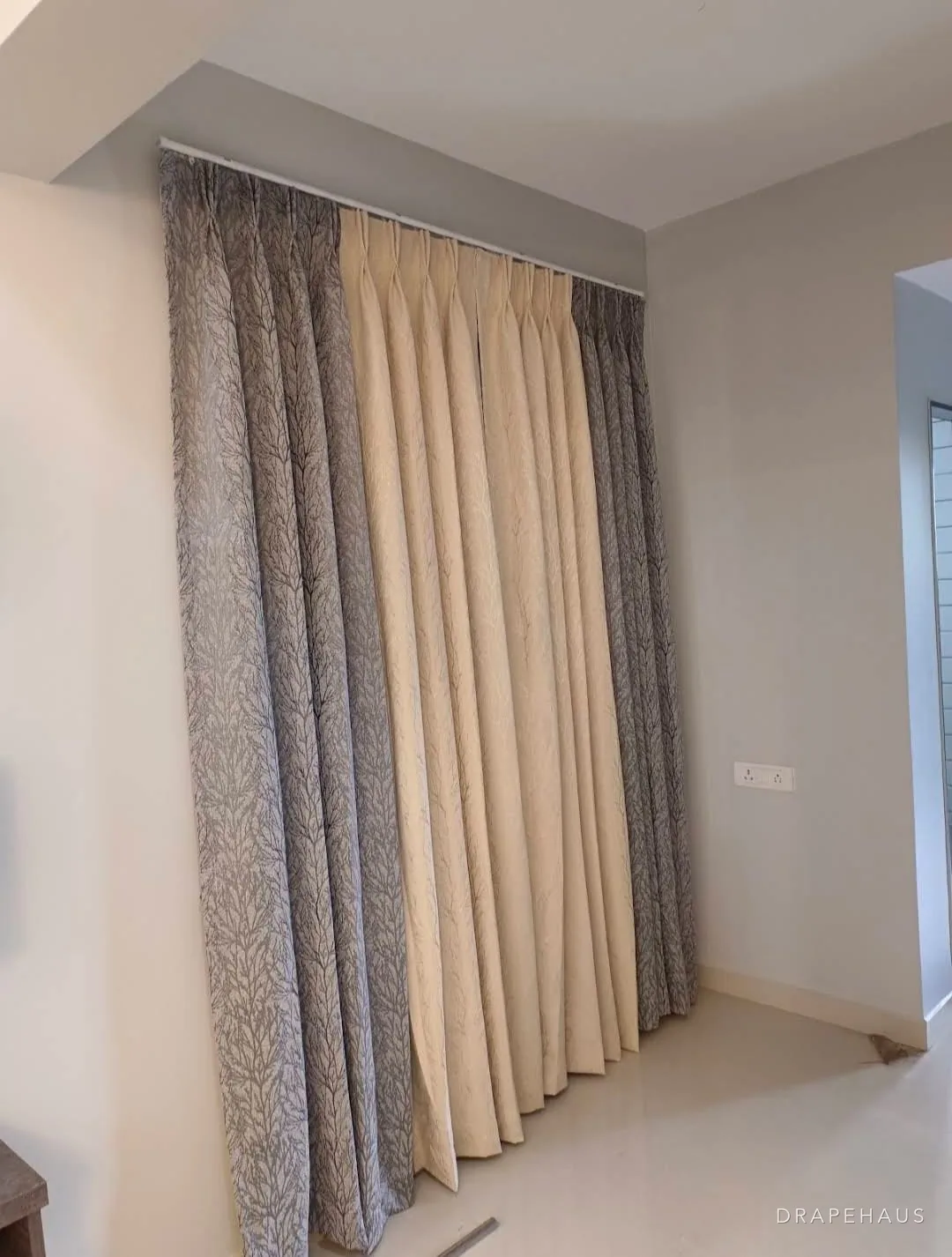
Good curtain ideas for a bedroom begin with who sleeps there and when. A shift worker sleeping through the morning, a couple in a flat facing another block, a child who naps after lunch and a guest who stays three nights all need different curtains from the same kind of window. Style comes after that, and in a bedroom it matters less than in any other room, because the curtain is mostly seen closed.
For a Goan bedroom, six ideas cover most situations: a blackout curtain fitted so the light cannot get round it; a sheer for daytime privacy where the window faces a lane or a neighbour; linen or cotton for a naturally ventilated room, made with the monsoon in mind; calm patterns and colours that do not look flat; linings and fabrics that stay fresh in a closed, humid room; and a track that suits the size of the room.
Each idea is set out below with the decisions that go with it. You can try most of them on your own window in our curtain simulator, and the bedroom curtains page lists the fabrics and linings we recommend.
Idea 1: Blackout for sleep, with the light gaps closed
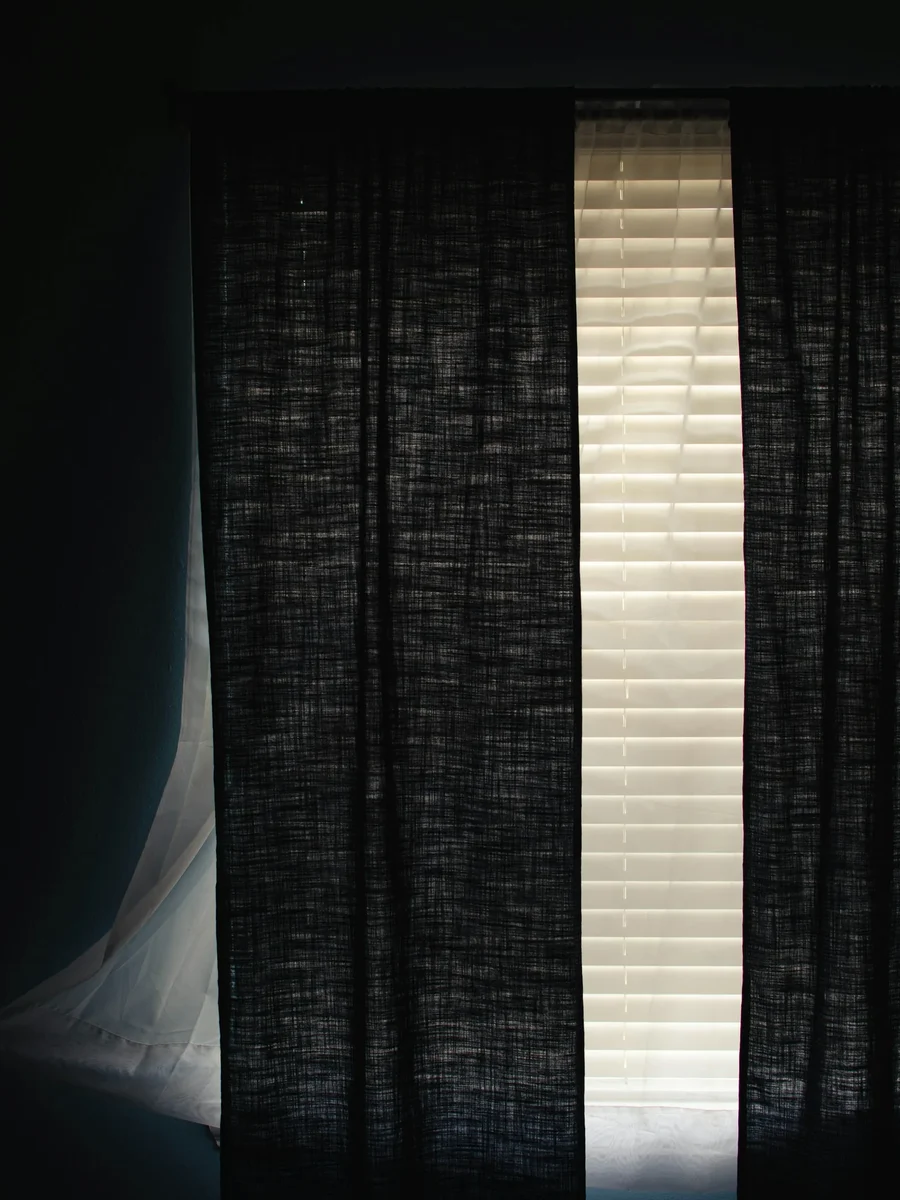
Darkness is the reason most people change their bedroom curtains. The NHS advice for people who struggle to sleep includes making sure the bedroom is dark and quiet, using curtains, blinds, an eye mask or ear plugs if needed. A blackout lining behind any face fabric makes the curtain itself opaque, and it is the starting point for anyone who wakes with the sun or sleeps by day.
The fabric is only half of it. Light comes in where the curtain ends: over a rod fixed just above the frame, down the sides where the curtain stops level with the window, through the centre where the two halves meet, and under a short hem. A blackout curtain on the wrong track can leave a room surprisingly bright. Fixing the track high, running it well past the frame and overlapping the centre closes most of those gaps.
If darkness really matters, as it does for shift workers and parents of young children, our step-by-step guide to blackout curtains for the bedroom explains every gap and how to close it, including when to add a blind behind the curtain.
Idea 2: A sheer for daytime privacy from lanes and facing flats
Many Goan bedrooms are overlooked in the daytime: a ground-floor room beside a village lane, a flat whose window faces the next block across a narrow gap, a bungalow bedroom beside a neighbour's terrace. Keeping a heavy curtain closed all day makes the room dark and stuffy. A sheer solves it. Drawn across the window, it lets in light and air while blurring the view from outside.
A sheer works by day only. Once a lamp is on inside, the sheer shows the room to anyone outside, so a bedroom sheer nearly always needs a second, closing layer for the evening. The usual answer is a double track with the sheer on the window side and a lined or blackout curtain on the room side. The bedroom then has three settings: open, sheer only, and fully closed.
Where wall space is short, a zebra or light-filtering roller blind can do the sheer's job inside the window recess, with a single lined curtain in front. Our sheer curtains page covers the weights that give the most privacy without losing the light.
A sheer gives privacy only while it is brighter outside. Plan the night-time layer at the same time.
Planning something like this?
We visit homes across North and South Goa, measure on site, and bring samples to see in your own light.
Idea 3: Linen or cotton for an airy bedroom, made for humidity
In a bedroom cooled by the breeze and a ceiling fan rather than air conditioning, natural fibres feel right. Linen has a dry, slightly crumpled texture and filters light softly; cotton is smoother, takes colour well and is easy to wash. Both breathe, which matters in a room where the windows are open half the year.
Both also respond to humidity. The India Meteorological Department records average morning relative humidity at Panjim of 88% in June and 91% from July to September. Natural fibres take up moisture from air like that, and a floor-length linen or cotton curtain can relax and lengthen a little in the wettest months and shorten again in the dry season. A curtain cut to just kiss the floor in January may drag in August. A workroom allows for this in the hem, and a linen blend or linen-look polyester moves much less.
Washing brings its own change. Cotton and linen can shrink if washed hot, so either pre-shrink the fabric before making up, or have the curtains dry-cleaned, and follow the care label. For the look of linen with less movement, our linen curtains range includes blends made for exactly this climate.
Idea 4: Patterns and colours that feel calm without looking flat
Plain curtains are the safe choice for a bedroom, and the risk is a room that looks unfinished. The answer is usually texture or a very quiet pattern rather than a bold print. A tone-on-tone weave, a narrow stripe, a small woven check or a fabric with a soft slub gives the curtain life when it is closed, without competing with the bed.
Borders are a useful idea. A plain curtain with a contrasting band down the leading edge or along the hem adds definition, picks up a colour from the headboard or rug, and looks tailored. On a tall window, a band near the hem anchors the curtain; on a low one, a vertical edge band adds height.
If you want a print, put it where it can be seen properly. A bedroom window often sits beside the bed or opposite it; a large botanical or a block print works on the window you look at from the bed, and a plain curtain in one of its colours suits the others. Our guide to curtain colour for the bedroom goes into palettes, linings and testing in lamplight.
- Tone-on-tone weaves: interest at close range, calm from across the room
- Narrow vertical stripes: add height in a bedroom with a low ceiling
- Contrast leading-edge band: tailored, and ties the curtain to the headboard
- One printed window, plain elsewhere: pattern without a busy room
- Small woven checks or herringbone: hide creases and light fading
Idea 5: Fabrics and linings that stay fresh in a closed, humid room
A bedroom with the windows shut and the air conditioner running, or a guest room closed for weeks, is where curtains start to smell musty and grow spots. The US Environmental Protection Agency advises keeping indoor humidity below 60%, ideally 30 to 50%, and notes that damp materials dried within 24 to 48 hours will in most cases not grow mould. A curtain that stays damp for days, against a wet window or a cool outside wall, is exactly the wrong condition.
Several choices help. Synthetic and blended face fabrics dry faster than heavy natural ones. A breathable lining is better than a fully sealed one in a room that is not air-conditioned. Heavy velvets and densely interlined curtains are best kept for rooms that are air-conditioned and in daily use. And a small gap between the hem and the floor lets air move under the curtain.
Habits matter as much. Draw the curtains fully back on dry monsoon mornings so the fabric and the window can air. Wipe condensation from frames and sills. In a guest room or a house shut for the rains, have the curtains taken down, cleaned and stored dry; our monsoon take-down and storage service exists for owners who are away.
Idea 6: Rods, tracks and ceiling mounting in small bedrooms
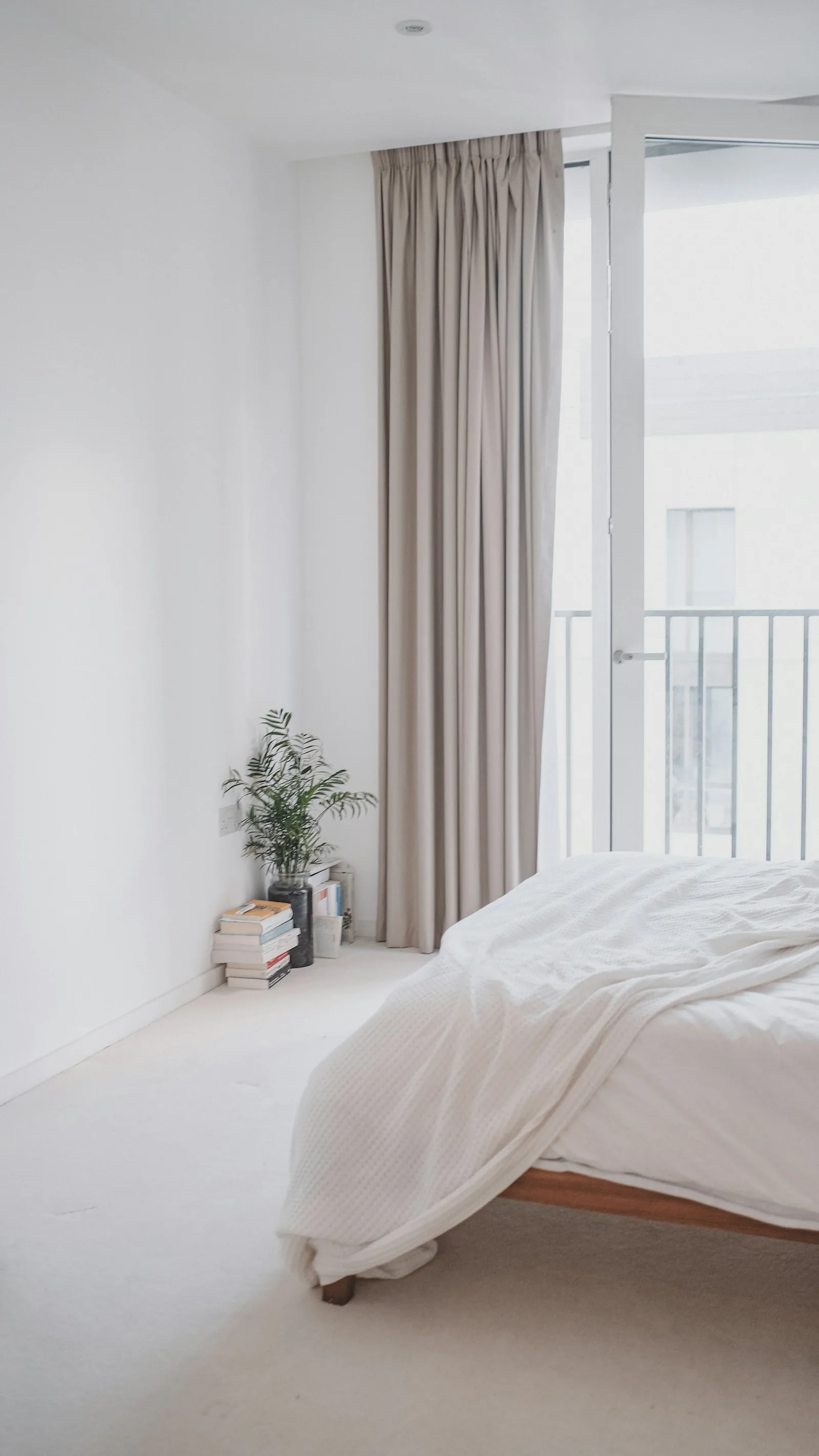
In a small bedroom, the track decides how big the room feels. A track fixed to the ceiling, or as close to it as the wall allows, carries the curtain the full height of the room and makes it look taller. It also closes the gap at the top where light spills over a rod. Run the track past the frame on each side so the curtains stack against the wall, not across the glass; in a small room, that extra daylight counts.
Poles and tracks suit different bedrooms. A decorative pole with eyelets or rings suits an informal room with a single window and space above the frame. A slim ceiling curtain track suits small rooms, wide windows, double layers and windows that run right up to the ceiling. Our article on types of curtain rods, linked below, compares the options.
Small bedrooms bring their own obstacles: a bed pushed against the window wall, a wardrobe beside the frame, a split air conditioner just above it. When the bed sits under the window, a floor-length curtain gets crushed behind the headboard; a sill-length curtain on a short track, or a roman blind inside the recess, works better. When an air-conditioner sits above the window, the track has to clear it and the stack should sit out of its airflow.
- Fix the track at or near the ceiling to make the room look taller
- Extend it past the frame so curtains stack off the glass
- Use a slim ceiling track where there is no wall above the window
- Choose a sill-length curtain or a roman blind if the bed is under the window
- Measure around wall-mounted AC units before choosing the track position
Ideas by bedroom: children, guests, rentals and the main bedroom
Each bedroom in a house has a different user and a different problem, and the best curtain idea follows from that. The list below is a starting point; our master bedroom curtains page covers larger suites, and the NHS's advice for babies is worth knowing before you black out a nursery: it suggests opening curtains during the day and keeping lights low at night, to help a baby learn the difference between day and night.
- Children's room: a blackout lining for early bedtimes in bright evenings, washable fabric, and cordless or tensioned controls on any blind
- Nursery: a curtain that can be opened fully by day and darkened at night, rather than permanent darkness
- Guest room: a lined curtain that is simple to operate, in a neutral that suits any visitor, with a spare set for the wash
- Rental or homestay bedroom: hard-wearing blended fabric, blackout lining, robust track and easy cleaning
- Main bedroom: layered sheer and blackout on a ceiling track, with motorisation on tall or hard-to-reach windows
- Bedroom used as a home office: a sheer or light-filtering blind to cut screen glare by day