 Drape Haus
Search for "yellow house goa" and the first page of results is almost entirely about one place: a hotel in Anjuna that trades under that name. We do not review or recommend hotels, and this article is not about it. If that is what you were looking for, the booking sites will serve you better than we can.
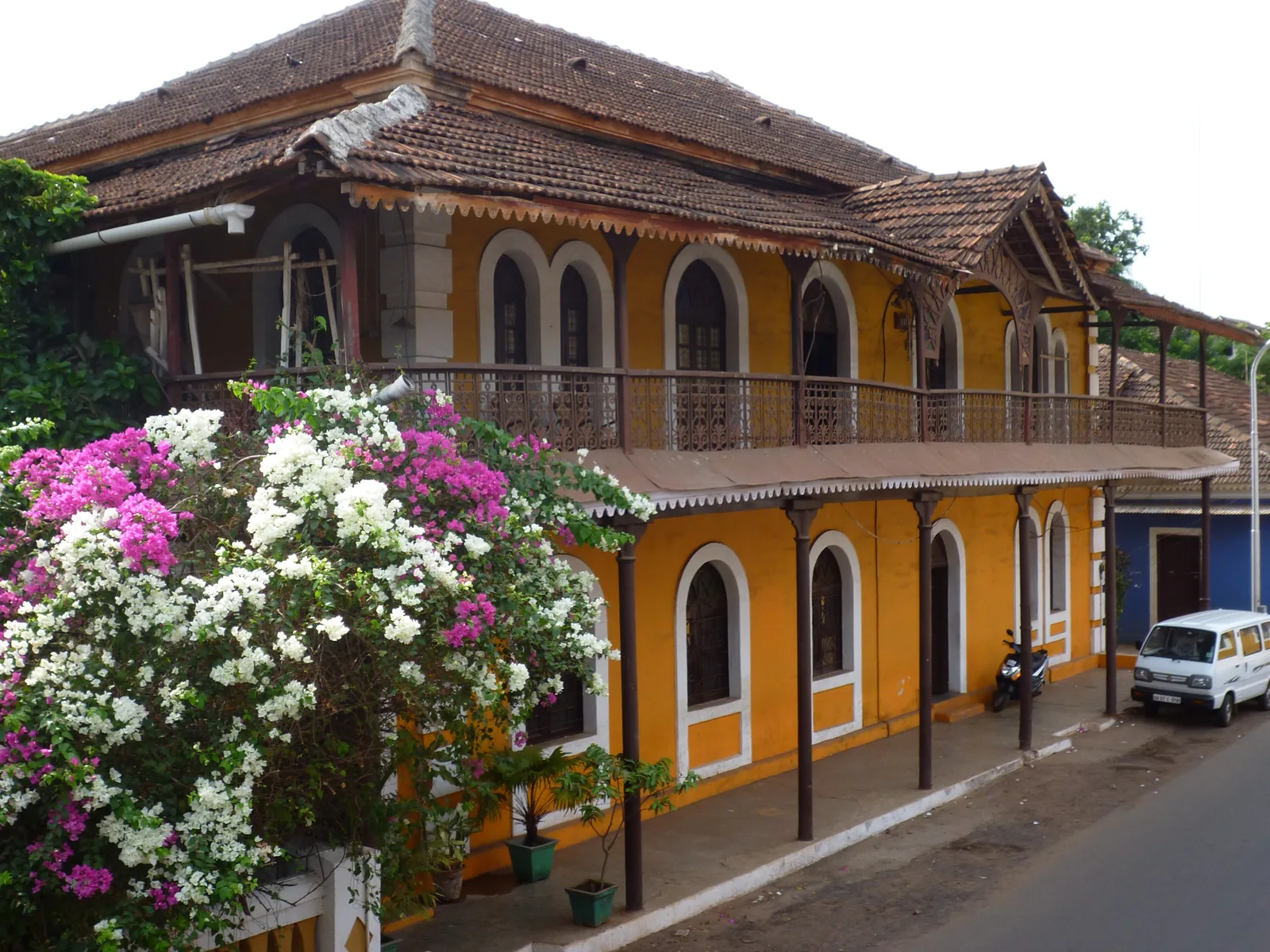
The rest of the searches point somewhere more interesting. People look for the yellow houses they have seen photographed in Panaji's Fontainhas quarter, for the ochre-washed village houses of Salcete and Bardez, or simply for an explanation: why are so many old Goan houses yellow, and could their own house be painted that way? Those questions have real answers, and they are the subject of this piece.
Below we cover where the colour came from, what yellow ochre actually is, why it ages so well on lime-plastered laterite, how to choose a yellow today without regretting it after one monsoon, and how to dress the rooms behind a yellow wall. We finish with a short note on photographing other people's houses, because the most photographed yellow houses in Goa are also somebody's home.
What "yellow house goa" usually means
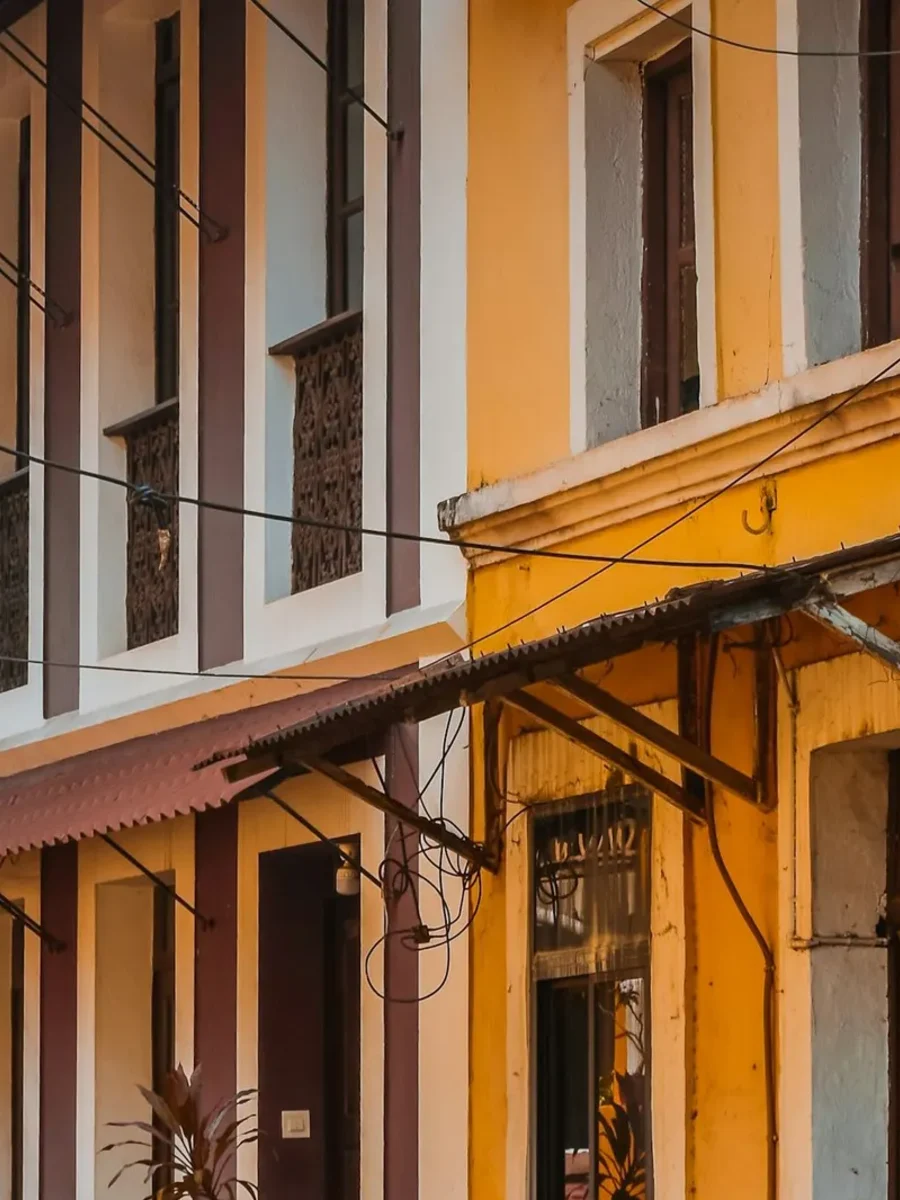
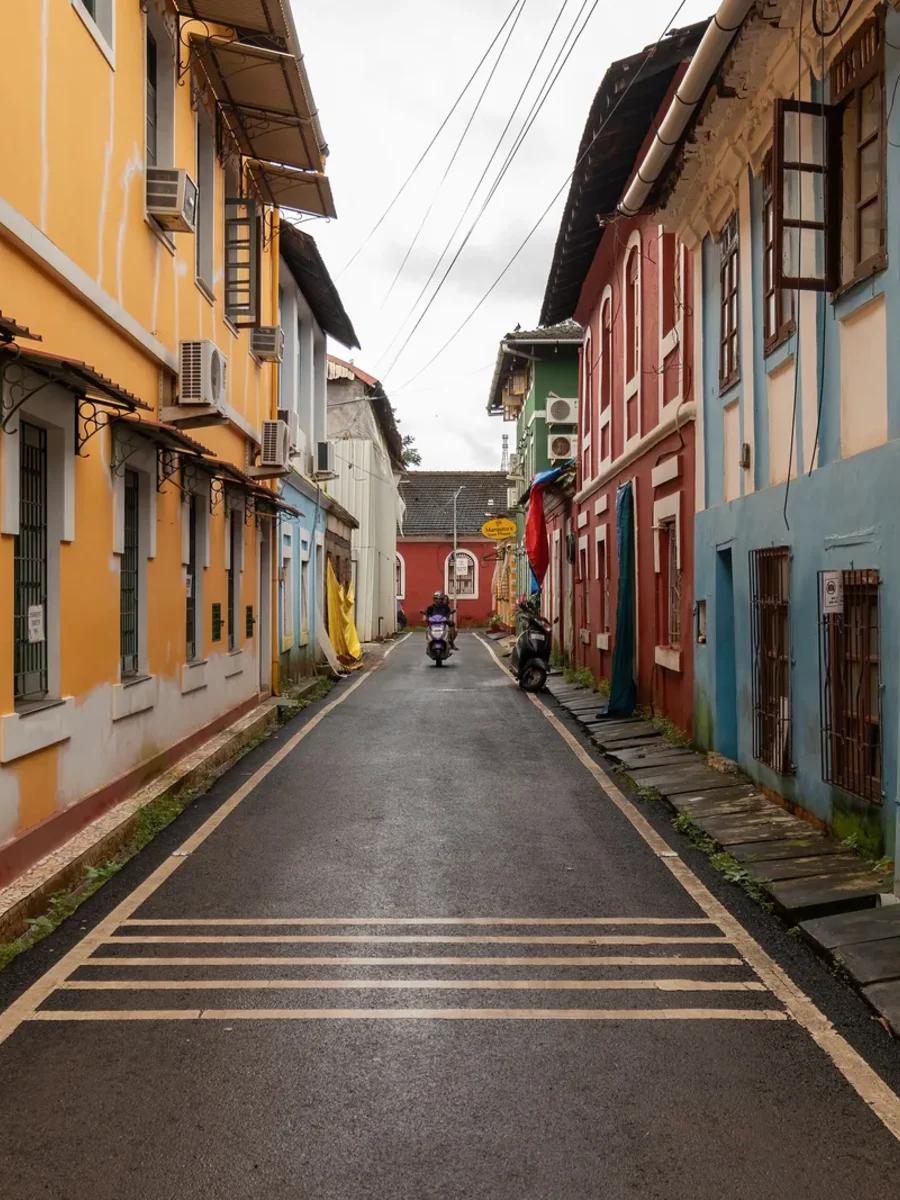
There are three overlapping meanings, and it helps to know which one you want. The first is commercial: a hotel in Anjuna that uses the name and dominates search results. The second is visual: the mustard and pale lemon houses on the lanes of Fontainhas, in Panaji, which appear on every list of photogenic places in Goa. The third is architectural: yellow and ochre as one of the traditional wall colours of the Goan house, found from Pernem to Canacona.
There is no single historic building known simply as "the Yellow House" in the way that a named mansion is known in Chandor. If a social media post promises one, it is almost certainly pointing at a private home in Fontainhas or at a commercial property. We would rather say that plainly than invent a landmark.
The architectural meaning is the one with depth. Yellow sits alongside indigo blue, green and laterite red as one of the familiar colours of old Goan houses, usually with white picked out on the window surrounds, pilasters and mouldings. Understanding why it is there, and how it was made, is useful whether you own an old house, are building a new one in the Goan idiom, or simply want to look at the villages with better eyes.
There is no single historic "Yellow House" in Goa. The search mixes a hotel, the lanes of Fontainhas and a long tradition of ochre-washed houses.
Why Goan houses are coloured at all
The short answer is a rule about white. Under Portuguese rule, white was reserved for churches and chapels, and private houses were not allowed to be painted that colour. Accounts of Goan houses record that the rule was observed by Hindu and Christian families alike, and that an owner could be fined for leaving a house unpainted. With white unavailable and bare walls penalised, colour became the norm, and neighbours competed through it.
Repainting was regular, not occasional. A 2017 report on Goa's colours describes a requirement, under Portuguese rule, for urban residents to repaint their houses every year after the rains, a habit that continued as tradition. A story published by the Museum of Goa on Google Arts and Culture notes that most Catholic families repaint the exterior every year before Christmas. Either way, the wall of an old Goan house is not one coat of paint but dozens of thin layers built up over generations.
Colour also carried status. Writers on Goan houses describe the colour wash as the house being "dressed": a freshly coloured front showed that the family was doing well. The earliest colours are said to have come from vegetable and natural sources; later generations used mineral pigments such as red oxide and yellow ochre, as the layers of one old house, described below, make very clear.
Planning something like this?
We visit homes across North and South Goa, measure on site, and bring samples to see in your own light.
What yellow ochre is, and why it suits a laterite house
Yellow ochre is an earth pigment. Its colour comes from limonite, a mix of iron-bearing minerals in which goethite, an iron oxide hydroxide, is the main component. It is one of the oldest pigments people have used, and it is remarkably stable: cave paintings coloured with it are still in good condition after thousands of years.
That stability matters on a wall in Goa. A conservation guide to limewash published in the Building Conservation Directory singles out red and yellow ochres as the pigments least likely to fade in sunlight or react with lime. Lime is strongly alkaline while it cures, and many brighter pigments shift or bleach in it; the iron oxide earths hold. On a west-facing front that takes the full afternoon sun through the dry months, that is the difference between a colour that mellows and one that fails.
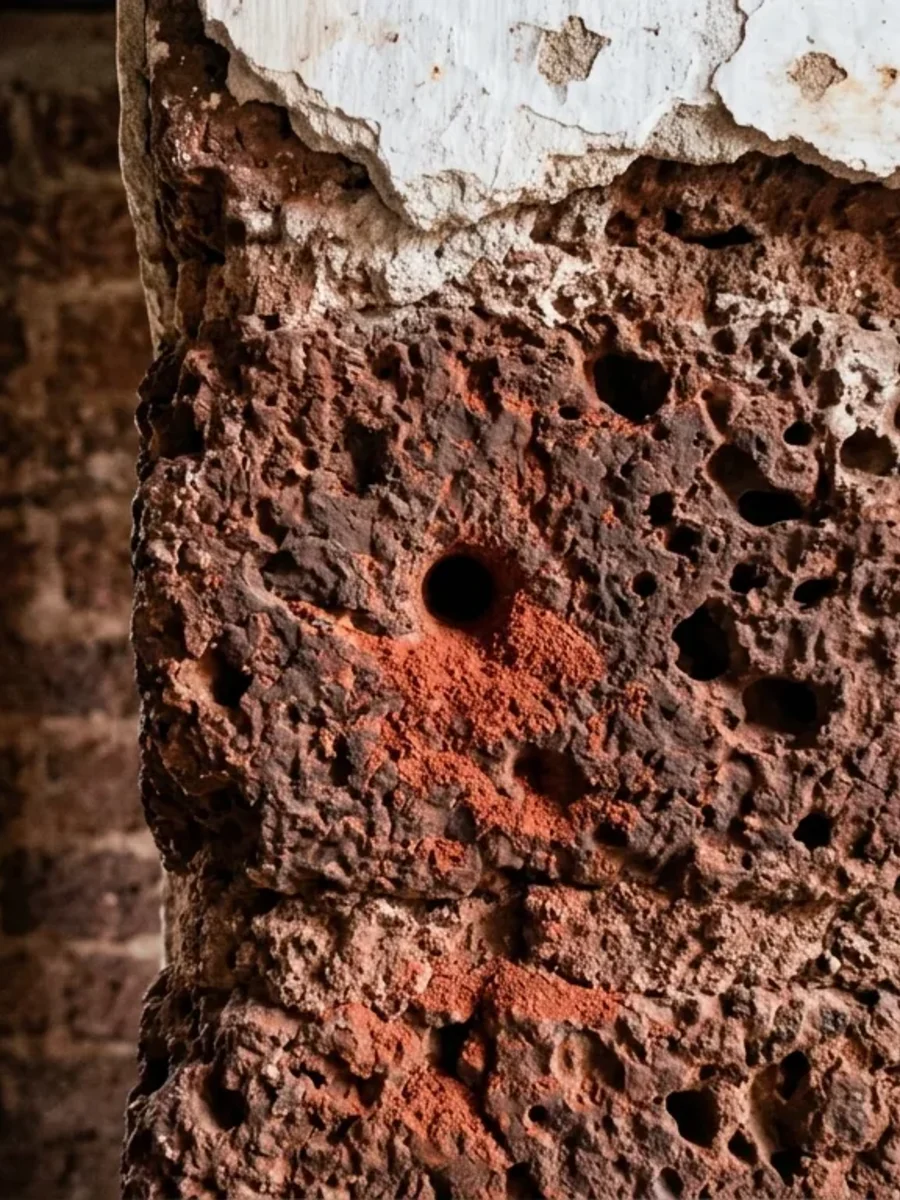
The pairing with laterite also makes visual sense. Laterite, the rust-red stone of Goa's plateaus, owes its colour to iron as well, and so do the clay roof tiles. An ochre wash sits in the same warm range as the ground, the roof and the exposed stone of a compound wall, which is one reason a yellow house looks settled in a Goan village rather than applied to it.
How a yellow wall ages: the case of one house
The Museum of Goa story describes a large house belonging to the Gomes family, more than 150 years old, which must have received something like 150 coats of lime. For roughly its first 30 years it was painted white. Then came about 40 layers of lime mixed with indigo. Later generations switched to red oxide, and for the last fifty years it has been washed in yellow ochre. An artwork in the museum, titled 150 Natals, was made from pieces of such a wall to show the layers in section.
Two things follow for anyone who owns an old house. First, the colour you see today may be only the most recent chapter; if you are restoring, a small careful scrape in an inconspicuous place can show what came before, and that history can guide your choice. Second, the early white on that particular house is a reminder that the no-white rule describes Portuguese-era practice in general, not something every house obeyed in every year of its life.
Limewash weathers by wearing back slowly rather than peeling. The same conservation guide notes that limewash dries many shades lighter than it looks wet, that new work needs at least three coats, and that it is far more vapour-permeable than most masonry paints. On a Goan house this produces the soft, chalky, slightly uneven yellow that people photograph, and which a plastic emulsion struggles to imitate.
Choosing a yellow for your own house today
Start with the wall, not the colour card. On an old laterite house finished in lime plaster, the finish must let the wall breathe. The Society for the Protection of Ancient Buildings explains that permeable materials allow absorbed moisture to evaporate, and that finishes which trap moisture lead to decay and mould. In a state where most of the year's rain falls in four months, a plastic coating over an old wall tends to blister within a few monsoons. Limewash, or a genuinely breathable mineral paint, is the safer route. On a modern concrete and block house the choice is wider, and a good exterior emulsion is normal.
Then test the colour where it will live. Yellow is the colour most changed by Goa's light: at noon in April it can look bleached and almost cream, and on a grey July afternoon it can look dull or faintly green. Paint large sample patches on two walls, one in sun and one in shade, and look at them morning, midday and evening over several days. Remember that limewash will dry lighter than the wet sample suggests.
Think about the white too. The classic Goan look depends on white mouldings, window surrounds and pilasters that frame the colour. A deeper ochre with crisp white trim reads as traditional; a pale lemon with cream trim reads as a newer house. Neither is wrong, but the choice should be deliberate. If your house sits in a heritage precinct or is listed, check whether colour changes need permission before you start; those rules belong to the planning authority, not to us, and we are not painters.
| Finish | Suits | How yellow behaves | Upkeep |
|---|---|---|---|
| Limewash with earth pigment | Old laterite and lime-plastered walls | Soft, chalky, dries lighter; ochres hold colour well | Renew periodically; wears back gently rather than peeling |
| Breathable mineral paint | Old walls where a more even finish is wanted | More uniform than limewash, still matt | Check the maker's permeability claims with a conservation adviser |
| Exterior acrylic emulsion | Concrete and block houses | Bright and even; some yellows fade on sun-facing walls | Repaint cycle depends on exposure; not for old lime walls |
Inside a yellow house: light, fabric and colour
A yellow exterior changes the light indoors more than people expect. Sun bouncing off an ochre verandah wall or courtyard carries a warm cast into the rooms, and an interior fabric that looks neutral in a showroom can look faintly orange at home. Bring samples to the house and look at them by the window at different times of day before you decide.
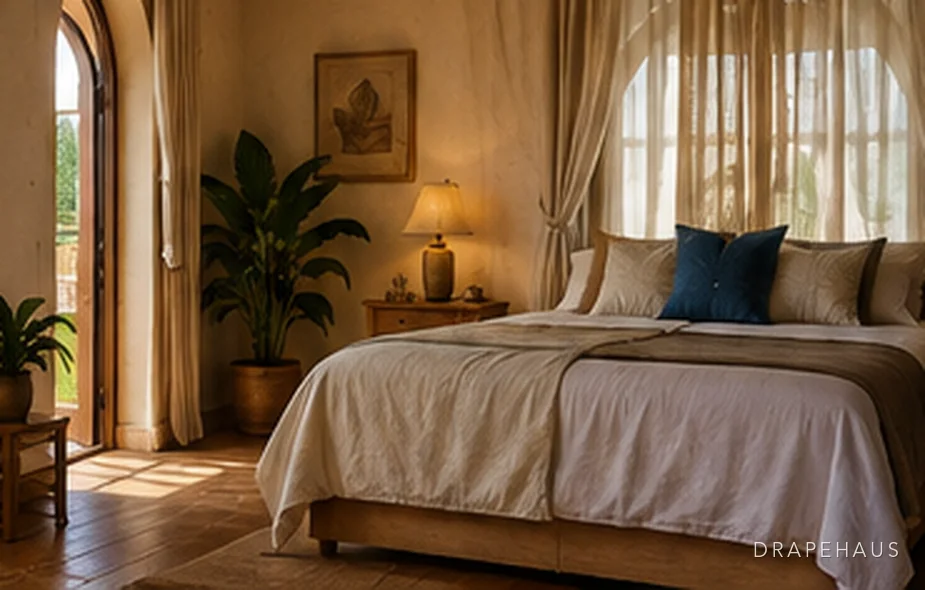
Natural fibres in quiet tones are the usual answer. Off-white and oatmeal linen curtains let the warm light through without adding more yellow to it; fine sheer curtains soften the glare on the west side while keeping the view of the garden. If you want colour in the textiles, the traditional companions of ochre walls are indigo, deep green and the white of the trim, which is why blue-and-white cushions and dark green upholstery tend to look right in these houses.
West-facing rooms behind yellow walls also need protection from sun damage, which fades cotton and silk faster than people realise. A lining or a second sheer layer is often enough, and our guide to fading and sun damage explains what works. You can try fabric colours against your own wall colour in the curtain simulator before asking us to bring samples to the house.
Photographing yellow houses respectfully
The yellow houses on the lanes of Fontainhas are among the most photographed buildings in the state, and people live in them. Panaji's 2014 heritage listing study identified Fontainhas as one of eight heritage precincts in the city, but a heritage precinct is a lived-in neighbourhood, not an open-air museum. The same is true of the village houses in Salcete and Bardez, and our guide to where to see old Goan houses covers the lanes worth walking.
Photographing a facade from the street is normally fine. Climbing onto a balcão, sitting on its built-in seats, opening a gate, posing against a door, or pointing a camera through an open window is not, unless you have been invited. Early mornings bring the best light on east-facing fronts and the fewest people, which helps everyone.
- Stay on the public road or lane; the steps and balcão belong to the house.
- Ask before photographing people, and before photographing through doors or windows.
- Keep doorways, gates and parking clear; residents still need to get in and out.
- Do not touch or lean on old plaster, shutters or shell windows.
- Avoid flying drones over homes, and avoid posting house numbers or name plates with exact locations.
- If someone asks you to move on, do so politely.