 Drapehaus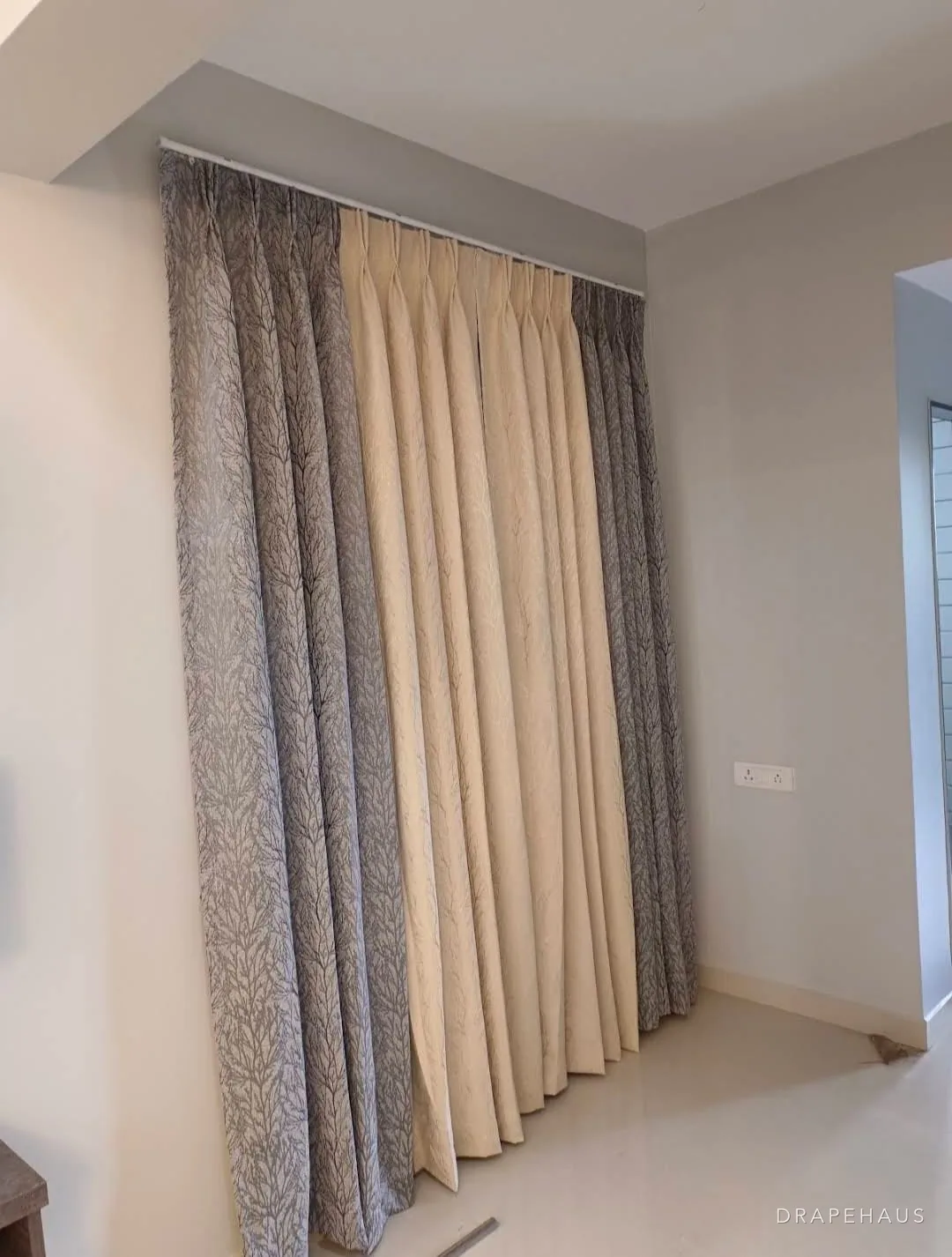
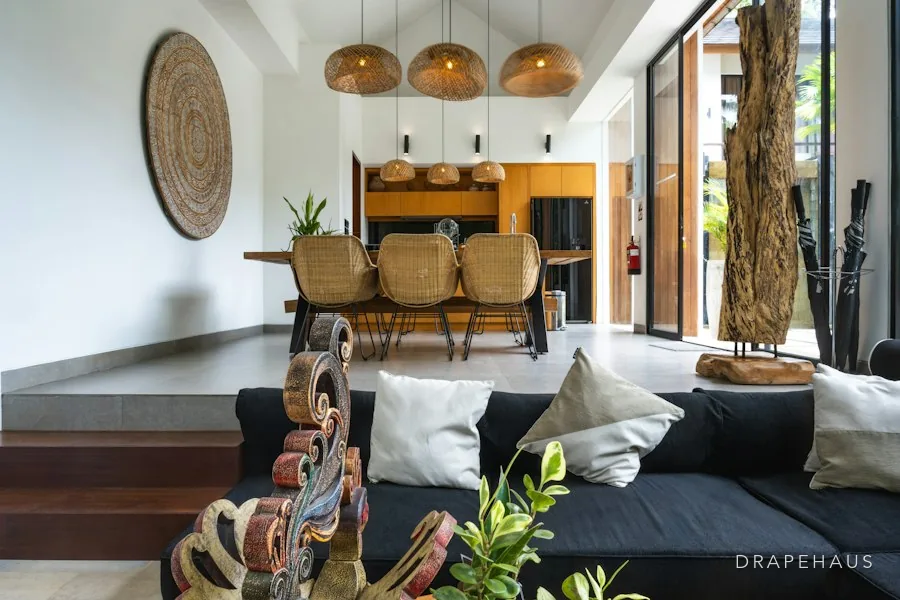
Villa interior design in Goa starts somewhere most design conversations do not: with the weather. A house here takes around 3,370 mm of rain in a normal year, nearly all of it between June and September, and spends those months at a morning relative humidity that sits between 88% and 91% at Panjim. Then it dries out, faces a low, hard afternoon sun and fills with people for the season. An interior has to work in both of those houses, and most of the decisions that matter follow from that.
That is why the order in which a villa interior is designed matters more than any single choice of colour or piece. Orientation and light come first, because they decide where glare and heat arrive. Air movement comes next, then the question of what happens to the house when nobody is in it. Materials follow from those three. Soft furnishings — curtains, blinds, upholstery, rugs — come last in the making, though they are the part people see and touch most, and three decisions about them belong right at the start.
What follows is that sequence as we see it working on site, with room-by-room priorities at the end. It is not a style guide. Good villas in Goa look very different from one another; the ones that age well share a way of thinking rather than a palette.
Orientation and light: where the sun actually arrives
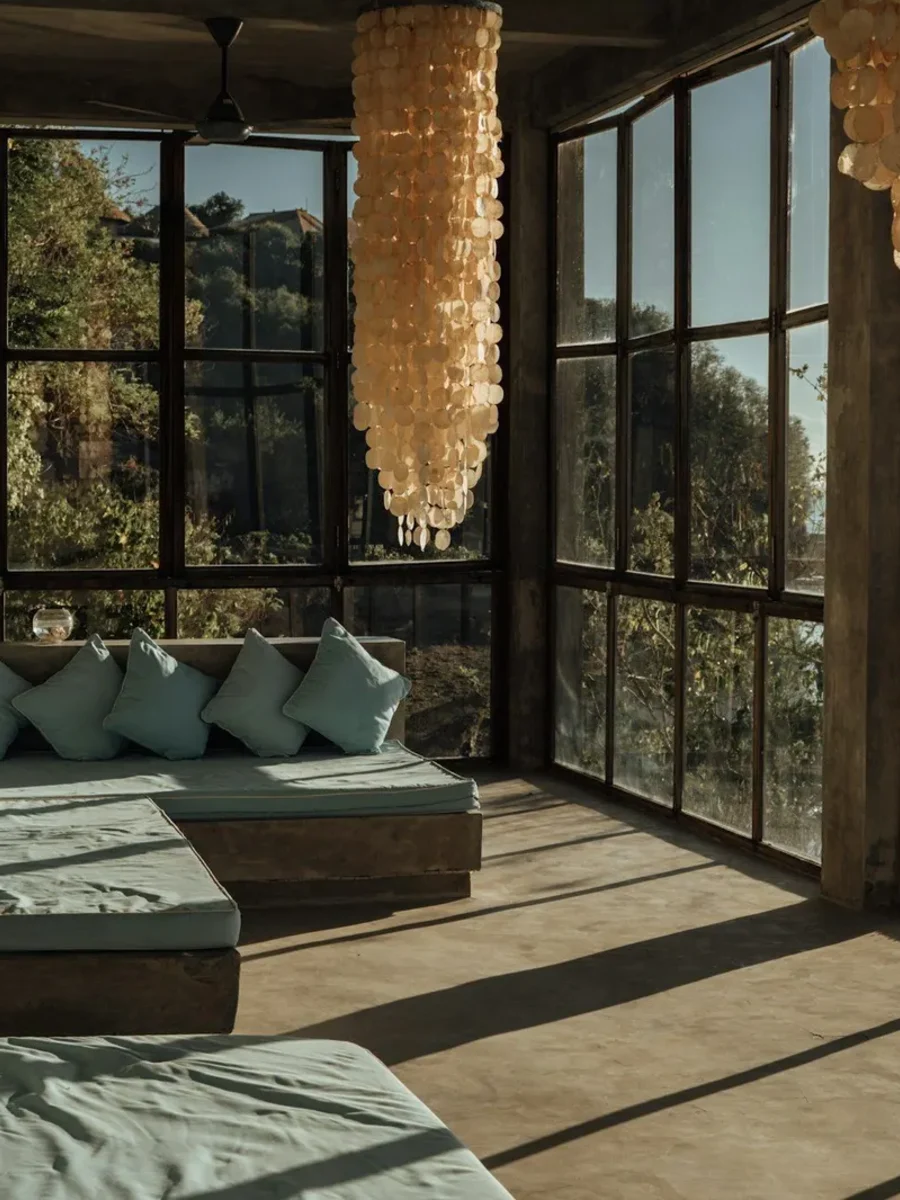
Goa is far enough south that the midday sun stands high for much of the year, so the south face of a villa is rarely the problem people expect. The punishing light is low and lateral: the west in the afternoon and, to a lesser degree, the east in the early morning. It comes in under verandah roofs, runs across polished floors and lands in the eyes of anyone sitting facing it. A villa's plan usually tells you within minutes which rooms will be unusable at four o'clock in April.
The most effective answer is outside the glass. US Department of Energy figures put the reduction in solar heat gain from awnings on west-facing windows at up to 77%, and research summarised by PNNL found exterior shades cut heat-danger hours by about 55% in extreme heat, against roughly 18% for interior roller shades. Deep eaves, verandahs, pergolas and external screens are architectural decisions, and they are far easier to make at design stage than to compensate for afterwards.
Inside, the job is control rather than blockade. A west-facing living room needs one layer that cuts glare while keeping the view and a heavier one for the hottest hours. Our guide to west-facing glare in Goan homes covers the window-level detail. At design stage the point is simply to know which elevations need which layers before anything else is drawn, because that dictates track positions, ceiling details and where furniture can sit.
Air movement and the damp months
Older Goan houses were built around moving air: high ceilings, openings on opposite walls, verandahs shading the walls themselves. Modern villas often keep the look and lose the mechanism, with large fixed glazing, bedrooms sealed on three sides for air-conditioning, and furniture pushed tight against every wall. IMD records the mean wind at Panjim peaking in July at 12.8 km/h from the west and south-west, off the sea — a welcome breeze on a dry afternoon and a carrier of wet, salty air in a storm.
The monsoon rewrites the brief. The US EPA advises keeping indoor relative humidity below 60%, ideally between 30% and 50%. No amount of open windows achieves that in August, when the outdoor air itself is close to saturated. A villa that is lived in through the monsoon needs dehumidification or air-conditioning in the rooms that hold textiles, and it needs air to move behind wardrobes, beds and sofas as well as through the middle of the room. The design consequences are small and specific. Leave a hand's width between large furniture and external walls. Keep fitted joinery off any wall that shows damp. Specify wardrobes with ventilated doors or backs. Choose rugs and loose furniture that can be lifted. None of this is visible in a finished photograph, and all of it shows by October.
Planning something like this?
We visit homes across North and South Goa, measure on site, and bring samples to see in your own light.
Designing a villa interior for the empty months
Many Goan villas stand empty for weeks or months at a time, often exactly when the weather is worst. A closed house in the monsoon is a box of warm, saturated air, and textiles, leather, timber and paper are what that air works on first. The EPA notes that wet materials dried within 24–48 hours will, in most cases, not grow mould. In an empty house nothing gets dried at all, which is why so many owners open the door in September to a smell before they see anything.
A villa interior designed for absence makes different choices from the start. Upholstery gets removable, washable covers. Curtains hang on systems that let them come down quickly for monsoon take-down and storage. Rugs are chosen with rolling and storing in mind. Rooms are wired so a dehumidifier can run on a timer, and there is a dry, ventilated store with shelving off the floor. It also means accepting that some rooms will be partly bare for a third of the year and designing them to look deliberate that way. We set out the practical routine in the closed-house season. For the design, the lesson is to plan storage and take-down in the first drawings rather than improvising in May.
Materials that last in salt and humidity
Salt and moisture are the two tests every material in a coastal villa has to pass. Corrosion from salt air is heaviest close to the shore and falls away quickly inland, so a villa within sight of the sea should assume the worst for exposed metal: curtain tracks, brackets, hinges, lamp bases and furniture feet. Stainless steel of a suitable grade, powder-coated aluminium and good-quality plastics outlast plated steel by years in that position.
For textiles the risks are mould, fading and loss of strength. Linen and cotton are comfortable and beautiful but hold moisture; polyester and solution-dyed acrylic shed it and resist fading. The honest design answer is usually a mix: natural fibres where they are sheltered and cared for, performance fabrics where they meet sun, spray or damp. For upholstery, the Martindale rub test gives a rough measure of durability, and BS 2543 puts general domestic use at 20,000 rubs and heavy domestic at 25,000. Timber wants air and a finish that lets it move rather than sealing it in. Leather wants conditioning and dry air. Wallpaper wants a wall confirmed dry. None of these is a reason to avoid the material; each is a reason to decide, at the design stage, who will look after it and how.
Where soft furnishings sit in the sequence
Curtains, blinds, upholstery and rugs are the last layer to go in, but three decisions about them belong at the very beginning: where the tracks go and whether they are recessed into the ceiling; whether any window needs power for motorisation; and how much wall either side of each window is kept clear so curtains can stack back off the glass. Once plaster and paint are finished, each of those becomes expensive to change.
Measuring for making, by contrast, belongs at the end — after plaster, flooring and paint, when openings are at their final size. Measuring from drawings or bare blockwork produces curtains that are a few centimetres wrong everywhere, which in a room with tall glazing is visible from the door. Our note on how to plan a villa makeover shows how that sequence fits Goa's calendar. Between those two points, fabric should be chosen in the room, in daylight, against the actual walls and floor. A sample looks different under a Goan afternoon than in a city showroom, and a colour that reads as warm neutral under shop lighting can turn grey against laterite or dark timber.
Design the villa for August and for an empty house; April and a full one will look after themselves.
Villa interior design, room by room
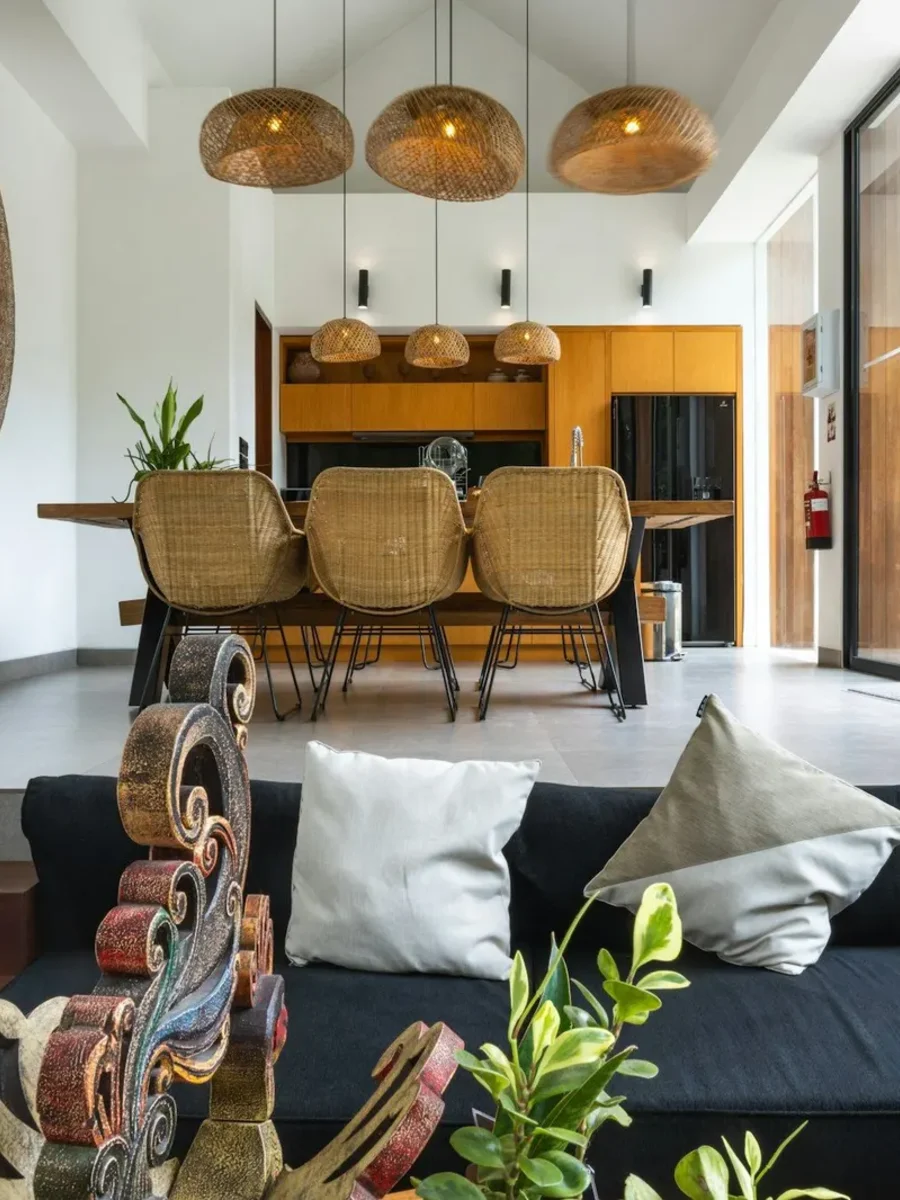
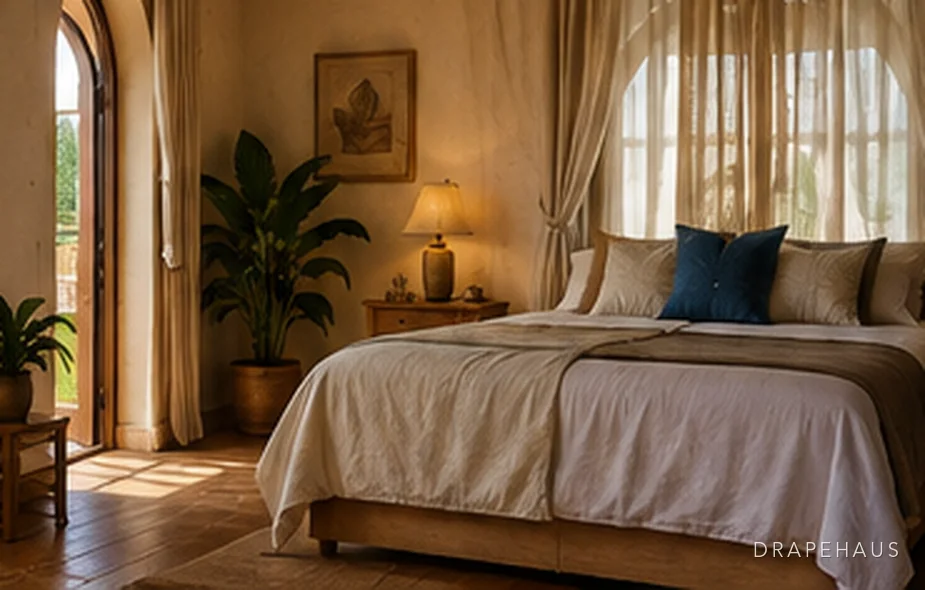
Each room in a villa has one job it must do well, and modern villa interior design works best when it is built around that job. In the living room it is controlling glare while keeping the view; in bedrooms it is darkness and cool, still air; on verandahs it is shade and durability. The detail for the main spaces is in our pieces on the double-height living room and the master bedroom.
Everything else — colour, pattern, collected pieces, art, villa decor in general — sits on top of those functional decisions, and it is far freer than it seems once they are settled. The villas that feel best in Goa are often the ones where the practical layer is invisible and the decorative layer is restrained. Settle the function first and the decoration can change with the owner's taste, the season or a new letting market without anything having to be rebuilt.
- Living room: glare control on west glazing, seating with removable covers, rugs that can be lifted
- Bedrooms: full blackout geometry, quiet cooling, textiles that dry quickly
- Bathrooms: moisture-tolerant blinds rather than fabric, extraction that actually runs
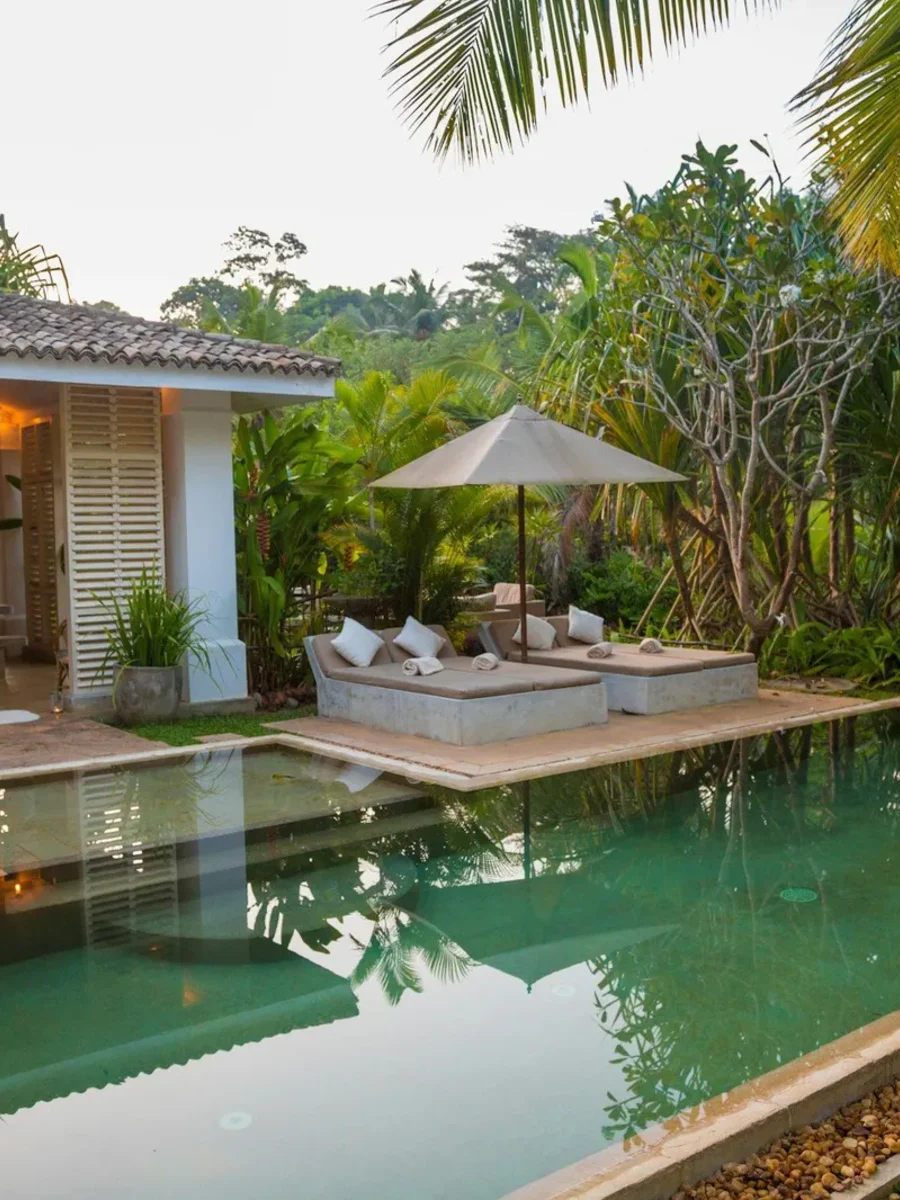
- Verandahs and pool rooms: outdoor-rated fabric, stainless or powder-coated fixings, shade before cushions
- Stairwells and tall glazing: motorised treatments, decided before plastering
- Store room: dry, ventilated, shelved off the floor — where textiles spend the monsoon