 Drape Haus
A mosquito net for a sliding door has a harder life than any window screen in the house. It is walked through many times a day, pushed by wet hands and curious dogs, rolled over by suitcases, and on a balcony it takes the full weight of the monsoon wind. The best screen for a door is the one that survives that use while still being easy enough that people actually close it at dusk.
There are three serious options. A sliding net is a framed mesh leaf in its own track, parked beside the glass. A pleated net folds into a slim post at the side and draws across like a concertina. A roller screen winds into a cassette and pulls out sideways. Each has a clear best use, and the choice usually comes down to four questions: how often is the door used, by whom, how exposed is it, and what kind of frame does the door have.
This guide works through those questions for the two doors Goan homes most often want to screen: the sliding glass door to a flat's balcony, and the French doors from a villa or old house to the garden or verandah.
Sliding, pleated or roller: how each behaves day to day
A sliding net is the workhorse. The mesh is stretched in a rigid aluminium frame, so it tolerates being pushed, knocked and leaned on, and it slides on rollers in a track that runs alongside the glass door's own. When it is open it stacks over the fixed pane, which means a strip of mesh is always in front of part of the view. For a door used constantly by a family, it is usually the one we recommend first, and our sliding door nets page explains how leaves are divided on wide openings.
A pleated net has no rigid leaf. The mesh is folded like a paper fan between a top guide and a very low bottom guide, with cords running through the pleats to keep them even, and it disappears into a post a few centimetres wide when open. That makes it the neatest choice where the view matters or the opening is wide, and its near-flat bottom guide is the kindest to feet. The trade-off is that the pleats and cords are more delicate, so it suits gentler households. The pleated mosquito nets page covers sizes and configurations.
A roller screen stores the mesh on a spring roller inside a vertical cassette at one side of the door, and you pull it across by a handle bar. It is tidy and nearly invisible when open. On a busy door, though, the spring and the edge guides take a lot of wear, the mesh can snap back if let go, and wind gets behind it more easily than a framed leaf. It is a reasonable answer for a door used now and then, less so for the main route to a balcony.
| Sliding net | Pleated net | Roller screen | |
|---|---|---|---|
| Strength under pushing | Good, rigid frame | Fair, soft pleats | Fair, spring and guides |
| Bottom track | Low track, can be recessed | Very low guide | Low guide or brush |
| When open | Stacks over the fixed pane | Folds into a slim post | Winds into a cassette |
| Wide openings | Divided into leaves | Single or paired | Limited width |
| Exposed, windy doors | Best of the three | Needs shelter | Least suited |
| Pets | Good with pet mesh | Pleats are easily torn | Mesh is easily pushed out |
Thresholds and bottom tracks: trips, luggage and sand
Every door screen needs something at the bottom to guide it, and that something is what people trip over. On a balcony door used by a grandparent at night, a child running out to the swing or a guest wheeling a suitcase, the height and shape of the bottom track matter more than almost anything else in the specification. A square-edged track a couple of centimetres high is a hazard; a low profile bevelled on both sides is not.
There are three ways to keep it low. Where a floor is being laid or relaid, a sliding net's bottom track can be recessed so it sits almost flush with the tile or stone. On a finished floor, a low bevelled surface track is the next best. A pleated net's guide is lower still, often only a few millimetres, which is why it suits households where the threshold is the main worry. Whatever the system, the track must not trap water: wind-driven rain reaches the foot of a balcony door, and the track needs a way to drain.
Near the beach the other enemy is sand. It collects in the bottom track, grinds the rollers and makes a sliding net drag, then jump the track. On a door to a garden or a beach path, plan for it: a doormat outside the net, a brush seal at the foot of the leaf, and a weekly sweep or vacuum of the track during the season.
If someone in the house walks with difficulty, choose the screen by its threshold first and everything else second.
Planning something like this?
We visit homes across North and South Goa, measure on site, and bring samples to see in your own light.
Pets and children pushing through the mesh
A closed screen that is invisible in bright light is also a screen that gets walked into, and one that a dog will learn to nose open. Standard fibreglass mesh tears under claws and pushing. For any door a pet uses, specify a heavier pet-resistant polyester mesh, at least on the lower half of the leaf, and a horizontal mid-rail so a push lands on the frame rather than the mesh. Pleated nets are a poor match for dogs that push, because the soft pleats cannot take it.
Children push at hand height, run through without looking, and swing on handles. A mid-rail at their height protects the mesh, a visible band stops collisions, and a handle that locks the leaf closed stops a small child sliding it open. One point needs saying plainly: a door net does not keep a child in. Safe Kids Worldwide's advice is that screens are meant to keep bugs out, not children in, and that children should not play on high balconies without an adult. A balcony door net is never a substitute for a proper railing, a grill or a lock on the glass door.
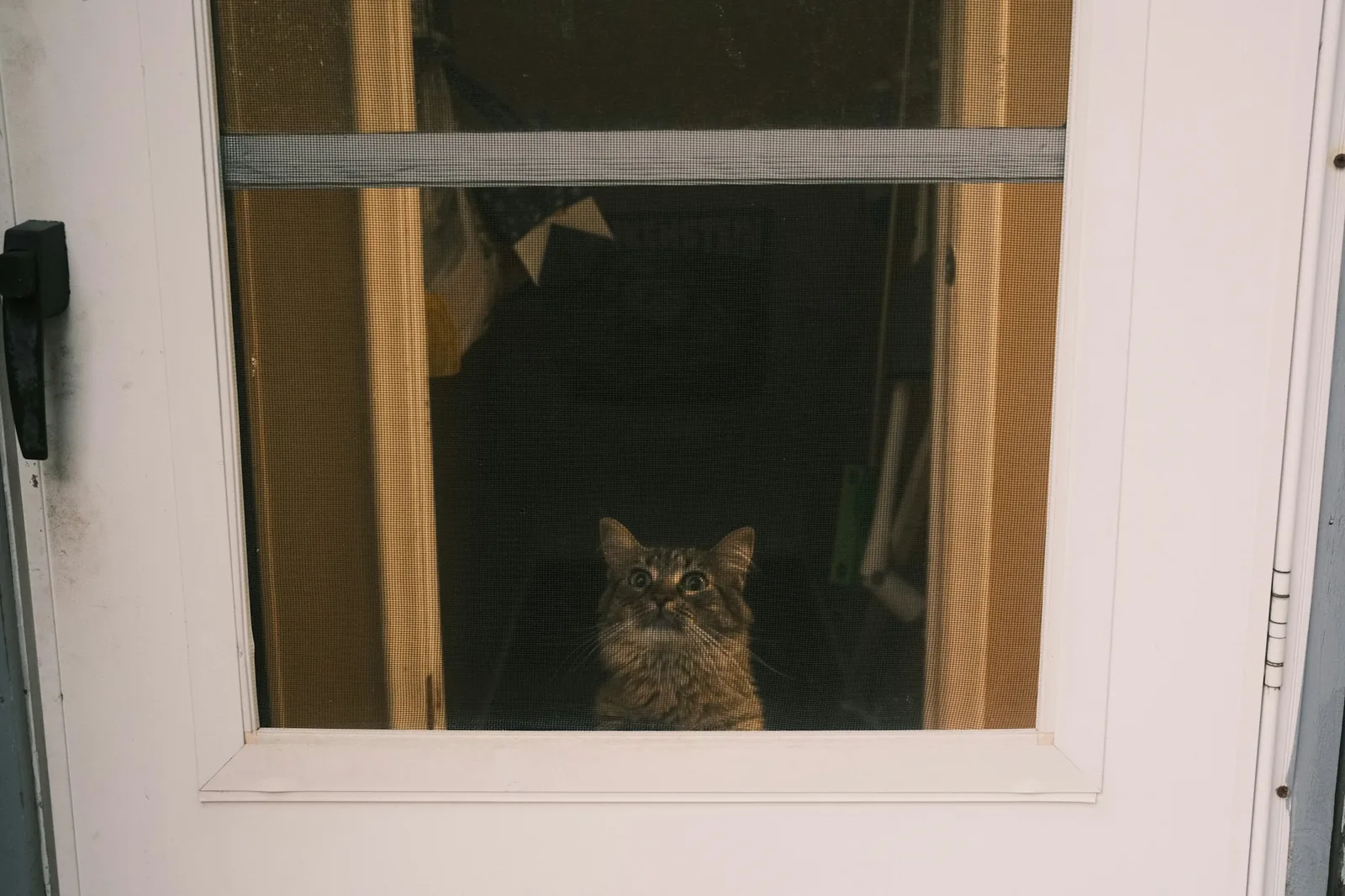
Cats are a separate case. They climb mesh rather than push it, and a cat that can climb a door net can climb out of it. If a cat uses the balcony, look at enclosing the balcony with framed pet-resistant mesh, which our balcony mosquito nets page covers.
Sea wind on balcony doors
The India Meteorological Department's climate summary for Goa describes winds strengthening from the west and south-west between June and August, which is the direction the sea lies for most of the coast. It also notes that thunderstorms peak in May, June, September and October, and that monsoon thunderstorms are sometimes accompanied by squalls. A balcony door facing the sea on an upper floor takes those gusts head on.
Wind loads a mesh door in two ways: it presses on the face, and it tries to lift the leaf out of its track. A framed sliding net copes best, provided the frame section is stiff enough for its height, the top track is deep, and anti-lift blocks stop it jumping out. A pleated net relies on its cords and guides to hold the pleats in line, and in strong gusts the mesh can billow and pull the cords out of true. On a sheltered garden door that rarely matters; on an exposed sea-facing balcony it can, which is why we usually steer exposed doors towards sliding nets.
Whatever the screen, the sensible habit in a storm is the same: close the glass door and leave the net parked behind it. A net is for keeping insects out of an open door, not for holding back weather.
Fitting nets to aluminium, uPVC and old wooden frames
The door frame decides where the net can go. Aluminium sliding doors are the easiest. Many have a spare channel or enough depth beside the glass for a mesh track, and a net in a matching powder-coated finish looks as if it came with the door. Near the sea, every screw holding it should be stainless, and the stainless steel trade body's guidance is to use grade 316 or equivalent within about five kilometres of the surf, because lower grades stain and corrode in salt air.
uPVC doors are deeper but softer. The track is screwed to the frame, and the fixings must go into the steel reinforcement inside the profile, not just the plastic skin, or they work loose as the leaf is pulled back and forth. A good fitter finds the reinforcement before drilling.
Old timber doors are the most interesting and the most varied. French doors in a Goan house may open inwards or outwards, may sit in a deep laterite reveal, and are rarely square after a century of monsoons. A sliding net usually runs on its own aluminium sub-frame across the face of the opening, on whichever side the doors do not swing, and needs clear wall beside the opening for the leaf to park. A pair of pleated nets meeting in the middle often fits better where the reveal is deep. Either way, the sub-frame is packed to follow the wall, so there is no gap at the edges for insects to find. Our page on mosquito nets for doors covers hinged screen doors for single timber doors as well.
Monsoon maintenance for door nets
The monsoon sets in over Goa in about the first week of June, according to the IMD, so May is the month to get door nets ready. Slide each leaf the full length of its track and listen: grinding means sand or worn rollers. Vacuum the bottom track, wipe the top guide, and check that the brush seals along the edges and where leaves meet are still in place. On a pleated net, pull it across and look at the cords; if the pleats sag or bunch, the cords need retensioning before the wind arrives.
Check mesh tension too. Mesh that has been pushed for a season starts to belly out of its frame and eventually pulls from the spline at one corner, which leaves a gap mosquitoes find within a night. The NCVBDC's vector control compendium describes screening as a physical barrier that has to cover all openings to work, and a slack corner on the most-used door undoes the rest of the house.
After the rains, rinse salt off the mesh and frame with fresh water, clean the track again, and replace any seals that have perished. Our step-by-step guide to cleaning mosquito nets covers the method, and if a net has torn or the rollers have gone, repair and re-meshing is usually possible without replacing the frame.