 Drape Haus
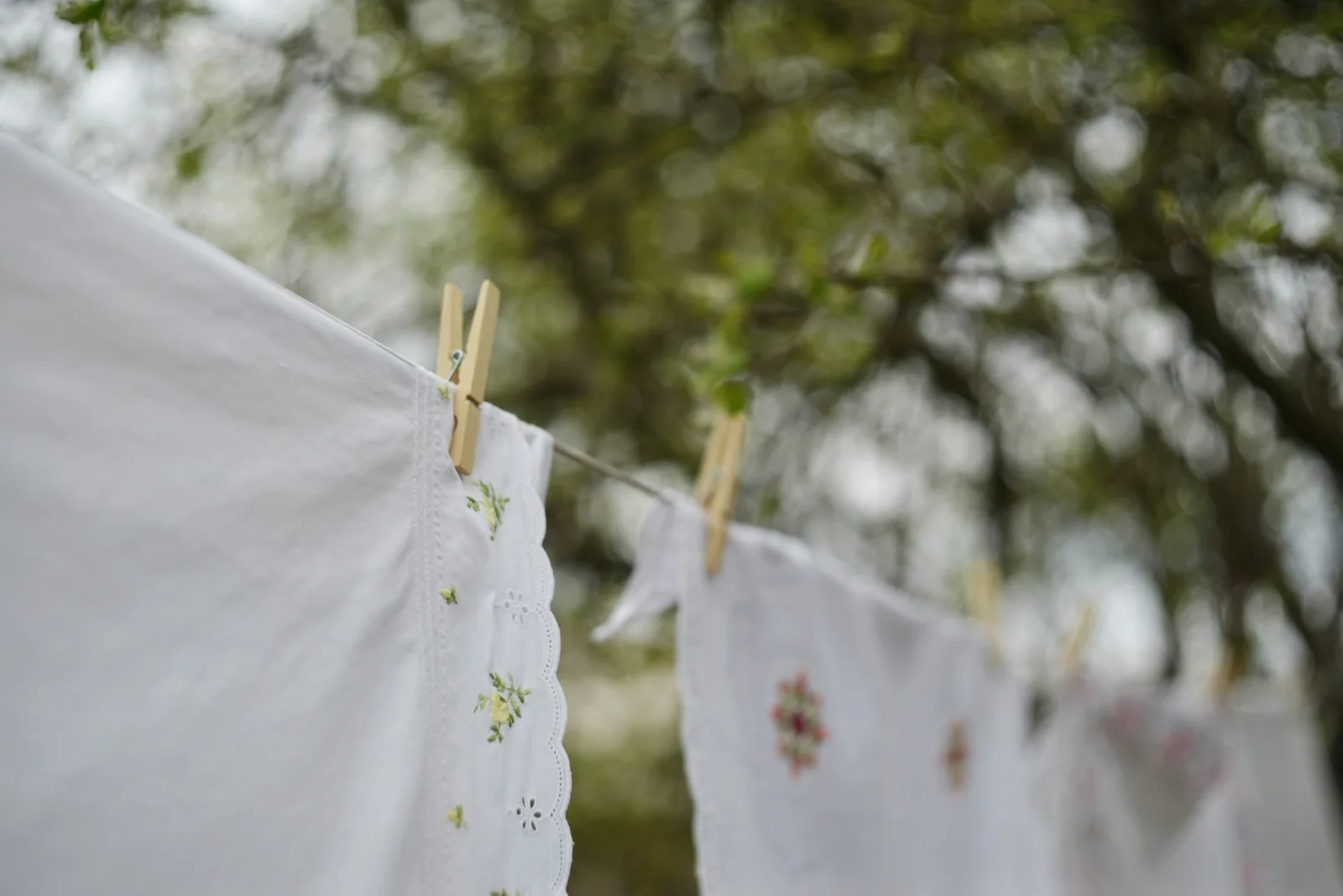
To wash curtains safely, work out three things before any water is involved: what the face fabric is, what the lining is, and how the heading is made. Unlined cotton, polyester and most sheers can usually go in a washing machine on a gentle, cool cycle. Linen can too, with care about shrinkage. Velvet, silk, heavily pleated headings and curtains with a coated blackout lining are a different matter, and are usually safer with a professional cleaner.
Timing matters as much as method in Goa. A curtain that goes into the machine on a July morning may still be damp three days later, and damp fabric left folded or bunched is where mildew starts. The best washing weather is the dry season, from November to May, and the best of it is December to February.
Below: how to read the label (and what to do when there isn't one), a fabric-by-fabric guide, the step-by-step method, how to dry and rehang without changing the drop, and when to hand the job over.
Before you wash: the label, the lining and the heading
Start with the care label if there is one. Care symbols follow the international ISO 3758 system, built on the five symbols developed by GINETEX, the international association for textile care labelling: a washtub for washing, a triangle for bleaching, a square for drying, an iron for ironing and a circle for professional cleaning. GINETEX is clear about how to read them. The label gives the maximum treatment the article will survive, judged on its most delicate part, including finishes and accessories. A gentler treatment or a lower temperature is always allowed.
Many curtains have no label at all. Care labelling rules tend to be written for clothing: the US Federal Trade Commission's Care Labeling Rule, for example, covers garments and the fabric sold to make them, not home furnishings. Made-to-measure curtains are cut from roll fabric whose care information was printed on the roll, not sewn into your hem. If you don't know the fibre, ask whoever made the curtains, or look up the fabric if you still have the sample or order sheet. If neither is possible, treat the curtain as the most delicate thing it could be.
Next, look at the lining. A sewn-in lining is washed with the curtain, so both layers have to tolerate the same treatment; if one shrinks more than the other, the curtain puckers and pulls. A detachable lining hooks onto the same heading and can be washed, or not washed, separately. A blackout lining with a rubbery or foam-like coating on one side needs its own rules, covered below.
Finally, the heading. Pencil-pleat and eyelet headings usually wash well once hooks and rings are out of the way. Pinch-pleat and other tailored headings are stiffened with a buckram or interlining that can soften, wrinkle or lose its shape in water. Ripple-fold headings depend on carrier snaps and exact spacing. And heavy curtains often carry lead or chain weights in the hem that must not go through a drum.
A care label shows the most a curtain can take. Going gentler, cooler or slower is always allowed.
Can you wash curtains in a washing machine?
Often, yes. Unlined cotton, polyester and many blends wash well in a machine on a delicate or wool cycle, at the temperature on the label or lower, with a low spin. The risks are mechanical more than chemical: a long, heavy curtain packed into a small drum creases hard, abrades along the folds and can twist so badly that seams distort. Wash one or two panels at a time, so the fabric moves freely, and use a mild liquid detergent that rinses out easily.
Take off every hook, ring, glider and clip. Loose metal hooks snag and tear fabric, and can damage the drum. Tie up any cords on the heading tape so they don't knot. Shake the curtains out, or vacuum them with a brush attachment, before washing: much of what makes curtains grey is dust and, near the sea, a fine salty film, and removing it dry means less is ground into the cloth.
Fragile fabrics belong in a large mesh laundry bag or in a basin. And long drops of heavy fabric are often better hand-washed in a bath, simply because the weight of a wet three-metre curtain is more than a domestic drum and its bearings want to spin.
| Curtain | Usual method | Drying | Watch for |
|---|---|---|---|
| Cotton, unlined | Machine, gentle cycle, cool | Line dry in shade; rehang just damp | Shrinkage if not pre-shrunk; fading in hard sun |
| Linen and linen blends | Machine on gentle or hand wash, cool | Line dry; iron while damp | Shrinkage, heavy creasing |
| Polyester and blends | Machine, gentle, cool to warm | Line dry or rehang damp | Creases set by heat; static dust |
| Sheers and voiles | Hand wash or mesh bag on delicate | Rehang damp to drop creases | Snags; sun-weakened fibres tearing |
| Sewn-in lining | Only if both layers wash the same; otherwise dry clean | Flat or on a line, lining outwards | Uneven shrinkage and puckering |
| Coated blackout lining | Sponge or hand wash cool; no tumble dryer | Hang to dry, coating not folded on itself | Cracking, peeling, sticking |
| Velvet, silk, interlined, pinch-pleat | Professional cleaning | By the cleaner | Crushed pile, water marks, distorted headings |
Planning something like this?
We visit homes across North and South Goa, measure on site, and bring samples to see in your own light.
Cotton, linen and polyester: washing by fibre
Cotton is the most forgiving curtain fibre to wash, with one caution: unless the fabric was pre-shrunk before it was made up, the first wash can take some length out of it. Wash cool, avoid the tumble dryer, and rehang while the fabric is still very slightly damp so its own weight eases out the wrinkles. Printed and dyed cottons fade from repeated hot washing as well as from sun, so the lowest temperature that gets them clean is the right one.
Linen is strong, and it gets softer and more relaxed with every wash, which is part of its appeal. It also creases deeply and, like cotton, can shrink, especially in the first wash and in hot water. Wash it cool, on a gentle cycle or by hand, and don't wring it. Linen is easiest to press while still damp; once it has dried bone-hard in sun, the creases are much harder to lift. If your linen curtains were made to brush the floor exactly, measure the drop before and after the first wash so you know where you stand.
Polyester and polyester blends are the easiest of all: they shrink very little, dry fast and resist mildew better than plant fibres. Their weakness is heat. A hot wash or a hot dryer can set creases that never fully hang out, so use cool water and a short, low spin. Polyester also tends to hold static, which draws dust, so curtains in this fibre often look grey long before they are actually dirty; a good shake or a vacuum between washes helps.
Blends behave like their most demanding fibre. A linen-polyester mix still creases like linen; a cotton-viscose still shrinks like viscose. When in doubt, wash it as if it were the more delicate of the two.
Sheers and voiles: gentle, quick and damp
Sheer curtains are the ones that need washing most often, because they hang closest to the open window and catch dust, pollen and salt. They are also the most fragile. Hand washing in a basin of cool water with a little mild detergent is safest: press the fabric through the water rather than rubbing it, rinse twice, and lift it out supported in both arms rather than by one corner. If you use a machine, put each panel in a large mesh bag, choose the delicate cycle and the lowest spin.
Before washing an old sheer, check its strength. Light fades colour and ultraviolet radiation causes yellowing, weakening and eventually disintegration of materials, as the Canadian Conservation Institute explains, and the damage is cumulative. A voile that has hung at a sunny west window for several years may look fine but tear like paper in the wash. Pinch a fold near the leading edge, where the sun hits hardest, and pull gently. If it splits, the curtain is at the end of its life and washing will only finish it.
Sheers are best rehung while still damp. Their own weight pulls them straight within a few hours on a dry day, without ironing. Our guide to sheer curtains covers the fabrics that cope best with sun and sea air if you are replacing them.
How to wash blackout curtains and lined curtains
Blackout curtains are made in two main ways, and they need different handling. Some use a woven blackout fabric, or a separate blackout lining sewn or hooked behind the face fabric. Others have a coated lining: a fabric backed with one or more layers of a foam-like coating that blocks light. The coating is the part to protect. Hot water, vigorous machine action and above all the tumble dryer can make it crack, peel or stick to itself, and once a coating cracks, light shows through as fine lines and pinholes.
For coated linings, the safest routine is regular vacuuming with a soft brush, spot-cleaning marks with a damp cloth and mild detergent, and hand washing in cool water only when a full wash is unavoidable. Never wring, never tumble dry, and dry the curtain hanging so that the coated face is not folded onto itself while damp. If the label says dry clean, follow it, and tell the cleaner the lining is coated. Our guide to blackout linings explains how the different types are made. The same rules apply to coated blind fabrics; for those, see how to clean fabric blinds.
Lined curtains with a sewn-in cotton or polyester lining are a judgement call. If face fabric and lining are the same fibre and both are washable, a gentle machine or hand wash works. If they differ, for example a linen face on a polyester lining, they will shrink at different rates and the curtain can pucker along the seams. That is a strong argument for detachable linings when curtains are made: the lining can then be washed, replaced or left alone, separately from the face.
Interlined curtains, the heavy kind with a soft blanket-like layer between face and lining, should not be washed at home at all. The interlining shrinks and bunches, the layers drift apart, and the curtain never hangs the same way again.
Never tumble-dry a coated blackout lining. Heat is what cracks the coating.
Velvet, silk and heavy drapes: when to call a professional
Some curtains should go to a professional cleaner rather than into any domestic water. Velvet is the clearest case: its pile crushes and mats when wet and agitated, and once crushed it rarely recovers evenly, leaving patches that catch the light differently. Silk water-marks easily, can bleed dye, and, at a sunny window, weakens over time in exactly the way described above for sheers. Large interlined, pinch-pleated or hand-headed curtains have stiffening and stitching that wet cleaning can distort.
Size is a reason in its own right. Curtains for double-height windows or long runs of glass can be too heavy to wash, rinse and hang to dry safely at home, and too long to rehang without scaffolding. If a curtain is valuable, irreplaceable or very large, the cost of a professional clean is small against the cost of replacing it after a domestic wash goes wrong.
Between cleans, much can be done without water. Vacuum the curtains every few weeks with a brush attachment on low suction, working from the top down, and pay attention to the top of the heading and the folds where dust settles. Air them on a dry, breezy day by opening the windows wide. Spot-clean marks with a barely damp cloth, testing first on a hidden hem.
Mildew spots on curtains after the rains
Grey or black speckling on curtains, usually low down, on the lining and in the folds, is mildew. It grows where fabric stays damp: curtains drawn against a cold, wet window, curtains bunched behind furniture, curtains left up in a closed house through the monsoon. Our guide to fungus on clothes and wardrobes covers the same problem in stored textiles.
Take mildewed curtains outside before brushing off loose growth, so spores don't scatter round the room. For washable fabrics, NC State Extension's guidance is to pretreat the marks with a non-ammonia detergent, then wash at the hottest temperature the care label allows, with an oxygen-based bleach for coloured and delicate fabrics, and chlorine bleach only on white or bleach-safe, colourfast items. Never mix chlorine bleach with ammonia-based cleaners. Dry the curtain completely and quickly afterwards.
Be realistic about the result. NC State notes that mould can permanently damage some items, and on curtains it often leaves a faint stain, and sometimes a weakened patch, even after the growth is gone. Coated blackout linings with mildew in the coating are rarely worth saving; the lining can usually be replaced without remaking the whole curtain. If the curtains keep growing mildew in the same place, the cause is the room, not the curtain: our guides to humidity in Goa and reducing humidity in a room deal with that.
Drying curtains in Goa: when to wash and when to wait
The single most useful piece of advice for washing curtains in Goa is to choose the month. IMD's climate normals for Panjim show why. From June to September, average relative humidity runs at 88–91% in the morning and 82–87% in the evening, and in July the morning sky is overcast on about 19 days of the month. Wet fabric dries slowly in that air, if at all. The US Environmental Protection Agency notes that materials dried within 24–48 hours usually do not grow mould; a heavy curtain hung indoors in a Goan July can take longer than that.
From December to February the picture reverses. Evening humidity averages 57–59%, clear-sky days outnumber overcast ones by a wide margin, and a cotton or linen curtain hung outside in the morning can be dry by evening. That makes the end of the year, after the post-monsoon damp has cleared and before the hottest months, the best time to wash curtains thoroughly. The second-best window is April and May, just before they come down for the rains.
Dry in shade or bright indirect light rather than hard midday sun. Sunlight dries fast, but it also fades dyes and weakens fibres, and the Canadian Conservation Institute puts the rate of light damage in sunlight at around a thousand times that of good museum lighting. A shaded verandah or a line under trees on a breezy day is ideal. If you must wash in the monsoon, choose a dry spell, wash one curtain at a time, spin it as well as the fabric allows, and hang it in a room with a fan running and a dehumidifier or the air conditioner on, rather than in a closed bathroom.
Drop changes are the other drying risk. A curtain that shrinks a few centimetres no longer touches the floor, and one dried folded over a rail can stretch on one side. Measure the drop before washing, dry the curtain hanging straight, and rehang while it is just damp so the weight of the fabric works for you.
For a house that closes for the rains, the simplest answer is not to leave the curtains up at all. Our monsoon take-down and storage service takes curtains down before the monsoon, cleans and inspects them, stores them flat and ventilated rather than bagged, and rehangs and dresses them in October. If you are replacing curtains rather than washing them, browse the curtain collection with these care questions in mind.
| Months | Morning / evening humidity | Verdict |
|---|---|---|
| December – February | 74–80% / 57–59% | Best: dry, often clear, fast drying |
| March – May | 75–81% / 65–69% | Good, especially before the rains |
| June – September | 88–91% / 82–87% | Avoid: slow drying, mildew risk |
| October – November | 77–86% / 65–76% | Wait until November if you can |
How to wash curtains at home, step by step
For washable cotton, linen, polyester and sheer curtains. Check the label and the notes above before you start.
Measure and photograph
Measure the drop of each curtain and note which panel hangs where. A quick photograph of the heading and hook positions saves time when rehanging pinch-pleat or ripple-fold curtains.
Take them down and strip the hardware
Remove every hook, ring, glider and clip, and take out any loose hem weights. Tie up heading-tape cords. Check that all the hooks are accounted for before anything goes near the machine.
Shake, brush or vacuum the dust out
Do this outdoors if you can. Dry dust and salt come out far more easily before washing than after, and the wash water stays cleaner.
Test for colour and strength
Dab a hidden hem with a damp white cloth to check that the dye doesn't run, and tug gently at a sun-exposed fold to check the fabric is still sound.
Wash gently and cool
Machine-wash one or two panels at a time on a delicate cycle at or below the label temperature, with mild liquid detergent and a low spin, or hand wash in a bath. Sheers go in a mesh bag. Never overload the drum.
Rinse well
Detergent left in the fabric attracts dirt and can leave stiff, greyish patches. An extra rinse is worth the time, especially for hand-washed curtains.
Dry hanging, in shade
Hang the curtains straight over a line or two, out of hard sun, lining side out. Don't tumble dry unless the label says it is safe, and never tumble dry a coated blackout lining.
Press, rehang and dress
Iron linen and cotton while slightly damp, on the reverse, at the setting for the fibre. Rehang while just damp, re-dress the folds by hand, and check the drop against your measurement.