 Drape Haus
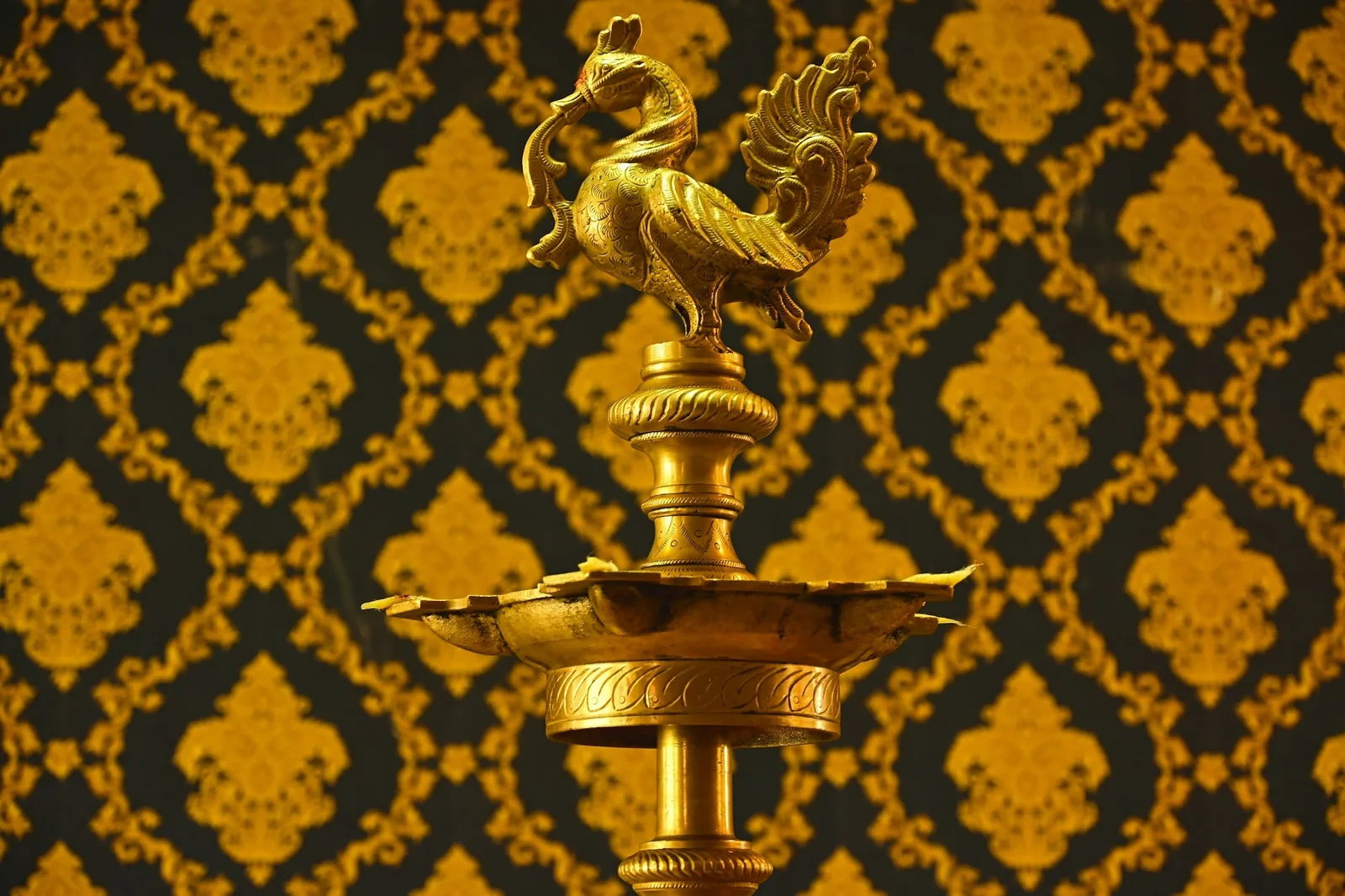
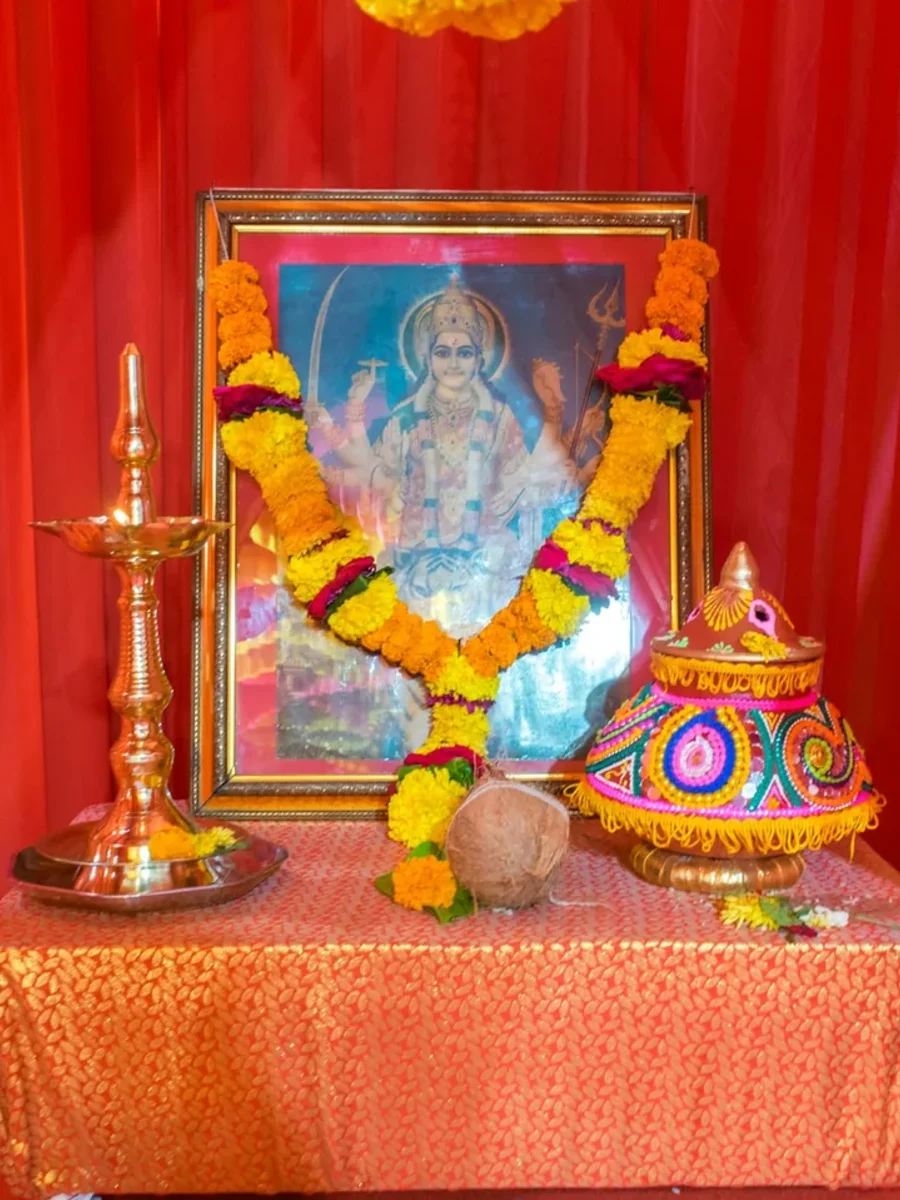
A samai is a standing brass oil lamp: a central stem rising from a heavy base to one or more dishes for oil and wicks, usually finished with a decorative top. A 2022 survey of Goan handicrafts describes it simply as a tree-like oil lamp with flower motifs, made by the state's brass artisans. In many Goan Hindu homes it stands in the home shrine, is lit for prayers and festivals, and is often the heaviest and oldest metal object in the house.
It is also the object that suffers most visibly from the Goan climate. Brass tarnishes in moist air and salt air speeds it up, so a samai polished for Ganesh Chaturthi can be dull again by Diwali. Most of the damage people do to old brass comes from cleaning it too hard, not from leaving it alone.
This guide explains how Goan samais are made, why they darken so quickly here, how to clean one gently with methods museum conservators use, when to leave the patina alone, how to keep lamp flames safely away from curtains and festive fabric, and how to store brass through the monsoon. We make curtains and soft furnishings, not lamps; the fabric and safety advice is where our work meets yours.
The samai and its place in a Goan house
Lamps are woven into Goan religious architecture. The Government of Goa's description of the state's temples notes that one of their special features is the lamp tower, the deepmal or deepa stambha, rising anywhere from two to six storeys, said to be a Maratha influence, and decorated with hundreds of oil lamps on festival days. Goa Tourism singles out the deepastambha at the Shri Shantadurga temple as one of its defining features. The household samai is the same idea brought indoors: a column of light on a single stand.
The lamps used in homes and temples come in many forms. The Asia InCH encyclopedia of crafts lists among the cast brass made in Goa the niranjan, a brass lamp; samala, the large lamps; and the kalash, the ritual pot, alongside small vessels, perfume sprinklers, diyas and candle stands. It notes that ritual lamps range from small to unusually tall, that elaborate three-tiered lamps are used in worship, and that tall lamps distinguish Goan temples such as Mangueshi and Mahalsa.
Festivals bring the samai out of the shrine. Goa Tourism describes Ganesh Chaturthi as an annual homecoming for many Goans, lasting anywhere from a day and a half to 21 days depending on the household, with homes decorated well in advance. Diwali follows after the rains. In both, more lamps burn for longer, in rooms full of guests, flowers and new fabric, which is why the safety section of this guide matters as much as the polishing.
How a Goan samai is made
Goa Tourism describes brass casting in the state as a hereditary craft, passed from one generation to the next, producing oil lamps of many designs, candle stands, temple towers and church bells. The Asia InCH encyclopedia names the makers as the Kansara community, practising in Mapusa, Sanquelim and Bicholim, and part of a lamp-making tradition that runs down the west coast to Karnataka and Kerala.
Two methods are used. Small parts and fittings such as handles are pressed from brass sheet. Lamps and heavier pieces are cast: the form is first modelled in wax hardened with resin, that wax master is used to make a negative mould in aluminium, molten brass is poured in, and the casting is removed and cleaned. It is then finished on a lathe, engraved by hand and buffed. A large lamp is made in separate parts and assembled.
Two practical points follow for an owner. First, because larger lamps are assembled from parts, many samais can be taken apart, and a lamp that can be dismantled is far easier to clean thoroughly and dry completely. Second, the engraving is cut by hand into a turned surface, so it is shallow. Every hard polish rounds its edges a little more, which is why an old samai polished weekly for decades looks soft and blurred.
Planning something like this?
We visit homes across North and South Goa, measure on site, and bring samples to see in your own light.
Why brass darkens so fast by the sea
Brass is an alloy of copper and zinc, and its tarnish is a reaction with the air. The US National Park Service's handbook on caring for metal objects sets out the main causes as relative humidity, temperature extremes, air pollution and handling. It notes that brass will not tarnish below 15% relative humidity, a level no Goan home ever reaches, and that coastal environments are among the most severe for metals. The India Meteorological Department records Goa's morning humidity at 87% to 91% from June to September and above 70% for most of the dry season.
The same handbook names sulphur compounds as the strongest tarnishing agents, given off by burning fuel and by everyday materials such as foam rubber, carpet padding, paint, wool and felt. That is useful at home: a samai stored on a woollen cloth or on felt pads, or kept in a cupboard with a rubber-backed mat, darkens faster than one on cotton. Lamp oil and soot add a sticky film that holds dust and moisture against the metal.
Fingers do damage too. The handbook warns that salts and oils from skin can etch metal, and recommends handling clean metal with clean cotton or nitrile gloves. A samai that is handled daily for prayer will always show fingermarks; the point is to wipe them off with a soft dry cloth after lighting rather than leaving them to etch.
| What you see | What it usually is | What to do |
|---|---|---|
| Even golden-brown to dark brown film | Ordinary tarnish or a stable patina | Wipe and leave, or polish lightly if you want it bright |
| Smooth, tight green, brown or black colour overall | A stable patina, often decades old | Leave it; polishing removes metal and history |
| Powdery green, blue or white spots | Active corrosion, often from salts or moisture | Clean gently, dry thoroughly, store drier; ask a conservator if it spreads |
| Sticky dark deposit around the wick dishes | Oil, ghee and soot residue | Degrease with mild detergent before any polishing |
Patina or polish: deciding what to keep
Not every old samai should shine. The National Park Service defines a patina as a thin, chemically formed layer of relatively stable corrosion, which can form naturally over time or be created deliberately when an object is finished. Its guidance for cleaning copper alloys stresses that cleaning and polishing remove original metal, and that over-cleaning usually comes from wanting brass to look bright and new.
For a family lamp, the choice is about meaning as much as metal. A lamp in daily use is usually kept bright, and that is a legitimate tradition. An heirloom samai that is no longer lit, or one with fine engraving, is often better left with an even, dark patina, cleaned of dust and oil but not polished back to raw metal. The conservators' guidance offers a middle way: polish the raised surfaces and leave the darker tarnish in the recesses, which, they note, helps the design stand out.
If a lamp is very old, unusual, or may have been lacquered or gilded when it was made, do not polish it at all until someone who knows metals has looked at it. Original coatings, once polished off, cannot be put back.
Polish the high points, leave the hollows dark. The engraving reads better and the lamp loses less metal.
Lamps, curtains and festive fabric
Three fire services, three ways of putting it. Goa's Directorate of Fire and Emergency Services lists oil lamps alongside candles as flames to keep clear of furniture, bedding, curtains, carpets, books and decorations, and wants them out before the household sleeps. London's fire brigade mentions diyas by name: a lamp lit for worship still must not burn unattended, and should stand in a holder that tolerates heat, on a surface that will not tip. The US Fire Administration puts a number on the gap, at least 12 inches, roughly 30 cm, between a flame and anything combustible.
Because a samai stands tall and burns several wicks at once, think in three directions. Above it, there should be stone, plaster or open air, never a valance, a festive garland swag or the edge of a canopy, since the heat column rises well past the flame. Beside it, picture where the nearest curtain goes when a fan or a gust catches it; if the hem can travel to within that 30 cm, move the curtain or tie it back with a fixed metal holdback. Below it, use a brass or steel tray on stone or tile, so dripping oil never soaks a cloth runner. For shrine curtains specifically, our article on pooja room curtains goes through fabrics and fixings.
Festival weeks are when these rules slip, because there are more lamps, more guests and more new fabric in the house at once. Goa's fire service adds a Diwali-specific warning: crackers have started serious fires on balconies, so nothing combustible, including laundry, should be left out there. Plan any festive fabric around where the lamps will stand, not the reverse; our Diwali and Ganesh Chaturthi guides cover timing and fabric for each festival.
Displaying brass on shelves, consoles and in the shrine
Brass is heavy, and the Park Service handbook notes that metal objects set down on period furniture can dent, scratch or stain it. Give every samai and heavy vessel a base: a small brass or steel tray, a stone slab, or at least a folded cotton cloth. On an old wooden console, that tray also protects the polish from oil, which soaks into timber and leaves a dark ring that is very hard to remove.
Avoid felt pads and woollen cloths under brass, for the sulphur reason above, and avoid displaying brass on a shelf directly above a kitchen hob or an incense stand, where grease and smoke settle on it. Group brass together rather than scattering it, so one dusting and one inspection covers the lot. A row of lamps and vessels on one tray in the sala, with a plain wall behind, reads far better than single pieces on every surface.
If the shrine is in a cupboard or a niche with a cloth door, keep the cloth well forward of the lamp and wash it often, because soot and oil from the lamp collect on the inside face. Our cotton curtains can be made up as small shrine curtains on a rod or track that keeps them clear of the flame.
Storing brass through the monsoon
Many families put away all but the daily lamp from June to September. Stored well, brass comes out in October needing only a wipe. Stored badly, damp and dirty, it comes out with green spots. Start with clean, completely dry pieces: any oil, fingerprints or moisture left on the surface goes on reacting for four months in the cupboard.
Wrap each piece in clean, washed cotton, such as an old sheet or muslin, so that pieces do not knock together and dust stays off. Do not wrap brass in wool or felt. Avoid sealing brass in a plastic bag in a humid room: whatever moisture is trapped inside condenses on the metal when the temperature drops at night. A closed cupboard on an internal wall, with a moisture absorber or silica gel changed regularly, is the best most homes can do; the Park Service notes that museums keep metals in salt-air areas below 35% relative humidity, which shows how far the ideal is from an ordinary Goan cupboard.
A thin coat of microcrystalline wax before storage, as the conservators describe, slows tarnish for a year or two and is removed easily when you want to polish again. If the house is closed for the season, the same care applies to curtains and cushions as to brass; our monsoon take-down and storage service handles the soft furnishings.
How to clean a brass samai gently
Adapted from the US National Park Service's guidance for cleaning copper-alloy objects. It is slower than a commercial polish and takes away far less metal. Do not use these steps on a lamp that may be lacquered, gilded or of museum value.
Take it apart and look
Unscrew or lift apart the stem, dishes and finial if they come apart. Check for cracks, loose joints and old repairs before you handle the pieces heavily.
Remove dust and loose soot dry
Brush off dust and soot with a soft brush before anything wet touches the lamp. Wet soot smears into the engraving.
Degrease the wick dishes
Wipe away old oil and ghee with cotton dampened in water with a few drops of mild detergent, working with a soft brush in the crevices. Rinse with clean water and dry immediately. Do not soak the lamp or let water into hollow parts.
Test before polishing
Wipe a small area with cotton moistened with denatured alcohol. If light tarnish lifts, that may be all the lamp needs.
Polish lightly where needed
Mix a little precipitated calcium carbonate with denatured alcohol to the consistency of cream and rub gently in circles with soft cotton, changing it often. Do not substitute ground chalk or whiting, which scratch. Leave darker tarnish in the recesses.
Rinse, dry and wax
Wipe off all residue with clean alcohol, dry thoroughly with flannel, and buff on a thin coat of microcrystalline wax. Handle the clean metal with cotton or nitrile gloves so fingerprints do not etch it.