 Drape Haus
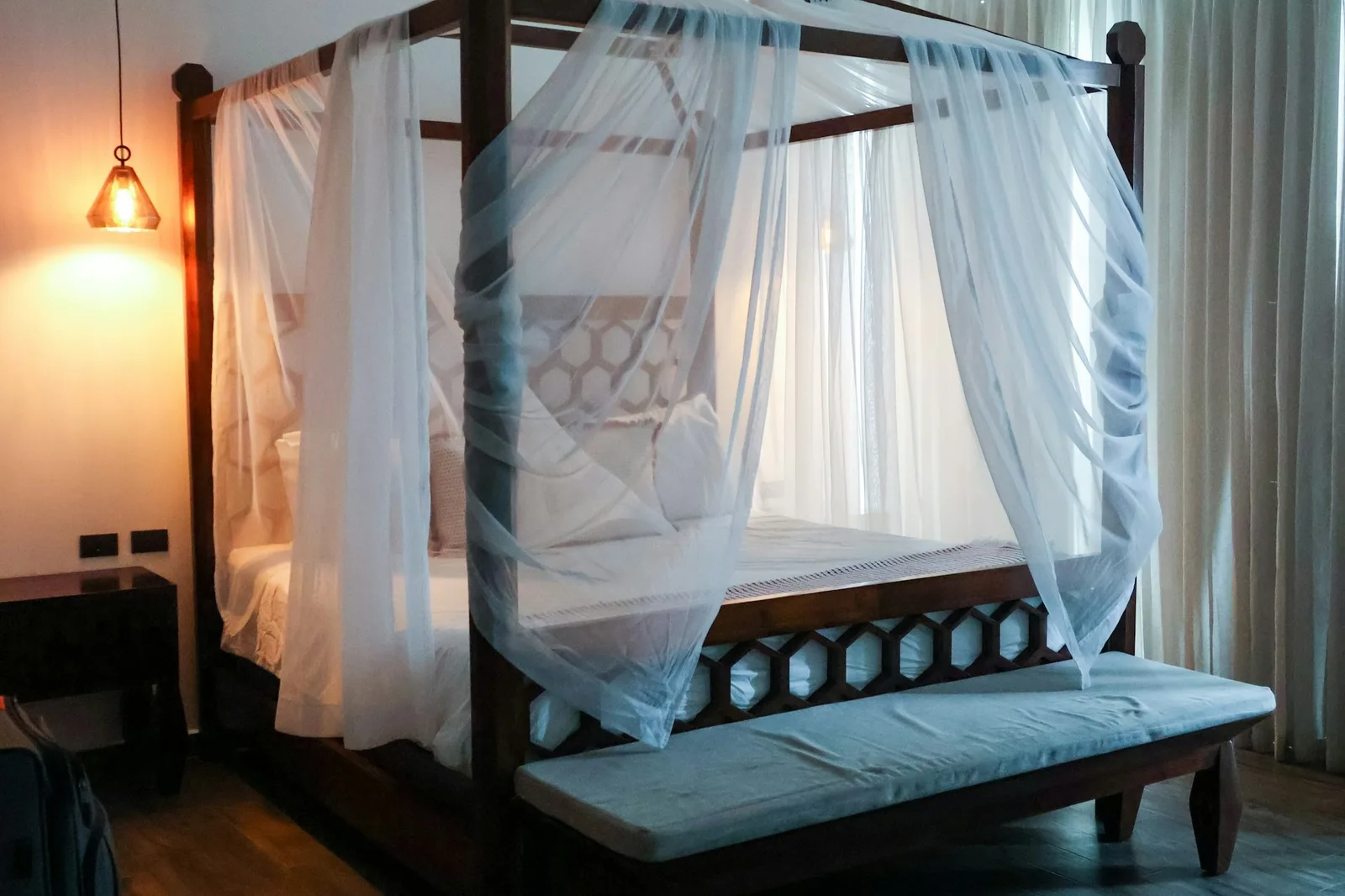
A four poster bed is a bed with a tall post at each corner, often joined at the top by a frame called a tester, built to carry fabric. In old Goan houses the four-poster is usually a dark, carved hardwood bed, sometimes with a caned or panelled head, and in many families it is the one piece of bedroom furniture that has outlived every mattress put on it. New four-posters, in turned or square timber, are also a common choice for villas and homestays that want a bedroom with presence.
The posts are not decoration. Museum histories of the bed explain that the frame was there to hold curtains for privacy and against draughts, and in warm coastal regions to hang mosquito netting. That last job is the one that matters in Goa, where a well-hung net on a four-poster is one of the most comfortable ways to sleep with the windows open.
This guide explains what the posts were for, what is and is not known about Goan four-posters, how to check an old bed before you dress it, how to fit a modern mattress without forcing the frame, and the options for nets, sheers and canopies, with monsoon care for all of them. We make the curtains, canopies, headboards and mosquito nets; the woodwork and pest control we leave to specialists.
Why a bed has four posts
The Heritage Society in Houston, whose collection includes a 19th-century four-poster with a tester, explains the form simply. From the Renaissance, bedsteads were often built with four vertical posts, a wooden frame and a canopy of cloth, because homes had few rooms and drapes on and around the bed gave both privacy and protection from draughts. The tester is the wooden frame carried by the posts, from which the curtains hang.
The same museum notes something directly relevant to Goa. In coastal Texas, tall-post beds with testers were still being made into the 1870s, long after they had gone out of fashion further north, because the framework lent itself to hanging mosquito netting, a necessity in coastal places. A four-poster in a humid, mosquito-prone climate is not a period affectation; it is a frame for a net.
Indian cotton has dressed four-posters for centuries. The Victoria and Albert Museum's Garrick Bed, made around 1775 for the actor David Garrick, was hung with Indian chintz: dyed and painted cotton made at Masulipatam, sent to Mrs Garrick by friends in Calcutta in 1775, and seized by British customs on arrival until Garrick pleaded for its return. The original hangings survive in the museum's collection. The idea of a carved bed dressed in fine cotton from this coast is an old one.
Four-posters in Goan houses: what is known, and what is not
Goan furniture of the great houses was largely local work in Indian hardwoods. The Government of Goa's account of the heritage mansions records that their furniture was carved from rosewood by local craftsmen, while porcelain, glass, chandeliers and tapestries came from abroad. A 2022 survey of Goan handicrafts notes that woodcarving came into prominence during the Portuguese period, with rosewood and teak furniture carved in floral, animal and figurative designs. Old Goan beds belong to that tradition.
What is missing is a documented history of the Goan four-poster as a type. The museum records that date Goan furniture concentrate on cabinets, tables and chairs; beds were private furniture, used hard, often altered, and rarely catalogued. Our guide to Goan furniture traditions explains how to look at construction rather than style when judging age. Apply the same caution to a bed: posts, testers and headboards are easily added, swapped or remade, and a carved four-poster can combine parts from different periods.
That does not make a later or composite bed less useful. It only means that if you are buying one as a heritage piece, ask what has been replaced, and judge it by its joints and timber rather than by a story. If you are buying one to sleep in, the questions that matter are whether it is sound, whether a mattress fits it, and whether its frame will carry a net or a canopy.
Planning something like this?
We visit homes across North and South Goa, measure on site, and bring samples to see in your own light.
Before you dress it: borers, termites and loose joints
Fabric hung from a weak frame pulls it further out of square, so check the bed first. Stand at each corner and push the post gently sideways. A sound bed moves as one; a loose one racks, and you will see gaps open where the side rails meet the posts. Old beds are usually held together by bolts or wedged joints at the rail ends, and many can be tightened or re-glued without changing anything visible. Look at the tester too, if there is one: it was designed to carry light cloth, and an old, dry frame may not take a heavy lined canopy.
Then look for insects. Borer beetles announce themselves with pinhole-sized exits: the University of Maryland Extension gives a range of about 1/32 to 1/8 inch, under a millimetre to around 3 mm, and says the test of a live infestation is fine powder that comes back after you have swept it away. Check the underside of the rails and the slats, which are rarely looked at. Termites leave mud tubes and soft, hollow-sounding timber, usually starting from the feet where the bed stands on the floor; our article on termites in wooden furniture explains what to do.
Deal with any active infestation and any structural repair before new fabric, a new mattress or a net goes on. We are not pest-control specialists or furniture restorers, and for a valuable bed a restorer should advise on both.
Fitting a modern mattress to an old frame
Old beds were made to the bedding of their day, not to today's mattress sizes, so do not assume a standard king or queen will fit. Measure the inside of the frame between the rails at the head, the middle and the foot, and diagonally corner to corner; an old bed is often a few centimetres out of square, and the smallest measurement is the one that counts. A mattress forced into a frame that is too small pushes the rails outwards and loosens exactly the joints you have just tightened.
There are two good solutions. A made-to-measure mattress sized to the frame is the cleanest. Alternatively, a new base, either slats or a board drilled with ventilation holes, can sit on the old rail ledges and carry a standard mattress that overhangs the rails slightly, as long as it does not press against the posts. Avoid a solid, unventilated board under a foam mattress in Goa; moisture from the sleeper has nowhere to go and the underside mildews in the monsoon.
Think about height before you buy. A thick modern mattress raises the sleeping surface well above where the bed was designed to be, which changes how the bed looks, how a net tucks in and whether the carved headboard is hidden. If the head of the bed is plain or damaged, an upholstered panel fitted between the posts gives a comfortable backrest without touching the old timber; our headboards can be made to fit between posts.
Dressing the posts: nets, sheers and canopies
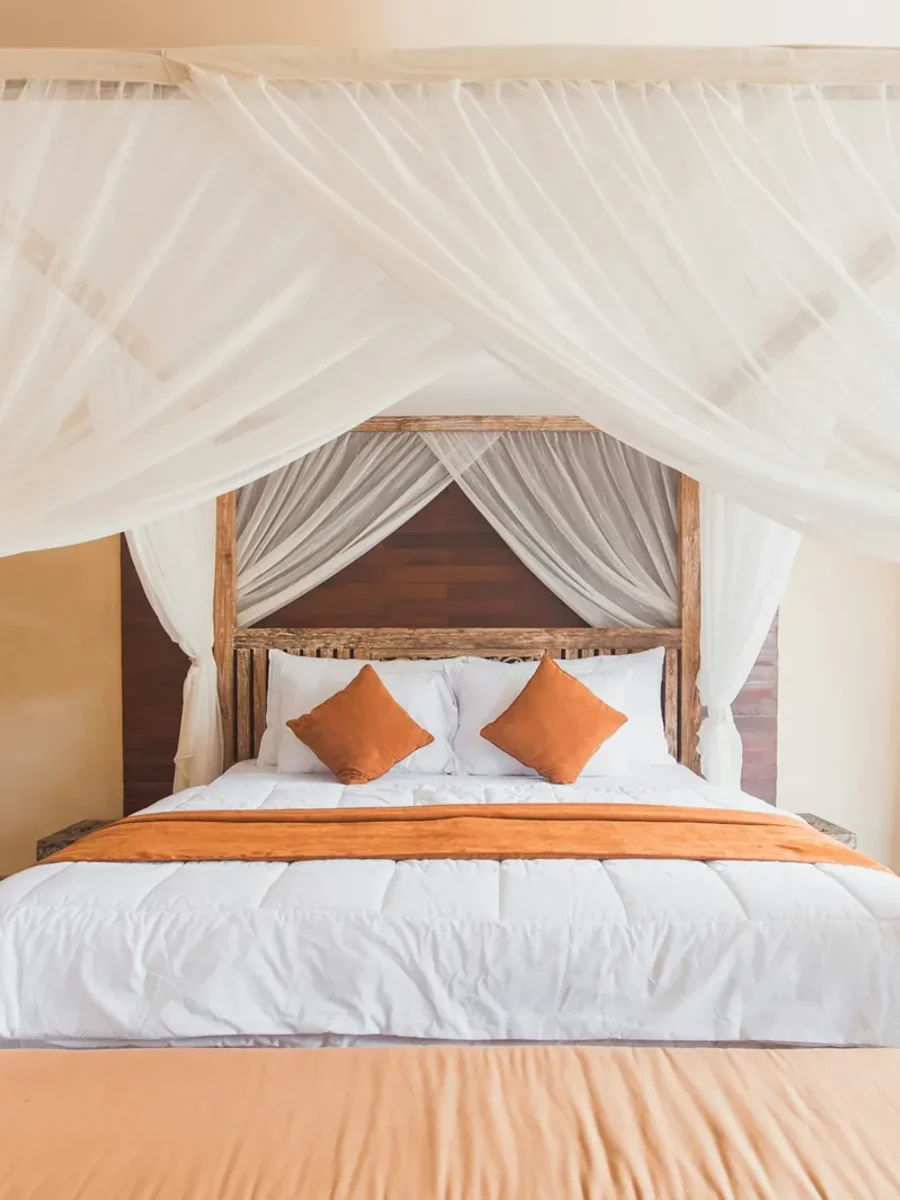
There are three ways to dress a four-poster, and they can be combined. A mosquito net hung from the tester or from a frame between the posts, falling to below the mattress and tucked in, turns the bed into a sealed room. Sheer side drapes, one at each post or a pair at the foot, soften the frame and filter light without protecting against insects. A fabric canopy across the top of the tester, with or without a short valance, gives the bed a ceiling and makes a large room feel more intimate.
The net is the one that earns its place. Among its dengue precautions, the National Center for Vector Borne Diseases Control advises using mosquito nets or repellents while sleeping during the daytime, so an afternoon rest under a net matters as much as the night. For a four-poster, choose a fine, soft mesh in white or ivory that lets air through, make it long enough to tuck well under the mattress on every side, and give it an overlapping opening on the side you get in. Hang it from rings or ties on the tester so it can be lifted off for washing. Our mosquito net guide compares bed nets with window screens, and our bedroom mosquito nets page covers both; for the windows themselves, see our sliding nets.
Keep flames and heat away from all of it. The Goa Directorate of Fire and Emergency Services asks households to keep mosquito coils, candles and oil lamps away from bedding, curtains and furniture, and to put lamps out before sleeping, and the US Fire Administration advises against lit candles in bedrooms and sleeping areas at all. A smouldering coil or a diya on a bedside table beside a net is exactly the risk they describe. Use screens on the windows instead, and leave the net for the bed.
| Option | What it does | Best fabric | Watch out for |
|---|---|---|---|
| Box mosquito net from the tester | Encloses the whole bed against mosquitoes | Fine, soft mesh in white or ivory | Must tuck under the mattress; gaps at the opening |
| Sheer drapes at the posts | Softens the frame, filters light, adds height | Voile, linen sheer or cotton muslin | No protection from insects; keep away from lamps |
| Canopy panel on the tester | Gives the bed a ceiling and a sense of enclosure | Light cotton or linen, unlined or lightly lined | Weight on an old tester; dust and damp above the head |
| Net plus tied-back sheers | Insect protection by night, a dressed bed by day | Mesh net inside, sheers outside | Two layers to wash; keep both on easy fixings |
Curtains, colour and proportion around a tall carved bed
A four-poster is the tallest thing in most bedrooms, and the window treatments either sit with it or fight it. Hang curtains from as close to the ceiling as possible, so the window rises to the same height as the posts and the bed does not dwarf it. A curtain hung just above the window frame next to a tall carved bed makes the window look small and the room look crowded.
Keep the fabric quiet. Dark carved timber is already the pattern in the room, so plain or softly textured curtains in white, ivory, oat or a pale colour drawn from the walls let the carving read. A white sheer at the window that echoes a white net on the bed ties the two together. If you want colour, put it in one place, such as a bedspread or cushions, rather than in the canopy, the curtains and the rug at once.
For sleep, pair a sheer with a lined or blackout curtain, or a blind behind it, so that the morning light is controlled at the window rather than by the bed fabric. Our sheer curtains suit both the window and the bed posts. On the floor, a rug sized to the bed rather than the room keeps a large frame anchored.
Monsoon care for canopy fabrics and nets
Fabric above a sleeping head lives in the dampest, stillest air in the room. Monsoon mornings in Goa average 87–91% relative humidity, according to the India Meteorological Department. The Canadian Conservation Institute's guidance on textiles shows why that is a problem overhead: what would take a quarter of a year to go mouldy at 70% can do so in a matter of days near 90%. A canopy that smells musty in August is already growing something.
Keep air moving. A ceiling fan on low under a net or canopy does more than anything else to keep fabric dry. Wash nets and canopy panels before the monsoon and after it, on a gentle cycle in a laundry bag, and dry them fully in shade before rehanging; a net bundled up while damp and tied to a post grows mould in its folds. Through the wettest weeks, unhook the canopy panel if the room is not air-conditioned or dehumidified, and keep only the net.
In a house closed for the rains, take everything down: nets, sheers, canopy and valance. Store them clean and completely dry in cotton bags, not plastic, and leave the bed bare so air reaches the timber. Our monsoon take-down and storage service does this for owners who are away. When you return, check the posts and rails for fresh borer dust before the fabric goes back up.
If a canopy smells musty, take it down that day. Mould above a bed is worse than no canopy at all.