 Drape Haus
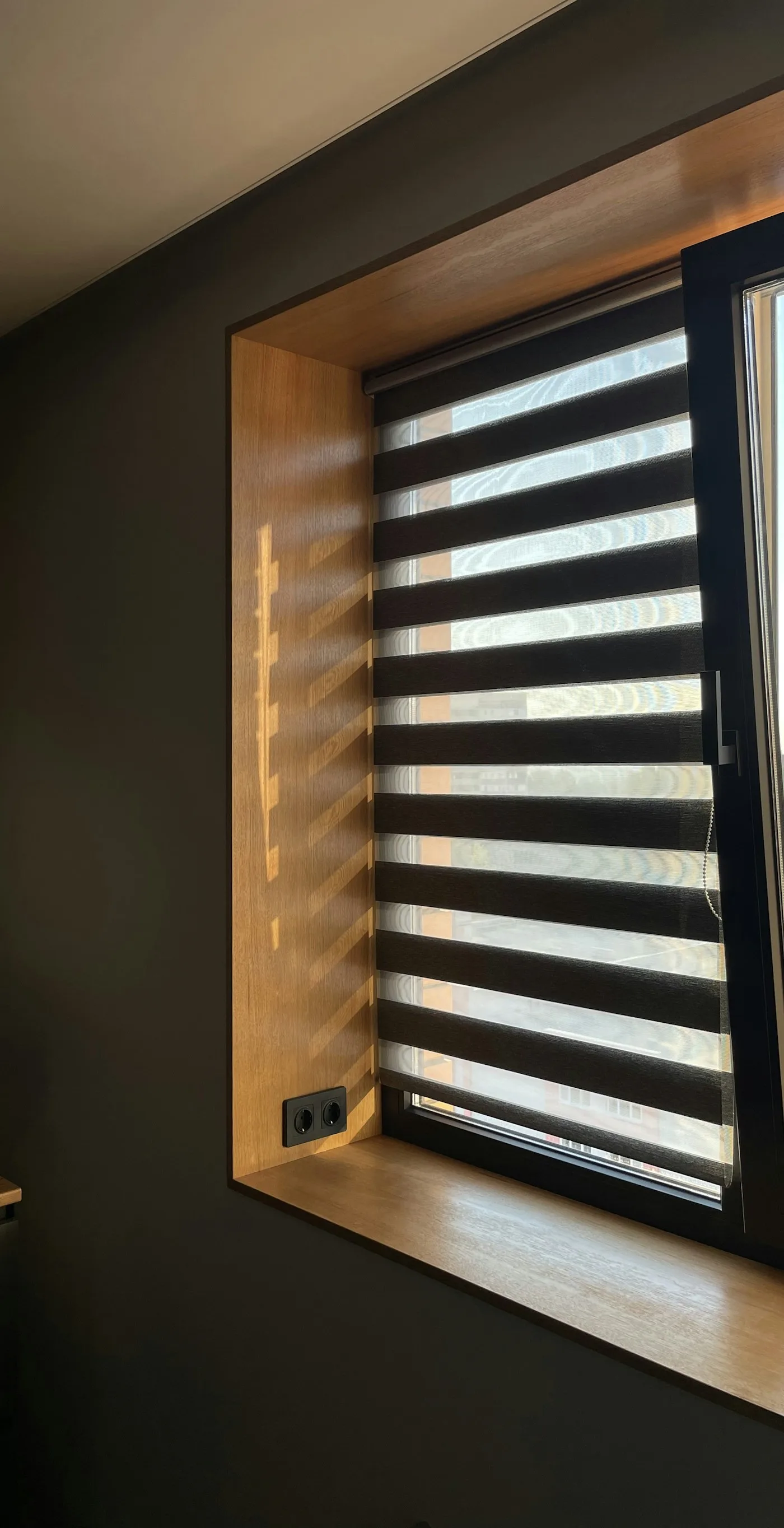
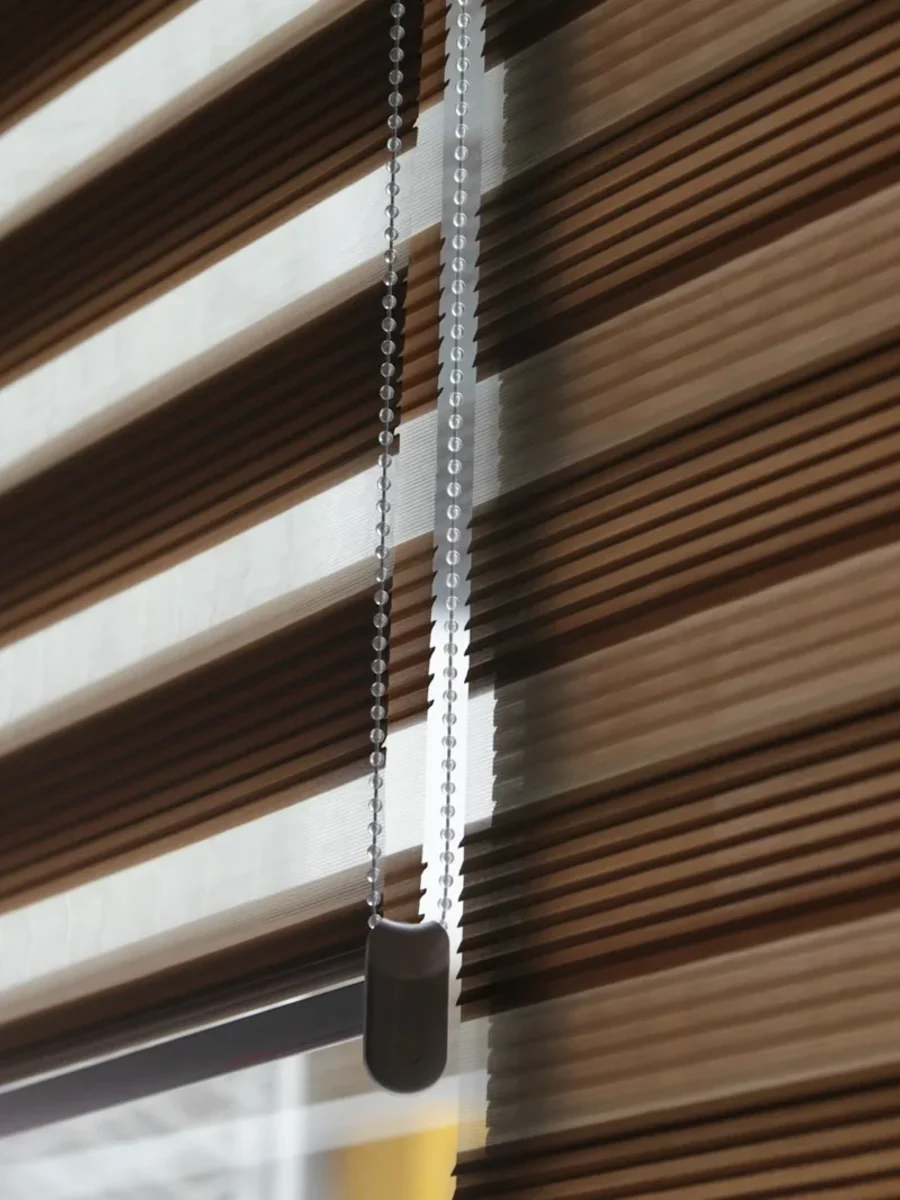
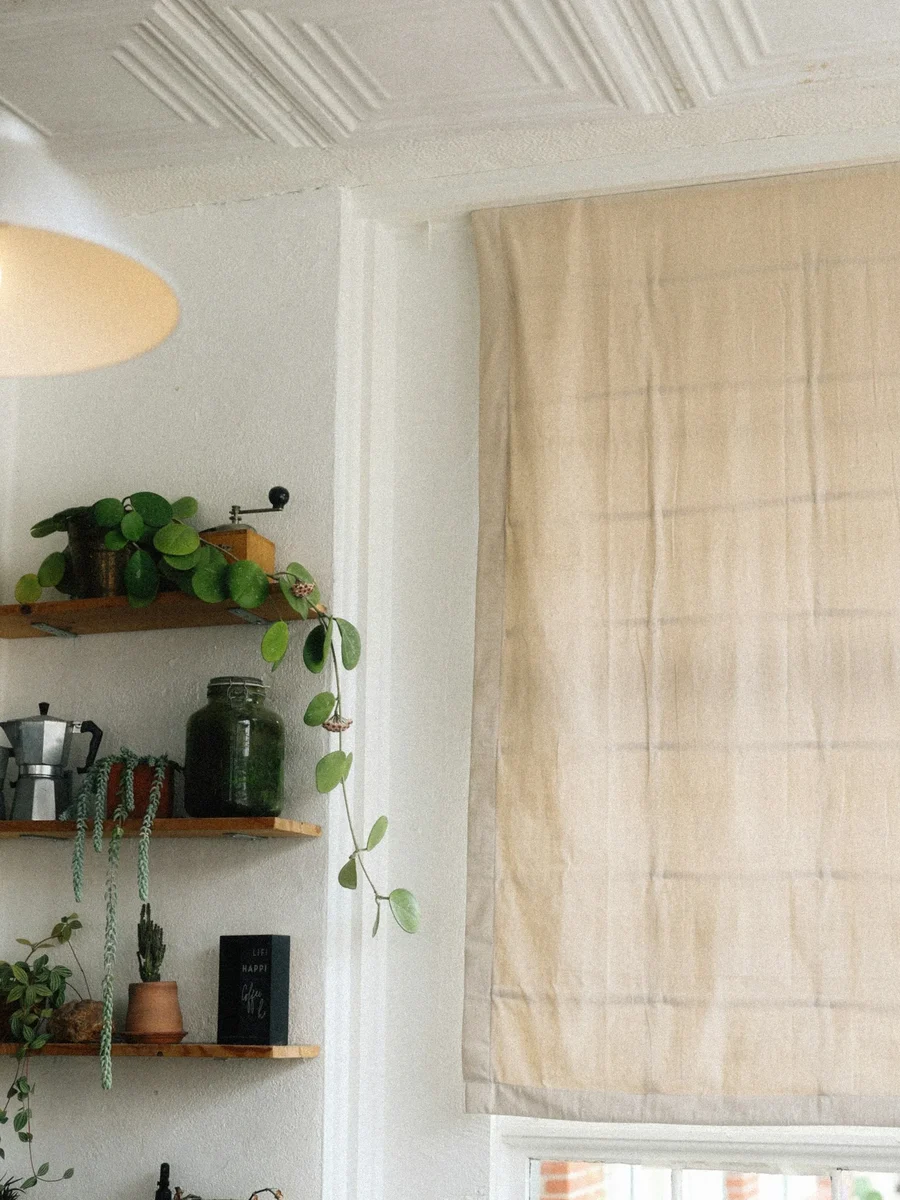
Zebra blinds vs roller blinds is a choice between flexibility and specialism. A zebra blind, also called a day-and-night blind, is a roller with a double layer of striped fabric: turn the chain and the sheer and solid bands slide past each other, so the room moves from bright to filtered to dim without the blind going up. A roller blind carries one flat fabric, and that fabric decides what it does: a sun screen that keeps the view, a translucent fabric that softens light, or a blackout that stops it.
In short, choose a zebra blind where the light changes through the day and you want to adjust it in small steps, such as a living room or a home office. Choose a roller where one job dominates: real darkness in a bedroom or nursery, a clear view through a solar screen on a sea-facing window, or a plain wipe-clean surface in a kitchen. And where you need both a view by day and darkness by night, there is a third option: a double roller, with a screen and a blackout fabric on one set of brackets.
This comparison covers how each works, light control across a Goan day, privacy after dark, blackout limits, dust and salt, heat, and a room-by-room recommendation. Try both in our zebra blind simulator and roller blind simulator first; for the mechanics of the bands, see our explainer on what zebra blinds are.
One tube, two very different fabrics
Mechanically the two are cousins. Both hang from a tube in brackets or a cassette, both are worked by a chain and clutch, a spring or a tubular motor, and both roll up out of sight. The difference is entirely in the fabric. A roller's single sheet drops from the tube to a bottom bar. A zebra's fabric is a continuous loop, down the front, round a weighted bottom rail and up the back, with both faces striped in alternating sheer and solid bands.
That loop is why a zebra blind can adjust light while fully lowered: turning the tube moves the front face down and the back face up, so the stripes line up (open) or overlap (closed). A roller has no such trick. Lowered, it is whatever its fabric is; to let more light in, you raise it and uncover part of the glass.
Two practical consequences follow. A zebra carries roughly twice as much fabric, so its roll is fatter and needs more depth in a recess and more clearance from window handles. And because the two faces must stay in register, a zebra is more sensitive to a crooked fit or a slipping clutch than a roller, whose single sheet only needs to roll straight.
| Zebra blind | Roller blind | |
|---|---|---|
| Fabric | Double layer, alternating sheer and solid bands | Single sheet: screen, translucent or blackout |
| Adjusting light | Turn the chain while lowered | Raise or lower the whole blind |
| View when open | Through two voile layers with stripes | Clear through a screen fabric, or none |
| Darkest result | Dim, never fully dark | Near-total darkness in side channels |
| Roll size | Fatter; needs more depth | Slim |
| Dust | Collects in the sheer bands | Flat surface, easy to wipe |
| Fit tolerance | Bands must stay aligned | Fabric must roll straight |
Light control through a Goan day
Think about how light moves round the house. An east-facing bedroom is bright and hot from first light, then shaded by noon. A west-facing living room is pleasant all morning and then takes the low afternoon sun straight in, often with glare off the sea or a white wall opposite. A home office needs steady, glare-free light on the screen whatever the hour.
A zebra blind handles rooms like the living room and the office best, because it can be nudged through the day: open in the morning, partly closed as the sun swings round, fully closed at four, open again at dusk. It keeps the lower half of the window covered for privacy throughout. With a roller you pick one fabric for the worst hour and live with it the rest of the time, or raise and lower it repeatedly.
Where a roller fights back is the view. A sun-screen roller fabric is woven with a stated openness, and the US federal guide specification for roller shades lists light-filtering fabrics at 1, 3 and 5 per cent. A dark screen at those openness levels cuts glare hard while leaving the horizon visible. A zebra in its open position puts horizontal solid stripes across the view, and you look through two layers of voile in the gaps. For a sea view you want to see all afternoon, the screen roller usually wins.
Light that changes through the day suits a zebra. A view you want to keep while the sun is on it suits a screen roller.
Planning something like this?
We visit homes across North and South Goa, measure on site, and bring samples to see in your own light.
Privacy after dark, with the lights on
After sunset the advantage reverses. With lamps on inside and darkness outside, a zebra blind in its open position shows the room through every sheer band, and even closed, a bright room can show faint shapes at the band edges. Our zebra blinds explainer goes through what neighbours can and cannot see. The rule is simple: close a zebra fully after dark in any overlooked room.
A roller is predictable. A blackout or opaque roller shows nothing from outside at night. A translucent roller shows a glow and, if someone stands between a lamp and the blind, a soft silhouette. A sun-screen roller, the one that keeps the view by day, becomes see-through at night in the same way as a zebra's voile bands, because the room is now the bright side. That is why screen rollers in living rooms are so often paired with curtains or a second blackout roller.
In apartment blocks facing each other across a compound, and in village houses close to a lane, this is the deciding question for bedrooms. Our guide to privacy on narrow lanes covers layering in more detail.
Blackout: dim-out bands versus a sealed roller
No zebra blind is blackout. Even with dense or coated solid bands, the closed position relies on one solid band overlapping one sheer band, and some light passes through and around those overlaps as well as round the edges of the blind. Dim-out zebra fabrics make a noticeable difference, but in an east-facing bedroom at six in the morning the room will still be light enough to wake a light sleeper.
A roller can be made genuinely dark. The US federal guide specification describes a room-darkening roller system as a headbox over the roller, U-shaped channels guiding the fabric down each side and a channel at the sill for the bottom edge, all designed to eliminate visible light gaps when the shade is closed. A blackout fabric in a system like that is the darkest result any blind gives. Our blackout blinds page explains how we seal the edges.
So for a nursery, a shift worker's bedroom or a guest room in a rental where people expect to sleep late, a blackout roller is the honest choice. A zebra can still go in front of it, or in a room that only needs dimming for an afternoon nap.
The third option: a double roller
If what you actually want is day and night, there is an alternative to the zebra that many people have not seen. A double roller, also called a dual roller, puts two separate roller blinds on one set of brackets: usually a sun screen nearer the room and a blackout nearer the glass, or the other way round. The federal specification lists dual-roller shades alongside single ones, with the two rollers mounted side by side or offset.
By day, the screen is down and the blackout is up, so you get the clear view and the glare control of a screen roller. At night, the blackout comes down and the room is properly dark and private. Each fabric does its job fully, which a zebra's compromise cannot.
The costs are depth, two controls and price. The bracket needs room for two rolls, so the recess must be deeper, or the blind is fixed on the face of the wall. There are two chains, two motors or one motor and one chain to operate. And it is two blinds' worth of fabric and mechanism. For a bedroom that also faces the sea, it is often worth it; for a study, a zebra is simpler.
Dust, laterite and salt in the bands
The sheer bands of a zebra blind are an open weave, and open weaves hold dust. In the dry season, the fine red dust of laterite roads and building sites settles on every surface in a Goan house, and on a zebra it lodges in the voile rows of both faces and inside the loop, where it is hard to reach. A roller's single flat surface sheds and wipes far more easily, especially a coated or PVC-faced fabric.
Near the sea, salt is the other load. The Australian Stainless Steel Development Association notes that sea-salt deposits begin to dissolve once relative humidity rises above about 34 per cent, because of the magnesium chloride they contain. In Goan air that is almost always, so salt on a blind becomes a slightly damp film that holds dust and, in the monsoon, encourages spotting. It also corrodes plated steel parts in the brackets and chain.
None of this rules out zebra blinds near the beach, but it changes the specification and the routine. A cassette over the roll keeps dust off the top; pale, tonal fabrics show less; and the sheer rows need a light vacuum or wipe every few weeks. Our guide to how to clean fabric blinds covers both types step by step.
Heat and fading on a hot window
Neither blind is a cooling system. Research summarised by the Pacific Northwest National Laboratory for the US Department of Energy found that interior roller shades cut the hours a home spent at dangerous heat by about 18 per cent in an extreme heatwave, against about 55 per cent for exterior shades. Once the sun is through the glass, an indoor blind can only stop part of what has already arrived. Shading outside the glass does far more.
Within that limit, a roller has the edge for heat. A screen or blackout roller with a pale or reflective back towards the glass returns more of the sun's energy than a zebra, whose open voile bands let it straight in. A zebra closed fully performs better than one left in its open position, but less well than a solid fabric.
Fading affects both, and dark fabrics show it first. The Canadian Conservation Institute notes that for light-sensitive colours, ultraviolet usually causes less than half of the fading, so visible light does the rest and UV filtering alone does not prevent it. On a west-facing window, choose ivory, sand or grey rather than charcoal or navy, in either type.
Room by room: our recommendation
Use the table as a starting point. Two windows in the same room can deserve different answers if one faces the sea and the other faces a neighbour. For homes with young children, choose either type with a motor or a cordless mechanism; the US Consumer Product Safety Commission's position is that going cordless is the only way to remove the strangulation risk, and RoSPA advises never fitting a looped cord or chain blind in a child's bedroom.
When you are ready, our zebra blinds and roller blinds pages show what we make, and we bring both kinds of fabric to a measuring visit so you can see them against your own light.
| Room | Pick | Why |
|---|---|---|
| Bedroom facing the morning sun | Blackout roller in channels | Only a sealed roller gives real darkness |
| Nursery or children's room | Motorised or cordless blackout roller | Dark for naps; no chain within reach |
| Living room with changing light | Zebra | Adjust in small steps through the day |
| Sea-facing living room | Screen roller, or double roller | Clear view by day; blackout layer for night |
| Home office | Zebra or light-filtering roller | Glare control on screens; daylight kept |
| Kitchen | Wipe-clean roller | Grease and dust settle in voile bands |
| Bathroom | Coated roller | Steam and splash; flat surface dries fastest |
| Rental guest room | Blackout roller, zebra in front if wanted | Guests expect a dark room for late mornings |