 Drape Haus
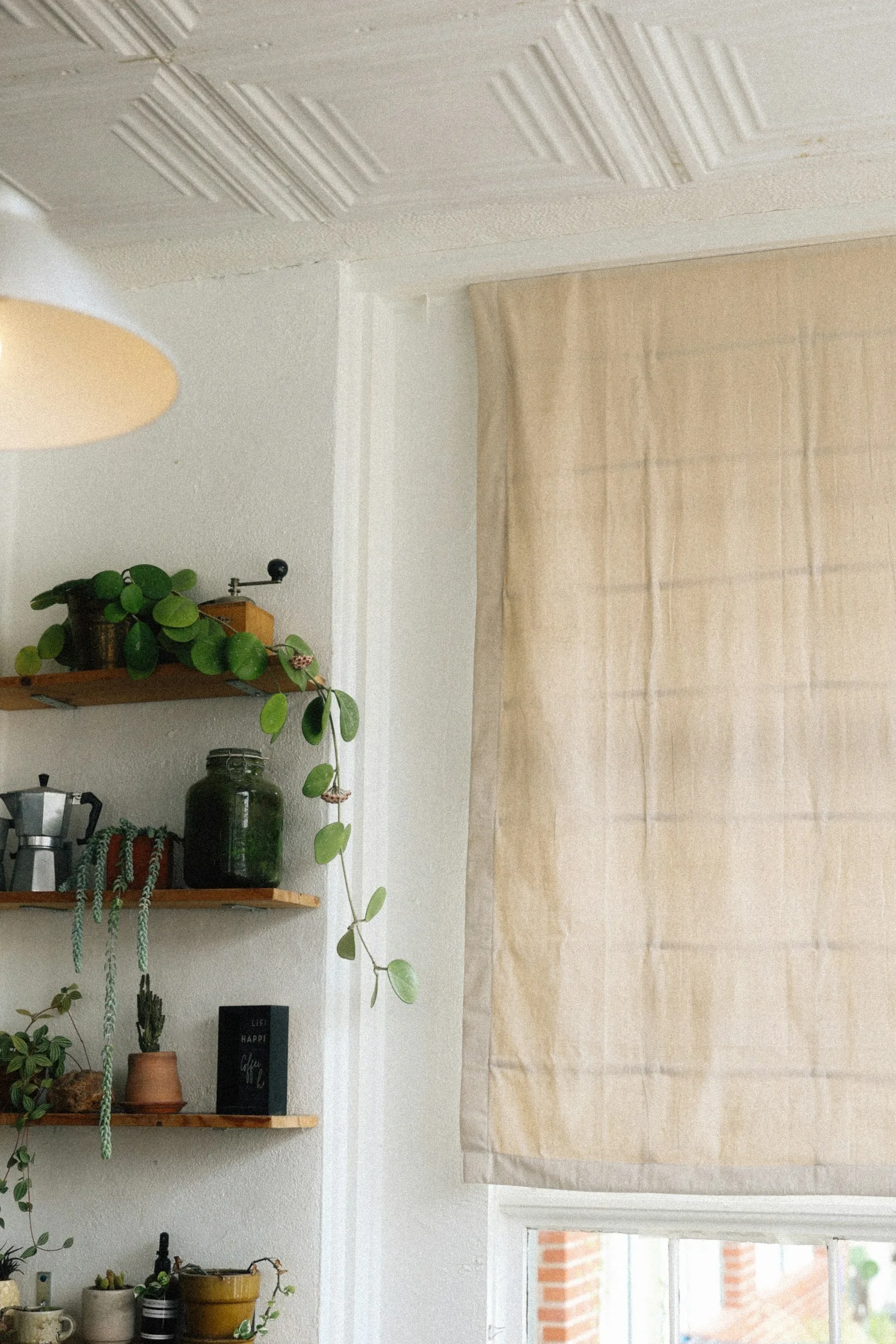
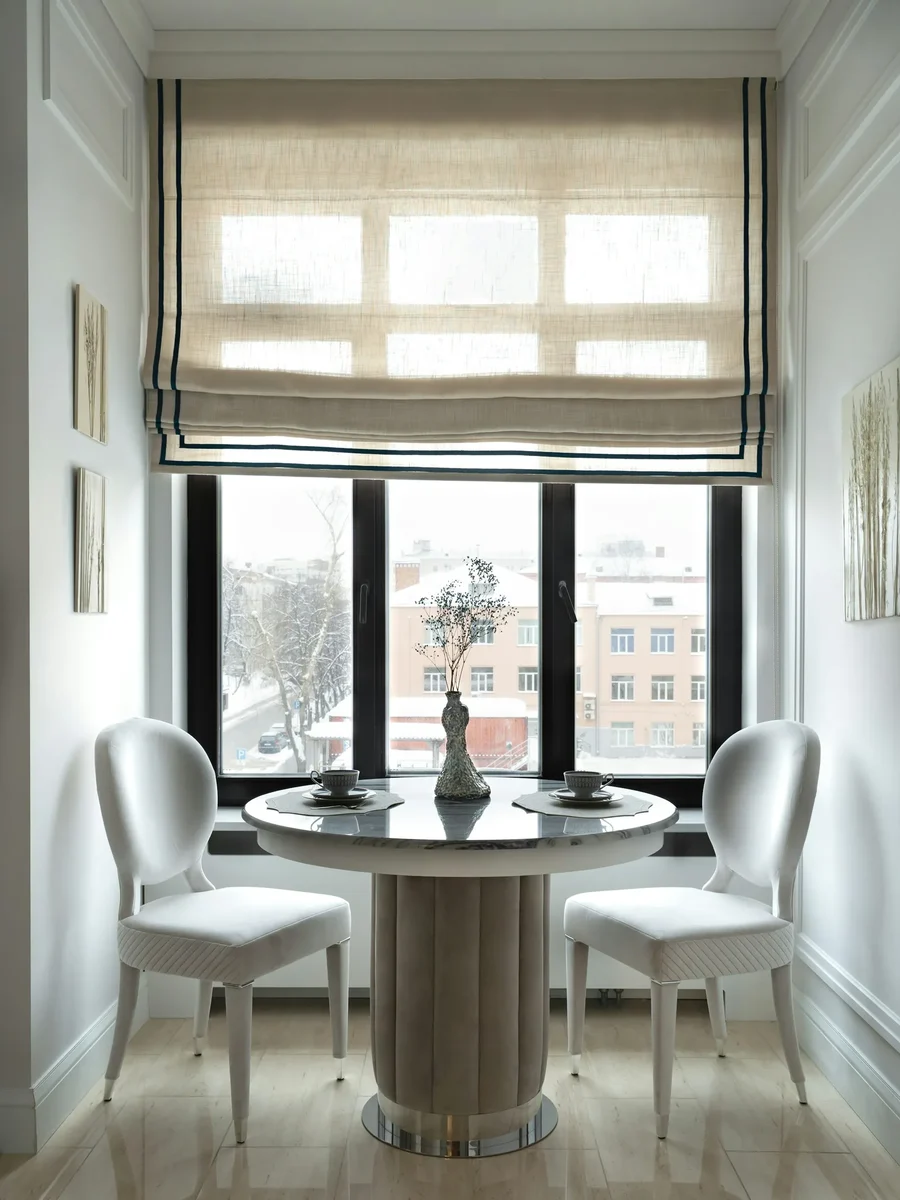
Roman blinds vs roller blinds comes down to one question: do you want the window dressed, or do you want it managed? A Roman blind is curtain fabric, usually lined, that folds upwards into soft horizontal pleats. It brings colour, texture and a sense of finish to a room. A roller blind is one flat sheet of stiffened or coated fabric wound round a tube. It disappears when raised, can be made genuinely dark, and wipes clean. Roughly speaking, Romans win in living rooms, dining rooms and bedrooms where the look matters most; rollers win in kitchens, bathrooms, home offices and any bedroom that must be properly dark.
In Goa, three practical points tip the choice more often than style does. Short windows under a deep lintel lose a surprising amount of glass to a Roman's folded stack. Months of monsoon humidity are easier on a coated roller fabric than on a sewn face fabric and its lining. And cleaning a Roman properly means taking it apart, while a roller is dusted and wiped where it hangs.
Below we compare the two on look, stack height, light control and blackout, cleaning, humidity and child safety, and finish with a room-by-room verdict. You can try both on a drawn window in our Roman blind simulator and roller blind simulator before you look at fabrics.
A folded panel versus a rolled sheet
Almost every difference between the two follows from how they are built. A Roman blind is sewn like a curtain: a face fabric, a lining and sometimes an interlining, with rods or battens across the back at intervals. Cords run up through rings to a headrail, and as they draw up, the fabric between each pair of rods folds out into a pleat. Our explainer on what Roman blinds are covers the styles and mechanisms in detail.
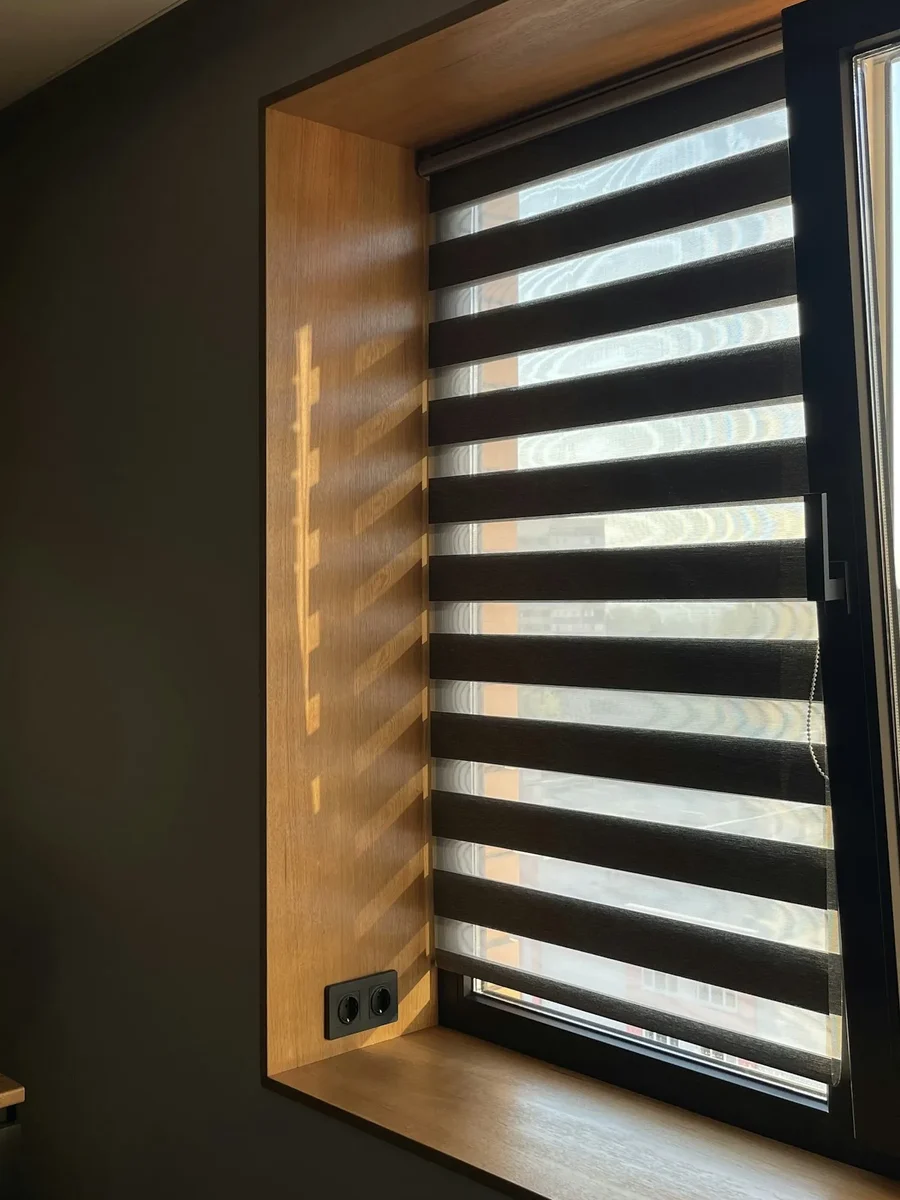
A roller blind has no sewing to speak of. One piece of fabric, stiffened so it hangs flat and does not fray at the cut edges, is fixed to a tube and wound up by a chain and clutch, a spring or a motor. The fabric is usually polyester, glass fibre or a coated cloth, chosen for what it does to light rather than for drape. There is no lining, because the fabric itself is engineered to be sheer, translucent or opaque.
That makes a Roman a soft furnishing and a roller a piece of equipment. A Roman can be made in almost any curtain or upholstery fabric that folds well, so it can match the cushions or the dining chairs. A roller comes from a much narrower range of technical fabrics, but each one does a specific job very well. Neither is better in the abstract; the room decides.
| Roman blind | Roller blind | |
|---|---|---|
| Construction | Sewn face fabric, lining, rods and rings | Single stiffened or coated sheet on a tube |
| Look | Soft folds, texture, pattern | Flat, minimal, almost invisible when raised |
| When raised | Stack of folds below the headrail | Slim roll at the top |
| Darkest result | Blackout lining, face-fixed with an overlap | Blackout fabric in side channels with a headbox |
| Cleaning | Vacuum in place; take apart to dry-clean | Dust and wipe in place |
| Damp rooms | Needs synthetic fabric and a breathable lining | Coated fabrics tolerate humidity well |
| Motorising | Headrail motor winds the cords | Tubular motor hidden inside the roller |
Stack height: how much window each one hides when open
A raised roller blind leaves a roll of fabric at the head of the window, and on all but the longest drops that roll is only a few centimetres deep. Inside a recess, with a small fascia or cassette over it, the glass below is almost completely clear. This is the main reason rollers suit short windows and windows where every bit of view counts, such as a sea view over a balcony wall.
A Roman blind does not roll; it stacks. The raised folds hang below the headrail as a band of fabric, and the band is deeper when the drop is longer, the fabric is thicker, the blind is lined or interlined, or the style is a hobbled or cascade Roman with extra fabric between the rods. On a tall window that band barely matters. On a short window it can take a noticeable share of the glass, which is a common disappointment with Roman blinds fitted inside small recesses.
Many Goan houses make this worse. Older houses often have windows set low under a deep timber or laterite lintel, and newer flats often have windows that run close to the ceiling with very little wall above. In the first case, a Roman inside the recess can hide the top of an already short window. In the second, there is nowhere above the opening to lift the blind clear of the glass.
There are two answers. Fit the Roman on the wall above the opening, so the stack sits over plaster rather than glass, which needs some height between the top of the window and the ceiling. Or choose a roller for that window and keep the Roman for taller ones. Ask your maker for the expected stack depth for your drop and fabric before deciding on an inside fit; we work it out on the survey for the same reason.
On a short window with little wall above it, a roller keeps the view; a Roman will sit across the top of the glass.
Planning something like this?
We visit homes across North and South Goa, measure on site, and bring samples to see in your own light.
Light control and blackout: what each can do
A roller's light control is chosen at the order stage, because the fabric is the control. Sheer screen fabrics cut glare and heat while keeping a view, and they are specified by openness, the share of the weave that is open. The US federal guide specification for roller shades lists light-filtering fabric at 1, 3 or 5 per cent openness: the lower figure blocks more sun and more of the view, the higher one keeps more of both. Translucent fabrics soften light without any view; opaque and blackout fabrics stop it.
A Roman's light control comes from the fabric and the lining together. Unlined, a linen Roman glows and softens the light. With a standard lining it gives privacy and protects the face fabric from sun. With a blackout lining, the fabric itself lets almost nothing through, but light still finds two routes: round the edges of the blind and, on poorly made blinds, through the needle holes where the rod pockets are stitched through all layers.
That is where the two differ most for bedrooms. The same federal specification describes a room-darkening roller system as a headbox over the roller, U-shaped channels guiding the fabric down each side, and a channel at the sill to receive the bottom edge, all designed to eliminate visible light gaps. A Roman cannot run in side channels, because its folds need room to form. The best a Roman can do is to be fixed on the wall outside the recess with a generous overlap on all sides, which is good, but not as dark as a channelled roller.
So if a bedroom must be dark at six in the morning, a blackout roller in channels is the stronger choice. If the room only needs to be dim and private, a blackout-lined Roman fixed outside the recess is usually enough, and it looks far softer. The arrangement many people end up with is a roller tight to the glass for darkness and curtains or a Roman in front for the look; our blackout blinds page sets out the options.
Cleaning after the monsoon
A roller blind is the easier of the two to keep clean. Lower it fully, vacuum it with a soft brush on low suction or wipe it with a dry microfibre cloth, and spot-clean marks by dabbing with a barely damp cloth. Coated and PVC-faced fabrics tolerate a damp wipe well. What a roller will not tolerate is soaking or machine washing, which strips the stiffener, can crack the coating and leaves fabric that no longer rolls straight. When a roller fabric is past cleaning, it is replaced on the existing tube and brackets.
A Roman blind needs two routines. In place, it is vacuumed along the folds every few weeks, because dust settles in the pleats and on the top of each fold. A full clean means taking it apart: down from the headrail, cords untied and pulled out of the rings, rods and bottom bar slid out of their pockets, and the fabric sent for dry cleaning, since face fabric and lining can shrink at different rates. Then it has to be re-rodded, re-corded and hung level again. It is a job, not a chore.
After a Goan monsoon, that difference matters. A roller that has spent the rains lowered against a damp window can be checked, dusted and wiped in an afternoon. A Roman with a musty smell or spotted lining usually needs to come down. Our guide on how to clean fabric blinds gives the full roller routine, and we take down, clean and refabric Roman blinds as part of our Roman blinds work.
Humidity: sewn fabric and linings versus coated roller cloth
Mould needs moisture, a food source and still air. The US Environmental Protection Agency puts the principle plainly: the key to mould control is moisture control, with indoor humidity kept below 60 per cent and ideally between 30 and 50. Goan monsoon air sits far above that for weeks at a time, as our article on humidity in Goa shows, so any window covering in an unconditioned room spends the rains in conditions mould likes.
Rollers start with an advantage. Most roller fabrics are polyester, glass fibre or coated cloth that take up very little water, and blackout and wipe-clean versions carry a coating that water sits on rather than in. A Roman is a sandwich of layers that are stitched together, and if the face fabric or lining is cotton or linen, the layers hold moisture and dust together in the folds. The EPA notes that porous materials may have to be thrown away once they go mouldy, which in practice means a spotted Roman lining is often replaced rather than rescued.
That does not rule Romans out of Goan homes. It means specifying them for the climate: polyester-rich or blended face fabrics in rooms that are not air-conditioned, breathable linings rather than thick cotton interlinings, and the habit of raising the blind on dry mornings so air reaches the glass. In a house closed for the monsoon, leave Romans raised, not lowered against damp glass. Rollers ask much less of you, which is why we lean towards them for second homes and rentals.
Cords, chains and children
Both blinds have a history with child safety, and it is worth knowing which part of each is the risk. In December 2009 the US Consumer Product Safety Commission announced a recall to repair all Roman shades and roll-up blinds. It reported five deaths and sixteen near strangulations in Roman shades since 2006, which it said could happen when a child put their neck between an exposed inner cord and the fabric on the back of the blind. The roll-up blinds in that recall were the kind lifted by loops of cord round the fabric, not chain-and-clutch rollers, but they are worth recognising in Goa, because many bamboo chiks are raised exactly that way.
A standard roller is worked by a continuous loop of chain, which is a hazard of its own if it hangs free. The Commission's current advice is that cordless window coverings are the only way to eliminate the strangulation risk; shortening cords, fitting cord stops and anchoring continuous loops to the wall reduce it but do not remove it. In a child's room, that points to a motor, a spring-operated cordless roller, or a cordless Roman mechanism.
Rollers are the easier of the two to make cordless or motorised, because a tubular motor slides inside the tube and nothing changes at the window. A Roman needs a motor in the headrail that winds the lift cords, which works well but adds depth and cost. If a family room needs a Roman for the look, ask for covered rear cords and a cordless or motorised system rather than a chain.
Room by room: bedrooms, living rooms, kitchens and bathrooms
The table gives our usual starting verdict for each room. It assumes an ordinary Goan window of moderate size; very wide openings change the answer, because a single wide Roman becomes heavy and its folds wander, while a wide roller may need splitting or a heavier tube.
Bedrooms divide on one question: how dark? For real darkness, a blackout roller in channels. For a soft, private room where some edge light is acceptable, a blackout-lined Roman outside the recess. Living rooms usually favour Romans, or Romans with curtains, because the room is about comfort and colour; the exception is a sea-facing living room with afternoon glare, where a solar screen roller keeps the view and cuts the sun. Kitchens and bathrooms favour rollers in wipe-clean fabric almost without exception.
For more on the rooms themselves, see our page on bedroom blinds, or start with the full range of roller blinds.
| Room | Our usual pick | Why |
|---|---|---|
| Master bedroom | Blackout roller in channels, with curtains or a Roman in front | Darkness from the roller, softness from the fabric layer |
| Guest or children's bedroom | Cordless or motorised blackout roller | Dark, easy to use, no loose chain |
| Living room | Roman blind | Colour, texture and a finished look |
| Sea-facing living room | Solar screen roller, perhaps with sheers | Cuts glare while keeping the view |
| Dining room | Roman blind | Can match chair fabric; little moisture |
| Kitchen | Wipe-clean roller | Grease and steam; Romans mark and absorb |
| Bathroom | PVC-faced or coated roller | Steam and splash; folds trap moisture |
| Home office | Screen or light-filtering roller | Glare off screens with daylight kept |