 Drape Haus
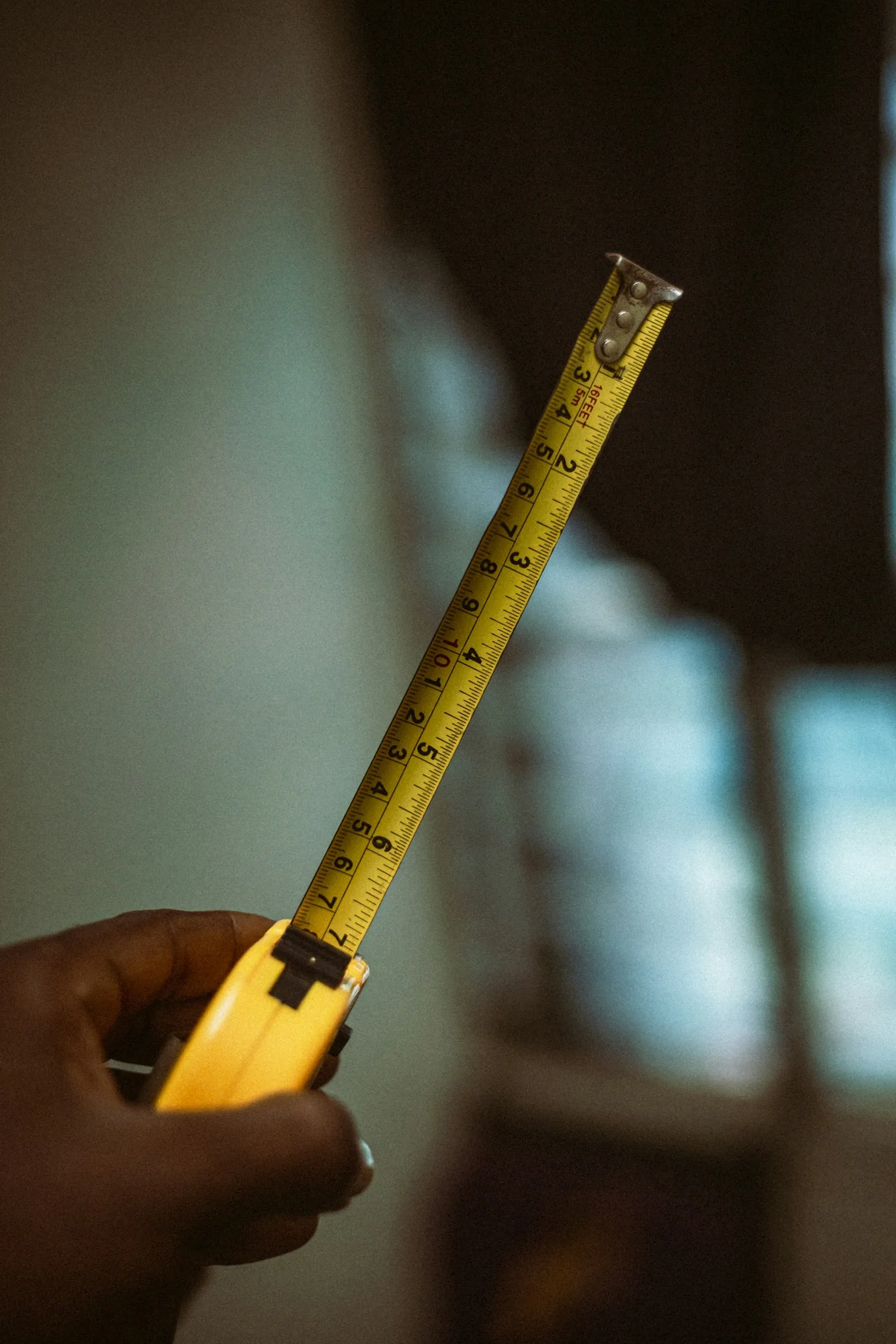
To measure windows for blinds, first decide whether the blind will sit inside the recess or outside it on the wall. For an inside mount, measure the recess width at the top, middle and bottom and the drop at the left, centre and right, and give the smallest of each; the maker then takes off a small clearance so the blind fits. For an outside mount, measure the opening and add an overlap on every side, and give the finished size of the blind you want. Either way, check that the recess is deep enough for the blind and clear of handles, and measure in millimetres with a steel tape.
That is the whole method, and most measuring errors come from skipping one part of it: measuring once instead of three times, giving a recess size and then deducting again yourself, forgetting a handle that sticks out into the reveal, or assuming an old opening is square. Goan houses, especially older ones with laterite walls and lime plaster, are rarely square, and a blind made to the widest point of a tapering recess will not go in.
Below are the decisions to make first, the measurements in order with worked arithmetic, the deductions makers apply, what to do with crooked or arched openings, and a list of what to send for a quote. If you would rather not do it yourself, we measure as part of every blinds order, and our blinds simulator helps you decide the type before anyone gets a tape out.
Inside or outside mount: decide before you measure
An inside-mount blind sits within the window reveal, its headrail or brackets fixed to the top of the recess. It looks neat, leaves the architrave and any good stone or plaster reveal visible, and keeps the window wall clear. Its limits are depth and light: it needs enough depth for the mechanism and for the fabric or slats to clear handles, and it always leaves a slim gap at each side where light passes.
An outside-mount blind sits on the wall above the opening, or on the face of the frame, and overlaps the opening on every side. It darkens better because it covers the edges, it hides a crooked or damaged reveal, and it is the only option where the recess is too shallow. It also lets a Roman or slatted blind stack on the wall rather than across the glass. The cost is a more visible headrail and a blind that reads as added to the window rather than part of it.
Decide this first, because the two are measured differently and the numbers you send mean different things. If you are undecided, measure for both: the recess for an inside mount, and the opening plus the wall around it for an outside one.
| Inside mount | Outside mount | |
|---|---|---|
| Where it fixes | Top of the window recess | Wall above the opening, or the frame face |
| Look | Neat, reveal visible | Headrail visible; covers an uneven reveal |
| Light at the edges | Slim gap each side | Covered by the overlap |
| Depth needed | Must fit the recess and clear handles | Little; projects from the wall |
| Stack of a Roman or slatted blind | Sits across the top of the glass | Can sit on the wall above |
| What you send | Recess size; the maker deducts | Exact size of the finished blind |
Is the recess deep enough?
Depth is the measurement people forget. Hook the tape on the front edge of the reveal and measure back to the window frame, then measure again to the front of the window handle, the stay or the lock, whichever projects furthest into the recess. The second figure is the one that matters, because the blind has to hang in front of whatever sticks out.
How much depth a blind needs depends on its type, and makers publish a minimum for each. A roller needs room for its roll, which grows with the drop and the fabric thickness. A zebra carries a double layer and so needs more. A Venetian needs depth not just for the headrail but for the slats to tilt, because a slat sweeps a little more than its own width as it turns; a wide slat in a shallow reveal will strike the handle every time. Roman blinds need room for the folds to stand out from the headrail.
In Goan homes, also look for what else lives in the reveal: a sliding insect net, an inward-opening timber shutter, a security grille, a curtain track already fixed at the top. Each takes its own slice of depth. If there is not enough left for the blind you want, the options are a different type with a slimmer profile, a roller set to reverse roll, or an outside mount. The US federal guide specification for roller shades distinguishes a regular roll, where the fabric drops from the back of the tube nearest the glass, from a reverse roll, where it drops from the front; reverse roll moves the fabric forward, clear of a projecting handle.
Measure depth to the front of the handle, not to the glass. The handle is what the blind will hit.
Planning something like this?
We visit homes across North and South Goa, measure on site, and bring samples to see in your own light.
Three widths, three drops, and why the smallest wins
For an inside mount, measure the width of the recess at the top, the middle and the bottom, from plaster to plaster, keeping the tape level. Then measure the drop at the left, the centre and the right, from the underside of the top of the recess to the sill. Write down all six numbers in millimetres.
Here is a typical result from an older house: widths of 1,212 mm at the top, 1,206 mm in the middle and 1,198 mm at the bottom. The recess narrows by 14 mm from top to bottom. A blind made to 1,212 mm would bind on the plaster as it came down, so the governing width is the smallest: 1,198 mm. Drops of 1,505, 1,500 and 1,496 mm give a governing drop of 1,496 mm, so the blind will not sit on the sill on the low side.
Finally, check whether the opening is square by measuring both diagonals, corner to corner. In a perfectly rectangular recess they are equal. If one reads 1,915 mm and the other 1,927 mm, the 12 mm difference tells you the recess is skewed, and that matters for any blind that runs close to the sides, such as a roller in side channels or a Venetian with a small edge clearance. It is the same check our catalogue guides recommend before fitting channels.
Deductions: who takes what off, and why it should only happen once
A blind cannot be made to the full width of the recess, or it would rub on both sides. Makers therefore deduct a clearance. A US federal guide specification for window blinds gives a typical figure for horizontal blinds mounted inside the opening: a clearance of 6 mm at each jamb. On our example, that is 1,198 − 6 − 6 = 1,186 mm for the blind. Other blind types, and other makers, deduct different amounts, because a roller's brackets and end fittings sit outside the fabric and a vertical blind's headrail behaves differently again.
This is why trade order forms ask whether a figure is a recess size or an exact size. A recess size is the hole; the maker subtracts its own clearance before cutting. An exact size is the blind; the maker cuts to your number. The most common ordering mistake is to deduct a clearance yourself and then send the result as a recess size, so the clearance is taken twice and the blind ends up with wide gaps at the sides.
Our advice is to send the raw recess measurements, all six, the two diagonals and the depth, clearly labelled as recess sizes, and let whoever makes the blind apply the deduction for that type. If you are ordering an outside mount, send the exact finished size you want, and say so.
Give recess sizes, labelled as such, and never deduct as well. One deduction, applied by the maker, is enough.
Outside mount: overlaps, fixing height and drop
For a blind fixed outside the opening, measure the opening at its widest, not its narrowest, because the blind must cover every part of it. Then add an overlap on each side. The same federal specification asks for blinds installed outside the jambs to overlap each jamb by 20 mm or more where the wall allows. That is a minimum for neatness; for a bedroom that must be dark, much more overlap helps, as light that escapes round the side of a blind spreads across the ceiling.
Worked example: an opening of 1,212 mm at its widest, with an overlap of 75 mm chosen for each side, gives 1,212 + 75 + 75 = 1,362 mm finished width. Check there is wall on both sides to take it: a switch, a cupboard, a corner or the next window may be closer than it looks.
For the drop, decide the fixing line above the opening first. Fixing higher lifts a Roman or Venetian stack off the glass and makes the window look taller, as long as there is solid wall or a lintel to fix into. Measure from that line to where you want the blind to finish, usually a little below the sill for an outside mount, or onto the sill if there is a deep one. In Goan houses with soft laterite or old lime plaster over the lintel, also look at what the brackets will be screwed into; our guide to laterite and old walls explains the fixings.
Older Goan houses: crooked openings, arches, shutters and grilles
Out-of-square openings are the norm, not the exception, in older Goan houses. Walls of laterite block or rubble with thick lime plaster were finished by hand, and decades of repainting and patching add their own unevenness. A recess that narrows by a centimetre or more from top to bottom, or leans so that its diagonals differ, is common. The three-point, smallest-wins rule handles a taper. A pronounced lean is better handled by fixing the blind outside the recess, where its straight edges are judged against the wall rather than against a crooked reveal.
Arched heads, a familiar feature of Indo-Portuguese windows, need a decision rather than a measurement. A standard blind can be fixed across the springing line of the arch, at the level where the curve starts, leaving the arch itself open as a fanlight; or fixed above the arch on the wall, covering it completely. Shaped blinds that follow the curve exist but are fixed rather than operable. Our guide to arched and odd-shaped windows goes through the choices.
Inward-opening timber shutters, oyster-shell panes and fixed iron grilles all take space in or in front of the reveal. Measure where the shutters land when folded back, and whether a blind inside the recess would stop them closing. Often the answer in a heritage house is to leave the reveal to the shutters and fit the blind or a curtain on the inner wall face.
Doors, wide windows and vertical blinds
On doors, measure the glass panel as well as the door, and note the handle position and which way the door opens. A blind fixed to the door itself must clear the handle and not hit the frame as the door swings; a blind fixed to the wall above must clear the door as it opens. For sliding doors, the federal specification asks for vertical blinds to draw one way, stacking on the side opposite the opening panel, so the stack does not block the way out. Measure how much wall there is beside the fixed panel for that stack.
Very wide windows usually need more than one blind. A single wide roller may exceed the fabric width or bow on its tube; a wide slatted blind becomes heavy to raise. Measure the full width and the position of every mullion, so the run can be split at the mullions where the joins will be least visible. The federal specification calls for intermediate support brackets on wider blinds, so note anything above the window that would get in their way, such as a pelmet or an air-conditioning pipe.
Vertical blinds are usually fixed outside the opening on the wall or to the ceiling, and finish just above the sill or just above the floor. Measure the drop to the sill or floor at several points, because floors and ceilings are rarely level either, and take the shortest. Our vertical blinds page covers stack widths and fixing options.
How to measure windows for blinds: step by step
Use a steel tape, measure in millimetres, and write every figure down against a window name.
Choose inside or outside mount
Decide where the blind will fix. Inside mount fits the recess; outside mount fixes on the wall above and overlaps the opening. If unsure, measure for both.
Measure the recess depth
Measure from the front of the reveal back to the frame, and again to the front of the handle or lock. The smaller figure is the usable depth. Note any nets, shutters or grilles in the reveal.
Measure three widths
For an inside mount, measure the recess width at the top, middle and bottom, plaster to plaster. For an outside mount, measure the opening at its widest.
Measure three drops
Measure from the top of the recess to the sill at the left, centre and right. For an outside mount, measure from your chosen fixing line to where the blind should finish.
Check the diagonals
Measure corner to corner both ways. If the two figures differ by more than a few millimetres, the opening is out of square; note both and consider an outside mount.
Add overlaps for an outside mount
Add the overlap you want to each side and to the top and bottom, and check there is clear wall to take it. Give the result as an exact size.
Record obstructions and controls
Note handles, sill depth, tiles, switches, pelmets and air-conditioning pipes, and which side the chain or wand should hang. In children's rooms, RoSPA advises keeping cots and beds away from windows and fixing any cord cleat at least 1.5 metres from the floor, so plan the control side with that in mind.
Label and photograph
Write the window name, each figure and whether it is a recess or exact size. Photograph the window straight on and the reveal from the side to show depth and handles.