 Drape Haus
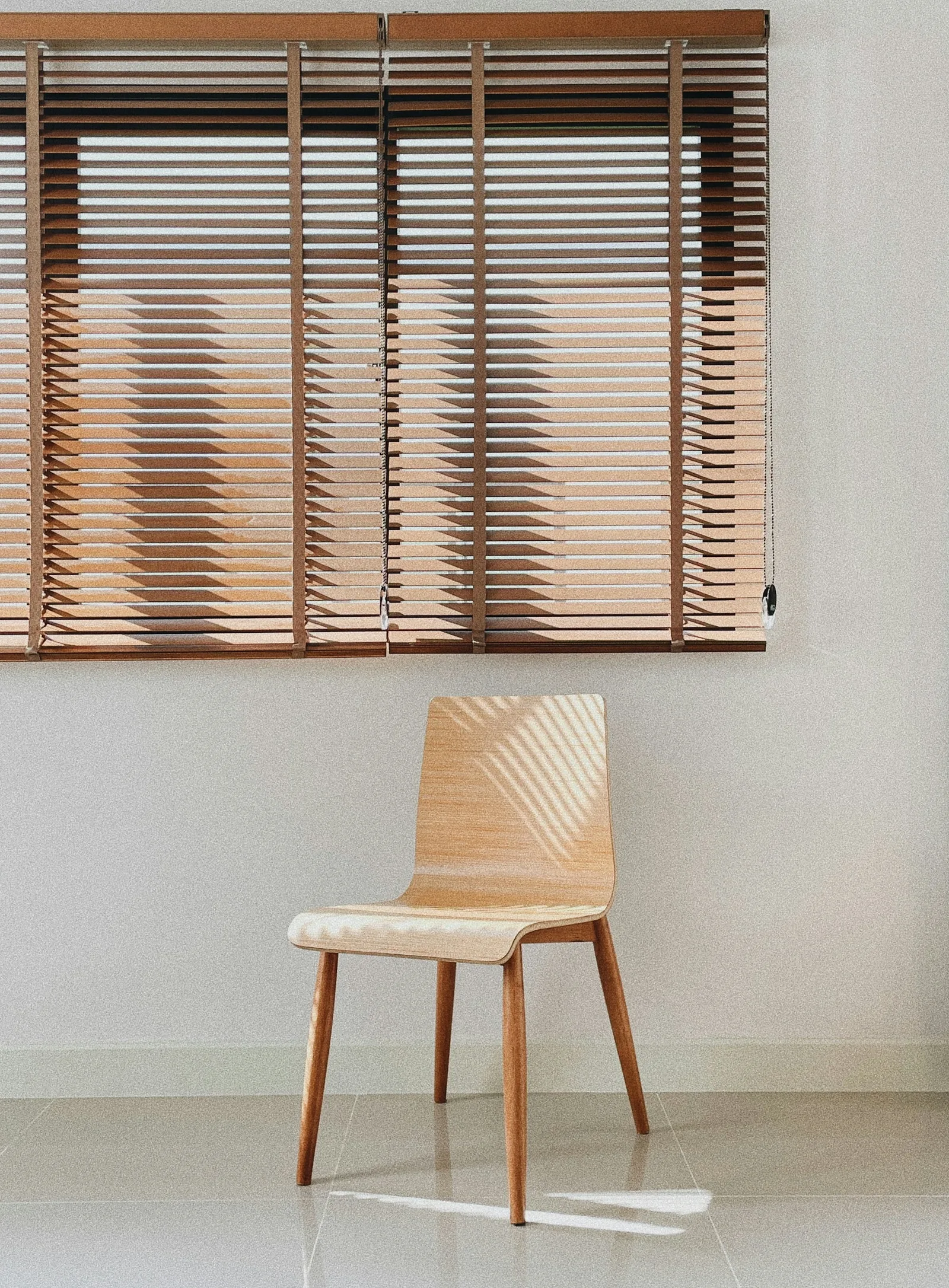
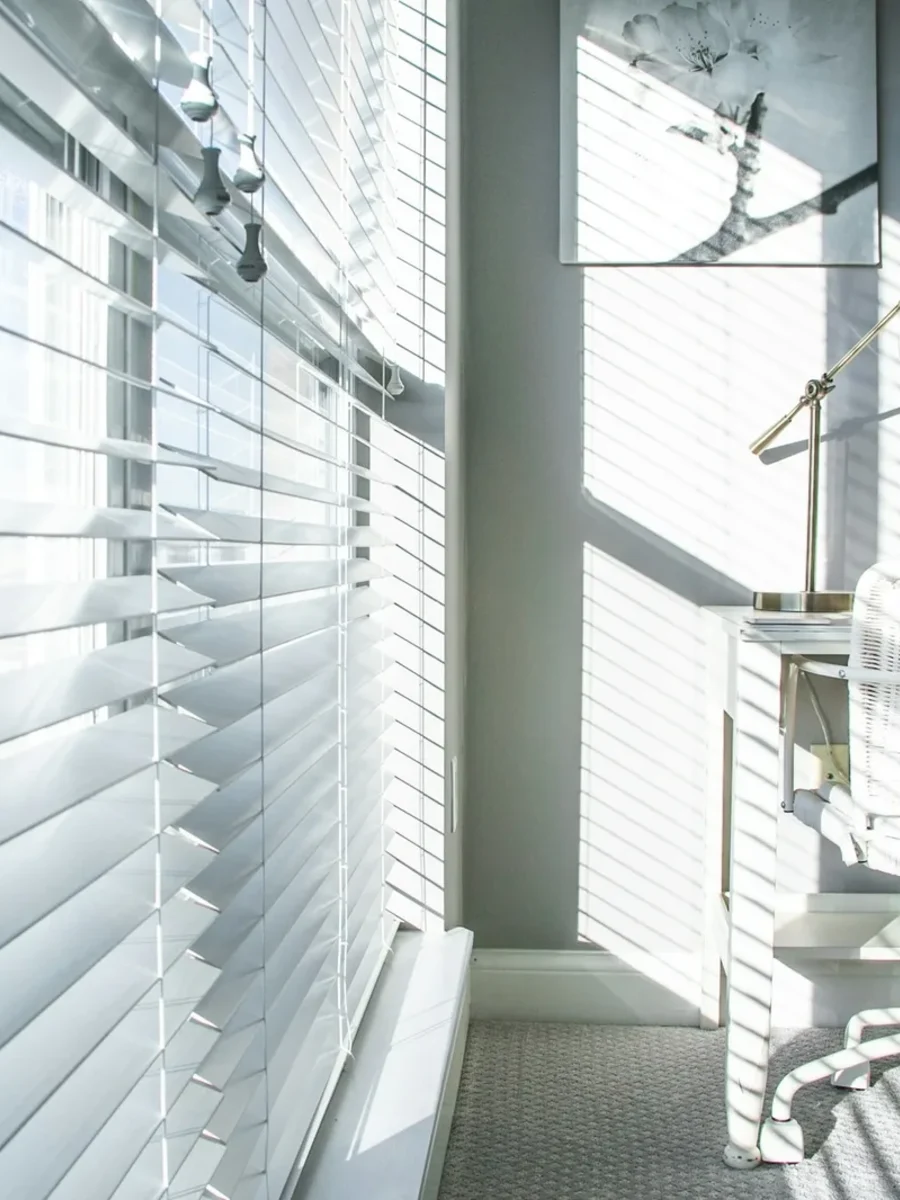
Wooden blinds vs faux wood blinds is really a question about water. Real wooden blinds, usually made from basswood, are light, stiff and warm to look at, and they take a stain like any timber. Faux wood blinds, made from PVC or a wood-and-polymer composite, look much the same from across the room, weigh more, and do not take up moisture at all. In a dry, lived-in, ventilated room, either works. In a bathroom, a kitchen, a sea-facing room or a house closed for the monsoon, faux wood is the safer choice, and the reasons are measurable.
Timber is hygroscopic: it trades moisture with the air around it, swelling as humidity rises and shrinking as it falls. Oregon State University Extension's table of equilibrium moisture content shows wood in air at 50 per cent relative humidity settling at around 9 to 10 per cent moisture, and in air at 90 per cent settling at 20 to 21 per cent. A Goan monsoon spends weeks near the top of that range. A lacquered slat slows the exchange but does not stop it.
This guide explains what each slat is made of and how to tell them apart, what humidity does to timber, the weight problem on wide windows, mould, colour matching against Goan furniture, and a room-by-room recommendation. You can tilt slats on a drawn window in our wooden blinds simulator before choosing a finish.
Basswood, PVC and composite: what the slats are made of
Most real wooden blinds use basswood, the North American lime or linden. The Wood Database lists its average dried weight at about 415 kilograms per cubic metre, which makes it one of the lighter hardwoods, with a straight grain, a fine even texture and few knots. It takes paint and stain well and stays stiff for its weight, which is exactly what a long horizontal slat needs. Some blinds use other timbers, bamboo or paulownia; the same moisture rules apply to all of them.
Faux wood slats come in two broad kinds. PVC slats are extruded plastic, sometimes foamed in the core to save weight, with a painted or printed surface and often an embossed grain. Composite slats combine wood fibre with a polymer binder and a vinyl or painted finish, so they behave more like plastic than timber in damp air. Both are denser than basswood, so the same blind in faux wood weighs noticeably more.
Telling them apart in a showroom is easier than in a photograph. Pick up a single slat of each: the faux one feels heavier and often a little thicker. Look at the grain along a run of slats: real timber varies from slat to slat, while an embossed pattern repeats. Bend a slat gently between your hands: a long PVC slat flexes more readily. And look at a cut end or a chip: timber shows wood fibre right through, faux wood a uniform core under its finish.
| Real wood (basswood) | Faux wood (PVC or composite) | |
|---|---|---|
| Moisture | Takes up and gives off moisture; swells and shrinks | Does not absorb water |
| Weight | Light for its stiffness | Heavier for the same size |
| Look up close | Natural grain that varies slat to slat | Painted finish; embossed grain can repeat |
| Finishes | Stains and paints, including warm timber tones | Mostly whites, painted colours and printed grains |
| Steam and splash | Poor; bows and stains | Good; wipe dry |
| Heat on hot glass | Stable | Long, dark slats can soften and sag |
| Cleaning | Dry dusting, barely damp cloth only | Wipe with mild soapy water |
Why humidity warps real wood blinds
Wood swells and shrinks as its moisture content changes, but only below what foresters call the fibre saturation point, which Oregon State University Extension puts at about 30 per cent moisture. Below that point every change in moisture is a change in size. Movement is greatest across the width of a board along the growth rings, smaller across the rings and negligible along the length. A blind slat is a thin, wide strip, so it moves across its width.
The numbers for basswood are on the high side. The Wood Database gives its shrinkage from green to oven-dry as 6.6 per cent radially and 9.3 per cent tangentially, while noting that once properly dried it is stable in service. Using the proportional method the Extension guide demonstrates, a slat that goes from about 10 per cent moisture in a dry season to about 21 per cent in a saturated monsoon room could change width by roughly 50 mm × 6.6–9.3% × 11/30, or about 1 to 2 mm on a 50 mm slat. That is an estimate, and the lacquer slows the change, but it shows the scale.
The width change itself is not the real problem. The trouble is that moisture rarely enters evenly. The face towards a damp window, the end nearest a leaking frame, the slats at the bottom that sit lowered against condensation: each takes up water faster than the rest. Uneven swelling is what bows, cups and twists slats, and a slat that has bowed rarely lies quite flat again. The Extension guide is explicit that a finish of paint or varnish slows moisture exchange considerably but will not completely stop it.
That is why the useful rule is not about room names but about air. A bedroom used every night with a fan running is far drier, over a season, than a guest room shut from June to September. If the house is closed for the monsoon, treat every room as a damp room when choosing slats.
Lacquer slows the moisture, it does not stop it. If a room stays shut and humid for weeks, choose faux wood.
Planning something like this?
We visit homes across North and South Goa, measure on site, and bring samples to see in your own light.
Bathrooms, kitchens and sea-facing rooms
The University of Kentucky Cooperative Extension's comparison of blind and shade types rates moisture as a factor that must be considered for wood blinds, and as not a factor for vinyl, mini and aluminium blinds. In a Goan house the rooms where that matters are easy to name. In a bathroom, a hot shower raises the humidity of a small room close to saturation every day and then lets it fall, so wooden slats cycle between swelling and shrinking far more often than they would in any other room. Splashes add water stains that sink into the grain.
Kitchens add steam from cooking and a film of grease that settles on horizontal slats; faux wood is wiped with mild soapy water, while a wooden slat can only be dusted and given a barely damp wipe. Sea-facing rooms bring salt on the breeze. Salt left on any slat draws moisture from humid air, and on timber that keeps the surface damp longer, which is the start of both staining and mould.
So our default in these rooms is faux wood or aluminium. It is not that a wooden blind will fail in its first monsoon; a well-finished one in a ventilated kitchen may last for years. It is that faux wood removes the risk entirely at no cost to the look. Our PVC and faux-wood blinds page covers the wet-room range, and the faux wood and PVC material guide explains the slats in more depth.
Weight on wide windows
Here real wood has a genuine advantage. Because basswood is so light for its stiffness, a wooden blind of a given size weighs less than the same blind in faux wood, and a slatted blind is raised by lifting the whole stack of slats on its cords. The heavier the slats, the harder it is to raise, the more strain on the cords and the lift mechanism, and the sooner a wide blind needs to be split.
In practice this shows on the big windows that are common in newer Goan villas: a living-room window two metres wide or more, or a run of glazing beside a verandah door. In real wood, a wide blind may still be comfortable to raise. In faux wood, the same width can become heavy enough that we would split it into two or three blinds, each lifted separately, or motorise it. Splitting is not a defect, but it does add vertical joins to the window.
Weight also matters for what the blind is fixed to. A heavy faux-wood blind on brackets screwed into the soft plaster or crumbling laterite above an old window needs proper fixings, or a timber batten spread across sound material. Our guide to laterite and old walls explains why.
Mould in the monsoon, and cleaning each one
Oregon State University Extension notes that wood kept below 20 per cent moisture content is less susceptible to fungi and insect attack. Its own table puts wood in air at 90 per cent relative humidity at 20 to 21 per cent. In other words, a wooden slat left for weeks in a closed, saturated Goan room drifts towards the moisture level where timber becomes vulnerable. The Wood Database also rates basswood as non-durable against decay. A finish protects it, but chips, cut ends and cord holes are where moisture and mould get in.
Most mould on blinds, wood or faux, starts on dust rather than on the slat. The US Environmental Protection Agency's advice is that moisture control is the key to mould control, with indoor humidity ideally between 30 and 50 per cent and below 60. Dust holds moisture, so a dusty blind in a damp room spots first. On faux wood, mould wipes off a non-porous surface with mild detergent. On real wood, it can stain into the grain at the cord holes and edges, and wetting the slat to clean it adds to the problem.
The cleaning routines follow from this. Wooden slats are closed flat, dusted with a dry cloth or soft brush on both faces, and only ever given a barely damp cloth that is dried at once. Faux-wood slats can be wiped with a cloth wrung out in mild soapy water, front and back, every week in a kitchen if needed. In a sea-facing house, wiping salt off the slats every few weeks protects both, and it protects the headrail hardware too.
Colour matching against teak, rosewood and laminate
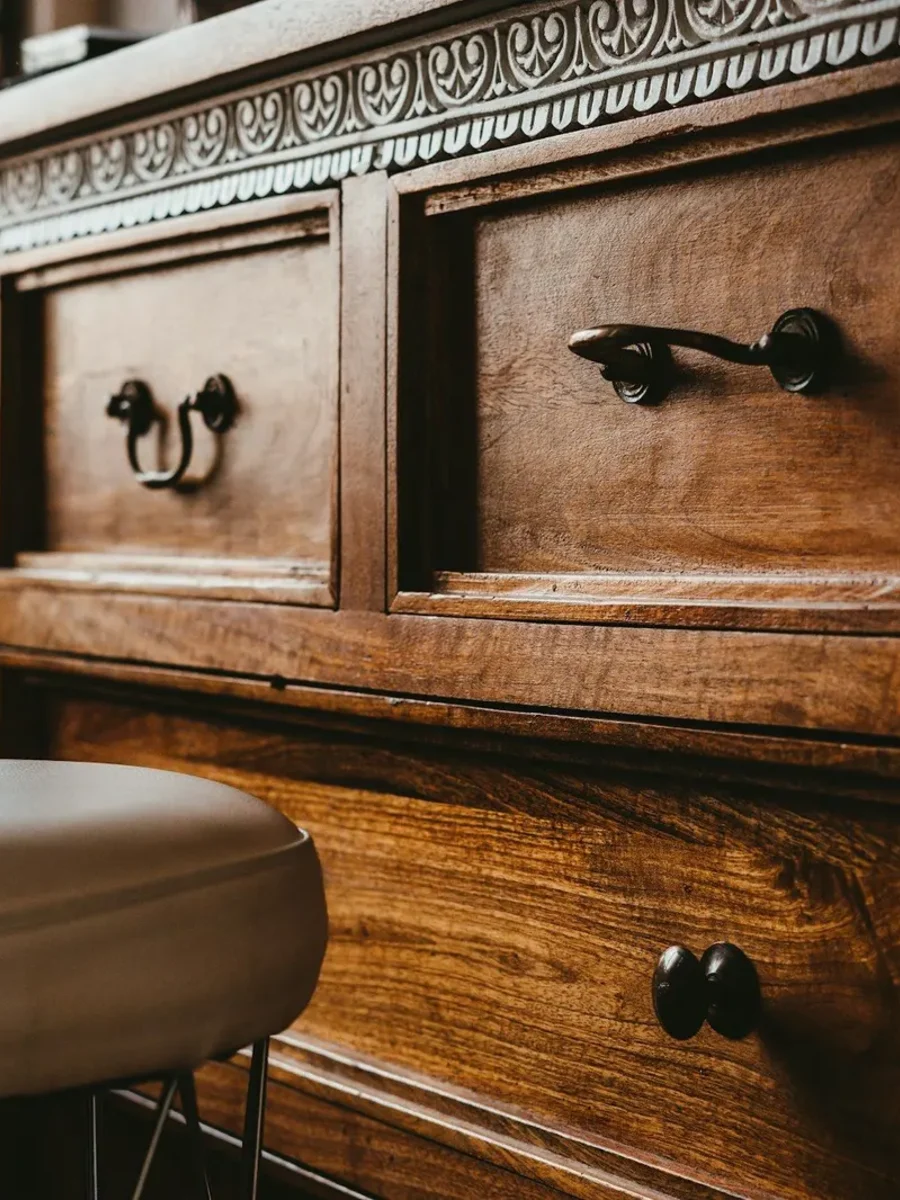
Goan homes tend to carry one of two furniture palettes. Older houses are full of dark polished teak and rosewood, carved almirahs and blackwood chairs. Newer flats and villas lean towards pale laminate, white lacquer and light oak-look joinery. The choice of slat often follows the furniture.
Real wood is the better match for the first palette. Because basswood is pale and even, it takes stain evenly, and a timber slat stained to sit beside teak reads as part of the joinery rather than a soft furnishing. Faux wood is at its most convincing in white and painted colours, where there is no grain to compare; printed or embossed darker grains look fine at a distance but rarely survive close inspection beside real teak.
Sun complicates both. Strong light through glass slowly changes the colour of any finish, and timber exposed to the sun will change tone over time. PVC has its own failure: without enough stabiliser, ultraviolet light breaks it down into conjugated chains that show as yellowing, according to research on PVC photodegradation. On a hot west-facing window, a white faux-wood slat of good quality holds its colour far better than a poor one, and a pale finish of either material runs cooler and changes less than a dark one.
Room by room: where each belongs
The verdicts below assume a house that is lived in and aired. If it is a second home closed for the monsoon, move every room one step towards faux wood. If a room has an air conditioner or dehumidifier running through the rains, real wood becomes more forgiving.
One more consideration for rentals and homestays: guests open windows in the rain, hang wet towels on the sill and close blinds on condensation. Faux wood tolerates all of that, and a damaged slat can usually be replaced individually. For guest-facing rooms we specify faux wood even where a wooden blind would technically survive. See our wooden blinds page for the timber range.
| Room | Recommendation | Why |
|---|---|---|
| Air-conditioned bedroom | Real wood | Dry, stable air; warm look; light to raise |
| Living room, lived in and ventilated | Real wood, or faux wood on very wide windows | Wood suits teak furniture; faux wood if the blind is very wide and heavy |
| Study or library | Real wood | Dry room; reads as part of the joinery |
| Kitchen | Faux wood or aluminium | Steam, grease and frequent wiping |
| Bathroom | Faux wood or aluminium | Daily humidity cycles and splash |
| Sea-facing room | Faux wood | Salt and damp air on the slats |
| Room closed for the monsoon | Faux wood | Weeks of saturated, still air |
| Homestay or rental room | Faux wood | Tolerates guests and wet sills; slats replaceable |