 Drape Haus
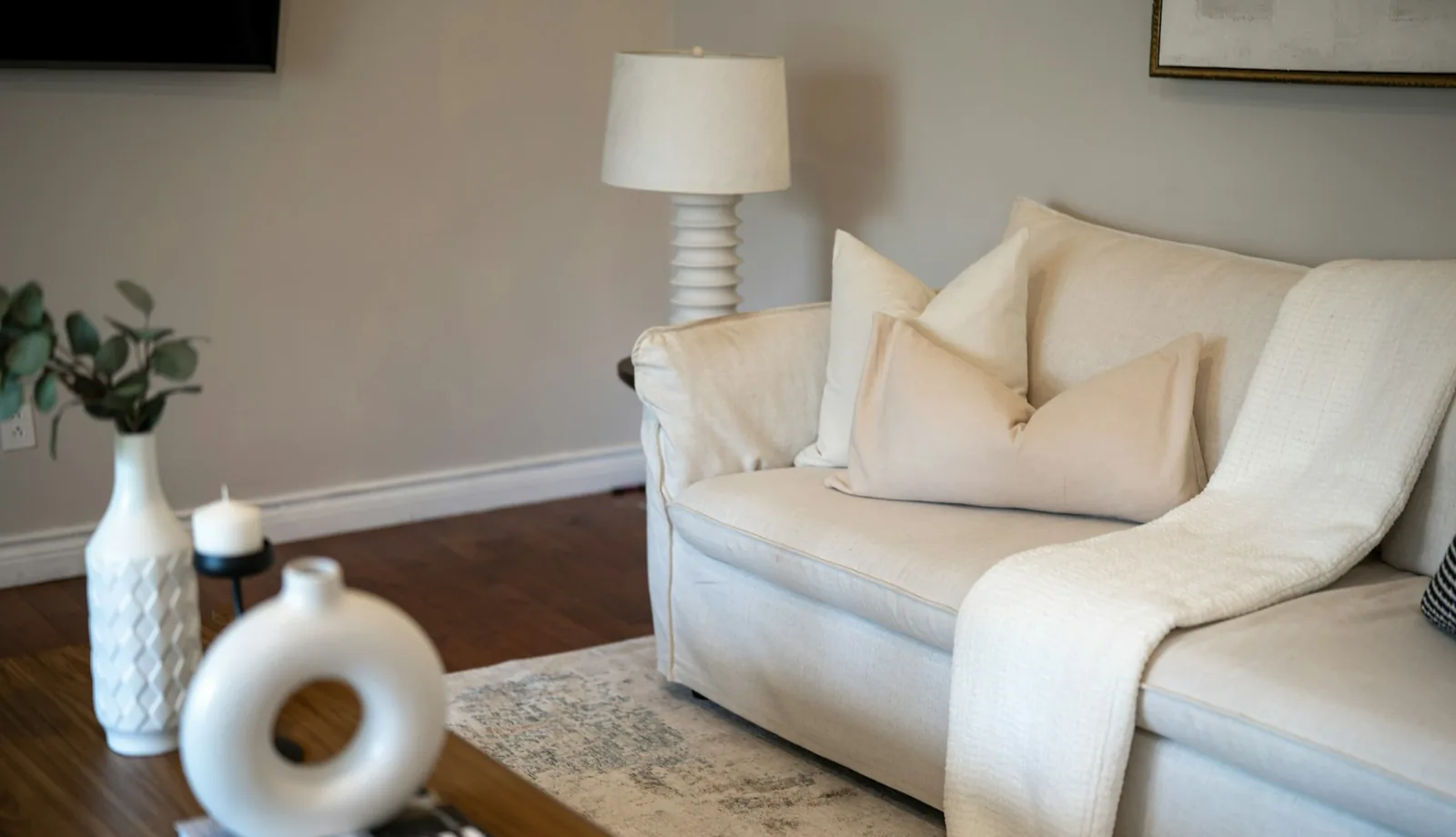
The right sofa cover cloth is the one that survives being washed. That sounds obvious, but it rules out a surprising number of beautiful upholstery fabrics, which were designed to be spot-cleaned in place and never see the inside of a washing machine. A cover is the opposite job: it comes off, goes through a wash, dries on a line or a rack in humid air, and has to go back on the sofa the same size and colour it went in.
For most Goan homes that points to a tightly woven polyester-cotton blend or a good polyester canvas for everyday covers, with cotton duck or twill where a more natural feel matters and the household can manage the drying. Velvets and textured cloths make richer, more formal covers but ask more of their owners. Linen and linen-look cloths are the relaxed option.
This guide covers washability and shrinkage, how each cloth behaves in monsoon humidity, the formal options, colourfastness, how cloth weight changes the fit around different arm shapes, and the case for a lighter and a heavier set through the year.
What a cover cloth has to do that upholstery fabric doesn't
Upholstery fabric and cover cloth look alike on the roll, but they are built for different lives. Trade cleaning guidance for upholstery, summarised by the Association for Contract Textiles, says even of water-safe fabrics that cushion covers should not be removed and laundered. Fixed upholstery is meant to be vacuumed and spot-cleaned, so its makers do not have to worry about how it behaves in a machine.
A cover cloth has four extra tests to pass. It must keep its dimensions through repeated washing, or the cover stops fitting. Its colour must survive water, detergent and the drying line without fading or bleeding. It must dry in a reasonable time in Goan humidity. And it must have enough body to hold the shape of the sofa, but enough give to go back on over the arms and cushions without a fight.
So when you choose a cloth for made-to-measure sofa covers, ask the questions you would never ask of fixed upholstery: has it been tested for shrinkage, what are its washing instructions, and how quickly does it dry? A cloth with no answer to those questions is an upholstery fabric, not a cover cloth.
Washable fabrics and how much each shrinks in a home wash
Shrinkage depends on the fibre and on how the cloth was finished, so no honest guide can give one figure per fabric. What can be said is the direction. Cotton and linen are the most likely to shrink in their first washes, especially in warm water and a hot dryer. Polyester is dimensionally stable and barely moves. Polyester-cotton blends sit between the two, and the more polyester they contain, the more stable they tend to be. Viscose is the least predictable and often loses strength when wet.
Textile laboratories measure this with dimensional change tests, and the contract trade uses laundering tests of this kind to rate fabrics before they are sold for washable uses. Ask the supplier for a shrinkage result after washing, not just a care label. If there is none, wash a sample yourself: cut a square, mark a measured box on it with a pen, wash and dry it the way you would the cover, and measure again.
Natural cloths can still make excellent covers if the shrinkage is taken out before cutting. Pre-washing the cloth, then cutting, means the cover's first home wash does not shorten it. Skipping that step is the most common reason a cotton or linen cover will not zip after its first wash.
Measure a washed sample before you trust a cloth for covers. Ten minutes with a ruler prevents a cover that no longer closes.
Planning something like this?
We visit homes across North and South Goa, measure on site, and bring samples to see in your own light.
Cotton, polyester or a blend in humid weather
In the monsoon the real test of a cover cloth is the drying rack. The India Meteorological Department records humidity across Goa of 87–91% on monsoon mornings and 83–87% in the afternoons, and wet cloth dries slowly in air already close to saturated. The US Environmental Protection Agency advises drying damp materials within 24 to 48 hours, after which mould usually starts. A heavy cotton cover that takes three days to dry indoors in July is a problem waiting to happen.
Fibre decides most of the drying time. Cotton and linen hold water inside the fibre; polyester holds it only between fibres, so it spins out and dries much faster. The Canadian Conservation Institute lists cotton, linen and rayon among the fibres most vulnerable to mould, and says growth is prevented below 60% humidity, which a Goan monsoon rarely offers without a dehumidifier. A blend gives some of cotton's feel with much of polyester's quick drying.
None of this rules cotton out. A household with a dehumidifier, a covered drying space and a second set of covers can live happily with cotton duck. A homestay that needs a cover back on the sofa by evening should choose polyester or a polyester-led blend. Our fabric guides to cotton and polyester and blends go deeper into each fibre.
| Cloth | Feel | Shrinkage risk | Drying in monsoon | Holds a tailored line | Best for |
|---|---|---|---|---|---|
| Cotton duck or canvas | Crisp, matt, natural | Moderate unless pre-washed | Slow | Very well | Lived-in homes with drying space |
| Cotton twill | Soft, durable | Moderate unless pre-washed | Slow to moderate | Well | Family sofas |
| Polyester-cotton blend | Close to cotton | Low to moderate | Moderate to quick | Well | Most homes and rentals |
| Polyester canvas or woven | Smooth, even | Low | Quick | Well | Rentals, pets, closed houses |
| Linen and linen blends | Cool, relaxed, creases | Higher unless pre-washed | Moderate | Poorly; suits relaxed covers | Dry-season, relaxed look |
| Linen-look polyester | Slubbed, matt | Low | Quick | Well | Linen look without the upkeep |
| Polyester velvet | Rich, warm | Low | Moderate; pile holds water | Well | Formal rooms, AC rooms |
Velvet and textured cloths for a richer, more formal look
A velvet or textured cover changes a sofa's character more than any plain cloth. It deepens the colour, softens the edges and makes an ordinary three-seater read as a formal piece, which is why owners often choose one for the Christmas and wedding season when the drawing room is in full use.
Velvet asks for extra care in the cutting room and at home. The pile has a direction, and every panel must be cut with the nap running the same way, or the sofa shows patches that look like different colours. Pressure from sitting leaves marks that need brushing up. And washing crushes pile, so many velvets are dry-clean only; check before you choose. For a velvet cover in Goa, polyester velvet is the practical fibre, because cotton and viscose velvets hold water deep in the pile. Our guide to velvet and heavy fabrics explains why.
Chenilles, jacquards and woven textures give a similar richness with less fuss. They hide marks well and do not show pressure in the same way. Their weakness is loops and floats on the surface, which catch on claws, buckles and toys, so they suit adult rooms better than family ones.
Colourfastness: covers that don't fade or bleed after washing
Covers face two colour risks that fixed upholstery mostly escapes: water and the drying line. A dark cloth with poorly fixed dye can bleed in the wash and stain its own piping or a pale contrast panel. A cover dried in full sun also fades every time it is washed. The Canadian Conservation Institute describes light fading as cumulative and irreversible, so a cover dried in the sun twice a month loses colour far faster than the sofa it sits on.
There is a third risk that runs the other way. The Association for Contract Textiles describes reverse crocking, where dye from clothing such as dark denim migrates onto upholstery, especially pale fabrics, and notes that it may be irreversible and depends on heat and humidity. On a cream cover in a humid room, new jeans can leave a blue shadow on the seat. A mid-tone cover, or a darker seat with lighter backs, sidesteps it.
Two simple checks help. Wash a sample with a white cotton handkerchief and look for transfer. And rub the dry sample firmly with a white cloth to see whether colour comes off. Then dry covers in shade, inside out if the cloth allows. If you want to see how a colour will sit in your room before ordering, try it in our sofa fabric simulator.
How the cloth changes the fit around different arm styles
The same pattern gives different results in different cloths. A crisp cotton duck or tightly woven polyester holds a sharp edge, so it suits track arms, square backs and the clean lines of a modern sofa. Its stiffness can also bridge slight dips and old lumps in the upholstery underneath.
Rolled and scroll arms need a cloth with more drape. Around a curve, a stiff cloth forms creases and bridges the hollow under the roll, so the cover looks inflated. A softer twill, a blend or a linen-look cloth follows the curve and lets the cutter ease or pleat the fullness neatly at the front of the arm. Sloped, flared and very deep arms behave the same way.
Weight matters too. A thin cloth shows every seam, button and staple beneath it; a medium-weight cloth smooths them over. Very heavy cloths are hard to get on and off, which matters more than people expect on a cover that will be removed every few weeks. For the full difference between cut covers and elastic ones, see stretch versus tailored sofa covers.
Seasonal swaps between lighter and heavier cover fabrics
A second set of covers is one of the most practical things a Goan household can own. From October to May, a lighter, paler cloth such as a linen blend or a cotton twill makes a living room feel cooler and brighter, and dries easily when washed. From June, a darker, quick-drying polyester-led cloth copes better with damp hands, wet umbrellas and the slower drying of the rains.
The off-season set should go into storage completely clean and completely dry, folded loosely and wrapped in cotton rather than sealed in plastic, then aired before it goes back on. A seasonal swap is also a chance to check the sofa underneath for damp, tired foam or loose joints while it is uncovered.
For rentals, the second set is less about seasons and more about continuity. One set on the sofa, one in the wash, means the room is never photographed or let with a bare sofa. If you want covers made, our sofa covers service patterns every piece on your sofa and makes both sets from one batch of cloth.