 Drape Haus
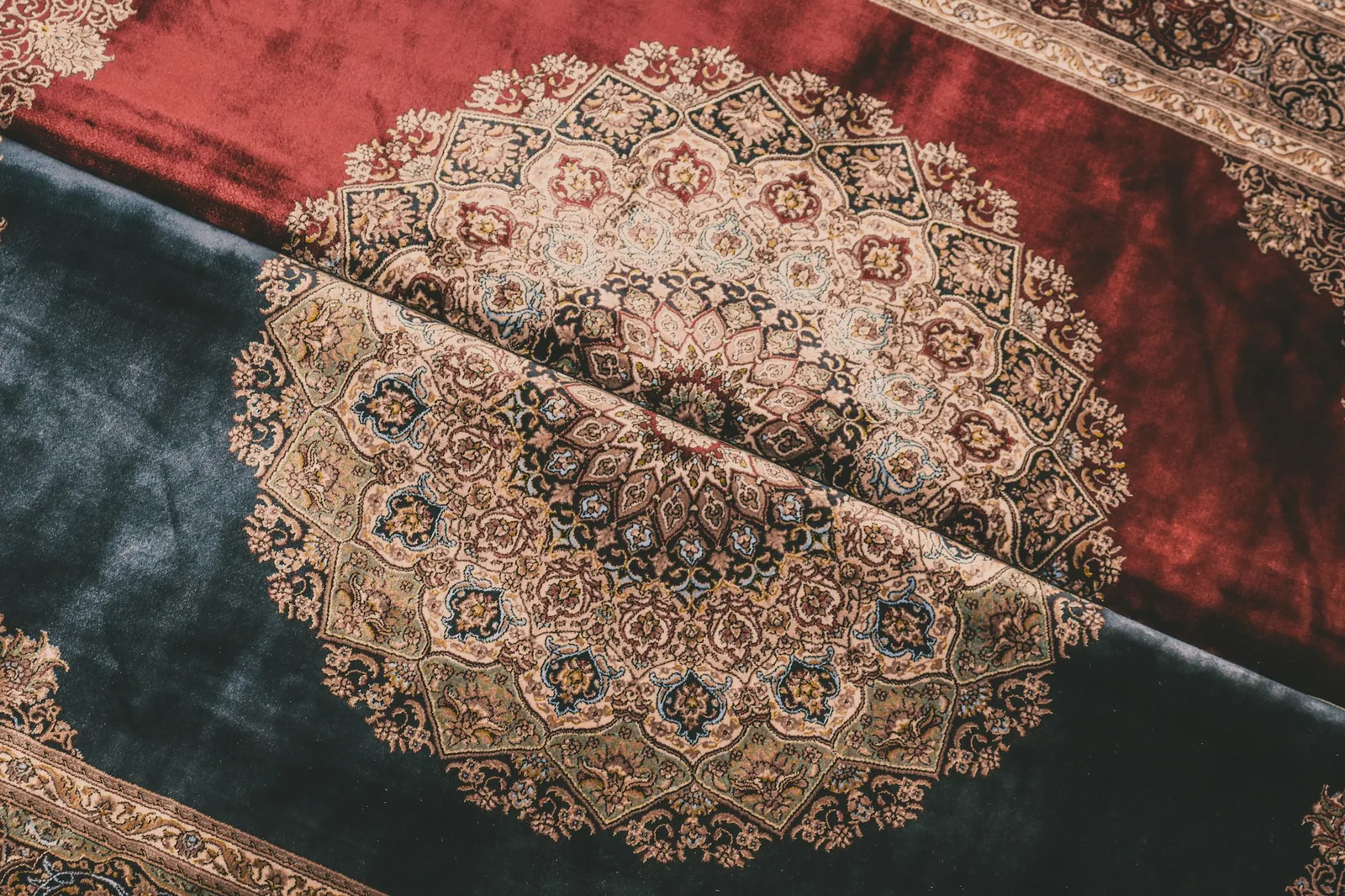
A silk carpet has a sheen no other fibre quite matches: the colour shifts as you walk round it, and fine detail stays crisp. But the word silk is used for two very different things. Real silk is a protein fibre spun by silkworms. Art silk, viscose and bamboo silk are regenerated cellulose, made by dissolving plant material and spinning it into a shiny filament. They look alike in a showroom. They behave very differently on a floor, and especially on a floor in Goa.
That difference matters most in humid air. Viscose weakens when wet, marks easily and is among the fibres most prone to mould. Real silk has different weaknesses: it is delicate underfoot, sensitive to light and best kept away from spills. Neither belongs in a busy room by the garden door.
This guide explains what each fibre is, the practical ways to tell them apart, how each copes with humidity, where a silk rug belongs in the house and the questions to ask before buying. For the craft of hand-knotting itself, see our article on hand-knotted rugs.
What a real silk carpet is
Silk is an animal fibre. The Central Muga Eri Research and Training Institute, under the Central Silk Board, describes it as made of proteins secreted in liquid form by the silkworm caterpillar as it spins its cocoon. India produces four commercial silks: mulberry, from the domesticated silkworm Bombyx mori, and the tasar, eri and muga silks from other species. Mulberry silk, with its long, fine, even filament, is the silk most associated with fine carpets.
In a rug, silk can appear in three ways. A pure silk carpet has a silk pile knotted on a silk foundation, allowing extremely fine knotting and detail. A silk-on-cotton rug has a silk pile on a cotton foundation, which is sturdier and lies flatter. And many wool rugs use silk only for highlights, outlining motifs so they catch the light. All three are real silk; what differs is how much of it there is and where.
Silk pile is made to be admired more than trampled. It is fine and smooth, so it shows the direction of the pile strongly, which is where the shifting sheen comes from, but it is also crushed and marked more easily than wool. That is why the best silk carpets have traditionally been used in quiet rooms, or hung.
Art silk, viscose and bamboo silk
Art silk is short for artificial silk. In the rug trade it almost always means viscose, a form of rayon: cellulose, usually from wood pulp, dissolved chemically and extruded as a filament with a silk-like shine. Bamboo silk is the same thing made from bamboo pulp. The US Federal Trade Commission has stated that most bamboo textiles are really rayon, that no trace of the original plant remains in the finished fibre, and that such products should be labelled as rayon, or rayon made from bamboo.
You will also see banana silk, faux silk, silk-look and similar names. They are trade descriptions, not fibres. Most such rugs are viscose; some are mercerised cotton, polyester or blends. The only reliable answer is the fibre content written on the label or the invoice.
None of this makes viscose a bad material. It dyes beautifully, has a genuine lustre and costs a fraction of silk, so it makes rugs with a rich look possible in more rooms. The problem is that it is often sold, or simply assumed, to be something it is not, and then put in a room where it cannot cope.
| Real silk | Art silk / viscose / bamboo silk | |
|---|---|---|
| Origin | Protein spun by silkworms | Regenerated cellulose from wood or bamboo pulp |
| When wet | Can water-mark; specialist cleaning | Loses a great deal of strength |
| Mould risk | Can be affected | Particularly vulnerable |
| Burn test smell | Burning hair | Burning leaves or paper |
| Burn residue | Soft, crushable bead | Soft grey ash |
| Price | High | A fraction of silk |
| Best placed | Quiet, dry rooms or on the wall | Low-traffic, air-conditioned rooms only |
Planning something like this?
We visit homes across North and South Goa, measure on site, and bring samples to see in your own light.
How to tell real silk from art silk
Start with the paperwork. A seller of a real silk rug should be willing to write the fibre content of the pile and the foundation on the invoice. Vague wording, such as silk touch, silk finish or luxury silk, is a reason to ask again. Price is a clue: hand-knotted silk is slow, skilled work with an expensive fibre, so a large silk rug offered at a low price is very unlikely to be silk.
Then look and feel. Turn the rug over: a hand-knotted rug shows its knots on the back, row by row, while many viscose rugs are hand-tufted with a glued backing cloth hiding the construction. That tells you about construction, not fibre, but it is a useful first check. Touch is less helpful than people think: both fibres feel cool, smooth and lustrous, so a hand on the pile cannot settle the question.
The test that tells fibres apart at home is a burn test, done carefully and only with the seller's agreement on a few loose fibres from the pile, not the fringe, which is the end of the foundation threads and may be a different fibre. Guidance from the home sewing trade describes the method: hold the fibres with tweezers over a non-flammable dish, outdoors or by an open window, bring them briefly into a small flame and note the result. Silk burns slowly, tends to go out when taken from the flame, smells of burning hair and leaves a soft bead. Rayon, which includes viscose, burns quickly, smells of burning leaves or paper and leaves soft grey ash. Blends cannot be identified with certainty this way.
For an expensive purchase, a textile testing laboratory can confirm fibre content under a microscope. It is a small cost against the price of a silk carpet.
Silk smells of burning hair; viscose smells of burning paper. Never test without the seller's permission, and never on the fringe.
Why viscose struggles in humidity
Viscose takes up water readily, and in a Goan monsoon the air supplies it. Fibre suppliers note that viscose loses a great deal of its strength when wet, and that it stretches and shrinks more than cotton. In a rug, that means the pile is at its weakest exactly when the air is wettest, so walkways crush and mat, and the pile can distort when it is cleaned.
Spills are the next problem. A dropped glass of water, a wet footprint from the shower or a careless wet clean can leave a visible mark or a change in the pile's sheen where the fibres have swollen and dried in a different direction. Home spot-cleaning often makes it worse, spreading the water further. The rule is to blot with a dry white cloth at once, never rub, and call a specialist cleaner for anything more.
Mould is the third. The Canadian Conservation Institute lists rayon among the cellulosic fibres particularly vulnerable to mould, with relative humidity above 65 per cent, warmth and still air as the conditions that promote it. The India Meteorological Department records Goa's morning humidity at 87 to 91 per cent from June to September. A viscose rug in a closed, fan-less room through the rains is in the worst possible place.
Silk in a humid house: light, damp and care
Real silk is less prone to mould than viscose, but it is still a natural fibre that takes up moisture and can grow mould when it stays damp; the conservation guidance names silk among the protein fibres that can be affected. Keep it in a room that is aired, or better still air-conditioned, through the monsoon, on a breathable underlay rather than a rubber sheet.
Light is silk's other enemy. The Canadian Conservation Institute notes that ultraviolet weakens and eventually fragments wool, cotton and silk, and that most natural dyes are highly light-sensitive. A silk rug in a pool of west sunlight will fade and weaken in that patch. Keep it out of direct sun, or filter the light with sheer curtains or blinds; our guide to fading and sun damage explains the rest.
Cleaning should be gentle and mostly professional. Vacuum with suction only, never a beater bar, and not too often on a fine pile. Blot spills at once. For washing, use a specialist who handles silk and can dry the rug fast, ideally in the dry season. Home washing risks dye running, distortion and, in humid weather, slow drying that invites mould.
For the monsoon in a closed house, roll the rug pile-out after cleaning and drying, wrap it in cotton, store it off the floor in a dry room and check it once during the season. Our monsoon take-down and storage service does this for owners who are away.
Where a silk rug belongs
Put a silk rug where it is seen more than walked on. A master bedroom with air conditioning, beside the bed where feet land softly. A formal sitting room used for guests rather than daily life. A dressing room or a study. Or on the wall, where a fine silk piece is safe from feet altogether and its sheen catches the light as you pass.
Keep it away from the places where Goan houses get wet: the door to the garden, the pool or the beach; the bathroom threshold; the dining room, where food and drink fall; and children's rooms. Those rooms want wool, a cotton flatweave or a synthetic; our guide to the best rugs for humid homes compares them.
The same rules apply to viscose, more strictly. If you love the look of a viscose rug, give it a quiet, air-conditioned bedroom, shoes off, no drinks, and plan on professional cleaning. Do not put it in a rental, where you cannot control any of that.
- Good: air-conditioned bedrooms, formal sitting rooms, studies, dressing rooms, walls
- Avoid: dining rooms, garden and pool doors, bathroom thresholds, children's rooms, rentals
- Always: out of direct sun, on a breathable underlay, shoes off
Questions to ask before buying a silk rug
A good seller will answer all of these without hesitation, in writing where it matters. If the answers are vague, treat the rug as viscose and price it accordingly.
When you have a shortlist, measure the room and the furniture first; our rug size planner helps you find a size that suits the room without being too large to lift and store. We source hand-knotted silk and wool rugs and can advise on whether a particular room suits silk at all; see our Persian and hand-knotted rugs collection or ask us through our contact page.
- What is the pile fibre, and what is the foundation? Will you write that on the invoice?
- Is it hand-knotted, hand-tufted or machine-made?
- Is it real silk, or viscose, art silk or bamboo silk?
- Are the dyes natural or synthetic, and have they been tested for running?
- How should it be cleaned, and who cleans it locally?
- May I take a few pile fibres for a burn test, or have it tested?
- Can I return or exchange it if the fibre content proves different?