 Drape Haus
Drape Haus
Preparing the room
Drape Haus
Preparing the room
Curtains
Metal or resin rings set into a stiffened heading and threaded straight onto a pole. Eyelet curtains fall in deep, even folds and slide open with one hand — the easy, contemporary choice for flats, bedrooms and rooms that are lived in rather than staged.

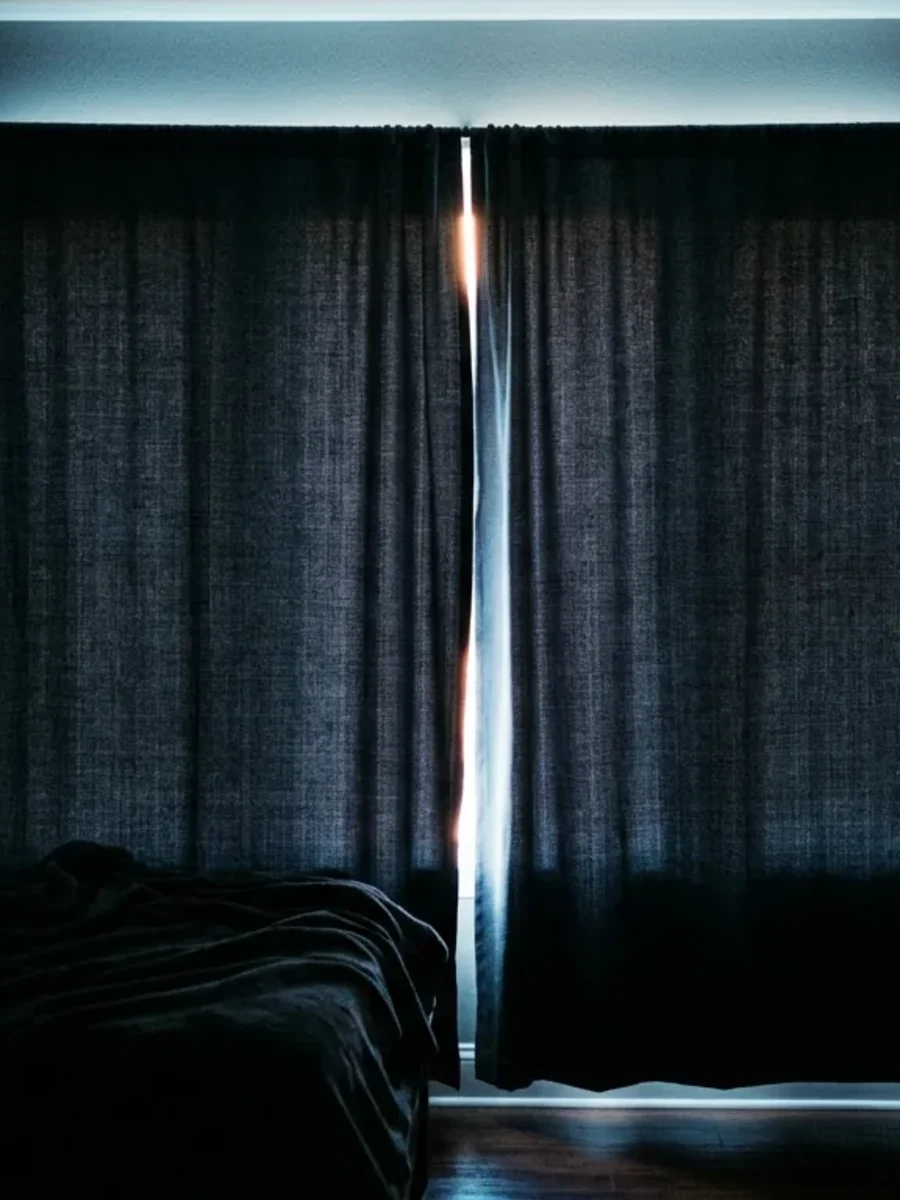
Linen · Midday
Treatment
Time of day
Glows with daylight and gives real daytime privacy. After dark, silhouettes can still show through unlined linen.
In short
By the Drape Haus studio · How we write
Is it right for you?
An eyelet curtain has a band of stiffening across the top, punched with large rings at regular intervals. The pole runs through the rings, front and back alternately, so the fabric naturally forms a series of identical folds. There is no tape, no hooks and no gliders; the curtain is the heading. That simplicity is the appeal, and it is why eyelets are the most common heading in ready-made curtains.
Made to measure, the same heading becomes a good deal more refined. The ring spacing is set for the fabric weight, the folds are calculated so the curtain ends with a fold turning back to the wall at each side, and the drop is cut to the real floor. Eyelets suit people who open and close their curtains every day by hand, rooms with a casual or contemporary feel, and windows where a visible pole is welcome rather than tolerated.
They are the wrong choice when the curtain must hang from the ceiling, run round a tight bay, be motorised, or seal light at the top for a dark bedroom. They are also less suited to very formal rooms where a tailored pleat looks more considered. In those cases we steer people to pleated or ripple-fold headings, and we say so at the first visit.
The details
The eyelet heading does two jobs at once. The rings carry the curtain on the pole, and the spacing between them decides the folds: each pair of rings throws one fold towards the room and one back towards the glass. Space them evenly, choose the right fullness, and the curtain hangs in the same soft tubes whether it is drawn across or stacked at the side.
Near the sea the ring itself is the detail to get right. Plated steel eyelets rust inside their first monsoon and leave brown halos on pale fabric. We use rings with a coated, anodised or stainless finish, matched to the pole, so the metal on the curtain and the metal it slides on age together rather than against each other.
Eyelets only work on a pole. They cannot run on a track or hang from the ceiling, and the stack is a little wider than a pleated curtain's because the folds are deep. That means planning the pole wider than the window so the curtain can clear the glass when open.
Made to measure, the heading is interfaced to stay upright in humid months, the drop is cut to the actual floor rather than a standard size, and the pattern is placed so it reads evenly between the rings — the details that separate a fitted eyelet curtain from a ready-made one bought by the pair.
Your options
Every eyelet curtain uses the same principle. The choices that change how it looks and lasts are the ring, the fabric, the lining and the size of the pole it rides on.
Swipe for all 6 →
The honest view
Effortless to draw
Rings slide over a pole with very little friction, so the curtain can be pulled open by its leading edge in one movement. There are no cords to tangle or gliders to jam.
Regular folds every time
Because the pole forces the fabric back and forth through each ring, the folds reform in the same place every time the curtain is drawn. It never looks dishevelled.
Simple to take down
Lift the pole off its brackets, slide the curtain off and it is ready to wash or store. That matters in a house closed for the monsoon or a rental turned over every few weeks.
Clean, modern heading
A row of rings reads as a deliberate design detail. In a flat with plain walls it gives the window a clear, graphic line without fuss.
Pole only
No ceiling fixing, no recessed track, no motor. If the window needs any of those, the eyelet heading is ruled out from the start.
Light over the top
The fabric sits below the pole and the rings leave gaps, so light spills above the curtain. Fine in a living room, a real limitation in a bedroom that must be dark.
Wider stack
Deep folds take more room when the curtain is open. On a window with little wall either side, the stacked curtain covers part of the glass.
Side by side
The realistic alternatives to an eyelet heading are a pinch pleat, a ripple-fold heading on a track and a simple tab-top or rod-pocket curtain.
| Eyelet | Pinch pleat | Ripple fold | Rod pocket | |
|---|---|---|---|---|
| Hardware | Pole | Track or pole with rings | Dedicated track | Pole |
| Ease of drawing | Very easy | Easy | Very easy | Stiff; mostly static |
| Fold shape | Deep, round tubes | Tailored pleats | Uniform S-wave | Gathered |
| Light at the top | Spills over the pole | Less with a ceiling track | Least on a ceiling track | Spills over |
| Stack-back | Wide | Moderate | Compact | Wide |
| Motorisation | No | Possible on a track | Ideal | No |
| Feel | Relaxed, modern | Formal, classic | Hotel, minimal | Cottage, informal |
Swipe to compare →
If you like the look of eyelet folds but need a ceiling fix or a motor, a ripple-fold heading gives a similar rhythm on a track.
Rather see it in your own room?
We bring samples to the house, measure every window, and specify for the light and exposure you actually have.
Room by room
Drawn many times a day by everyone in the house, eyelets take the handling without complaint. A lined fabric gives evening privacy; an eyelet sheer on a second pole handles midday glare.
A lined or blackout eyelet darkens the room well. If light over the pole bothers you, mount the pole higher and closer to the ceiling, or add a pelmet.
No cords, no small fittings to pull off and an easy slide. Resin rings are quiet and will not chip or rust if the window is left open in the rain.
Guests understand them instantly and they are quick to strip and wash between stays. Choose durable polyester blends that hold their colour.
Eyelets can look casual against panelled walls and chandeliers. A pinch or goblet pleat sits better in a formal heritage room.
Reaching the leading edge of a very tall curtain is awkward, and the heavy drop strains the heading. A track with a draw rod or a motor is the better route.
Easy to push aside on the way out, and a wide pole lets the curtain clear the doorway completely. Use salt-resistant rings if the door faces the sea.
In depth — tap a heading to read
The look of an eyelet curtain is decided at the cutting table. Rings are placed at even centres across the heading, always in even numbers so both outer edges finish with a fold returning to the wall. Closer spacing gives smaller, tighter folds; wider spacing gives deep, generous tubes. We set it according to the fabric weight and the depth of pole bracket, so the folds do not hit the wall or the glass.
Fullness — how much fabric goes into each curtain against the width it covers — matters as much as spacing. Too little and the curtain looks flat and stretched, with the rings visibly pulling the fabric. Too much and the stack becomes bulky. Eyelets generally need slightly less fullness than a gathered heading but more than many ready-made pairs provide.
If ready-made eyelets have always looked thin to you, it is usually the fullness, not the fabric.
The pole is half the look, so it has to suit the room as well as the load. The ring's inner diameter must be comfortably larger than the pole, or the curtain will drag and judder; we always size the two together rather than buying the rings first. Long spans need a centre bracket, and because eyelets cannot pass a bracket, the curtain on each side stops there — fine for a pair of curtains, a problem for a single panel that must travel the whole width.
Near the sea the pole and rings should be the same family of material. Stainless rings on a plated pole will not save the pole, and a rusting pole will mark the rings and then the fabric. Anodised aluminium and powder-coated poles keep their finish best in salt air; timber poles work well indoors but need sealing ends in damp rooms. The curtain rod and track planner on this page helps you work out how far the pole should run past the window.
The stiffening inside the heading is what keeps an eyelet curtain upright. In a humid monsoon a soft, fusible interfacing can relax, and the heading starts to fold over between the rings. We use a firmer, humidity-tolerant stiffener and stitch it in rather than relying on glue alone, so the band keeps its shape through the wettest months.
Corrosion is the other monsoon risk. Moisture plus salt finds any cut edge or scratch in a plated ring, and rust then wicks into the fabric around it. Once the stain is there it rarely washes out completely. Choosing the right ring at the start costs nothing in the look and avoids replacing a curtain in a year's time.
Because the fabric hangs below the pole, the bracket height sets where the curtain begins. Mounting the pole well above the window frame makes the room feel taller and hides the head of the frame behind the folds; mounting it tight to the frame shortens the window visually. In houses with high ceilings we often fix the pole close to the cornice and let the curtain fall the full height.
We cut the drop to clear the floor by a small margin. A curtain that pools on tiles looks generous in a magazine but wicks up water when the floor is mopped and picks up damp in the monsoon. Measuring at several points across the window matters in older houses, where floors are rarely level.
A single eyelet curtain is either open or closed. To get soft daytime light as well as evening privacy, add a second layer: a sheer on its own pole closer to the glass, or a blind inside the window reveal. Double pole brackets carry both, provided the brackets project far enough for the two sets of rings to pass without catching.
Where privacy and darkness are the main brief, our layered curtains page explains the sheer-plus-blackout system in depth. For an eyelet room, the simplest pairing is often a roller or zebra blind in the reveal doing the functional work and the eyelet curtain framing the window.
Living with it
Take the pole down before removing the curtain. Pulling the fabric over a fixed bracket strains the heading and can tear the fabric around a ring.
Wash in a laundry bag or on a gentle cycle so the rings do not knock against the drum. Follow the fabric's own care label; lined curtains are often better dry-cleaned.
A damp cloth along the pole removes salt and grit that make rings stick. Dry it afterwards, especially on timber.
In the monsoon, never rehang a curtain that is still damp at the heading. Trapped moisture in the stiffener is where mildew starts.
After washing, hang the curtain, push it open and leave it stacked for a day so the folds settle back into their rhythm.
Avoid these
Brown rust halos appear around the rings within a season or two. Specify stainless, anodised or resin rings from the outset.
The deep stack then covers the glass when the curtain is open. Extend the pole beyond the frame on both sides.
The curtain drags and jerks. Choose the pole and ring sizes together.
Light comes over the pole and between rings. For a dark bedroom, use a pelmet, mount high, or choose a ceiling track with a different heading.
Thin eyelet curtains look stretched. Allow proper fullness so the folds are round.
Checklist
More in curtains
Curtains measured on site, cut to the window and specified for what it actually faces — from airy sheers on a veranda door to full blackout in a bedroom that catches the sunrise.
From the Journal
All articlesOur process
One team from the first visit to the last bracket, so nothing is lost between the person who specified it and the person who fits it.
FAQ
No. Eyelets are threaded onto a pole, so they need a pole on brackets. If you want a ceiling-fixed or recessed track, choose a pleated or ripple-fold heading instead.
Plated steel eyelets often do, within a season or two. We use coated, anodised or stainless rings and pair them with a pole that resists salt air, so neither marks the fabric.
Wider than for most headings, because eyelet folds are deep and stack wide. As a rule we allow enough pole on each side for the open curtain to sit clear of the glass, and we check it against the wall space on site.
Yes, with a blackout lining sewn in. Light can escape over the top of a pole and between the rings, so for a truly dark bedroom a pleated curtain on a ceiling track does better.
Yes. Eyelet sheers are light and easy to draw, and they suit a relaxed room. We use smaller rings and a lighter interfacing so the voile does not pucker at the heading.
Nothing — they are two names for the same heading. Grommet is the term more often used for the ring itself, eyelet for the curtain style. Both describe a curtain whose rings thread directly onto a pole.
Usually a little less than a heavily gathered heading and roughly comparable to a pinch pleat. The exact amount depends on the ring spacing and the depth of fold you want, which we set for each fabric.
Often, if there is enough fabric above the current heading to take the eyelet band and the fabric is in good condition. We check the width too, because eyelets need sufficient fullness to fold properly.
The heading stiffener has softened or was too light for the fabric. In humid weather a fusible interfacing can relax. A firmer, stitched stiffener fixes it.
Next step
An eyelet curtain looks right when the pole, the rings and the fabric are chosen as one. We visit, measure the window and the wall either side for the stack, check what the brackets will fix into and how close the sea is, then bring fabrics and ring finishes to see against your light. Book a home visit and we will specify the full set — pole, rings and curtain — before we make anything.