 Drape Haus
Wall-to-wall carpet works in Goa in one kind of room: one that is closed, air-conditioned and kept that way. In a hotel suite, a cooled media room, a conference room or an office with its air conditioning running every working day, fitted carpet does what nothing else does. It quietens the room, softens the floor and makes a space feel finished.
In a naturally ventilated room it is a different story. Carpet holds moisture in its pile, its backing and the underlay beneath, and it cannot be lifted, beaten and dried in the sun the way a rug can. The India Meteorological Department's normals put Goa's morning humidity at 87 to 91 per cent from June to September. A fitted carpet in an open room spends those months damp, and a house closed for the season makes it worse.
This guide sets out where fitted carpet works and where it fails, what has to happen to the floor beneath it, which fibres cope, how to keep it healthy through the year, and when a large rug is the better answer. Our wall-to-wall carpets page covers what we supply and fit.
The real risks of fitted carpet in a humid house
The problem is not that carpet gets wet; it is that it stays wet. The US EPA's guidance on mould is that wet materials dried within 24 to 48 hours will in most cases not grow mould. A rug can be lifted and hung in moving air within that window. Fitted carpet cannot. The EPA's mould course is explicit that wet vacuums alone will not dry a carpet: to dry it within 48 hours, the carpet and pad have to be pulled off the floor and dried with fans, and the padding must be dried as well as the carpet, or mould will likely follow.
Most of the damage is out of sight. The EPA lists the underside of carpets and pads among the hidden places mould grows, and warns that porous materials such as carpet may have to be thrown away if they become mouldy. The first sign is often the smell: a stale, musty note in a room that looks perfectly clean, strongest when the air conditioning has been off for a while.
Humid air alone can do it. The Canadian Conservation Institute notes that relative humidity between 65 and 100 per cent, warm temperatures and poor air circulation promote mould on textiles. In an open Goan room in July, the first two are given and the third is common under furniture and along walls. Add a spilled drink, wet feet from the pool or a leaking window, and the carpet has all it needs.
- A musty smell that returns whenever the air conditioning is off
- Dark or grey patches on the underside or along skirting
- Underlay that feels damp or crumbles when lifted at a corner
- Tack strips or grippers rusting at the edges of the room
- Pile that stays flat and clammy after cleaning
Rooms where wall-to-wall carpet works
The industry's own installation standard tells you what carpet expects. The Carpet and Rug Institute's residential standard asks for the building's air conditioning to be running for at least 48 hours before fitting, during it and for 72 hours after, with the room between 18 and 35 degrees Celsius and relative humidity no higher than 65 per cent. It warns that installations outside those conditions are open to moisture failures, including condensation. In other words, fitted carpet is designed for a conditioned room.
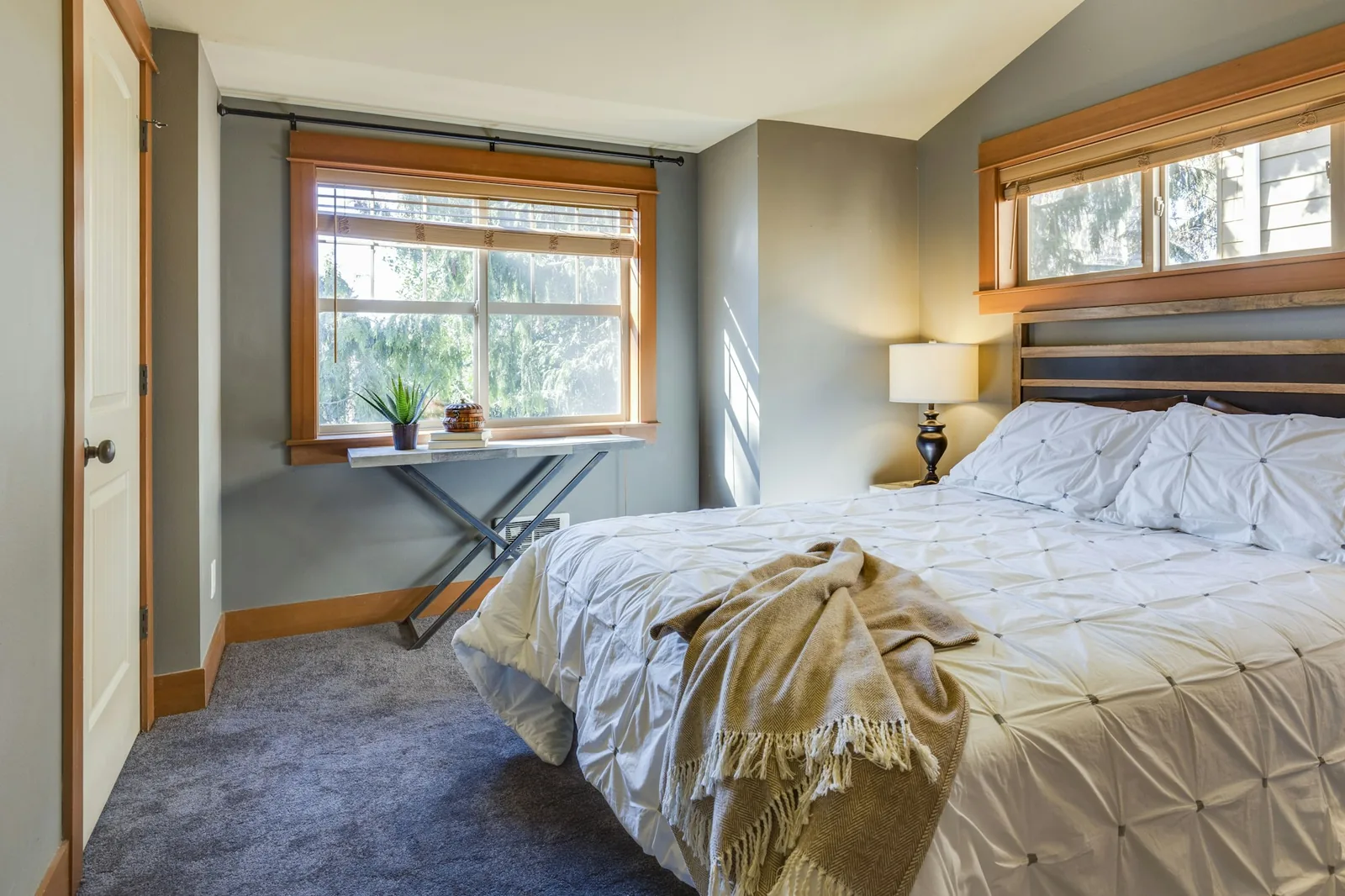
That points to the rooms where it works in Goa. An air-conditioned media room or home theatre, where carpet absorbs sound, darkens the room and is rarely walked on in wet feet. A home office or study kept cool through the working day. Hotel guest rooms and corridors with central air conditioning and housekeeping. Offices and conference rooms, where carpet tiles quieten footfall and chair noise. A master bedroom on an upper floor, with the air conditioning running most nights.
The rooms where it fails are just as clear. Ground floors that sweat in the monsoon. Rooms that open onto a garden, pool or beach. Anywhere near a bathroom door or a kitchen. Rental villas and homestays where guests come in wet and the house sits empty between bookings. And any room in a house that is closed for the monsoon without dehumidification. For those, a rug is the answer; for hotels and offices, our commercial and hospitality team specifies contract carpet for the building.
| Room | Verdict | Why |
|---|---|---|
| Air-conditioned media room | Works well | Sealed, cool, little wet traffic; carpet absorbs sound |
| Office or conference room | Works well | Daily air conditioning; carpet tiles can be replaced singly |
| Hotel rooms and corridors | Works well | Central air conditioning and regular professional cleaning |
| Upper-floor bedroom with AC | Works with care | Keep humidity controlled; avoid if the house is shut for months |
| Ground-floor living room | Avoid | Floor moisture, garden doors and monsoon humidity |
| Rental villa or homestay | Avoid | Wet feet, empty spells and hard cleaning schedules |
| Near pools, bathrooms or kitchens | Avoid | Repeated wetting that carpet cannot dry from |
Planning something like this?
We visit homes across North and South Goa, measure on site, and bring samples to see in your own light.
Underlay, fixing and moisture barriers over concrete
Concrete is never as dry as it looks. The installation standard warns that any concrete floor, even one properly cured and dry, can pass moisture vapour to its surface, and that the rate at which it does so greatly influences whether a carpet lasts. It calls a properly installed moisture membrane essential to stop that moisture migrating into the carpet. Before any glued-down carpet or carpet tile goes on concrete, the standard requires moisture and alkalinity testing of the slab and a written report.
In Goa this matters most on ground floors and on slabs laid over damp ground. A simple warning sign is a floor that feels cool and clammy in the monsoon, or tiles whose grout darkens in the rains. On such floors, fitted carpet is a poor idea whatever is put under it. On a dry upper floor, the usual methods are open to you.
There are three. Stretch-in carpet is laid over a separate cushion and held taut by gripper strips fixed around the edge of the room; the standard caps residential cushion at 11 millimetres and requires a power stretcher, not a knee kicker alone, to stretch it. Glue-down carpet is bonded straight to the floor, firmer underfoot and common in offices. Carpet tiles are usually laid on a pressure-sensitive adhesive that the standard describes as engineered for easy removal and replacement, so they can be lifted one at a time, which makes them the most forgiving choice in a humid building: a wet or stained tile is replaced, not the room.
Whatever the method, choose an underlay that will not rot or crumble in humidity, ask what it is made of, and let the carpet acclimatise in the room before fitting; the standard recommends at least 24 hours. Plastic sheeting laid over new carpet to protect it traps moisture and should not stay down.
Carpet fibres that cope with humidity, and the one to avoid
Fibre choice follows the same logic as for rugs, but the stakes are higher because fitted carpet cannot be taken outside to dry. Nylon is widely used in contract carpet: tough, resilient, cleanable and much less absorbent than natural fibres. Polypropylene absorbs almost no water and resists staining, though its pile crushes more readily, so it suits low-pile loop carpets and carpet tiles. Polyester is soft and holds colour well but flattens in walkways.
Wool is the luxury choice. The wool industry's research and marketing body notes that it can absorb up to 35 per cent of its weight in moisture before it feels wet, which helps it ride out swings in humidity, and it recovers from crushing better than any synthetic. In a conditioned bedroom or a quiet media room it is lovely. It needs the room kept dry, though, and protection from moths in corners and under furniture where it is never vacuumed.
Avoid viscose, sold as art silk or bamboo silk, in fitted carpet. It is a cellulosic fibre, among those the Canadian Conservation Institute calls most vulnerable to mould, it weakens when wet and its pile crushes easily. Our silk carpet guide explains the difference between viscose and real silk.
| Fibre | Moisture | Wear | Best for |
|---|---|---|---|
| Nylon | Low absorbency; cleans well | Very resilient | Offices, hotel rooms, corridors |
| Polypropylene | Almost none | Crushes in heavy traffic | Carpet tiles, loop pile, conference rooms |
| Polyester | Low | Flattens in walkways | Bedrooms with light use |
| Wool | Absorbs and releases moisture | Excellent recovery | Conditioned bedrooms and media rooms |
| Viscose | Absorbent; weak when wet | Crushes and marks | Not recommended for fitted carpet |
A cleaning and maintenance year for carpeted rooms
A carpeted room in Goa needs a routine planned around the monsoon, not just around dirt. The daily part is humidity: keep the room's air conditioning or a dehumidifier running enough to hold humidity well below 65 per cent, and remember that the US EPA advises keeping indoor humidity below 60 per cent, ideally 30 to 50, to limit mould. Close the door when the room is conditioned.
The weekly part is vacuuming, more often in busy rooms, with a machine that has good suction and a clean filter. Blot spills at once, working from the edge inwards, and dry the spot with a fan. Keep doormats outside and inside every entrance to a carpeted area; most of the grit that wears carpet arrives on shoes.
The seasonal part is the deep cleans. Before the monsoon, in April or May, have the carpet professionally cleaned by hot-water extraction or a low-moisture method, on dry days, with fans and air conditioning running until it is completely dry. After the monsoon, in October or November, inspect the edges, the underside of a corner and the gripper strips for damp or rust, deal with any smell, and clean again if the season has left marks.
If the house will be closed for the monsoon, decide before you leave. Either the carpeted room has dehumidification running on a timer and someone checking it, or the carpet is in the wrong house. Our guide to the closed-house season covers what else needs doing.
Large rugs: the removable alternative
For most Goan rooms that want the softness of carpet, a large room-size rug gives nearly all of it without the risk. A rug that covers most of the floor, leaving a border of tile or wood around the edge, warms the room and quietens it. Unlike fitted carpet, it can be lifted, aired, sent for cleaning in the dry season and rolled away for the monsoon.
The trade-off is size and weight. A very large rug is a two- or three-person job to roll, and the bigger it gets, the more it behaves like carpet when it comes to drying. Often the best answer is a rug sized to the furniture rather than to the walls: big enough that the seating or bed sits on it, small enough to lift. Our rug size planner shows how much floor to leave, and our guide to the best rugs for humid homes compares fibres.
If you are deciding between fitted carpet and a rug for a particular room, we will look at the floor, the room's use and its air conditioning, and give you an honest answer before quoting for either. Ask us through our contact page.
If you cannot keep a room below about 65 per cent humidity, fit a rug you can lift, not a carpet you cannot.