 Drape Haus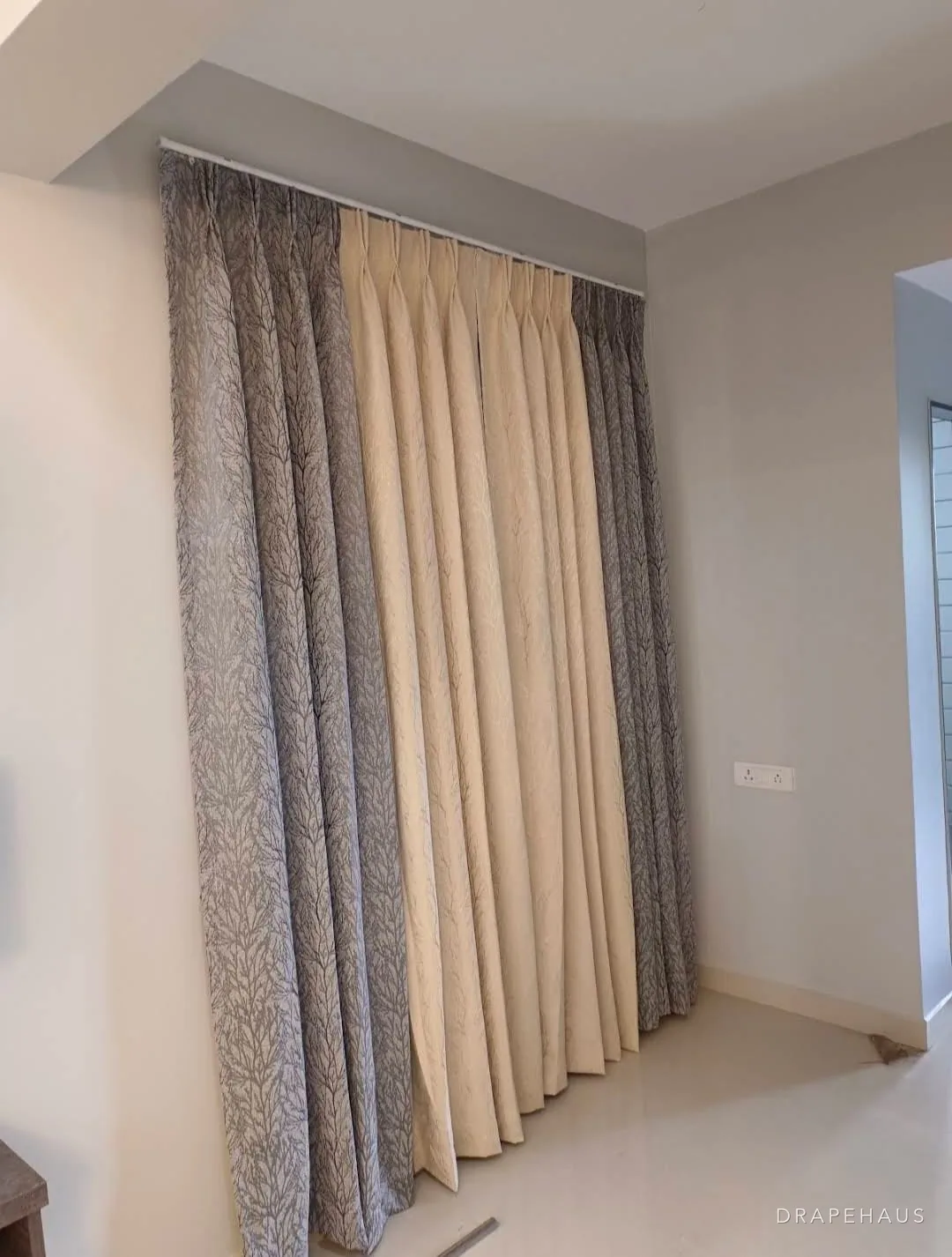
Drape Haus
Preparing the room
Drape Haus
Preparing the room
Curtains
Pinch pleats, goblets, box pleats and pencil pleats: headings that are sewn into the curtain rather than gathered on the day. Pleated curtains hold a tailored shape from top to hem and suit tall windows, formal rooms and the high ceilings of older Goan houses.
Lined · Midday
Treatment
Time of day
A lining protects the face fabric from sun and salt, and makes the curtain properly private at night.
In short
By the Drape Haus studio · How we write
Is it right for you?
Pleated curtains are the traditional made-to-measure curtain. The heading is sewn before the curtain leaves the workroom, so it arrives with its folds fixed rather than relying on how someone bunches a tape on the day of fitting. That gives a precise, repeatable shape, and a curtain that looks equally composed open or closed.
They suit rooms that reward a tailored finish: a drawing room with high ceilings and tall timber windows, a main bedroom that needs a curtain closing tight to a ceiling track, a dining room that is used for occasions. They also make the most of heavier fabrics — lined linens, cotton blends, jacquards — whose weight shows off a well-formed pleat.
They are less suited to a breezy, informal room where a relaxed eyelet or unlined sheer feels more natural, and to motorised or very contemporary schemes where a uniform ripple-fold wave reads cleaner. A pleated curtain also takes more fabric and more workroom time than a simple heading, which is worth knowing before choosing it for every window in the house.
The details
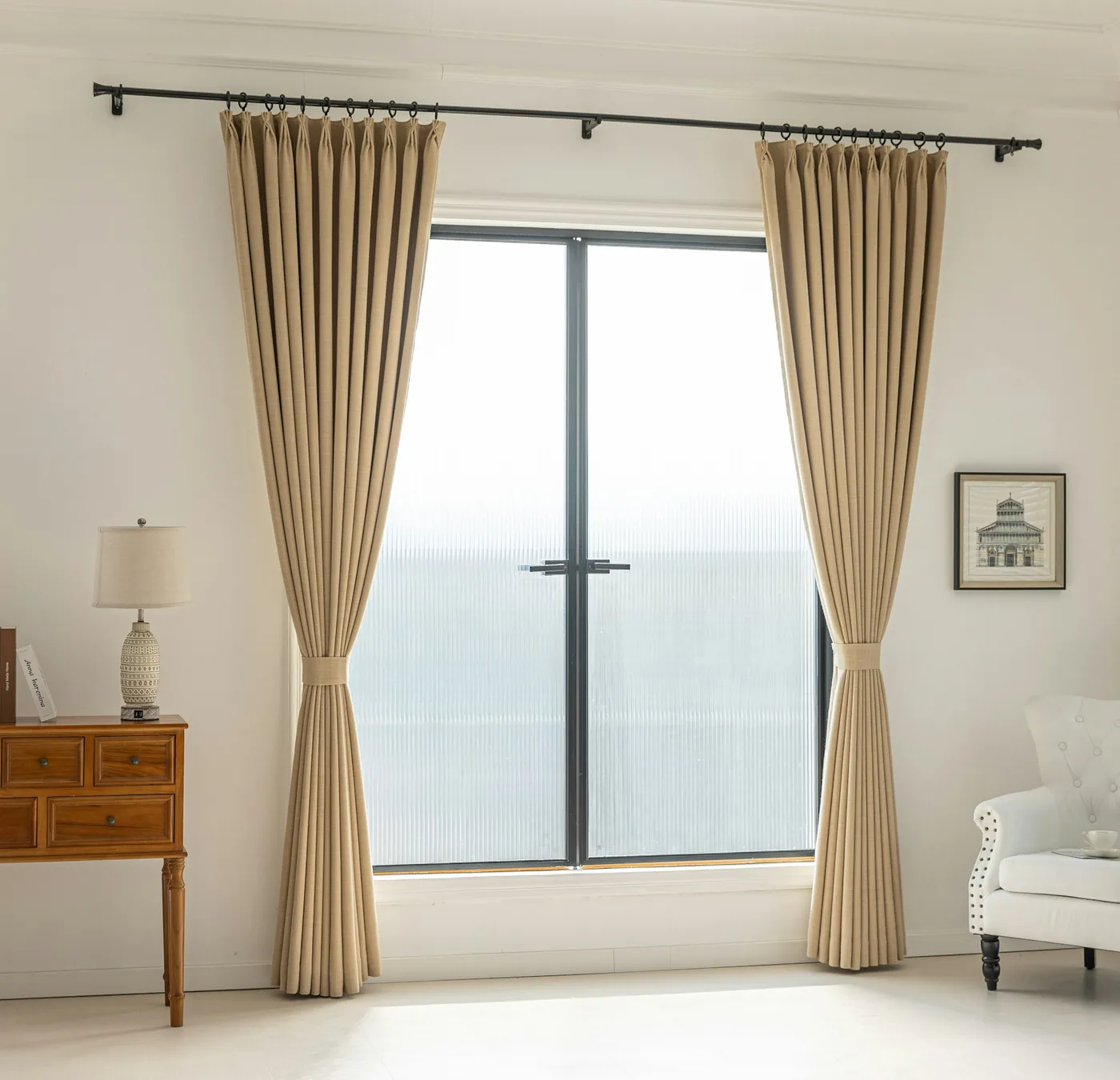
A pleated heading is built, not gathered. A band of stiffening is sewn behind the top of the curtain, the fabric is folded into pleats at measured intervals and each pleat is stitched in place. Hooks then sit behind every pleat, so the curtain hangs from a track or from rings on a pole with the folds already decided.
The style of pleat sets the character of the room. A triple pinch pleat is crisp and classic; a double pinch is softer and more relaxed; a goblet pleat is grand and best seen from below; a box pleat is flat and architectural; a pencil pleat is the simple, gathered option. We help choose by the room, the ceiling height and how often the curtain will be drawn.
In Goa the stiffener matters. Buckram that is perfect in a dry climate can soften in the monsoon and let the pleats droop. We use stiffeners that tolerate humidity and size the pleats for the fabric weight, so a heavy lined curtain does not drag its heading forward.
Because the heading is fixed, the stack is compact and predictable, and a pleated curtain on a ceiling-fixed track can close right up to the ceiling — useful in a bedroom where light over the top would otherwise wake someone.
Your options
The pleat is the decision. Each style takes up fabric differently, stacks differently and sets a different tone, so we choose it by the room before we choose the fabric.
Swipe for all 6 →
The honest view
A shape that does not drift
The pleats are stitched, so the folds sit in the same place year after year. There is no re-dressing after every wash or every guest.
Closes tight to a ceiling track
Hooks behind the pleats let the heading sit right up against a ceiling track, so very little light passes over the top in a bedroom.
Works on a track or a pole
The same curtain can hang from gliders on a track or from rings on a pole, which gives more freedom than an eyelet heading.
Shows off good fabric
Heavier, lined fabrics fall into deep, rounded folds below a pinch pleat. It is the heading that most flatters a quality cloth.
More fabric and making
Each pleat takes up fabric, and every one is formed and stitched by hand. A pleated curtain costs more to make than a simple heading of the same size.
Stiffener sensitive to damp
If the backing is wrong for the climate, pleats can soften and droop in the monsoon. The material choice matters more here than in a dry climate.
Less forgiving to wash
Lined pleated curtains rarely wash well at home. Plan on professional cleaning, especially before a house is closed for the season.
Side by side
Most people choosing a pleat are weighing it against an eyelet heading, a ripple-fold wave or a simple gathered tape.
| Pinch pleat | Eyelet | Ripple fold | Pencil pleat | |
|---|---|---|---|---|
| Look | Tailored, classic | Relaxed, modern | Uniform, hotel-like | Gathered, informal |
| Hardware | Track or pole with rings | Pole only | Dedicated track | Track or pole |
| Light over the top | Minimal on a ceiling track | Spills over pole | Minimal on a ceiling track | Some |
| Fabric used | More | Moderate | Moderate | More |
| Stack-back | Compact | Wide | Very compact | Moderate |
| Ease of home washing | Limited if lined | Good | Good | Good |
| Suits heritage rooms | Very well | Sometimes | Rarely | Sometimes |
Swipe to compare →
In a formal room with tall windows, a triple pinch pleat on a ceiling track is the safest choice. In a minimal room, consider ripple fold instead.
Rather see it in your own room?
We bring samples to the house, measure every window, and specify for the light and exposure you actually have.
Room by room
The natural home of the pinch and goblet pleat. Full-height, lined pleated curtains give a heritage room the weight it is built for.
A pinch pleat with a blackout lining on a ceiling track closes right up to the ceiling, which helps keep the room dark at dawn.
Goblets or triple pinches suit a room used for occasions. Keep fabrics clear of the floor so they stay clean.
Pleats hold their form over a very long drop better than gathered headings. Use a track rated for the weight, and consider a motor or draw rod.
A box or cartridge pleat in a plain fabric gives a quiet, orderly look that does not compete with bookshelves.
Lined pleats absorb cooking smells and are fiddly to clean. A blind or a light, washable curtain is more practical.
Wind and salt work hard on a heavy pleated curtain left open to the sea. Use a synthetic-rich fabric and a protected track, or choose a lighter heading.
In depth — tap a heading to read
Fullness is the ratio of flat fabric width to the width the curtain covers when closed. Pleated headings take up more fabric than most, because each pleat folds several centimetres of cloth into the heading. Too little fullness and the pleats stand far apart, leaving flat stretches between them; too much and the stacked curtain becomes bulky and heavy on the track.
Pleat spacing follows from it. We calculate the number of pleats so the spaces between them are equal and each curtain ends with a flat return at the edge that wraps to the wall. On a pattern, the pleats are positioned so the motif sits centrally in each space rather than being folded away.
Equal spaces, full returns at the ends, and the pattern placed between pleats — these three details make a pleated curtain look tailored.
Pleats keep their shape because of the stiffening sewn into the heading, traditionally buckram. In a dry climate almost any buckram behaves. In a Goan monsoon, with humidity sitting high for months, a starch-based or loosely bonded stiffener softens, and pleats begin to lean forward or fold over.
We use synthetic, humidity-tolerant stiffeners, stitch the pleats firmly at the base and, for heavier curtains, add a little more depth to the heading so it carries the weight below it. In houses that are closed for months, a curtain left drawn and still is more likely to hold its shape than one bunched tightly against a damp wall.
Every pleat carries a hook. On a track, the hook position sets whether the heading hides the track or sits below it: set high, the fabric covers the profile; set low, the track shows. With a ceiling track we usually set the hooks so the top of the curtain sits close to the ceiling, closing off light. On a pole, the hooks drop into small eyes on the rings and the curtain hangs just below the pole.
Pleated curtains need gliders or rings sized for their weight, and enough of them — one per pleat plus one at each end. A heavy lined pleat on undersized gliders will drag and wear the track. Near the sea, choose an aluminium or coated track and stainless or plastic-lined rings so nothing rusts behind the heading where it cannot be seen.
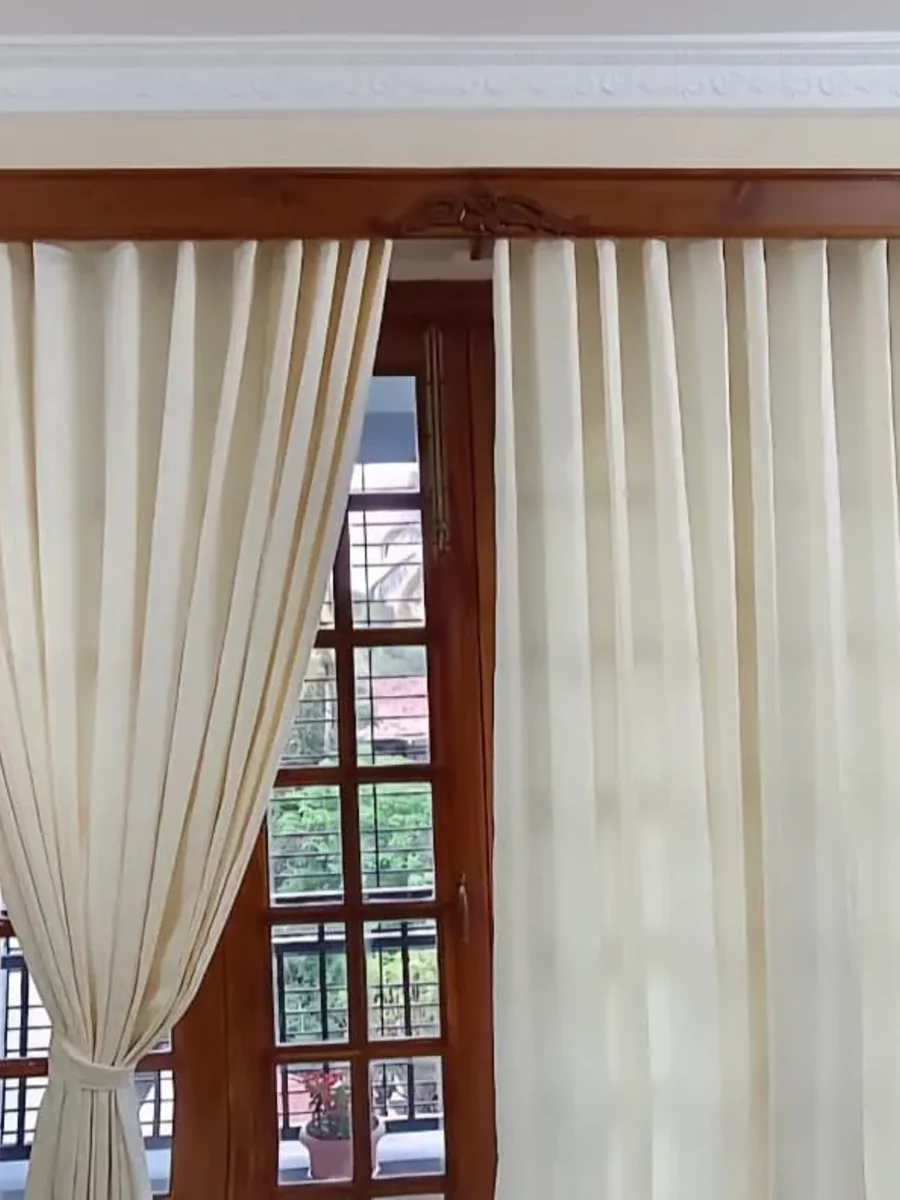
Older houses often have ceilings far higher than modern flats and windows that rise close to them, sometimes with a timber pelmet or a carved frame above. A pleated curtain suits that scale. Hung from a track close to the ceiling, it draws the eye upwards and makes the most of the height.
Long drops increase the weight on the heading and the effect of humidity on the fabric. We allow for a natural fibre to drop slightly in the wet months, choose blends where an exact length matters, and space the pleats a little closer on very tall curtains so the heading stays even under load.
Most pleated curtains are lined; the lining gives body to the folds and protects the face fabric from sun. A blackout lining adds darkness for a bedroom. Unlined pleats are possible in light fabrics, but without a lining the heading backing can show through as a pale band when the sun is behind it.
We avoid interlining in Goa. The extra layer looks luxurious in a cold climate but holds moisture through the monsoon and makes a curtain heavy and slow to dry. A good lining gives most of the drape with none of the damp risk.
Living with it
Dust gathers in the tops of pleats. A soft brush attachment every few weeks keeps the heading clean and stops dust holding damp.
Face and lining can shrink at different rates. Have lined pleated curtains cleaned professionally rather than machine washed.
After hanging or cleaning, draw the curtain open and run your hand down each fold, then tie it loosely for a day or two to train it.
On a dry day, open the windows and leave the curtain loosely stacked so air reaches the heading.
Replace any glider or ring that has cracked or stiffened. A missing glider lets a pleat sag and pulls the ones beside it.
Avoid these
Pleats lean and fold over in the monsoon. Specify a humidity-tolerant stiffener.
Pleats end up far apart with flat fabric between them. Allow the proper fabric width for the style.
Goblet pleats crush when stacked repeatedly. Keep them for dress curtains or rarely drawn windows.
Heavy lined pleats drag and wear the track. Match gliders and track to the weight.
If pleats are not planned around the motif, the print disappears into the folds. Position pleats between motifs.
Checklist
More in curtains
Curtains measured on site, cut to the window and specified for what it actually faces — from airy sheers on a veranda door to full blackout in a bedroom that catches the sunrise.
From the Journal
All articlesOur process
One team from the first visit to the last bracket, so nothing is lost between the person who specified it and the person who fits it.
FAQ
A curtain whose heading is gathered into small groups of two or three folds, stitched together at the base. The groups are spaced evenly across the top, giving a tailored, classic heading that falls into regular folds.
Either. On a track the heading sits just below or in front of the profile and hides it; on a pole the curtain hangs from rings so the pole stays on show. A ceiling track gives the cleanest, darkest result.
Usually the stiffener has softened in humidity, or the pleats are spaced too far apart for the fabric weight. A humidity-tolerant backing and correct pleat spacing prevent it.
Generally more than an eyelet or ripple-fold curtain, because fabric is taken up in each pleat. The exact fullness depends on the pleat style and how full you want the folds.
Some light, unlined ones can, gently. Lined pleated curtains are usually better cleaned professionally, because washing can shrink the face and lining at different rates.
Neither is better overall. Pinch pleats are tailored and work on tracks, including ceiling tracks; eyelets are relaxed, easy to draw and need a pole. For a formal room or a dark bedroom, choose pinch pleats; for a casual room drawn many times a day, eyelets suit well.
A pinch pleat is sewn into fixed groups of folds at set intervals. A pencil pleat is gathered on a tape into many narrow folds and can be adjusted. Pinch pleats look more tailored and hang more regularly; pencil pleats are simpler and less formal.
Yes, on a motorised track with gliders. Ripple-fold headings run more evenly on motors, but a pinch pleat curtain motorises well if the track and motor suit its weight.
A double pinch or cartridge pleat can. Avoid heavy goblets in a small room, and keep the stack compact by ceiling-fixing the track and extending it a little past the window.
Next step
Pleat style is easiest to judge at full height, against your own walls and light. We visit, measure the window and ceiling, check the track or pole position and bring heading samples and fabrics so you can see a pinch, a goblet and a box pleat side by side. We then specify the fullness, stiffener, lining and track together and make the curtains to those measurements. Book a home visit to start.