 Drape Haus
Church curtains and drapes do several jobs at once. Behind and around the sanctuary they frame the altar and focus attention. At the windows of a tall nave they control the glare and heat of the afternoon sun. In the sacristy, the confessional and the parish hall they give privacy and divide space. And on feast days they carry much of the decoration that turns an ordinary Sunday into a celebration.
Goa's churches and chapels add particular demands. Many are tall, with high windows and arches that no ladder reaches comfortably. Candles and oil lamps burn close to the sanctuary. The monsoon brings months of air at or near saturation, and a building that is open only for services can stay damp for weeks. Fabric that is not chosen, hung and stored with those things in mind will be scorched, faded or mildewed within a few seasons.
This guide covers the practical side: what each kind of church textile is for, how colour is used through the year, fire safety near flames, hanging systems for tall spaces, sun and sound, and keeping fabric clean and dry. We make and fit drapes, curtains, blinds and tracks for churches, chapels and parish halls through our commercial and hospitality service. We do not make vestments or embroidered altar linens; for those, parishes should go to a specialist.
The fabrics a church uses, and what each is for
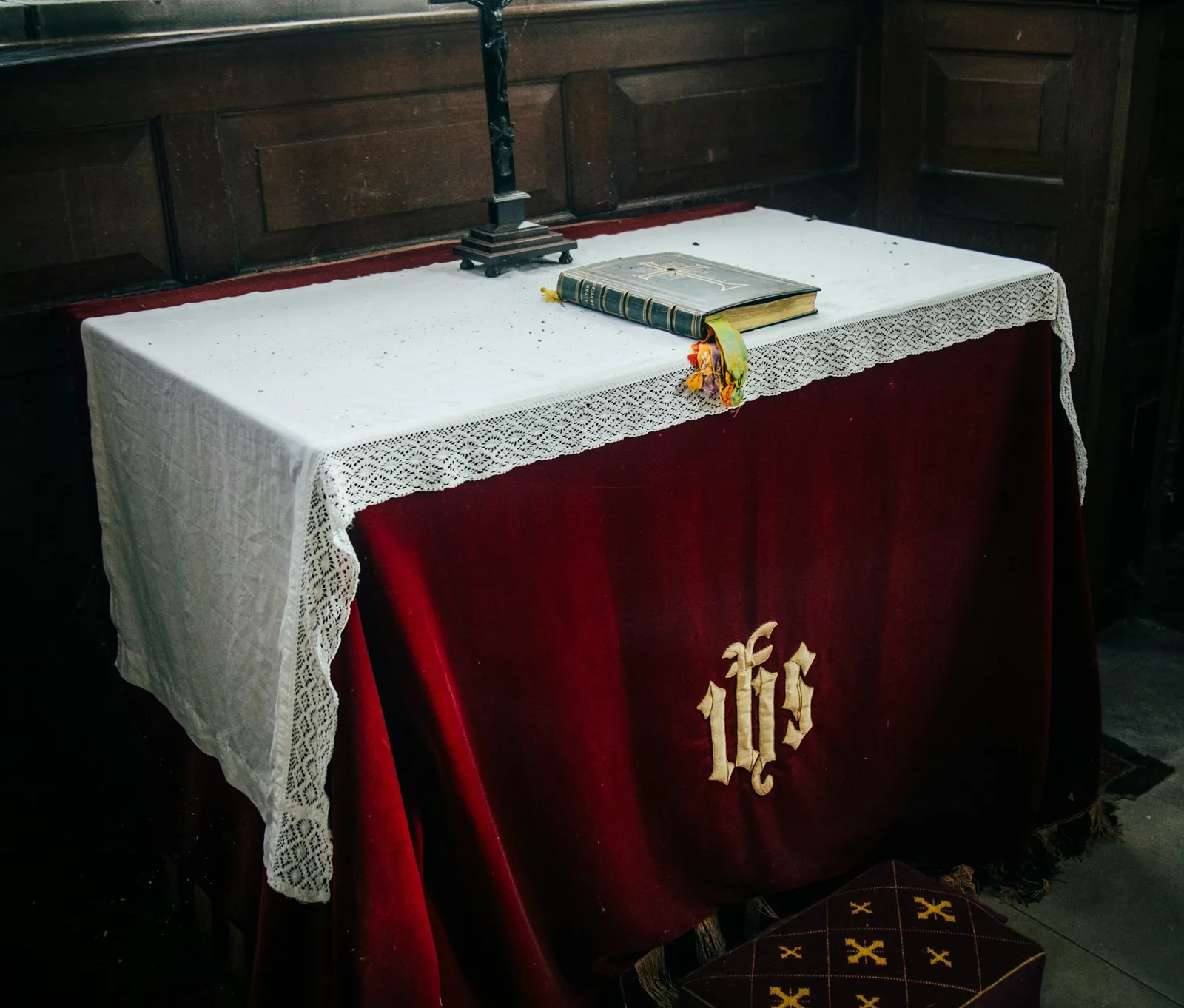
On the altar itself, the General Instruction of the Roman Missal, the Church's governing text for the Mass, asks for at least one white cloth, its shape, size and decoration in keeping with the altar's design. Many churches also use a frontal, sometimes called an antependium, a decorated panel hanging in front of the altar. These are liturgical linens and are usually made by specialist embroiderers and church suppliers.
Behind and around the sanctuary hang the larger drapes: a backdrop curtain behind the altar or the crucifix, side drapes framing an arch or a reredos, and sometimes a valance across the top. These are the pieces most often renewed and the ones a soft-furnishing workroom makes. Further back come the practical curtains: in the sacristy, at the confessional, across a doorway to a side chapel or store, and at the windows. The parish hall, where feasts, meetings and tiatr performances happen, has its own stage curtains, which our guide to stage curtains covers.
The GIRM also notes that furnishings admitted into a church should be worthy and suited to their purpose. In practice that points to fabrics with weight and quality, hung so they fall cleanly, and made to be cleaned and repaired rather than replaced every few years.
- Altar cloth and frontal: liturgical linens, usually from specialist suppliers
- Sanctuary backdrop and side drapes: framing the altar, cross or reredos
- Valances and swags: finishing the top of an arch or a drape
- Sacristy, confessional and doorway curtains: privacy and division
- Window curtains and blinds: glare, heat and fabric protection in the nave
- Parish hall stage curtains: performances, feasts and meetings
Liturgical colours and changing drapes through the year
The GIRM sets out the colours of vestments through the year. White is used in the Easter and Christmas seasons and on many feasts; red on Palm Sunday, Good Friday, Pentecost and the feasts of martyrs and apostles; green through Ordinary Time; violet in Advent and Lent; and rose, where it is the practice, on the third Sunday of Advent and the fourth Sunday of Lent. On more solemn days, more precious festive vestments may be used even if not of the colour of the day.
Those rules govern vestments, not curtains. Many parishes echo the season in hangings, frontals or small panels, and many keep their large sanctuary drapes neutral all year. Practice varies from church to church, so the parish priest should decide what is wanted before anything is ordered.
If drapes are to change with the season, design for it from the start. A neutral backdrop in cream, gold or soft white stays up all year, and seasonal colour is added with lighter panels, a valance or banners hung on a separate track or on hook-and-loop fixings. That way the heavy, expensive drape is made once, and the seasonal pieces are small enough for volunteers to change, wash and store.
| Colour | Used for |
|---|---|
| White | Easter and Christmas seasons; feasts of the Lord (other than of his Passion), of Mary, the Angels and Saints who were not martyrs |
| Red | Palm Sunday, Good Friday, Pentecost, celebrations of the Passion, Apostles, Evangelists and martyrs |
| Green | Ordinary Time |
| Violet or purple | Advent and Lent |
| Rose | Where it is the practice, Gaudete and Laetare Sundays |
Planning something like this?
We visit homes across North and South Goa, measure on site, and bring samples to see in your own light.
Fire safety near candles and oil lamps
Candles are required at every liturgical service, and the GIRM asks for them to be placed on or around the altar. That puts open flames close to fabric in every church. The US Fire Administration's household guidance is to keep candles at least 12 inches, about 30 cm, from anything that can burn, in stable holders where they cannot be knocked over. In a church, with drafts from open doors, crowds moving past and drapes that sway, more clearance than that is sensible, and drapes should never hang directly above a flame.
Plan the drapes around the candles rather than the other way round. Fix the bottom of side drapes, or use tie-backs, so a breeze through the main door cannot swing them towards the altar candles. Keep valances and swags well above the height of any candle stand. Think about the temporary flames too: the Christmas crib with its lamps, feast-day oil lamps, and the candles people light at side altars and grottoes.
Specify fire-retardant fabric for anything that hangs near flames or in a crowded space. There are two routes. Inherently fire-retardant fabrics are made from fibres that resist flame for the life of the fabric, even after washing. Treated fabrics have a finish applied that can weaken with repeated cleaning. Ask for the test documentation for the exact fabric and keep it on file, and ask the local fire officer what applies to your building. The Bureau of Indian Standards publishes the National Building Code of India, and the fire authorities decide what a public building must meet; we specify fabric to that requirement but do not describe a fabric as certified unless its paperwork says so.
Drapes should never hang directly above a flame. Tie or fix the bottom of side drapes so a draught from the door cannot swing them towards the candles.
Sun, glare and heat on tall church windows
Many churches have tall windows on the side walls, and in Goa a west-facing wall takes the hard afternoon sun through evening services and feast-day vespers. The glare falls across the congregation and the heat builds in a building with high ceilings and limited air movement. Modelling for the US Department of Energy by Lawrence Berkeley National Laboratory found that in cooling-dominated climates, all the window attachments it studied saved energy, so shading those windows helps comfort as well as sightlines.
On plain glass, roller blinds in a sunscreen fabric cut glare while keeping a view of the sky, and can be motorised on windows nobody can reach. Vertical blinds suit very tall openings because the louvres can be turned through the day. Curtains on the side windows soften the nave but add fabric to clean and store. Stained glass is a different matter: it is meant to be seen with light through it, and covering it from inside rarely makes sense.
The sun also takes its toll on the fabric already in the church. The Canadian Conservation Institute explains that light fades colours and ultraviolet weakens natural fibres such as cotton, silk and wool, and that the damage is cumulative. Banners and altar frontals near sunny windows fade and weaken first. Shading the windows, rotating seasonal pieces, and storing them in the dark between uses all extend their life.
Fabric and church acoustics
Most churches are hard, reflective rooms: stone or tiled floors, plastered walls, high ceilings and wooden pews. That reverberation is part of how sacred music sounds in a church, and it is not something to eliminate. It can also make the spoken word hard to follow, especially for older parishioners at the back.
Heavy fabric absorbs sound, mostly at speech and higher frequencies, while thin sheers do very little. A large, full drape behind the sanctuary or on a rear wall softens echo noticeably without changing the character of the building. Over-draping does the opposite, deadening the choir and the organ. For any significant change to how a church sounds, ask an acoustic consultant; fabric is one tool among several, alongside the sound system and the placement of speakers.
Washing, mildew and monsoon storage
A church that is open only for services spends much of the monsoon closed, and IMD's normals put Panjim's morning humidity at 91% in July, August and September. Heavy drapes hanging in still, saturated air are where mildew starts, especially at the hem and the back face against the wall. Open the church on dry days, run the fans, draw curtains back so air reaches both sides, and keep the bottom of every drape clear of a floor that may be damp.
Choose fabrics with cleaning in mind. Polyester and inherently fire-retardant fabrics usually wash well; velvets and heavy weaves often need professional dry cleaning, which is harder to arrange for very large pieces. If a drape gets wet from a roof leak or driven rain, dry it quickly: the US Environmental Protection Agency notes that drying damp materials within 24 to 48 hours usually prevents mould.
For seasonal pieces and anything taken down for the monsoon, clean before storing, because stains and food for mould set in storage. Make sure the fabric is completely dry, fold it loosely or roll it on a tube with acid-free tissue or clean cotton between layers, and store it in breathable cotton bags, never sealed plastic, in a dry room off the floor. Label each bag with the piece and the season. Our monsoon take-down and storage service handles this for buildings that would rather not manage it themselves.