 Drape Haus

A magnetic mosquito net is a sheet of soft mesh with magnetic strips along its edges that stick to a matching strip fixed round the window frame with adhesive tape. A velcro net does the same with hook-and-loop tape. For doors there is a third kind: a mesh curtain split down the middle, with small magnets along the centre seam that snap it shut after you walk through. All three are designed to be put up by the owner, without drilling, in an hour or two.
They work, within limits. On a smooth, clean aluminium or uPVC frame, on a window that is rarely opened, in a sheltered spot, a magnetic net can keep mosquitoes out for a season or longer. On a painted timber casement in a sea-facing room, opened every evening through the monsoon, it usually starts lifting at a corner within weeks.
This guide explains why, compares DIY nets with fitted sliding and pleated screens on the things that matter in daily use, and is honest about when a magnetic net is all you need.
How magnetic and velcro nets attach to a window or door
A window kit has two parts. The first is a strip, either thin steel or magnetic tape, or the hook side of a hook-and-loop tape, with adhesive on the back. You stick it round the outside of the window frame. The second is the mesh panel, cut slightly larger than the opening, with magnetic strips or the loop side of the tape along its edges. Press the panel to the frame and it holds. Peel it off to clean the glass or wash the mesh.
Everything depends on the adhesive. The magnets or the hooks are strong enough; the weak point is the bond between the tape and your window frame. That bond is made once, on the day you fit it, and it has to survive every peel, every gust and every humid night afterwards.
A magnetic door curtain is different. It hangs from the top of the door frame, usually by adhesive hook-and-loop strip or pins, as two vertical halves. Weights in the hem pull it straight, and magnets down the centre pull the halves together. You walk through it with full hands and it closes behind you. That convenience is real, which is why it is a common first try for a kitchen door to a yard.
Why adhesive fails in humid air and on painted or laterite frames
Adhesive tapes need a clean, dry, smooth and sound surface to bond to. Many Goan window frames offer only some of those. The India Meteorological Department records morning humidity of 87–91% across Goa from June to September, and even from November to May mornings run at 71–79%. A frame wiped down on a humid morning is rarely dry enough for a lasting bond.
Painted frames are the next problem. The tape bonds to the paint, not the timber, so the bond is only as good as the paint's grip. Old paint on a Goan casement, softened by years of monsoon, often comes away with the tape the first time the net is peeled off for cleaning. Timber also swells and shrinks with the seasons, which works the edge of the tape loose. Powder-coated aluminium and uPVC are the best surfaces for adhesive tapes, which is why the kits do best in newer flats.
Laterite and lime-plastered reveals are the worst. They are rough, porous and often dusty, and tape simply does not hold on them. If your window has no smooth frame of its own, a magnetic net has nothing to stick to, and a screen on its own sub-frame is the answer that will last. Our guide to laterite and old walls explains why fixings behave differently in these walls.
Fit adhesive strips on a dry day, on a clean, smooth frame, and give them time to settle before you first press the mesh on.
Planning something like this?
We visit homes across North and South Goa, measure on site, and bring samples to see in your own light.
Monsoon wind: DIY nets against fitted screens
The IMD describes winds over Goa strengthening from the west and south-west from June to August, with monsoon thunderstorms sometimes accompanied by squalls. Wind is where soft, frameless mesh shows its limits. A gust pushes the middle of the panel inwards and pulls its edges away from the frame. On a magnetic net the magnets let go one by one along the edge; on a velcro net the tape peels. Even when the edges hold, the mesh billows and sags, and a sagging net leaves gaps at the corners.
A magnetic door curtain is affected even more. A through-draught pushes the two halves apart, and the centre seam does not close again until the wind drops. In a monsoon squall it flaps open and stays open.
Fitted screens deal with wind through their structure. A sliding window net has its mesh stretched in a rigid frame that runs in a track, with anti-lift blocks so it cannot be blown out. A pleated net is held top and bottom in guides, with cords through every fold. Neither is meant to hold back a storm, and the habit with any screen is to close the glass in bad weather, but both stay square and sealed through ordinary monsoon gusts, which is what decides whether you can sleep with the window open.
Daily use: windows behind the net, pets and children
The question most people do not ask before buying a magnetic net is how they will open and close the window behind it. On a sliding window, you can usually reach past the net. On a casement that opens outwards, the net is on the inside of the frame, so to reach the handle you have to peel back a corner, every time. After a few weeks of that, the corner stops sticking properly, or the net is left half off. A fitted pleated or roller screen solves exactly this: you draw it back, open the window, and draw it across again.
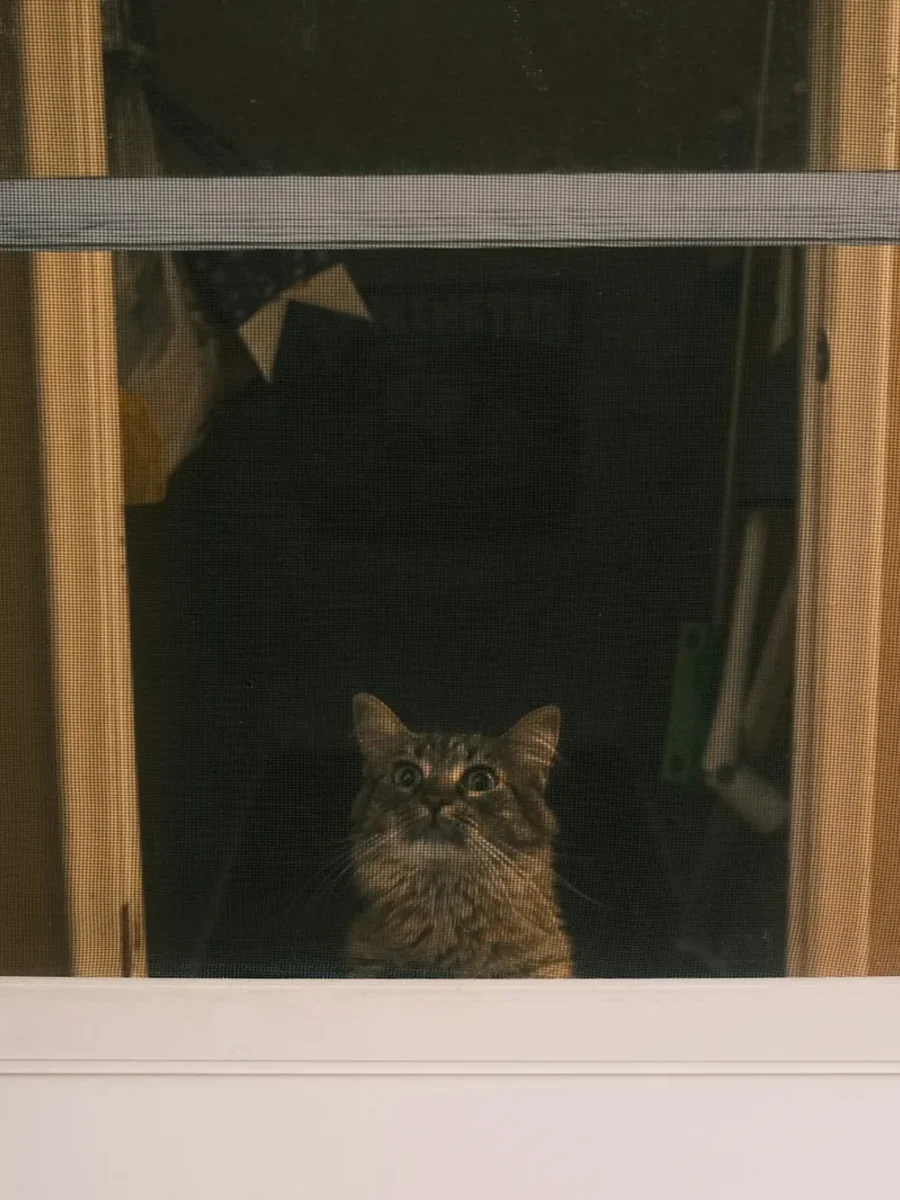
Pets learn quickly that soft mesh gives. A cat will claw at it, a dog will push its nose through the centre seam of a magnetic door curtain and widen it, and both will pull a corner away from its tape. Children treat a magnetic door curtain as a game. Fitted screens are not immune, but a framed panel with pet-resistant mesh, a mid-rail and a latch takes this far better, and when the mesh does tear it can be replaced in the same frame. Remember too that no screen keeps a child in: Safe Kids Worldwide's advice is that screens are meant to keep bugs out, not children in.
Guests are the third test. In a homestay or rental, people unfamiliar with a magnetic net tend to pull it off to open the window and press it back crookedly, if at all. A fitted screen with an obvious handle is used properly far more often.
| Magnetic or velcro net | Fitted sliding or pleated net | |
|---|---|---|
| Installation | By the owner, no drilling | Measured and fixed into the frame or reveal |
| On painted timber or laterite | Holds poorly | Holds, with a sub-frame where needed |
| Monsoon wind | Edges lift, mesh sags | Stays square in its frame or guides |
| Reaching the window handle | Peel back a corner | Slide or draw the screen aside |
| Pets and children | Easily torn or pulled off | Framed, with tougher mesh options |
| When it wears out | Replace the kit | Re-mesh, new rollers or cords |
| Removal | Usually clean, if the paint is sound | Leaves small fixing holes |
What a fitted sliding or pleated system gives you for the extra
A fitted screen costs more than a kit, and it is fair to ask what that buys. The first thing is a frame that is sized and squared to your opening. Goan windows, especially in older houses, are rarely perfectly square, and a fitted frame is packed to follow the wall so there are no gaps at the corners. A kit assumes a square opening and a flat frame.
The second is independence from the window. A sliding net runs in its own track beside the glass, so the window and the net each move freely; a pleated net folds away to the side. Neither has to be peeled off to use the window. The third is serviceability. Mesh, rollers, brush seals and cords are replaceable, and a well-made frame can be re-meshed several times; our net repair and re-meshing work exists because of this.
The fourth is planning. A fitted net can be placed so it does not clash with the curtain track, blinds or window grilles, and so the curtain still draws in front of it. A magnetic net taped round the frame often sits exactly where the curtain hangs. Our sliding nets page explains how we plan nets and curtains together.
When a magnetic or velcro net is perfectly adequate
There are plenty of cases where a DIY net is the right call. A rented flat where you cannot drill is the obvious one; our guide to no-drill rentals covers other ways to furnish without fixings. A smooth aluminium or uPVC window that is rarely opened, in a room used now and then, is another. So is a short stay, a trial to see whether a room really needs screening, or a single window that lets mosquitoes into an otherwise screened house while you wait for a fitted net.
A magnetic door curtain earns its place on a narrow, sheltered back door with light traffic, where walking through with full hands matters more than a perfect seal. It is less suited to a main door, a windy balcony door or any door a dog uses.
To get the most from a kit, fit it in the dry season on a clean, dry, smooth frame. Cut the mesh generously so it overlaps the frame on every side. Check the corners every week through the monsoon and press back anything that has lifted, before it becomes a gap. Expect to replace it, and treat it as a stopgap rather than a specification.
Gaps matter more than the type of net
Whatever you choose, a net only works if it closes the whole opening. The NCVBDC's vector control compendium describes house screening as a physical barrier that should be placed on all openings, including windows, doors and eaves, along with closing holes and filling crevices. A magnetic net with one lifted corner is, to a mosquito, an open window.
Timing matters too. The World Health Organization notes that the mosquitoes that spread dengue are active during the day, and lists window screens among the ways to avoid their bites. A magnetic door curtain standing open in the afternoon breeze, or a window net peeled back for the day, gives no protection at exactly the hours those mosquitoes bite.
If you are deciding between options for several windows, our guide to the types of mosquito nets for windows sets every type side by side, and our mosquito nets for doors page covers hinged, pleated and sliding screens for the doors where magnetic curtains are most often tried first.