 Drape Haus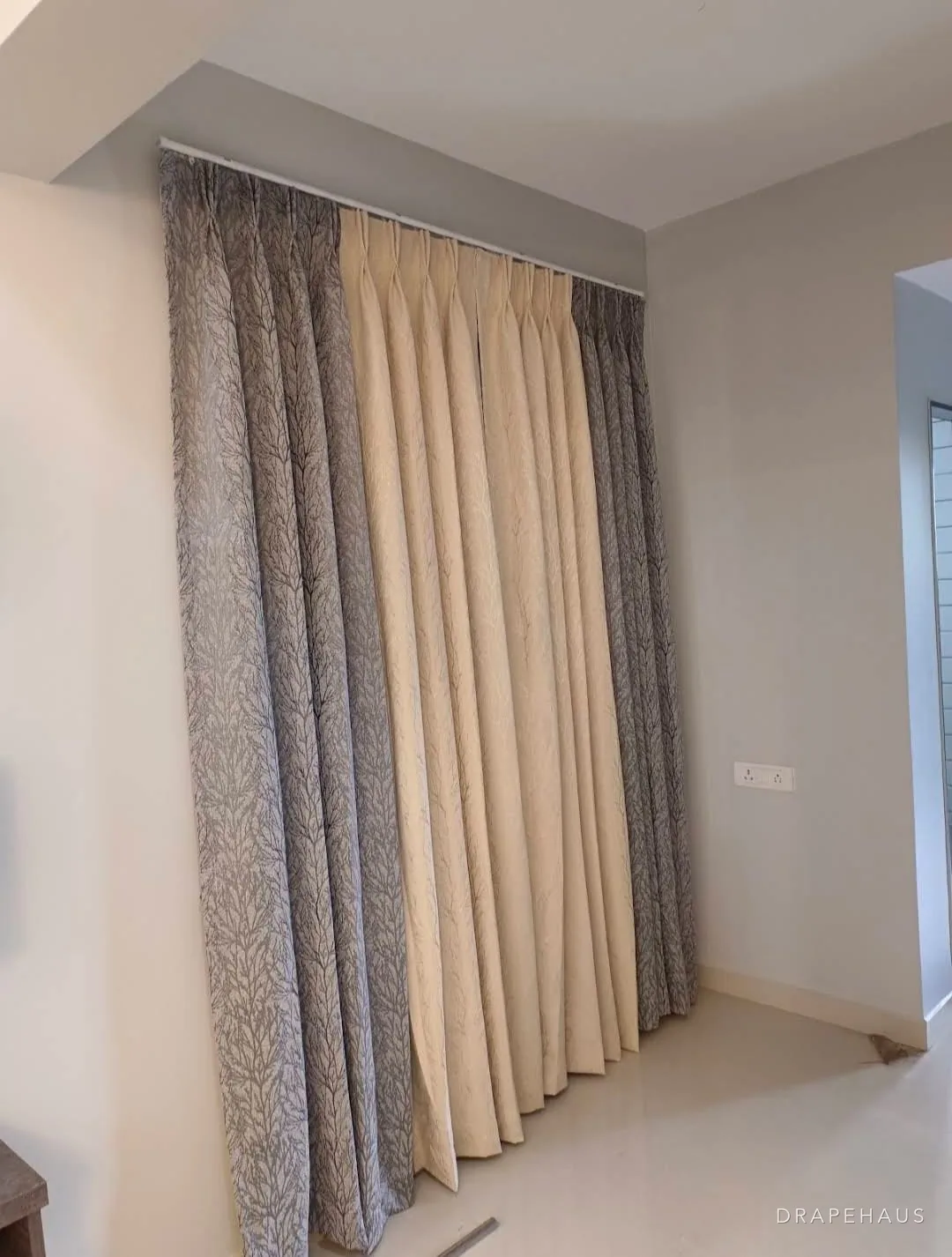
Drape Haus
Preparing the room
Drape Haus
Preparing the room
Curtains
Two curtains working together on one window — two colours, two textures, or two fabrics hung front and back on a double rod. Double curtains are a design decision as much as a practical one, and they look best when the pair is chosen together from the start.
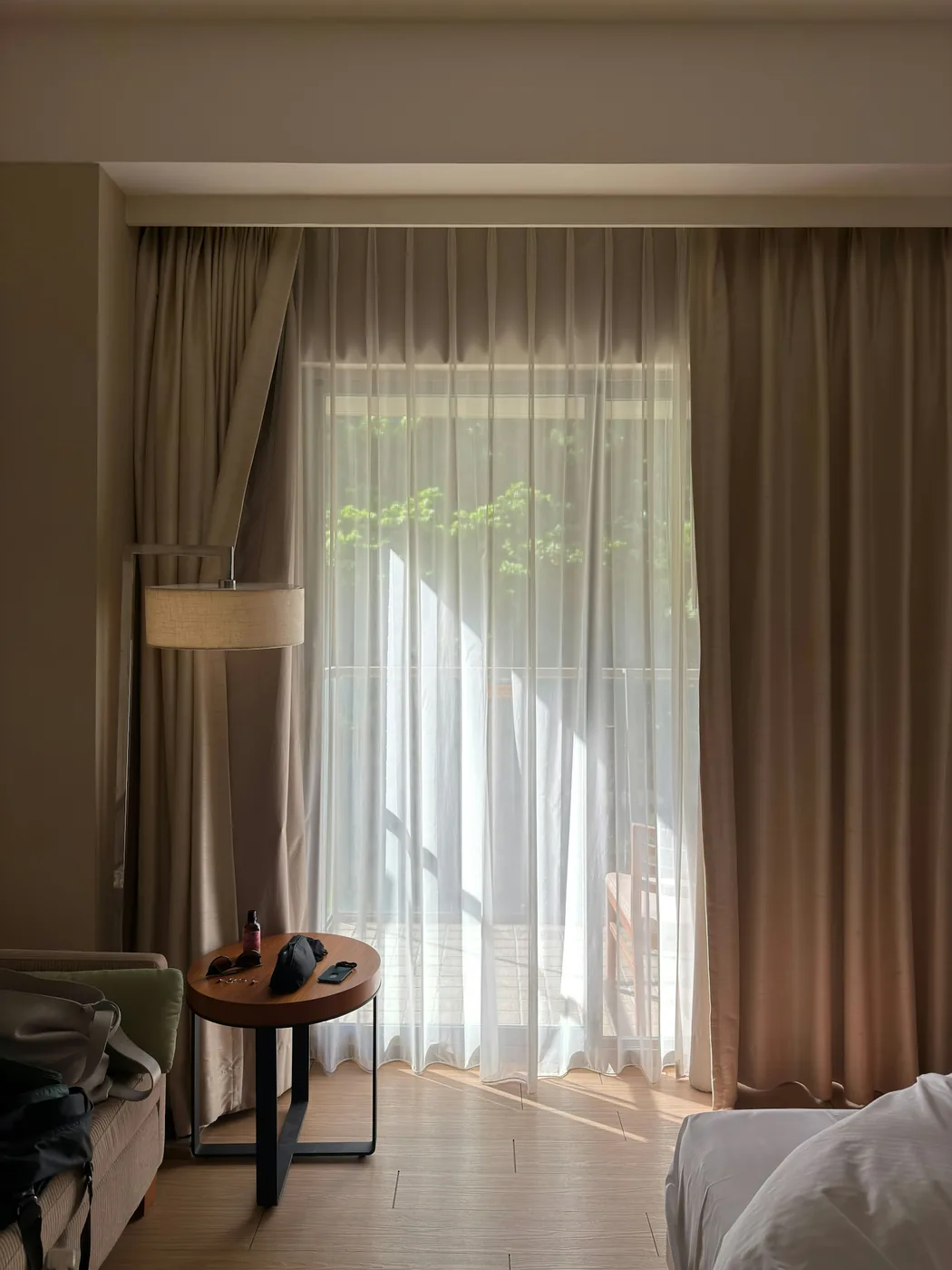
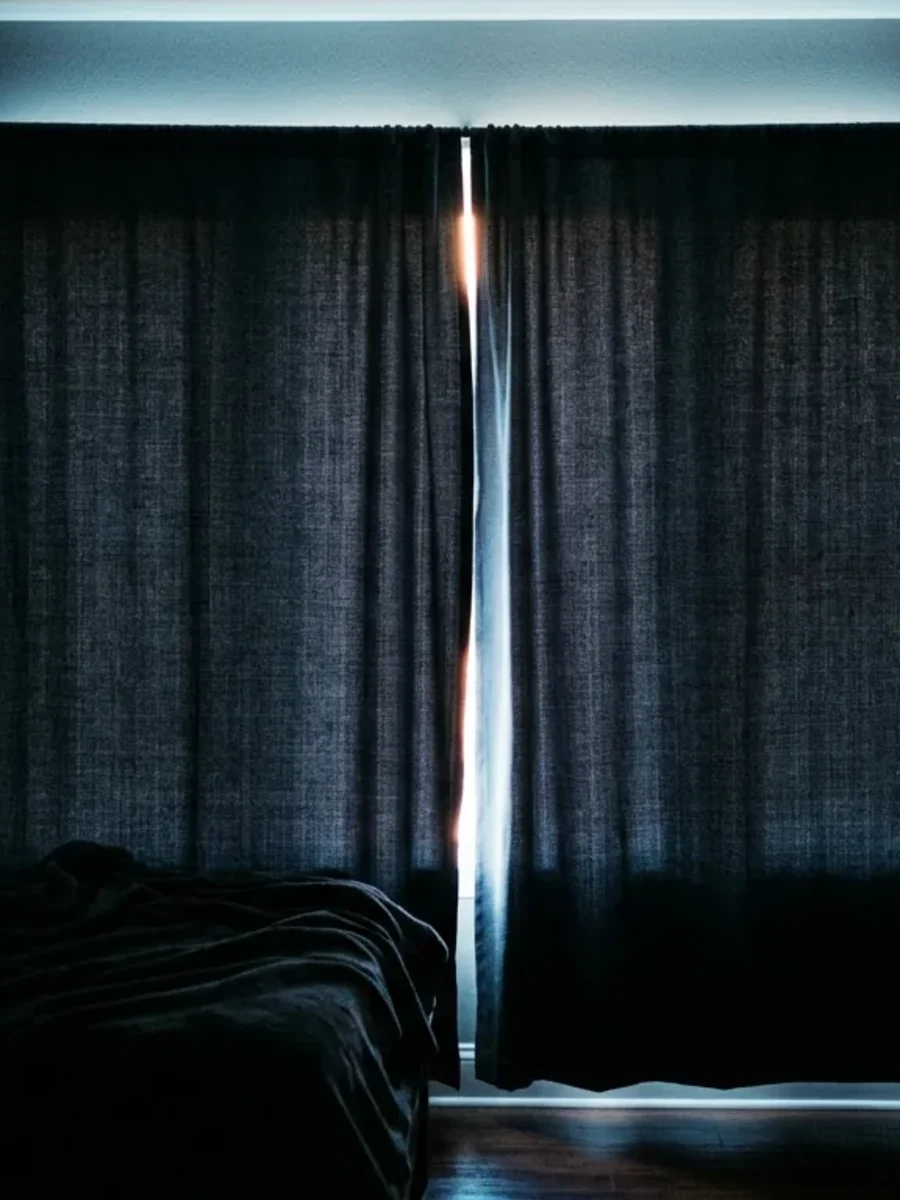
Sheer + blackout · Midday
Treatment
Time of day
Two layers on a double track: the sheer stays drawn for the day, the blackout closes over it at night. The most flexible answer for a bedroom.
In short
By the Drape Haus studio · How we write
Is it right for you?
Double curtains is a loose phrase, and it is worth being clear about which version you want before choosing fabric. One version is a single curtain made from two fabrics: a two-tone panel joined across the width, or a plain curtain with a band of contrast down its leading edge or along its hem. The other is two separate curtains on one window, hung on a double rod or double track, each drawn independently.
Both are styling tools. They let a window carry more than one colour or texture, pick up something else in the room and give the window more presence than a single plain curtain would. They suit living rooms that need warmth, dining rooms that are used in the evening, bedrooms where a decorative fabric sits over a quieter one, and tall windows in older houses that can take the extra fabric.
They are not the answer to every problem. If the brief is purely functional — glare control in the day and darkness at night — a sheer-and-blackout system does that job, and our layered curtains page covers it. And in a small room with a low window, two heavy fabrics can crowd the space. The best double curtains begin with the room, then the pair, then the hardware.
The details
People mean several things by double curtains. Some want two-tone panels: a curtain in two colours joined horizontally or vertically, or a plain curtain with a contrast border down the leading edge. Others want two separate curtains on a double rod — a patterned fabric in front of a plain one, or a heavy drape framing a lighter one. Both are covered here.
If what you need is a sheer by day and a blackout by night, that is a specific two-layer system and our layered curtains page explains it in detail. This page is about the styling side: choosing two fabrics that belong together, setting their proportions and specifying a double rod or double track that carries both without catching.
Two curtains are heavier than one, so the hardware matters. Double brackets must project far enough for both layers to pass, the fixings must take the combined weight, and near the sea both rods or tracks need salt-resistant finishes. We specify the pair, the hardware and the fixing together.
Done well, double curtains give a room depth: a colour picked up from the sofa, a texture that softens a hard tiled floor, a frame of fabric that makes a modest window look taller.
Your options
These are the arrangements we are asked for most. Each uses two fabrics differently, and each has its own hardware need.
Swipe for all 6 →
The honest view
Colour where the room needs it
A second fabric lets the window pick up a tone from the sofa, rug or art, tying the room together in a way one plain curtain cannot.
More flexibility at the window
With two independent curtains you can open one, close the other or frame the window with the front pair while the back one does the work.
Makes windows look grander
Two layers of fabric, hung high and wide, give a modest window more height and presence.
Hides wear on busy curtains
A darker base fabric on a two-tone panel disguises the marks that collect near the floor in family homes and rentals.
Easy to get wrong
Two fabrics chosen separately rarely sit well together. The pair needs to be planned as one decision.
Heavier on the wall
Two lined curtains weigh considerably more than one. Brackets, fixings and the wall itself must carry it.
More to clean and store
Two curtains per window double the washing and the storage before a monsoon closure.
Side by side
Double curtains overlap with layered curtains and with a curtain over a blind. Here is how they differ.
| Two-tone panel | Two curtains on a double rod | Layered sheer and blackout | Curtain over a blind | |
|---|---|---|---|---|
| Main purpose | Styling | Styling and flexibility | Day and night light control | Function with softness |
| Hardware | Single pole or track | Double rod or track | Double track | Track plus blind |
| Weight | As one curtain | Two curtains | Moderate | Moderate |
| Daytime light | As the fabric allows | Depends on back curtain | Soft, through the sheer | Set by the blind |
| Night privacy | Lined panel gives it | Back curtain gives it | Blackout gives it | Blind gives it |
| Best for | Colour accents | Rich, decorated rooms | Bedrooms, living rooms | Deep reveals, hot façades |
Swipe to compare →
Many rooms combine both ideas: a contrast-bordered lined curtain in front and a sheer behind.
Rather see it in your own room?
We bring samples to the house, measure every window, and specify for the light and exposure you actually have.
Room by room
The room most often given double curtains. A decorative front pair framing a plain or sheer back pair adds warmth to a large space with hard floors.
Used in the evening, it benefits from rich fabrics. A pole-over-track arrangement looks formal and stays easy to use.
A contrast-edged blackout curtain in front of a softer fabric gives colour and darkness. Keep the palette calm for sleep.
A two-tone panel with a darker lower band hides fingerprints and wear. Keep cords and tiebacks out of reach.
Two heavy curtains can crowd a small window. A single curtain with a contrast border gives the effect with less bulk.
Two layers of natural fabric hold salt and damp. Use synthetic-rich fabrics and give the window space to breathe.
A hard-wearing two-tone panel adds character with no extra hardware. Avoid delicate front fabrics guests will handle.
In depth — tap a heading to read
Start with what the room already has. Pull one colour from the largest thing in the room — the sofa, a rug, the floor — and use it for one fabric. The second fabric can then be a lighter or darker tone of the same family, a neutral, or a texture rather than a colour. Pairs that share a tone almost always work; pairs that share nothing rarely do.
Scale matters when one fabric is patterned. A large print reads best with a plain partner; a small pattern can sit with a fine stripe or a textured plain. Hold the two fabrics together at the window, in daylight and under the lamps you use at night, before deciding. Colours that match in a showroom can drift apart in strong coastal light.
Choose both fabrics in the same session, at the window. Never buy one and try to match the second later.
On a horizontal two-tone panel, the join should line up with something real: the sill, a dado rail, the top of a sofa back. A join at an arbitrary height looks like a mistake. A common proportion is roughly one third dark below and two thirds light above, but tall windows can carry a deeper band.
Contrast borders should be in proportion to the curtain: too narrow and they look like piping, too wide and they compete with the main fabric. We set the width by the drop and the window size, and make sure the borders meet neatly where the curtains close.
Two separate curtains need two parallel runs of hardware. A double pole has a front and back pole on shared brackets; a double track does the same with hidden profiles; a pole-over-track bracket carries a decorative pole in front of a working track. In each case the gap between the two must allow both curtains, with their folds, to pass without rubbing.
Projection is the measurement most often got wrong. The back curtain has to clear the window frame, handles and sill; the front curtain has to clear the back curtain's folds. Heavier fabrics with deep folds need more projection. We set bracket depth on site after seeing the frame, rather than choosing a standard bracket and hoping. The curtain rod and track planner helps with length; depth is something we measure.
Two lined curtains on one window can weigh as much as a small piece of furniture hanging from a few screws. In laterite and old lime plaster, an ordinary plug can pull out under that load over time. We use resin anchors in old masonry, fix into the slab or concrete lintel where we can, and space brackets more closely than for a single curtain.
False ceilings are the other risk. A double track fixed only into gypsum board will sag. If the ceiling is not yet closed, we ask for timber or metal backing along the track line; if it is, we find the framing or fix down to the slab above.
Two curtains hanging close together trap still air between them. In a humid monsoon, especially in a room closed for weeks, that pocket can stay damp long enough to encourage mildew on the back fabric. Leave the back curtain open on dry days, choose synthetic or blended fabrics for at least one layer near the sea, and avoid heavy pile fabrics on both layers at once.
Living with it
Two fabrics fade and soften at different rates. Cleaning them at the same time keeps them looking like a pair.
On two-tone panels, a dark fabric can bleed into a light one in water. Many joined panels are better cleaned professionally.
In the monsoon, draw the back curtain open on dry days so the space between the layers can dry out.
If the front curtains stay open as a frame, swap them occasionally so both sides fade evenly in the sun.
Once a year, check that double brackets are still tight. The extra weight works fixings loose over time.
Avoid these
Dye lots and light make late matches look wrong. Choose both together.
The two curtains rub and snag. Measure projection for both sets of folds.
A two-tone line that relates to nothing in the room looks accidental. Align it with the sill or furniture.
Strong colour blocks shrink a small space. Use tones or a slim border instead.
A double track in a false ceiling without backing will sag under two curtains.
Checklist
More in curtains
Curtains measured on site, cut to the window and specified for what it actually faces — from airy sheers on a veranda door to full blackout in a bedroom that catches the sunrise.
From the Journal
All articlesOur process
One team from the first visit to the last bracket, so nothing is lost between the person who specified it and the person who fits it.
FAQ
Layered curtains usually mean a sheer and a blackout on a double track for day and night use. Double curtains is the broader styling idea: two-tone panels, contrast borders or two decorative fabrics hung together.
Tones of one colour are the safest; a light and a dark of the same family look calm. Stronger contrasts work when one colour already appears in the room, such as in a rug or the upholstery.
Two separate curtains need a double rod or double track, with brackets deep enough for both. A two-tone panel is a single curtain and hangs on an ordinary pole or track.
They can be. Two lined curtains on a ceiling track need timber or metal backing above the board, or fixings into the slab. We check before specifying.
Not if they are planned well. Keep both fabrics light in tone, mount the rod high and wide, and let the curtains stack beyond the window rather than over it.
Often, yes. A contrast border can be added to existing curtains in good condition, or a second curtain made to hang in front or behind on a new double rod. We check the fabric and fullness first.
Usually the front curtain carries the stronger colour or pattern and the back one is plainer, because the front is seen most. In a bedroom, the back curtain is often the blackout one.
Two layers add some insulation and, with a lined back curtain, cut heat from west-facing glass. For serious heat, a solar blind or external shade does more.
A pair of curtains on a double rod — two poles on shared brackets — so each curtain can be drawn independently. It is one of the two main forms of double curtain.
Next step
Two fabrics only make sense together in the room they are for. We visit, measure the window and the projection the brackets need, check what the wall or ceiling will carry, and bring fabrics so you can see pairs side by side in your own light. We then specify the curtains, the double rod or track and the fixings as one, and fit them complete. Book a home visit to start.