 Drape Haus
Drape Haus
Preparing the room
Drape Haus
Preparing the room
Sofas
A single sofa or a compact 2 seater is the seat a room is built around when there is no space for a full sofa: the reading chair in a bedroom corner, the pair of sofa chairs in a flat's living room, the loveseat in a homestay room. Made to measure, each one is scaled to the corner it lives in and to the person who sits in it most.
Durability scale (Martindale rubs, BS 2543)
15k
20k
25k
30k
40k
Who uses it
Where it lives
How it is used
Durability to ask for
30,000+ rubs
Severe domestic / general contract
Removable covers
Yes
zipped, washable, and a spare set
Fibres that suit
Avoid: Anything you cannot clean in place, on a piece used every day. Rub count is one number among several — weave, colour-fastness and how a fabric handles humidity matter as much. We bring samples to see in your room.
In short
By the Drape Haus studio · How we write
Is it right for you?
Not every room needs a sofa. A bedroom wants somewhere to sit that is not the bed, a study wants a chair for a visitor or for reading away from the desk, and a one-bedroom flat often has space for two good chairs where a three-seater would block the balcony door. In each case a single sofa or a compact two-seater does the job better than squeezing in something larger.
These small seats are also the pieces people use alone and for long stretches. A grandmother reads the newspaper in the same chair every morning; a homestay guest sits in the corner chair with a laptop for an afternoon. That makes the fit of the seat to the person far more important than on a family sofa, where everyone shifts around and nobody sits in one place for long.
Choose a single seater or a small two-seater if you are furnishing a secondary room, adding a reading or conversation corner, or completing a living room that already has a main sofa. If you need one piece to seat a household of four or five in the evening, look at a longer sofa or a sectional instead.
The details
Small seats are judged more closely than big ones. One person sits in a single seater for an hour with a book or a cup of tea, so the seat height, depth, arm height and back angle all matter more than they would on a long sofa shared by the family. We set those dimensions from the people who will use the chair, which makes a real difference for older parents who need a firmer, higher seat to rise from easily.
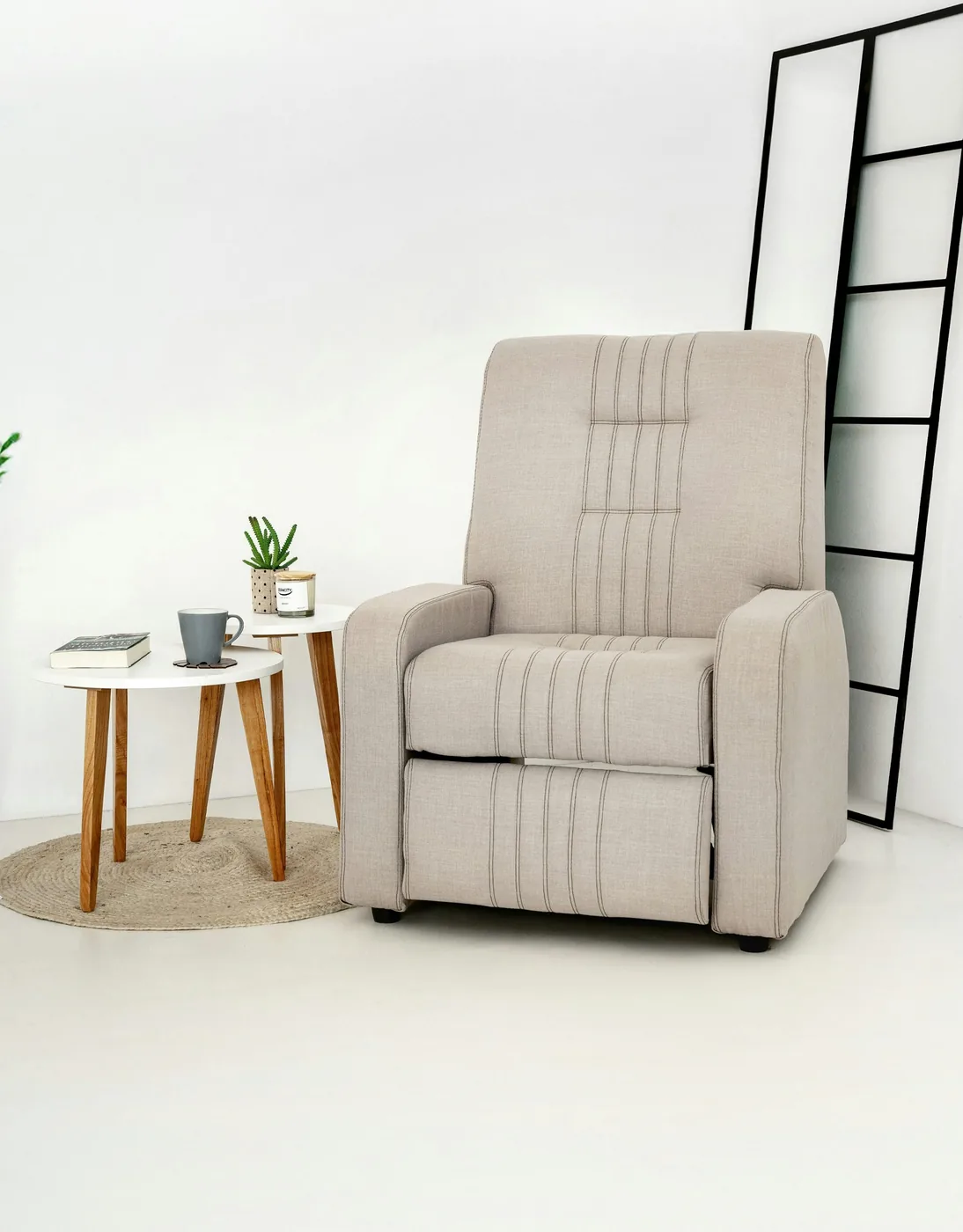
The range runs from an upright accent chair for a hallway, through a deep reading chair and a chair-and-a-half wide enough to curl up in, to a compact two-seater for a bedroom bay or a study. Each is built on a hardwood frame and sized so it passes through the narrow doors and turning stairs common in Goan houses and older flats.
In a humid climate a small chair has one advantage: it is easy to move away from a damp wall and easy to air. We raise most of ours on legs, choose fibre-wrapped foam over feather, and recommend tight-woven synthetic or blended fabrics for coastal homes. You can try colours on screen with our sofa fabric simulator before we bring samples.
If you already own a well-made armchair with a sound frame, reupholstering it may be the better route, and a fitted, washable cover is the practical choice for homestay rooms where guests change every few days.
Your options
The names overlap between makers, so it helps to think about how you want to sit. These are the forms we make most often, roughly in order from most upright to most relaxed.
Swipe for all 5 →
The honest view
Fits where a sofa cannot
A single seater or compact two-seater uses a corner, a bay or the space beside a window that would otherwise sit empty, and it leaves walkways clear in small rooms.
Comfort tuned to one person
Because one person uses it most, the seat height, depth, firmness and arm height can be set precisely for them, which no shared sofa can offer.
Easy to move and air
A small chair can be lifted away from a damp wall in the monsoon, turned towards the light for a season or moved to another room entirely.
Gets into any house
Almost every single seater and most compact two-seaters pass through old narrow doorways and up turning timber stairs without any need for sections.
Limited seating
One or two seats is all you get. For family evenings or guests you will still need a main sofa or several chairs.
Easy to under-scale
In a large room or a tall heritage space, a small chair can look lost. It needs pairing, a rug or a side table to hold its place.
Hard wear on one seat
A favourite chair takes all its wear in one place, so the seat cushion and the front edge need sturdier fabric and fill than an occasional piece.
Side by side
For a corner or a small room, these three are usually the real choice. Here is how they compare on the things that decide it.
| Sofa chair | Chair-and-a-half | Compact two-seater | |
|---|---|---|---|
| Regular sitters | One | One, with room to curl up | Two, close together |
| Floor area | Smallest | Moderate | Largest of the three |
| Reading and lounging | Good with a footstool | Excellent | Fair |
| Matching a main sofa | Easiest | Good | Good |
| Moving it alone | Easy | Manageable | Needs two people |
| Best room | Living room set | Bedroom or study corner | Bedroom bay or small flat |
Swipe to compare →
If the existing sofa is a straight two- or three-seater, see our page on two- and three-seater sofas for sizing the main piece; this page is about the seats around it.
Rather see it in your own room?
We bring samples to the house, measure every window, and specify for the light and exposure you actually have.
Room by room
A reading chair or chair-and-a-half by the window, with a lamp and a small table, gives a place to sit that is separate from the bed and the dressing area.
A firm sofa chair for visitors, or a reading chair for breaks away from the screen. Keep the back upright enough to sit and talk in.
A compact two-seater with one or two sofa chairs often seats as many people as a three-seater while keeping the route to the balcony door open.
A single seater with a removable, washable cover gives guests a seat for working or reading. Choose a mid-tone, tight-woven fabric that hides sunscreen marks.
An accent chair gives somewhere to sit to put on shoes or wait. Keep it slim so it does not narrow the passage.
Indoor upholstery will not survive driven monsoon rain. Use outdoor fabric and quick-drying fill, or bring the chair indoors from June to September.
In depth — tap a heading to read
Seat height is the dimension that most decides whether a chair is comfortable. With shoes off, the sitter's feet should rest flat on the floor and their thighs should be level or slope gently down towards the knee. Too low, and the knees rise above the hips, which is tiring and makes getting up hard. Too high, and the feet dangle and the front edge presses into the backs of the thighs.
Seat depth comes next. Measured from the front edge to the backrest, it should let the sitter's back meet the back of the chair while leaving a few fingers' gap behind the knee. Tall people want more depth; shorter people end up perching on the front edge of a deep chair or stuffing cushions behind them.
Arm height matters more on a single seater than people expect. Arms that are too low give nothing to rest on; arms too high push the shoulders up. For a reading chair, the elbow should rest naturally with the forearm level when holding a book.
Many Goan homes have three generations under one roof, and the most-used single seat is often a parent's or grandparent's chair. For an older sitter, a slightly higher seat and a firmer cushion make standing up far easier, because the hips start above the knees and the body does not sink.
Arms should be solid, at a comfortable push-up height and extend to the front edge of the seat, so they give leverage at exactly the moment of rising. A shallower seat depth helps too, keeping the feet under the body. We avoid very soft, low lounge chairs for this use, however inviting they look, and we choose a seat foam with a firm core and a softer wrap so the chair is comfortable without being hard.
Fabric choice matters as well. A smooth, tight weave is easier to slide across when sitting down and getting up than a deep velvet pile, and a removable cover can be washed if there are spills.
If someone uses a walking stick, plan where it rests. A small side table with a lip, or a hook under the arm, saves it falling every time they sit.
Small chairs are easy to get wrong in both directions. In a compact flat, a bulky armchair with wide rolled arms can take as much floor as a slim two-seater. In a tall Portuguese-era room with high ceilings and deep window reveals, a dainty accent chair can look stranded.
In tight rooms we keep arms slim, raise the chair on legs so floor shows beneath it, and keep the back no higher than needed. In large rooms we work in pairs: two matching sofa chairs either side of a window, or flanking a console, read as a deliberate group and hold their own against the room's height. A rug that the front legs sit on also anchors a single chair.
Corners deserve a plan. A chair set diagonally across a corner, with a lamp behind, makes a reading nook in a bedroom; the same chair pushed flat against one wall just looks parked. We sketch both on the plan at the survey before deciding.
A favourite chair is used daily in the same spot, so its seat front and arm fronts take heavy rubbing. We recommend at least heavy domestic grade, around 25,000 Martindale rubs, for a well-used sofa chair, and general domestic grade is enough for an accent chair that is rarely sat in.
Near the coast, tight-woven synthetics and performance blends resist damp and mould better than pure cotton and linen, and they keep their colour in a sunny window seat. Fibre-wrapped foam stays fresher through the monsoon than feather-filled cushions, which can hold moisture and smell musty in a closed room.
Because single chairs are small, they are also the easiest pieces to try a bolder fabric on. A deep colour or a pattern on one chair adds interest without the commitment of a whole sofa. You can preview options on our sofa fabric simulator, then see real samples in your room's light at the visit.
A ready-made chair suits a room with no particular constraints and a sitter of average height. Made to measure earns its place when the sitter is notably tall, short or older, when the chair has to match an existing sofa exactly, or when the corner it goes in is unusually narrow or deep.
If you already own a chair with a sound hardwood frame, reupholstering it with new foam and fabric is often the more sensible route, and we can adjust the seat height and firmness as part of that work. For a homestay or rental, a fitted removable cover on a simple chair is usually the most practical answer.
Living with it
If the cushion is loose and reversible, flip and rotate it weekly. A single chair has no other seats to share the wear.
Hands and elbows rest in the same spot every day. Brush the arms often, and consider arm caps in matching fabric for a reading chair.
In the monsoon, pull the chair a hand's width from exterior walls so air circulates behind it and the back does not mark.
If the house is shut for weeks, stand the cushion on its edge and leave a dehumidifier or fan running where possible.
A chair beside a west-facing window fades on the window side first. Draw a sheer in the strongest afternoon light.
Avoid these
A chair that looks right but is too low or too deep for its main sitter will be avoided. Sit-test the seat height or have it set to them.
Deep, sinking seats are hard to rise from. Choose firmer, higher seats with solid arms for parents and grandparents.
A single accent chair in a tall heritage room looks adrift. Use a pair, or anchor it with a rug and a lamp.
A reading chair without a surface for a cup, a lamp and a phone is uncomfortable to use. Plan the table with the chair.
Checklist
More in sofas
Seating made to size, which matters in Goan houses where rooms are rarely the proportions furniture is manufactured for.
Our work
Our process
One team from the first visit to the last bracket, so nothing is lost between the person who specified it and the person who fits it.
FAQ
Mostly the build. A single sofa, or sofa chair, is upholstered like a sofa, with a sprung or webbed seat, padded arms and a cushion, so it matches a larger sofa. An armchair can be lighter, with a show-wood frame and slimmer padding. We make both and can match either to an existing sofa.
Usually a little higher and firmer than a lounging chair, with arms at a height that gives leverage when standing. We measure the person's knee height on site and set the seat so their feet rest flat and their hips sit level with or slightly above the knees.
A compact two-seater with slim arms fits most double bedrooms, in a bay, under a window or at the foot of the bed. We plan it against the bed, the wardrobe doors and the walkway so it does not narrow the route around the room.
A single seat made wider than a standard chair, roughly between an armchair and a loveseat. One adult can curl up in it with a book, or a parent can sit with a small child, and it takes far less room than a two-seater.
Yes. We copy the arm profile, leg style and seat height of the sofa, and source the same or a closely coordinating fabric, so the chair reads as part of the set.
It can be, if the back is tall enough to support the head and the seat depth suits the reader. A reading chair version, with a slightly reclined back and a footstool, is designed for exactly that. A standard sofa chair is better for conversation and shorter sits.
Allow for the chair itself plus a clear walkway past it and space in front for legs and a footstool if you use one. We sketch the chair on the room plan at the survey so it does not crowd the bed, a wardrobe door or the route to a balcony.
Two chairs give each person their own seat, can be angled towards each other for conversation and are easier to rearrange. A two-seater uses slightly less floor, lets two people sit close together and suits a narrow wall. In small flats, a compact two-seater plus one chair is a common compromise.
Yes. We can make the seat cushion cover and the body cover removable, which is useful in homestays, rentals and homes with children or pets. A loose, fitted cover can also be made for an existing chair.
Next step
We visit, measure the corner or room, and, if you like, the person who will sit in the chair most, so the seat height, depth and arm height suit them. We bring fabric samples and arm and leg options to compare against any sofa you already own. Once the size, style and fabric are agreed, we build, upholster and deliver the chair, the pair or the compact two-seater and place it in the room. Book a home visit through our contact page.