 Drape Haus
Drape Haus
Preparing the room
Drape Haus
Preparing the room
Sofas
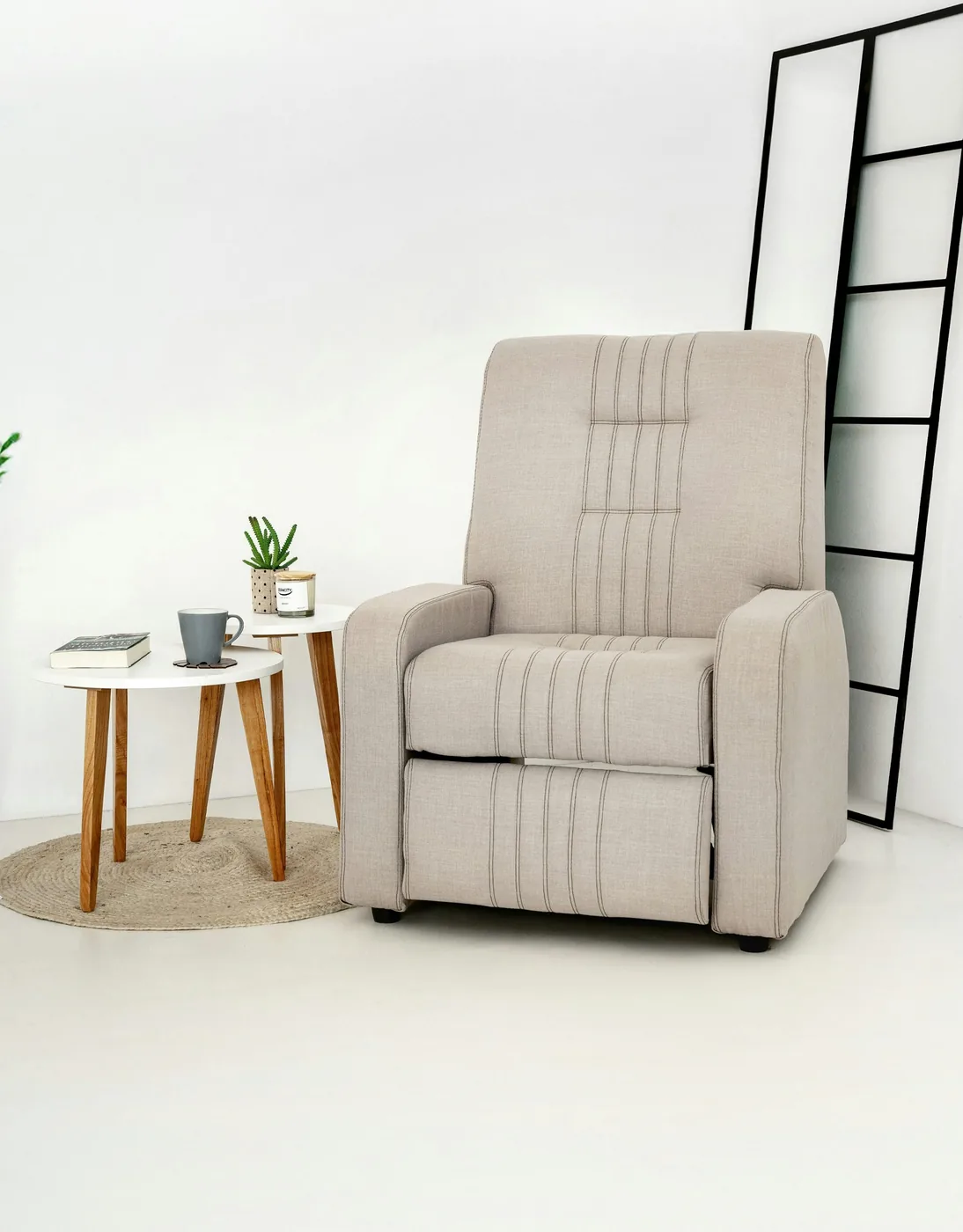
A recliner sofa tips the back and lifts a footrest so you can lie half-flat without leaving the seat. We plan each one around the room's wall clearance, the house's power supply and the salt in the air, because those three decide whether a recliner keeps working.
Durability scale (Martindale rubs, BS 2543)
15k
20k
25k
30k
40k
Who uses it
Where it lives
How it is used
Durability to ask for
30,000+ rubs
Severe domestic / general contract
Removable covers
Yes
zipped, washable, and a spare set
Fibres that suit
Avoid: Anything you cannot clean in place, on a piece used every day. Rub count is one number among several — weave, colour-fastness and how a fabric handles humidity matter as much. We bring samples to see in your room.
In short
By the Drape Haus studio · How we write
Is it right for you?
A recliner earns its place when someone in the house spends long evenings on the sofa and wants their legs raised: a parent with tired knees, someone recovering from surgery, a family that watches films together, or a person who naps sitting up. For them, a seat that tips back and lifts a footrest is more comfortable than any amount of cushion.
It is a heavier commitment than an ordinary sofa. A recliner is bulkier, it needs space behind and in front of it to open, and it contains moving metal parts that must survive humidity, salt air and the dust that blows in through open windows in the dry months. A power recliner adds a motor, a cable and a dependence on the electricity supply.
If the sofa is mainly for upright conversation, or the room is small and every centimetre of walkway matters, a deep fixed sofa with a separate footstool may serve you better. If you want to lie down fully rather than recline, a chaise or a sofa cum bed is the better tool.
The details
Every recliner is a frame wrapped around a steel mechanism. The mechanism sets the seat width, the depth when reclined and how far the sofa has to stand from the wall, so we choose it first and build the upholstery around it rather than the other way round.
Manual recliners open with a lever, a pull tab or a push on the backrest and need nothing but your weight. Power recliners move on a small motor at the touch of a button, which suits older family members and anyone with stiff knees, but they need a socket nearby and a plan for the hours when the electricity goes.
In a house near the sea, bare steel in a recliner base rusts faster than anywhere inland. We specify coated or treated mechanisms, keep the underside open so air can move through it, and advise leaving a dehumidifier or fan running in rooms that stay shut through the monsoon.
Recliners can be single seats, a two- or three-seat sofa with one or more reclining positions, or a full recliner sofa set arranged around a television. Not every seat has to recline: a fixed middle seat with a fold-down console often makes the whole piece more useful.
Your options
The mechanism decides almost everything about a recliner: how it opens, how much room it needs and what can go wrong. These are the types we fit, and the layouts we build around them.
Swipe for all 6 →
The honest view
Legs up without a footstool
The footrest rises from the seat itself, so the room needs no separate ottoman and the sitter gets proper support under the calves.
Kind to knees and backs
A power recliner lets someone with limited mobility lower themselves into a reclined position and rise again without strain.
Flexible comfort
One seat can be upright for reading while the next is fully reclined for a nap, which a fixed sofa cannot offer.
Upright when closed
Closed, a good recliner looks and sits like an ordinary sofa, so it still works for guests and conversation.
Space in two directions
The footrest projects forwards and a standard mechanism tips backwards, so a recliner claims more floor than its closed footprint suggests.
Moving parts
Steel pivots, springs and, in power versions, motors and switches can wear or corrode. They need occasional checking, especially near the sea.
Heavy and awkward to move
Mechanisms add weight. Recliners are harder to carry up stairs, though detachable backs help a great deal.
Limited made-to-measure
Reclining seats come in the widths their mechanisms allow. The overall layout can be tailored; each reclining seat cannot be narrowed at will.
Side by side
There are several ways to get legs raised in a living room. This sets a recliner against the three most common alternatives.
| Recliner sofa | Sofa and footstool | Chaise sofa | Sofa cum bed | |
|---|---|---|---|---|
| Leg support | Built in, adjustable | Good, fixed height | Full length | Only when opened |
| Back angle | Adjustable | Fixed upright | Fixed upright | Flat when opened |
| Floor space | Extra in front and behind | Footstool in front | Long on one side | Large when open |
| Moving parts | Yes | None | None | Yes |
| Works in a power cut | Manual yes, power with backup | Yes | Yes | Yes |
| Ease of carrying in | Harder, heavy | Easy | Moderate | Moderate |
Swipe to compare →
If the main need is lying flat rather than leaning back, a chaise or sofa cum bed does it with no mechanism at all.
Rather see it in your own room?
We bring samples to the house, measure every window, and specify for the light and exposure you actually have.
Room by room
The natural home for a recliner, particularly facing a television wall, as long as the walkway in front of the open footrest stays clear.
A recliner set with power seats suits a dedicated room for films, where everyone faces one direction and the curtains are drawn.
A single power recliner in a large bedroom gives an older parent a place to rest with legs up during the day without lying on the bed.
Recliners are bulkier and read as casual. In a room meant for conversation, facing sofas and armchairs usually suit better.
Possible with wall-hugger mechanisms and a two-seater, but measure the open footprint carefully against the door and walkway.
Even under a roof, driven monsoon rain and salt air attack a steel mechanism quickly. Keep recliners indoors.
In depth — tap a heading to read
Outages are a fact of life in much of Goa, more so during monsoon storms. A power recliner without backup simply stops: if the cut comes while it is reclined, the footrest stays up and the back stays down until the supply returns, which can mean climbing out awkwardly over the footrest. For an older user, that is a real problem rather than an inconvenience.
There are two answers. A rechargeable battery pack, clipped under the seat between the motor and the plug, keeps the seat working for a number of cycles and recharges when mains power is back. Alternatively, if the house has an inverter, the recliner's socket can be wired to an inverter-backed circuit. We decide which with you at the survey.
Ask, too, whether the mechanism has a manual release. Some do, allowing the seat to be closed by hand. Where a recliner is for someone who cannot easily climb out, we treat backup as part of the specification, not an extra.
If a power recliner is for someone with limited mobility, never fit it without a battery pack or an inverter-backed socket.
A recliner has three sizes: closed, fully reclined, and the space a person needs to stand up from it. We measure all three against the room. Behind the sofa, a standard mechanism needs a clear gap so the back can tip without striking the wall or a window sill; a wall-hugger needs far less. In front, the raised footrest projects well beyond the seat edge, and the walkway past it must remain usable.
Look at what sits behind the sofa in your room. Low windows, curtains that would be crushed, a switchboard or a west wall that heats up in the afternoon sun all affect where it can stand. Coffee tables usually need to sit further away than with a fixed sofa, or be replaced with side tables.
A recliner's base is a frame of steel arms, pivots and springs. In a dry inland city it might never give trouble; within reach of the sea, damp salty air settles on exposed steel and rust starts at the pivots and spring hooks. A house closed for the monsoon, with no air moving, is the worst case.
We specify mechanisms with protective coatings, avoid closing the underside with a solid dust board that traps damp, and keep the base lifted on legs rather than sitting directly on a stone floor that sweats in the rains. For power seats, the motor and switches should sit where a mopped floor cannot splash them.
Once a year, ideally after the monsoon, tip the sofa forward and look at the mechanism. Wipe away dust, check for orange bloom on the pivots, and apply a light machine oil to the moving joints. Squeaks and stiffness are early warnings; deal with them before a spring hook rusts through.
Upholstery on a recliner works harder than on a fixed sofa. It stretches over the footrest every time it opens, folds at the hinge between seat and back, and rubs where hands push on the arms. Choose a fabric with real stretch and a high rub count, or a leather soft enough to flex without creasing permanently.
In a room without air conditioning, a woven fabric is cooler against bare legs than leather or a coated material, and it breathes through the monsoon. If you prefer the look of leather, read up on how hide copes with damp first, including the Journal's piece on fungus on a leather sofa, and see our leather sofas page. Low-grade coated fabrics tend to crack first at the footrest fold, so avoid them on any reclining seat.
Before committing, try colours and textures on a photo of your own room with the sofa fabric simulator. Removable covers are harder on a recliner than on a fixed sofa because of the mechanism, so we plan arm and headrest covers that slip off for washing, and point you to sofa covers for the rest.
Recliners are heavy, and an old Goan staircase with a tight turn at the landing is not forgiving. Most of the recliners we specify have backs that lift off their brackets, which cuts the depth and weight of each piece considerably. Larger sofas are built as separate seats joined in the room.
We measure the route at the survey, including gate posts, verandah steps and lift cars in apartment buildings. The pieces are then sized and ordered so the heaviest part can pass the tightest point on its side, with space for hands.
Living with it
Let the footrest down with your legs rather than kicking it closed. Slamming the mechanism shut loosens fixings over time.
Toys, remotes and shoes under a recliner jam the mechanism. Check before closing, especially with children and pets around.
After the monsoon, tip the sofa forward, wipe the mechanism and oil the moving joints lightly. Look for rust at the spring hooks.
If a power seat has a battery pack, keep it charged and test it before the rains, when outages become more frequent.
A closed, damp room corrodes steel and grows mould on upholstery. Run a fan or dehumidifier if the house is shut for weeks.
Avoid these
A standard recliner placed hard against a wall cannot open fully and scrapes the paint. Choose a wall-hugger or leave the measured gap.
A power recliner with no battery or inverter can trap an older user in a reclined position during an outage.
Mechanisms in every position add weight and bulk. A fixed middle seat or console is often more useful.
Low-grade faux leather cracks at the footrest fold within a few seasons in humid air. Use a durable fabric or real leather.
People measure the closed sofa and forget the open footrest, which then blocks a doorway or the route to the garden.
Checklist
More in sofas
Seating made to size, which matters in Goan houses where rooms are rarely the proportions furniture is manufactured for.
Our work
Our process
One team from the first visit to the last bracket, so nothing is lost between the person who specified it and the person who fits it.
FAQ
It stops where it is. If it is reclined when the electricity goes, it stays reclined until power returns. A rechargeable battery pack under the seat, or running the socket from an inverter, lets it close normally. We plan one or the other for most Goan homes.
It depends on the mechanism. A standard recliner needs a generous gap behind it to tip back fully; a wall-hugger mechanism slides the seat forward as it reclines and needs only a few centimetres. We measure the room and choose the mechanism to fit it.
Manual recliners are simpler, have nothing to fail electrically and work through any outage. Power recliners stop at any angle and need no effort, which helps older users. Many households mix them: power for the main seat, manual for the rest.
Untreated steel will, especially in a house closed for months. We specify coated mechanisms, keep the underside ventilated and show you how to check and lightly oil the pivots once a year.
Partly. The mechanism sets the width of each reclining seat, so those sizes are fixed. The arms, fixed seats, consoles, back height, fabric and overall layout are made to the room.
A matching group of reclining pieces, usually a three-seater with one or two reclining armchairs. Each piece can have its own mechanism, so a power seat can sit beside manual ones. The set needs space for every footrest to open.
Yes, with a wall-hugger mechanism and a compact two-seater. Measure the fully open footprint, including the raised footrest, against the doorway and walkway before deciding.
Often, if the mechanism is sound. We check the steel for rust and the springs for wear first; if both are good, reupholstery gives the piece a new cover for less than a replacement.
Manual recliners do, in a living room where guests watch television. Power seats are more vulnerable to rough use and outages in a rental, so we usually advise manual mechanisms and removable arm covers there.
Next step
We visit, measure the room, the wall gap and the route in, and talk through who will sit where. We bring fabric and leather samples to see in your light, and explain the mechanisms side by side, including how a power seat will behave in an outage. Then we build and deliver the sofa, assemble it in place and show you how to care for the mechanism. Book a home visit through our contact page.