 Drapehaus
Drapehaus
Preparing the room
Drapehaus
Preparing the room
Carpets
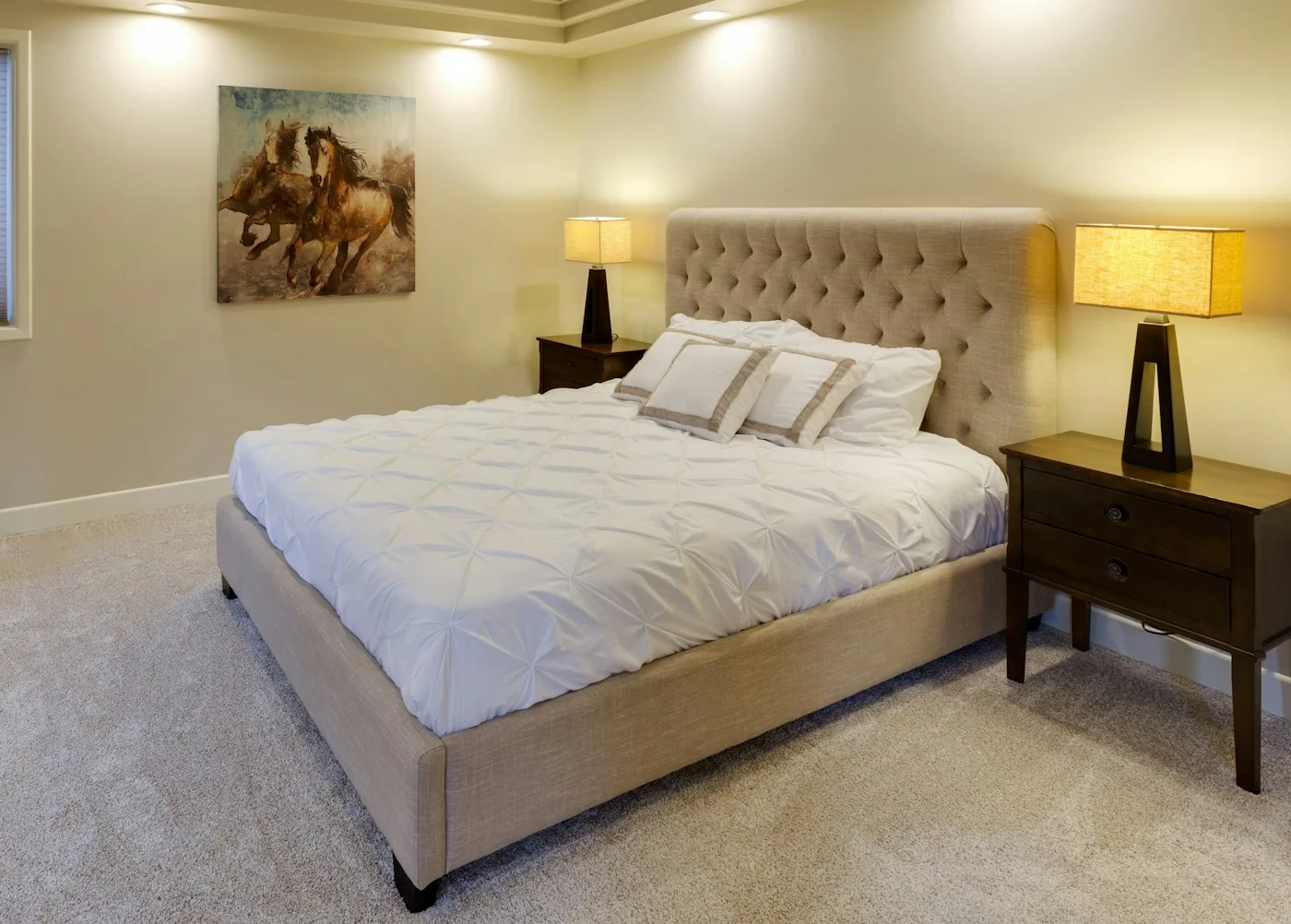
Fitted carpet is quiet, warm and luxurious underfoot — and in Goa it belongs in sealed, air-conditioned rooms: bedrooms, hotel suites, offices and media rooms.
In short
By the Drapehaus studio · How we write
Is it right for you?
Wall-to-wall carpet is the quietest and warmest floor there is. It absorbs footfall and voices, removes the chill of stone under an air-conditioned room at night, and gives a bedroom or suite a finished, enclosed calm that rugs on tile never quite reach. In a hotel corridor or an office it also cuts the noise that carries between rooms.
The condition is controlled humidity. Fitted carpet cannot be lifted to dry, so it needs a room where the air stays below the damp threshold all year: a sealed bedroom, a media room, a study, a guest suite in a hotel that runs its cooling through the monsoon. In those rooms it performs as well as anywhere.
Choose rugs instead if the room has windows that stay open, doors to a garden or pool, or cooling that is switched off for months while the house is empty. Carpet in those conditions takes up moisture it cannot release, and the smell of damp carpet is one of the hardest problems to reverse.
The details
In a naturally ventilated coastal room, fitted carpet holds moisture and is hard to dry, so we rarely recommend it there. In a room where humidity is controlled it performs beautifully, and it is the standard in many hotel rooms and offices.
We specify the underlay for the floor and the climate, and fit with seams planned away from doorways and walkways.
Your options
How a carpet is built decides how it feels, how it wears and how it copes with the climate. These are the choices we work through for each room.
Swipe for all 5 →
The honest view
The quietest possible room
Carpet over a good underlay absorbs impact noise and airborne sound better than any rug, which matters in bedrooms above living areas and in hotel rooms that share walls.
Warmth in a cooled room
Stone and tile under a bedroom air-conditioner can feel cold first thing in the morning. Carpet takes the edge off the floor without changing the thermostat.
A continuous, calm surface
Wall to wall, there are no rug edges to trip on or to frame, and the room reads as one quiet plane. It suits minimal bedrooms and media rooms.
Hides an imperfect subfloor
An uneven screed or a floor you do not want to see can be covered completely, often more simply than relaying hard flooring.
Cannot be lifted for the monsoon
If humidity rises in the room, the carpet and underlay absorb it and cannot be taken up to dry. This is the single reason we are selective about where we recommend it.
Holds sand and allergens
Pile traps grit, dust and allergens. Regular vacuuming and periodic deep cleaning keep it healthy, but it asks more of housekeeping than a hard floor with a rug.
Spills go deeper
A spill on a rug can be lifted and treated from both sides. On fitted carpet it can soak into the underlay, so fast blotting and the right fibre choice matter.
Side by side
For a cooled bedroom or suite, the realistic choices are fitted carpet, a large rug on the existing floor, or carpet tiles.
| Fitted carpet | Large rug on stone | Carpet tiles | |
|---|---|---|---|
| Acoustic softening | Highest | High within the rug | High |
| Can be lifted to dry | No | Yes | Tile by tile |
| Repair after a stain | Patch or clean in place | Clean or replace rug | Swap one tile |
| Needs year-round cooling | Yes | No | Yes |
| Look | Continuous, soft | Framed by floor | Crisp, can show grid |
| Best setting | Bedrooms, suites | Any living space | Offices, corridors |
Swipe to compare →
If there is any doubt about the room staying cooled through the rains, a large rug is the safer choice.
Rather see it in your own room?
We bring samples to the house, measure every window, and specify for the light and exposure you actually have.
Room by room
Where the room is sealed and cooled, a soft cut pile gives the quiet and warmth that make it the calmest room in the house.
Carpet deadens echo and helps the sound system. Rooms like this are usually sealed and dark, which is exactly the condition carpet needs.
A tight loop pile or carpet tiles take a desk chair and quieten calls, provided the study is cooled rather than left open to the garden.
Standard in hospitality for acoustic reasons. Specify a stain-resistant synthetic or blend and a pattern that hides wear.
Most coastal living rooms open to verandahs and gardens. Sand and humidity come in with the air, so rugs are usually better.
Not suitable. Open-air spaces take driven rain and salt, and fitted carpet will not survive them.
In depth — tap a heading to read
Broadloom carpet is made in standard roll widths, commonly 4 m and 5 m, so a large bedroom usually needs at least one seam. Where the seams fall matters more than how many there are. We plan the layout so seams run along the direction of the light from the main window, which makes them less visible, and keep them out of doorways, away from the bed's walking line and outside the path from the door to the bathroom.
We measure on site rather than from drawings, including door swings, thresholds and any built-in joinery, and draw a cutting plan before ordering. For patterned carpet the pattern repeat is added to each length so the design lines up across the seam. The small extra material this uses is the difference between a join you cannot find and one you see every time you enter the room.
Seams parallel to the light and away from doors all but disappear. Seams across a doorway always show.
Underlay decides how a carpet feels and how long it lasts. It absorbs the impact of each step so the pile is not crushed against a hard base, adds insulation and sound absorption, and evens out small irregularities in the screed. A good carpet on a poor underlay wears faster than a modest carpet on a good one.
We choose underlay for the subfloor, the room and the climate. Firm rubber or dense felt suits bedrooms and suites; thinner, firmer underlays suit offices where chairs roll. Over a concrete slab, the slab must be properly dry before anything is laid, and we check it: a slab that still carries construction moisture will release it into the underlay for months. Glue-down fitting without underlay is sometimes right for offices and wheeled traffic.
From June to September the outdoor air in coastal Goa sits at around 87 to 91 per cent relative humidity in the mornings. The US EPA advises keeping indoor humidity below 60 per cent to avoid mould. A room with fitted carpet needs to stay on the right side of that line all year, which in practice means air-conditioning or dehumidification that keeps running, including when the owners are away.
If a house closes for the monsoon, decide before fitting how carpeted rooms will be kept. Options are a caretaker who runs the cooling on a schedule, a dehumidifier with a drain line, or a humidity sensor that switches equipment on and alerts someone if levels rise. If none of these is realistic, choose a large rug on the existing floor that can be rolled and stored instead.
In hospitality, carpet is chosen for acoustic comfort and for how it looks after a thousand arrivals. Solution-dyed nylon or a nylon-rich blend in a tight construction resists staining, fading and crushing. A mid-tone or a small-scale pattern hides everyday soiling far better than a pale plain. Many hotel operators also require floor coverings to meet a recognised fire standard, and we confirm the certification of the product against the operator's specification.
Think about replacement from the start. Order a small reserve from the same dye batch so future patches match, or specify carpet tiles in corridors and offices where damage is likely. Keep a record of product, colour and batch for each room.
Living with it
Grit trapped at the base of the pile cuts the fibres every time someone walks on it. Weekly vacuuming, more often in rooms used by guests, removes it before it does damage.
Blot with a clean white cloth from the edge inwards and use as little water as possible, so nothing soaks through to the underlay. Never rub.
Have carpet professionally cleaned when the air is dry, so it dries quickly. Low-moisture methods are safer than heavy wet extraction in a humid climate.
A simple hygrometer in each carpeted room tells you if humidity is creeping up. A musty smell is the late warning; the meter is the early one.
Avoid these
Doors that stand open let in humid air and sand. Keep carpet to rooms that stay closed, and use a rug in any room that lives open to the outside.
A thin or tired underlay lets the carpet wear fast and feel hard. Specify it with the same care as the carpet itself.
The busiest line in the room is the worst place for a join. Insist on a cutting plan that shows where every seam falls.
Carpet in a house left shut and unconditioned through the rains is likely to come back damp. Arrange humidity control, or choose rugs.
Checklist
More in carpets
Rugs, runners and fitted carpet chosen for a humid climate.
Our process
One team from the first visit to the last bracket, so nothing is lost between the person who specified it and the person who fits it.
FAQ
In an air-conditioned room, yes. In a naturally ventilated room near the sea it holds damp and is hard to dry, so rugs are usually the better choice there.
Yes. Contract carpet in cooled offices and guest rooms is one of its best uses.
For a cooled bedroom, a soft cut pile in wool or a wool-rich blend over a good underlay gives the most comfort underfoot. If the room is also used by children or pets, a solution-dyed nylon cut pile is more forgiving of spills. Choose a mid-tone rather than a very pale colour if the room gets a lot of use.
Carpet does not cause mould, but it can hold moisture that allows it. If indoor humidity stays high for long periods, the carpet and underlay absorb damp they cannot release. In a room kept below 60 per cent relative humidity by cooling or dehumidification, carpet performs well.
Fitted carpet gives a quieter, more continuous room and suits sealed bedrooms and suites. A large rug can be lifted, aired and stored, which suits rooms that are ventilated or houses that close for the monsoon. If the cooling might ever be off for months, choose the rug.
Once the carpet is ready, fitting a single bedroom usually takes a day or less, including laying the gripper and underlay. Larger areas, patterned carpet and rooms with a lot of joinery take longer. The room needs to be clear of furniture, or we move it as part of the work.
Usually yes. Office and contract carpets are built for heavier traffic and rolling chairs, often as tight loop pile or carpet tiles in solution-dyed synthetics. They are firmer underfoot than residential cut pile but hold their appearance for longer under constant use.
Next step
We start by visiting the room. We check how it is cooled, test the floor, measure every wall, door and threshold, and bring carpet and underlay samples to see in the room's own light. We draw a cutting plan with each seam placed away from doors and walkways, then order, prepare the floor and fit. If the room is not right for fitted carpet, we will say so and suggest the rug that is. Book a home visit to begin.